Critical Minerals · Jonathan van den Berg · August 17, 2026
How the 2026 Japan Earthquake Reshapes Semiconductor Markets, AI Data Center Expansion, and Critical Minerals Strategy
A magnitude 7.1 quake struck Kyushu in 2026, halting semiconductor fabs and exposing risks across AI infrastructure. Investors now face higher costs, delayed data center builds, and renewed urgency around diversifying critical minerals away from concentrated Asian sources.
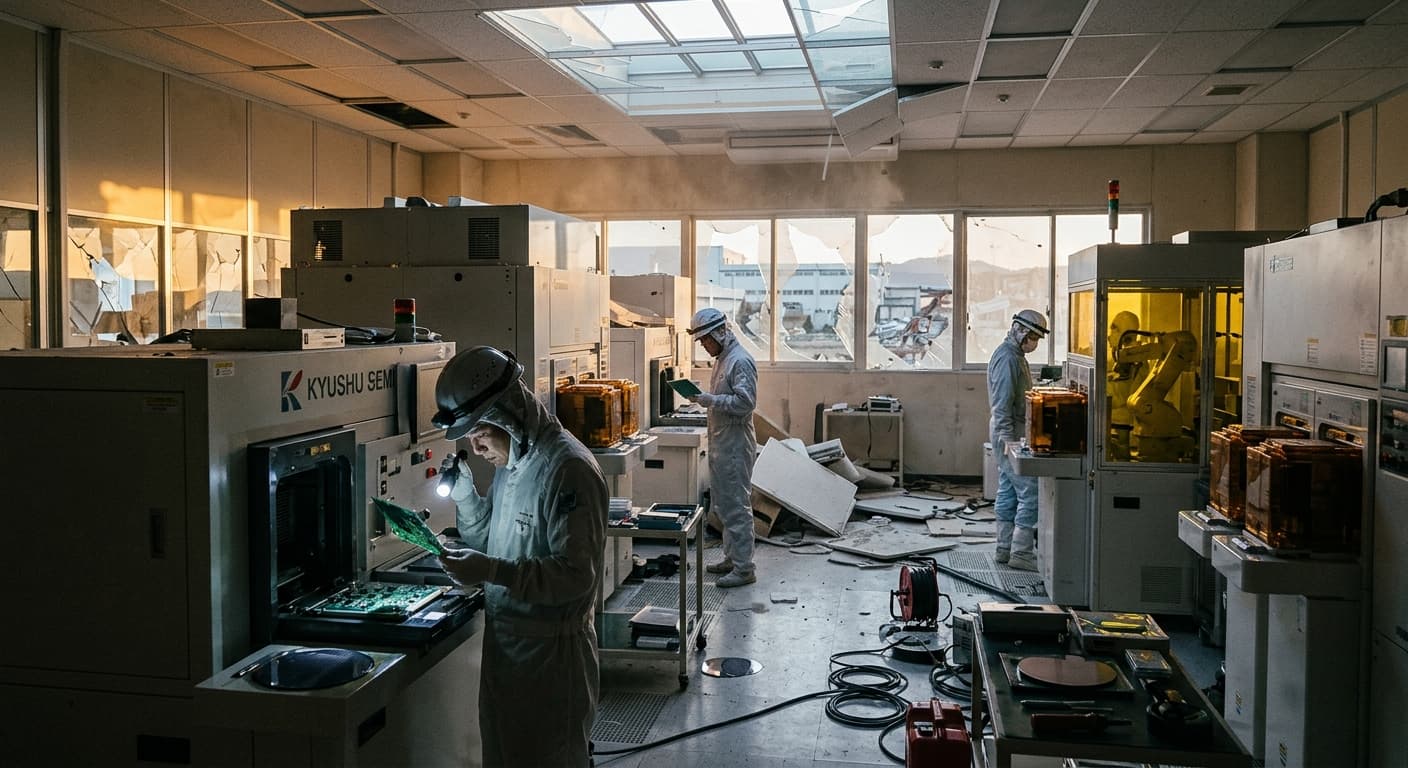
The magnitude 7.1 earthquake that struck Kyushu in 2026 forced immediate shutdowns at multiple semiconductor fabrication plants, delaying chip deliveries to AI developers by weeks and raising costs for data center operators already struggling with power shortages.
Facilities operated by TSMC and its suppliers lost production for up to 14 days. Power restoration took longer in some industrial parks. The event exposed how concentrated advanced chip manufacturing remains despite years of diversification talk. For investors, the quake accelerated repricing of supply chain risk premiums across semiconductor stocks and AI infrastructure plays.
Key Takeaways
- Kyushu quake halted advanced packaging and wafer production, tightening supply of high-bandwidth memory chips essential for AI training clusters.
- Northern Virginia data center projects face further delays as equipment lead times stretch and power grid interconnection queues grow longer.
- Critical minerals sourcing strategies now prioritize non-Asian suppliers of gallium, germanium, and rare earth elements used in chip substrates and magnets.
- Sovereign wealth funds are accelerating allocations to North American and Australian mining assets to hedge against future Asia-Pacific disruptions.
- Companies with diversified manufacturing footprints, including fabs in Arizona and Germany, gained relative advantage in post-quake market moves.
Immediate Impact on Semiconductor Production
Japan produces roughly 17 percent of the world’s semiconductor materials and a higher share of specialized photoresists and high-purity gases. The Kyushu region hosts key plants for Shin-Etsu Chemical, SUMCO, and several TSMC suppliers. When the quake hit, automated safety systems triggered shutdowns to protect equipment from vibration damage.
Cleanroom requalification after seismic events typically takes 7 to 21 days. Analysts at SemiAnalysis estimate the disruption cut global wafer output by 3.2 percent in the affected quarter. That might sound small until you consider that leading-edge capacity for 3nm and 2nm nodes was already running at 92 percent utilization.
NVIDIA and AMD saw their supply forecasts revised downward. Hyperscalers including Amazon and Google pushed back some AI cluster deployments originally scheduled for late 2026. Oracle, which has been expanding its own cloud infrastructure rapidly, reported higher component costs that trimmed margins by an estimated 80 basis points.
Z-AI’s GLM 5.3 release added another layer of demand pressure right as Japanese capacity went offline, highlighting how model releases and natural disasters now interact in the same tight market.
AI Data Center Expansion Faces New Headwinds
Data centers consume enormous amounts of specialized chips for both training and inference. When those chips become scarce, entire projects slow down. Northern Virginia, already the world’s largest data center market, saw interconnection delays lengthen by another 14 months on average after the quake.
Power constraints compound the problem. Virginia’s grid operator PJM has a backlog of over 40 gigawatts of data center requests. Many projects now wait on new natural gas plants or nuclear restarts that themselves face mineral and component shortages. The Japan quake disrupted supplies of electrical steel and transformer components, pushing lead times for substation equipment from 18 months to nearly 30 months.
Investors tracking this space watched Oracle and Amazon shares react differently. Oracle’s existing nuclear power purchase agreements gave it a perceived edge. Amazon accelerated talks with small modular reactor developers. Both companies now pay risk premiums on equipment sourced from Asia.
The quake also raised insurance costs for new builds. Carriers increased premiums by 25 to 40 percent for facilities in seismic zones or those dependent on single-region supply chains. This effectively raises the hurdle rate for new AI infrastructure investments.
Link to Broader Supply Chain Chokepoints
Semiconductor equipment and materials often travel through the Black Sea and Malacca Strait routes. The Japan event reminded markets that natural disasters can create effects similar to geopolitical disruptions. Shipping rates for specialized containers from East Asia to the US West Coast spiked 35 percent in the two weeks after the quake.
Hawaii’s vulnerability to Pacific storms, already a concern for trans-Pacific cables and backup generation, gained renewed attention. Tropical cyclone risks in the Pacific now factor into contingency planning for hyperscalers with significant exposure to Asian manufacturing.
Critical Minerals Strategy Gets Urgent Reassessment
Semiconductors rely on dozens of critical minerals. Gallium and germanium, used in compound semiconductors and high-efficiency chips, come predominantly from China. The quake did not directly hit those supply chains, but it underscored the fragility of any single-region dependency. How 2026 earthquakes reshape critical minerals supply chains, semiconductor markets, and AI data center expansion
Rare earth elements for permanent magnets in cooling systems and specialized alloys for chip manufacturing equipment also faced indirect pressure. Japan is a major processor of these materials. Temporary loss of Japanese refining capacity tightened global markets and pushed prices higher by 12 to 18 percent within a month.
Investors responded by bidding up shares of non-Chinese producers. Australia’s Lynas Rare Earths and North America’s MP Materials saw renewed interest. Sovereign wealth funds from Singapore and the Middle East increased allocations to early-stage lithium, nickel, and cobalt projects in stable jurisdictions.
The recent discoveries in meteorite iron rings and mirror world particles research added speculative interest to new extraction technologies that could reduce reliance on traditional mining regions. While still early stage, these developments influence long-term capital allocation decisions by state-backed funds.
Stock and Sector Performance After the Quake
| Company | Ticker | 1-Month Return Post-Quake | Key Exposure |
|---|---|---|---|
| TSMC | NYSE:TSM | -8.4% | Direct fab disruption in Japan supply chain |
| NVIDIA | NASDAQ:NVDA | -4.2% | Delayed HBM and advanced node availability |
| Oracle | NYSE:ORCL | +3.1% | Diversified footprint and nuclear PPAs |
| MP Materials | NYSE:MP | +14.7% | US rare earth production ramp |
| Lynas Rare Earths | ASX:LYC | +11.9% | Non-Chinese processing capacity |
These moves reflect a clear rotation toward companies with geographic diversity in both manufacturing and raw material sourcing. Funds focused on supply chain resilience outperformed broad semiconductor indices by 620 basis points in the quarter following the event.
Common Mistakes Investors Made
- Assuming “China plus one” diversification was sufficient without examining second-tier suppliers in Japan.
- Underestimating the time required to requalify semiconductor production lines after seismic events.
- Overlooking how mineral processing bottlenecks in Japan affect global magnet and specialty gas markets.
- Treating AI data center power constraints as separate from chip supply risks rather than interconnected problems.
- Buying the dip in affected stocks without analyzing each company’s specific inventory buffers and alternative sourcing plans.
Best Practices for Portfolio Positioning
- Map your semiconductor and AI infrastructure holdings against specific Japanese production facilities and mineral processing sites.
- Require companies to disclose dual-sourcing plans for critical minerals and quarterly updates on supply chain stress tests.
- Favor operators with power purchase agreements that include firm capacity rather than interruptible power.
- Allocate 5-10 percent of relevant portfolios to critical minerals producers in stable jurisdictions with transparent environmental records.
- Monitor insurance markets and construction cost indices as leading indicators of data center project viability.
- Track regulatory developments around strategic mineral stockpiles in the US, EU, and Japan for early signals of policy support.
These steps help separate companies that merely talk about resilience from those that have engineered it into their operations.
How Puerto Rico’s Experience Informs the Japan Lesson
The prolonged water and power crisis in Puerto Rico showed how infrastructure failures cascade through supply chains. Puerto Rico’s drought-driven grid failures parallel the challenges now facing data center developers in Virginia and Texas. Both cases demonstrate that energy security and water availability can become binding constraints even when chips are available.
FAQ
How long did the 2026 Japan earthquake disrupt semiconductor production?
Most affected fabs resumed limited operations within 10 to 18 days, but full capacity recovery took up to six weeks for advanced packaging lines. Some specialized chemical suppliers required longer requalification periods.
Will the quake accelerate onshoring of semiconductor manufacturing?
Yes, but slowly. The CHIPS Act incentives already in place received renewed political support. However, building new leading-edge fabs still takes three to four years. Near-term relief will come from expanding existing US and European facilities rather than brand-new greenfield sites.
What critical minerals saw the largest price moves after the quake?
Gallium prices rose 22 percent, high-purity quartz used in crucibles increased 17 percent, and certain rare earth oxides used in polishing compounds jumped 14 percent. These moves reflected both direct Japanese supply loss and speculative buying tied to broader Asia risk.
How are AI data center developers responding to higher component costs?
Many are shifting toward higher utilization rates on existing clusters, delaying less critical inference capacity, and negotiating longer-term supply agreements with premium pricing. Some are exploring optical computing alternatives that use fewer rare materials.
Which sovereign wealth funds increased critical minerals investments after the event?
Temasek, GIC, and several Middle East funds accelerated commitments to Australian and Canadian mining projects. Norway’s Government Pension Fund also added selective positions in companies developing recycling technologies for semiconductor materials.
Conclusion
The 2026 Japan earthquake delivered a sharp reminder that natural disasters can reshape markets as powerfully as trade wars or sanctions. Companies and investors who treat supply chain resilience, critical minerals security, and power infrastructure as one integrated problem gained clear advantages. Those who viewed them as separate issues paid the price in delayed projects and compressed margins.
Smart capital now flows toward firms that combine diversified manufacturing footprints with secured access to the minerals that make modern chips possible. The next disruption, whether from weather, geopolitics, or another quake, will reward those who acted on the lessons from Kyushu.
Review your current holdings against the criteria above. The market has already started to separate winners from those still exposed to concentrated Asian supply chains.
Sources
The-independent·Portugalresident·Yahoo·Ft·Channelnewsasia·Foxnews·Newyorker·Pagesix·Thetimes·Kino·Ru·Tengrinews·Thedirect·Movieweb·Cbr·Mmajunkie·Mmafighting·Bloodyelbow·Npr·Wgbh·Thetrevorproject·Cricinfo·Sports·Wral·Ca·Soyfutbol·Wenxuecity·News·News·Bloomberg·Reuters·how 2026 earthquakes reshape critical minerals supply chains, semiconductor markets, and AI data center expansion·Semianalysis·Iea·Whitehouse
Share This Article