Supply Chain · Jonathan van den Berg · August 16, 2026
Romania Drone Incident 2026: How Black Sea Airspace Breaches Expose NATO Supply Chain Risks and Energy Infrastructure Vulnerabilities
Romania's destruction of an intruding drone drifting toward vital offshore gas infrastructure reveals how hybrid aerial threats can suddenly disrupt European energy flows and expose broader NATO supply chain weaknesses.
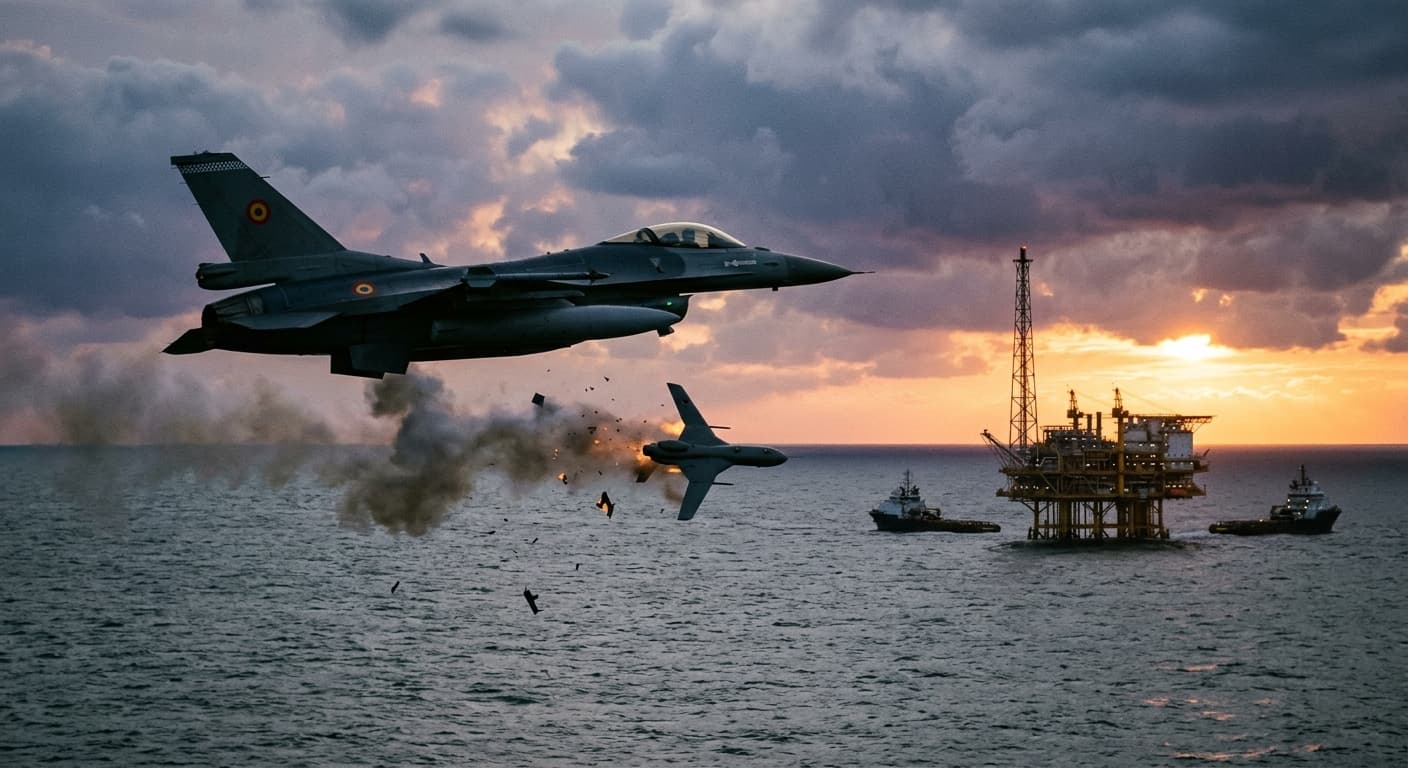
Romania shot down a Russian drone that breached its airspace and drifted dangerously close to offshore natural gas platforms in the Black Sea. The incident underscores how hybrid aerial incursions now directly threaten European energy infrastructure and expose vulnerabilities in NATO's eastern flank supply chains.
Key Takeaways
- Romania's air defenses destroyed a drone heading toward key Black Sea gas installations, marking another escalation in hybrid threats to European energy assets.
- The event highlights risks to underwater pipelines, offshore platforms, and related supply routes that feed European markets.
- NATO members are accelerating drone detection and 5G-enabled countermeasures, with implications for defense contractors and technology providers.
- Persistent airspace violations compound existing pressure on European energy diversification away from Russian supplies.
- Similar chokepoint dynamics appear in the Japan earthquake's impact on semiconductor logistics and Strait of Hormuz tensions.
What Happened in the Romania Drone Incident
Romanian defense forces detected and neutralized an unmanned aerial vehicle that crossed into sovereign airspace from the direction of the Ukraine conflict zone. The drone was on a trajectory that would have taken it near critical offshore gas production sites operated by European energy companies.
According to official statements, Romanian fighter jets and ground-based systems engaged the target successfully before it could reach the platforms. No casualties or infrastructure damage occurred, but the proximity triggered immediate alerts across NATO command structures.
This marks at least the second confirmed drone interception by Romania in recent months. Earlier incidents involved debris from Russian strikes on Ukrainian ports washing up on Romanian territory, already straining diplomatic channels with Moscow.
Why Black Sea Gas Infrastructure Matters
The Black Sea holds substantial untapped and developing natural gas reserves. Romania's offshore fields, including those developed by OMV Petrom and ExxonMobil partnerships, form part of Europe's strategy to reduce dependence on Russian pipeline gas.
These platforms and their connecting underwater pipelines represent concentrated targets. A successful disruption here would ripple through European wholesale gas prices, particularly in winter months when storage levels face pressure.
The incident also draws parallels to other energy chokepoints. Just as tensions in the Strait of Hormuz create risk premiums on oil, Black Sea airspace violations now add a security premium to regional gas supply.
Hybrid Threats Targeting Energy Assets
Modern conflict increasingly features low-cost drones used to probe defenses, gather intelligence, or create plausible deniability for direct strikes. These systems cost fractions of the missiles used to intercept them, creating an asymmetric economic burden on defending nations.
In the Black Sea theater, such tactics test NATO's Article 5 thresholds without crossing into declared kinetic attacks on member-state territory. Each incident forces alliance members to weigh escalation risks against the need to protect critical infrastructure.
Supply Chain Implications for Europe and Beyond
Energy infrastructure incidents in one theater quickly affect global logistics. European manufacturers already operate with thin energy buffers after the 2022 supply shocks. Further uncertainty around Black Sea gas flows forces companies to secure more expensive LNG imports from the United States, Qatar, or Australia.
This dynamic tightens shipping capacity in already congested routes. The same vessels moving LNG can face delays at ports or rerouting around contested waters, creating cascading effects similar to those seen after natural disasters.
For technology supply chains, the implications run deeper. Many European data centers and semiconductor fabs rely on stable, affordable power. Any sustained threat to regional energy security raises operational costs and forces diversification spending that diverts capital from core production.
The recent power outages across parts of the Midwest United States demonstrated how quickly grid stress can compound with other disruptions. European operators now face similar compounding risks from both physical threats and policy-driven energy transitions.
Technology and Defense Responses
The Romania incident accelerates investment in advanced detection systems. Companies like Lockheed Martin are preparing drone-detection services delivered over commercial 5G networks, offering persistent surveillance at lower cost than traditional radar networks.
These systems integrate with existing telecom infrastructure, creating dual-use networks that support both civilian connectivity and security missions. Verizon's partnerships in this space illustrate how commercial wireless providers now play indirect roles in national defense.
Semiconductor demand stands to benefit. Advanced radar, sensor fusion, and edge computing chips required for these detection networks directly support companies like TSMC and suppliers to Oracle's cloud infrastructure used in defense analytics.
Link to AI Data Center Expansion
AI training clusters require enormous, uninterrupted power. Any threat to European energy stability pushes hyperscale operators toward locations with stronger grids and clearer geopolitical risk profiles. This shifts investment toward U.S. markets, particularly Northern Virginia, further straining local power infrastructure there.
Google and Oracle continue expanding AI data centers in stable jurisdictions while monitoring European exposure. The Romania events add another data point favoring North American builds despite their own constraints.
Common Mistakes in Assessing These Risks
- Treating drone incidents as isolated events rather than part of a sustained campaign to raise defense costs across NATO's eastern flank.
- Underestimating secondary effects on insurance premiums for energy assets and shipping in the Black Sea.
- Assuming European energy diversification has eliminated meaningful exposure to Russian hybrid tactics.
- Overlooking the semiconductor and technology supply chain linkages that turn regional security incidents into global pricing signals.
Best Practices for Investors and Operators
- Track airspace violation frequency and proximity to critical infrastructure as leading indicators for energy price volatility in European hubs.
- Assess corporate exposure to Black Sea-related supply contracts, including both physical gas and supporting maritime logistics.
- Monitor defense technology budgets for accelerated procurement of 5G-enabled sensor networks and autonomous detection systems.
- Stress-test data center siting strategies against multi-vector threats that combine physical infrastructure risks with cyber and hybrid aerial tactics.
- Consider diversified exposure across critical minerals used in both defense electronics and renewable energy components, given the ongoing resource competition dynamics.
Broader Geopolitical Context
The Romania drone incident occurs against a backdrop of frozen but unstable conflict lines in Ukraine. Russia maintains pressure through indirect means while avoiding direct confrontation with NATO air forces. This calibrated aggression forces constant recalibration of rules of engagement.
At the same time, European governments balance energy security needs with climate commitments. Offshore gas development in the Black Sea offers a bridge fuel, but only if platforms remain operational and politically viable.
The convergence of hybrid warfare, energy transition, and technology supply chains creates a complex risk matrix. Companies that map these intersections gain clearer insight into both vulnerabilities and opportunities.
FAQ
What exactly happened with the Romania drone incident?
Romanian forces destroyed a Russian-origin drone that entered national airspace and approached offshore natural gas platforms in the Black Sea. The engagement prevented any potential damage to critical energy infrastructure.
Why are Black Sea gas platforms strategically important?
They represent a key element of Europe's effort to replace Russian pipeline gas with domestic and non-Russian supplies. Disruption here would increase reliance on more expensive LNG imports and raise wholesale energy prices across the continent.
How does this incident affect global supply chains?
It raises risk premiums on European energy, which flows through to manufacturing costs, shipping rates, and technology production. These pressures mirror dynamics seen in other chokepoints like the Strait of Hormuz or post-disaster semiconductor logistics.
What technologies are being deployed to counter these threats?
5G-enabled drone detection networks, advanced sensor fusion, and commercial satellite monitoring systems are seeing accelerated adoption. Defense contractors and telecom providers are forming new partnerships to deliver persistent coverage.
Could this lead to broader NATO involvement?
While individual incidents remain below Article 5 thresholds, cumulative pressure on member-state infrastructure increases the risk of miscalculation. NATO continues to reinforce air policing and maritime presence in the region.
How should investors track related risks?
Focus on frequency of airspace violations, changes in European gas storage levels, defense budget allocations for counter-drone systems, and shifts in data center investment geography toward more stable power environments.
Conclusion
The Romania drone incident serves as a clear reminder that hybrid threats now target the arteries of modern economies. Energy infrastructure, technology supply chains, and data center power requirements all intersect at these vulnerable points. Organizations that treat these risks as systemic rather than episodic will position themselves more effectively as the pressure on NATO's eastern energy flank continues.
Monitor developments in Black Sea security closely. The next incident may not end with a successful interception, and the market consequences will arrive faster than most models anticipate.
Sources
Share This Article