Critical Minerals · Jonathan van den Berg · August 9, 2026
Mirror World Particles and Meteorite Iron Rings: How Bronze Age Discoveries and Dark Matter Research Reshape Critical Minerals Strategy and Geopolitical Resource Competition
Ancient Greek elites prized meteorite iron for its otherworldly origin. Modern physicists now chase invisible mirror particles that could explain dark matter. Both stories highlight the same truth: control over rare materials determines power.
Ancient Greek rulers wore rings forged from iron that fell from space. At the same time, physicists are hunting for mirror world particles that drift through reality like wisps of fog. These two discoveries, separated by 3,500 years, both turn on the same scarce resources that now drive geopolitical strategy, semiconductor production, and sovereign wealth fund allocations.
The meteorite iron in Bronze Age signet rings proves early civilizations valued rarity and cosmic origin over earthly abundance. Today, nations compete for gallium, germanium, lithium, and rare earth elements with the same intensity. The physics search for mirror particles requires ultra-pure materials and massive energy infrastructure that depend on the very same supply chains under strain.
Key Takeaways
- Bronze Age Greek elites used meteorite iron for rings as early as 1400 BCE, showing early recognition of critical materials' symbolic and practical value.
- Mirror world particles could explain dark matter; their detection relies on advanced semiconductors and cryogenic systems built from conflict-prone minerals.
- China controls 80-90% of rare earth processing and has used export restrictions on gallium and germanium to pressure semiconductor markets.
- Sovereign wealth funds are shifting capital toward projects that secure non-Chinese sources of critical minerals.
- Supply chain chokepoints in the Malacca Strait and Bab el-Mandeb directly affect delivery of materials needed for both scientific instruments and AI data centers.
- Northern Virginia data center operators face power and cooling constraints that mirror the energy demands of modern particle physics experiments.
Bronze Age Space Bling and What It Reveals About Resource Perception
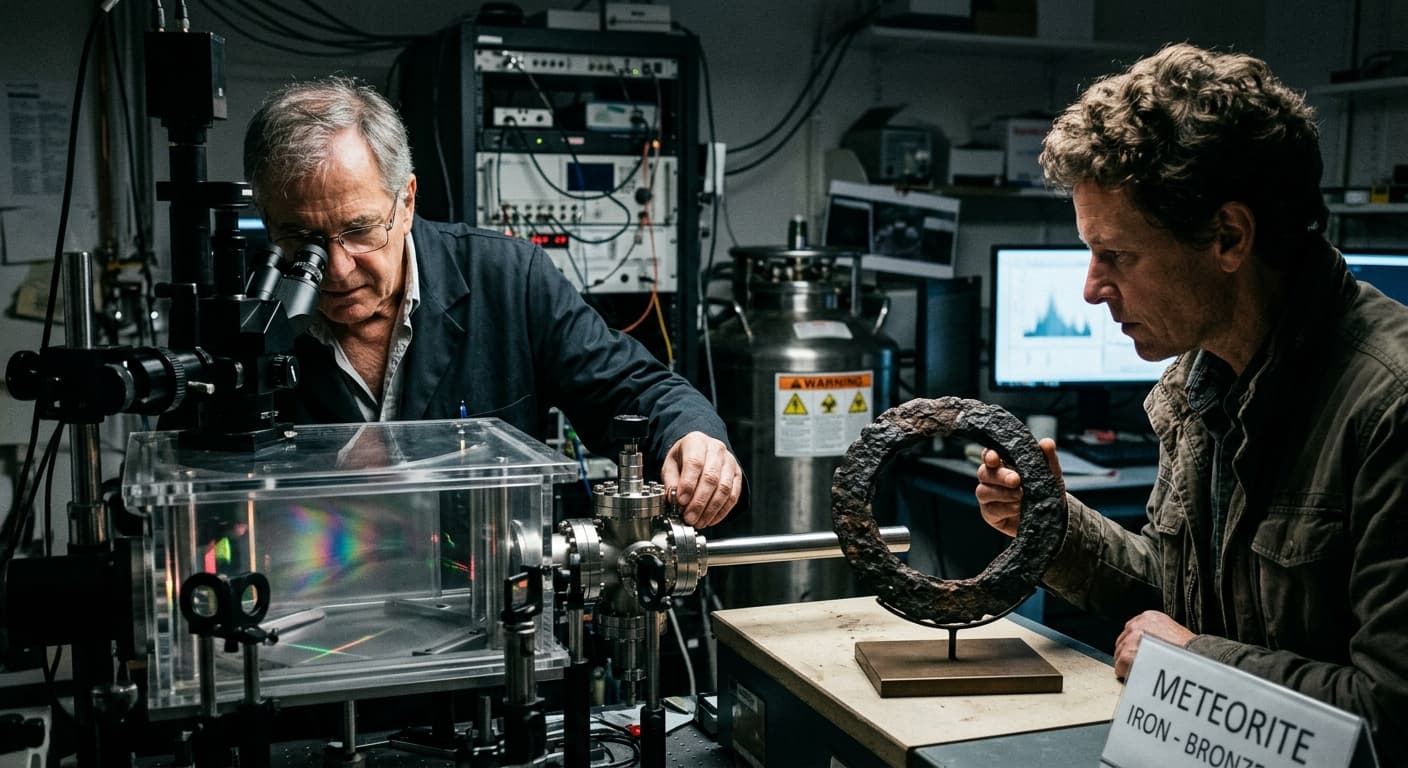
Archaeologists examining graves in the Mycenaean palace of Pylos found six signet rings made of iron. Chemical analysis confirmed the iron came from meteorites. In an era when terrestrial iron smelting was unknown in Greece, these rulers chose metal that had traveled through space.
The rings were not mere jewelry. They carried seals used in administration and diplomacy. The choice of meteorite iron signaled both technological sophistication and divine favor. This early example of critical minerals as status and power markers parallels today's use of semiconductor-grade materials in national security tools.
Similar meteorite iron artifacts appear in Egypt and the Middle East from the same period. The pattern suggests Bronze Age societies understood that materials with unusual properties conferred strategic advantage. Modern governments reach the same conclusion when they classify gallium and antimony as critical minerals essential for defense electronics.
Mirror World Particles: The Invisible Fog That Could Rewrite Physics
Physicists at leading laboratories propose that a hidden "mirror world" exists parallel to ordinary matter. These mirror particles would interact only weakly with normal matter, explaining why dark matter remains undetected despite making up most of the universe's mass.
The theory predicts wisps of this mirror matter drifting through the solar system. Detection requires instruments built with materials refined to nine-nines purity or better. That level of refinement depends on stable supplies of gallium, indium, and specialized rare earths. Any disruption in those flows delays experiments that could reshape our understanding of the universe and, by extension, future technology roadmaps.
The connection to critical minerals is direct. Mirror world detection experiments often use bolometers and superconducting sensors that rely on materials vulnerable to export controls. A nation that dominates those supply chains gains leverage over both scientific progress and the next generation of quantum sensors with defense applications.
How Ancient Discoveries Illuminate Today's Supply Chain Chokepoints
The Japan earthquake in 2026 reminded markets how quickly natural events can tighten mineral flows. The same logic applies to meteorite iron in antiquity: when a resource is rare and irreplaceable, its acquisition becomes a strategic priority.
Modern equivalents include the Malacca Strait, through which roughly 80% of China's seaborne oil and critical minerals pass, and the Bab el-Mandeb strait, where Houthi attacks have already raised insurance premiums on shipments. These maritime chokepoints directly affect the cost and availability of materials needed for both particle detectors and commercial semiconductors.
South American lithium nationalization moves in Chile, Bolivia, and Argentina add political risk to another key battery and electronics mineral. Investors now price in "nationalization risk premiums" similar to the way ancient traders valued meteorite iron for its scarcity.
Critical Minerals in Semiconductor Markets and AI Infrastructure
The premium smartphone segment reached 29% of total shipments in the first half of 2026, according to Counterpoint Research. Apple and Samsung dominate this tier, both relying on advanced chips that use gallium nitride and other compounds derived from critical minerals.
AI data centers in Northern Virginia consume massive amounts of power and specialized hardware. The same constraints that affect physics laboratories—ultra-pure materials, stable energy supply, advanced cooling—apply to hyperscale facilities. Any sustained shortage of gallium or germanium raises costs across the entire technology stack.
Sovereign wealth funds from Singapore, Norway, and the Gulf have increased direct investments in non-Chinese mining and processing projects. Their strategy mirrors the Bronze Age logic: secure access to irreplaceable materials before competitors lock them down.
Investment Implications for Sovereign Wealth Funds and Resource Nationalism
Resource nationalism is rising. Countries with deposits of critical minerals are tightening control, much as Bronze Age rulers hoarded meteorite iron. Funds like Saudi Arabia's Public Investment Fund and Singapore's Temasek now allocate capital with explicit geopolitical supply chain criteria.
Investors track several indicators:
- Export licensing delays from China on gallium and germanium
- Progress on Western rare earth separation facilities in Texas and Australia
- Nationalization moves in South American lithium districts
- Power purchase agreements for data centers and research campuses that lock in nuclear or renewables
The physics quest for mirror particles may seem abstract, but it drives demand for the same materials that power missiles, satellites, and data centers. A breakthrough would likely accelerate investment in quantum sensing and detection technologies with clear dual-use applications.
Common Mistakes in Critical Minerals Analysis
- Treating all rare earth elements as interchangeable. Specific isotopes and purities matter for different applications.
- Ignoring processing capacity. Mining output means little without refining and separation facilities.
- Underestimating maritime risk. Most critical minerals still move by sea through vulnerable chokepoints.
- Assuming substitution is easy. Many advanced applications have no viable replacement for gallium or indium at scale.
- Overlooking energy requirements. Refining and purifying these materials is energy-intensive, linking them to power grid constraints in Northern Virginia and elsewhere.
Best Practices for Tracking Critical Minerals Exposure
- Map every link in the supply chain from mine to finished component for key technologies.
- Monitor both production and export policy changes in dominant supplier nations.
- Track sovereign wealth fund flows into upstream projects as early indicators of strategic priorities.
- Assess maritime insurance rates for key routes like the Malacca Strait and Bab el-Mandeb as real-time risk signals.
- Evaluate energy availability and power purchase agreements for both research facilities and commercial data centers.
- Include nationalization and regulatory risk in valuation models for mining and processing companies.
Practical Examples in Current Markets
When China restricted gallium exports in 2023, prices spiked and semiconductor firms accelerated efforts to diversify sources. Companies that had already secured long-term contracts with Australian and North American processors maintained production continuity. Those that relied on spot markets faced delays.
Similarly, data center operators in Northern Virginia that signed nuclear power purchase agreements gained cost certainty while competitors scrambled during heat-driven grid strain. The pattern repeats across industries: early movers in critical minerals secure competitive advantage.
The Bronze Age rings from Pylos demonstrate that strategic material choices can endure for millennia. Modern organizations making equivalent decisions today—whether in physics labs, sovereign funds, or tech boardrooms—will shape capabilities for decades.
FAQ
What are mirror world particles?
Mirror world particles are hypothetical counterparts to ordinary matter that interact very weakly with normal particles. They offer one explanation for dark matter, the invisible mass that influences galactic motion but has never been directly observed.
Why did Bronze Age Greeks use meteorite iron for rings?
At that time, iron smelting technology had not reached Greece. Meteorite iron was the only available source of the metal. Its celestial origin also carried cultural and religious significance, making it ideal for elite signet rings used in administration.
How do critical minerals affect semiconductor stocks?
Gallium, germanium, and rare earths are essential for compound semiconductors used in 5G, radar, satellites, and power electronics. Export restrictions or supply disruptions directly impact production costs and availability for companies across the sector.
What role do sovereign wealth funds play in critical minerals?
These funds provide patient capital for mining, processing, and refining projects that commercial markets often avoid due to political risk or long payback periods. Their investments increasingly reflect national security priorities around supply chain resilience.
How do maritime chokepoints affect critical minerals markets?
Most physical trade in minerals and refined products still travels by sea. Disruptions in the Malacca Strait or Bab el-Mandeb raise shipping costs, insurance rates, and delivery times, quickly feeding through to end-user prices in technology and defense industries.
Why does Northern Virginia matter for this topic?
The region hosts one of the world's largest concentrations of data centers. These facilities compete for power and cooling resources while depending on advanced chips that use critical minerals, creating overlapping constraints with scientific research infrastructure.
Conclusion
The meteorite iron rings from Bronze Age Greece and the search for mirror world particles both demonstrate that certain materials confer unique capabilities. In antiquity, those capabilities were administrative and symbolic. Today they are computational, scientific, and military.
Organizations that treat critical minerals with the same seriousness that ancient rulers showed toward meteorite iron will maintain advantage. Those that do not risk finding themselves on the wrong side of future power structures. Investors, policymakers, and corporate strategists should track these supply chains with the same attention physicists give to faint signals in the cosmic fog.
Read more on how extreme weather events expose similar vulnerabilities in energy infrastructure and AI data center expansion, or examine the water crisis in Puerto Rico that further highlights infrastructure risks tied to resource competition.
Share This Article