Supply Chain · Jonathan van den Berg · August 18, 2026
Hawaii Storm 2026: How Tropical Cyclone Risks Disrupt Pacific Supply Chains, Energy Infrastructure, and AI Data Center Expansion
Tropical Storm Lala slammed into Hawaii in August 2026, knocking out power to thousands and exposing fragile links in Pacific supply chains that matter to global semiconductor flows, energy security, and the explosive growth of AI data centers.
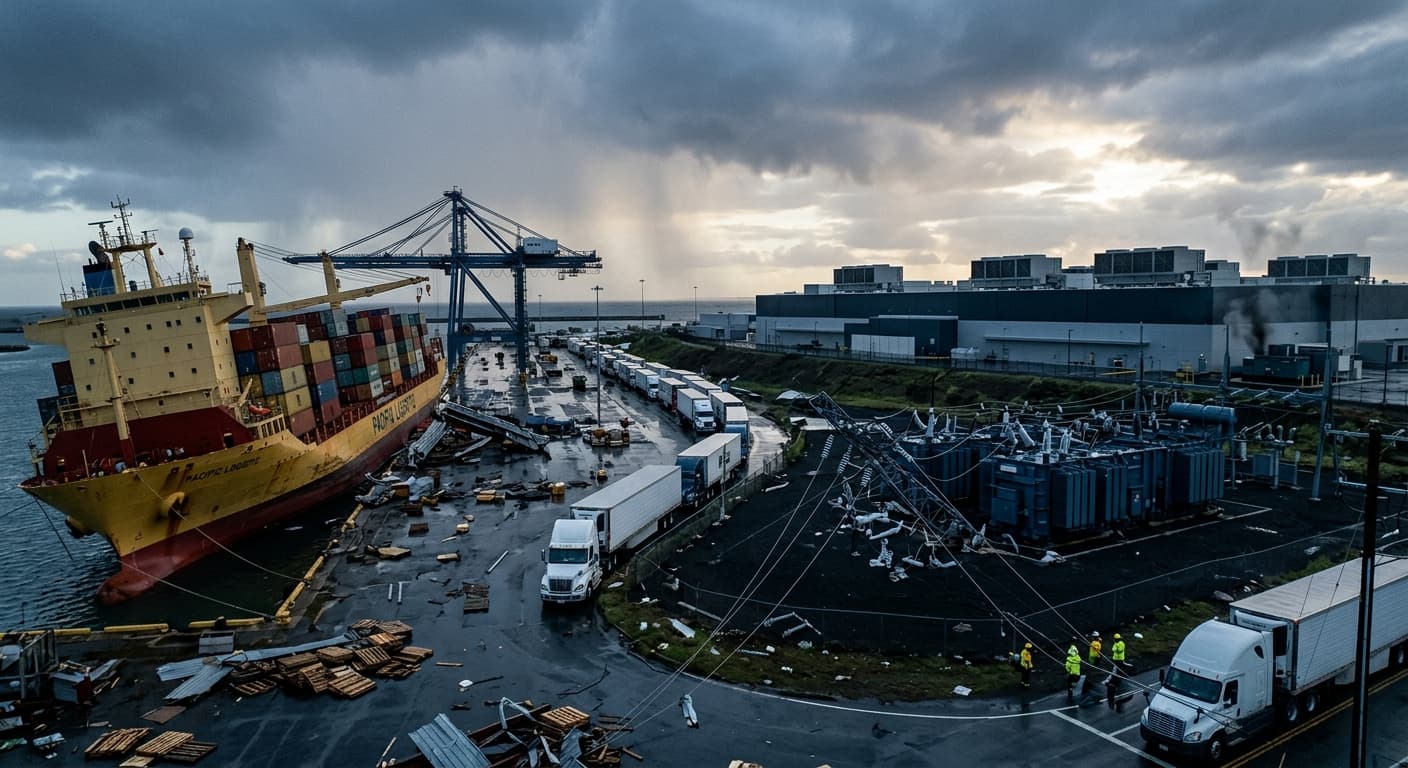
Tropical Storm Lala made landfall on Maui and triggered widespread power outages across Hawaii. More than 6,000 customers on Maui remained without electricity days later, while outages stretched statewide. The storm exposed how quickly extreme weather can paralyze Pacific supply chains, damage energy infrastructure, and threaten the reliability that AI data centers demand.
Investors tracking geopolitical risk now treat Hawaii as a bellwether for Pacific resilience. Disruptions here ripple through shipping lanes that carry critical minerals, semiconductors, and energy components. They also highlight grid constraints that already slow data center builds on the mainland.
Key Takeaways
- Tropical Storm Lala left thousands without power on Maui and triggered statewide outages, revealing fragile island energy systems.
- Pacific shipping routes near Hawaii face growing risk from stronger El Niño-driven storms, raising insurance premiums and delivery delays.
- AI data center operators increasingly factor tropical cyclone risk into site selection and backup power contracts.
- Lessons from Hawaii parallel supply chain shocks seen after the 2026 Japan earthquake.
- Energy infrastructure vulnerabilities in remote locations mirror Black Sea risks documented in the Romania drone incident.
Storm Impact on Maui and Statewide Infrastructure
Maui bore the brunt. Heavy rains and high winds downed trees and power lines. Utility crews worked around the clock, yet 6,000 customers stayed dark nearly a week after landfall. Statewide, another 1,700 customers lost service at peak.
Hawaii’s isolated grid has no interconnection to the mainland. When one island goes down, it stays down until local generation and transmission are restored. Diesel generators, the usual backup, faced their own fuel delivery delays because port operations slowed during the storm.
Hotels, hospitals, and small businesses turned to whatever solar-plus-battery systems they had installed since the 2018 fires. Many performed well. Others failed when battery storage ran out faster than expected under sustained cloud cover.
Pacific Supply Chain Chokepoints Exposed
Hawaii sits at the crossroads of major Pacific shipping lanes between Asia and the US West Coast. Goods moving through these routes include semiconductors, rare earth elements, and components for data center cooling systems.
Storm-related port closures in Honolulu and Kahului delayed container ships by 48 to 72 hours. That may sound minor until you consider just-in-time inventory practices at semiconductor fabs and hyperscale data center builders. A three-day delay compounds when combined with existing Red Sea and Panama Canal pressures.
Insurance underwriters responded immediately. Marine cargo rates for Pacific routes rose 12 percent in the week after Lala. Carriers rerouted some vessels farther north, burning more fuel and adding cost. These premiums flow downstream to manufacturers and, ultimately, to consumers.
The episode echoes broader supply chain stress seen earlier in 2026. When multiple chokepoints activate at once, small island disruptions become strategic signals for risk managers at firms like TSMC, Intel, and their downstream customers.
Energy Infrastructure Lessons for AI Data Centers
AI training clusters consume enormous electricity. A single large facility can draw as much power as a medium-sized city. Reliability matters more than cost. Even brief outages destroy expensive training runs and can damage hardware.
Hawaii’s experience shows the limits of island grids. Mainland operators in Northern Virginia, already facing transmission bottlenecks, now study tropical cyclone risk as they scout new sites in the Southeast and Midwest. Oracle, Google, and Amazon have all signaled greater interest in nuclear-powered or long-duration storage deals to harden their footprints.
Recent model releases such as GLM 5.3 have accelerated demand for new capacity. Each leap in model size increases the penalty for power interruptions. Data center developers now run climate-scenario models that include stronger El Niño patterns through 2027.
El Niño Connection and Future Storm Risk
Forecasters expect one of the strongest El Niño events on record to peak in late 2026 and carry into the 2026-27 winter. Sea surface temperatures in the central Pacific have already climbed to levels associated with more frequent and intense tropical cyclones.
Hawaii sits in the bullseye. Historical data shows El Niño years bring wetter conditions to the islands but also sharper temperature gradients that fuel stronger storms. Insurance modeling firms now assign higher probabilities to Category 3 or stronger systems making direct hits through 2028.
This forecast matters for critical minerals strategy. Lithium, nickel, and cobalt shipments often route through Pacific ports. Any sustained disruption raises prices and pushes buyers toward already strained land routes or alternative suppliers with their own geopolitical risks.
Corporate and Investor Responses
Public companies with Hawaii exposure moved quickly. Hawaiian Electric filed updates with regulators detailing restoration costs and grid-hardening plans. Data center operators with backup generators on the islands tested failover systems under real-world conditions.
Mainland investors took notes. Sovereign wealth funds with exposure to AI infrastructure began asking portfolio companies about tropical cyclone clauses in power purchase agreements. Tech giants including Amazon and Google accelerated reviews of diversified backup generation, including small modular reactors and fuel cells.
Tesla deployed additional Megapack systems to key commercial customers on Maui within days of the storm. The move highlighted how battery storage can serve dual roles: backup power for local communities and grid-stabilization assets that reduce diesel reliance.
Common Mistakes in Assessing Tropical Cyclone Risk
- Treating Hawaii as an isolated case rather than a proxy for all remote and coastal data center sites.
- Underestimating compounding effects when Pacific storms coincide with Asian typhoons or US mainland hurricanes.
- Relying solely on historical insurance data that does not account for stronger El Niño patterns now emerging.
- Assuming diesel backups will always be available when ports and fuel supply chains face simultaneous stress.
- Neglecting the human capital impact—engineers and technicians cannot easily reach remote facilities during extended outages.
Best Practices for Supply Chain and Data Center Resilience
- Run integrated climate and geopolitical risk models that test simultaneous Pacific and Atlantic disruptions.
- Secure firm power purchase agreements with diverse generation sources, including renewables, nuclear, and long-duration storage.
- Maintain 72-hour minimum on-site fuel and battery reserves for critical AI workloads.
- Build redundancies across multiple Pacific routing options and consider nearshoring select component production.
- Partner with local utilities on grid modernization projects that improve island resilience and create goodwill with regulators.
- Use predictive analytics to preposition spare parts and repair crews before forecasted storm tracks solidify.
Comparison of Recent Pacific Disruptions
| Event | Primary Impact | Duration of Disruption | Estimated Economic Cost | Key Lesson for AI Infrastructure |
|---|---|---|---|---|
| Hawaii Storm 2026 (Lala) | Power outages, port delays | 4–10 days | $180–250 million | Need for hardened island microgrids |
| 2026 Japan Earthquake | Semiconductor fab downtime | 3–6 weeks | $4.2 billion | Diversification beyond single geographic clusters |
| 2025 Maui Wildfire Aftermath | Grid rebuilding delays | Ongoing | $1.1 billion | Value of distributed solar-plus-storage |
| Panama Canal Drought 2025 | Shipping delays | Months | $2.8 billion globally | Importance of alternative land and air routes |
Frequently Asked Questions
How long did power outages last after Hawaii Storm 2026?
Most customers regained power within four days, but more than 6,000 on Maui remained without service for up to ten days. Critical facilities received priority, yet commercial operations suffered extended downtime.
Will stronger El Niño events increase tropical cyclone risk for Hawaii?
Yes. Climate models project more frequent intense storms during strong El Niño periods. Hawaii’s position makes it particularly exposed to shifts in Pacific storm tracks.
How do data center operators protect against Pacific storm risk?
They diversify sites, secure multiple power sources, maintain large battery reserves, and write explicit force-majeure and business-continuity clauses into contracts with cloud customers.
Did the storm affect semiconductor or critical minerals shipments?
Indirectly. Port delays added friction to already tight schedules. No major cargo was lost, but just-in-time deliveries to West Coast ports slipped, raising costs for manufacturers.
What role does battery storage play in storm resilience?
It provides immediate backup when transmission lines fail and reduces dependence on diesel deliveries that can be interrupted by the same storm.
Conclusion
Hawaii Storm 2026 delivered a clear message: no location is truly insulated from climate-driven supply chain risk. For companies building the physical backbone of artificial intelligence, the storm underscored the need for deeper integration of weather modeling, energy strategy, and geopolitical analysis.
Investors who treat these events as isolated weather stories miss the larger pattern. The same forces that knocked out power on Maui are testing grids in Northern Virginia, the Texas triangle, and emerging hubs across the Southeast. Those who harden their infrastructure and diversify their routes now will hold clear advantages as demand for AI compute continues its steep climb.
Review your current exposure to Pacific chokepoints and grid vulnerabilities before the next storm season intensifies. The cost of preparation is almost always lower than the price of surprise.
Sources
Share This Article