Jonathan van den Berg · May 8, 2026
US Strikes on Iranian Ports Heighten Tensions in Strait of Hormuz Energy Chokepoint
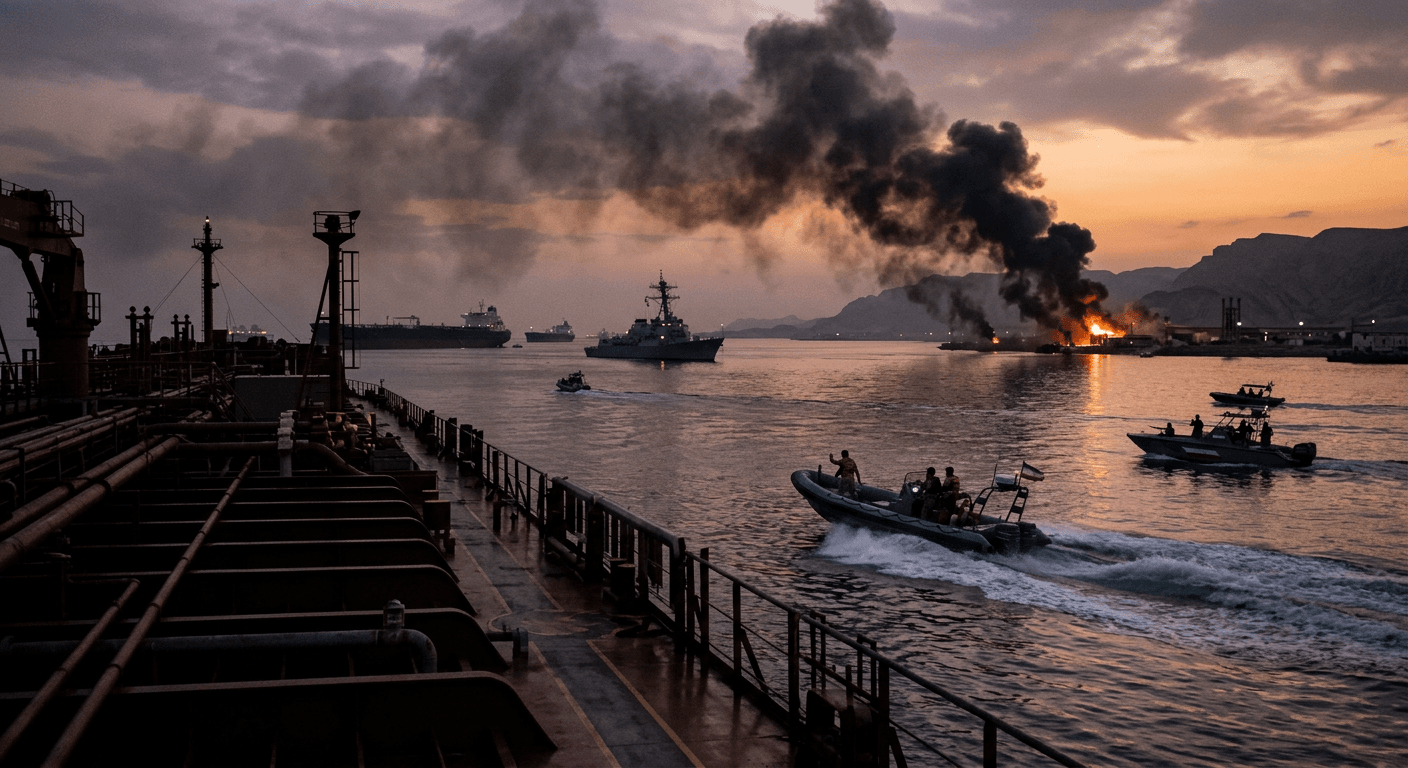
In the Strait of Hormuz, US forces have struck Iranian-linked port facilities as Tehran deploys its "mosquito fleet" of fast-attack boats, raising fresh risks to the daily flow of 20 percent of global oil supplies through this narrow waterway.
“The Strait of Hormuz is not just a waterway. It is the jugular vein of the global energy economy.” — Kurt Volker, former US Special Envoy for Energy Security.
The latest US strikes on Iranian port infrastructure have thrust the Strait of Hormuz back into the spotlight. American forces targeted facilities linked to Tehran’s Revolutionary Guard near the narrow passage between the Persian Gulf and the Gulf of Oman. Iran responded by increasing deployments of its “mosquito fleet” — hundreds of small, fast attack boats designed to swarm larger naval vessels and commercial tankers.
This flare-up matters because roughly one in every five barrels of oil traded worldwide passes through this 21-mile-wide chokepoint. Any sustained disruption would send fuel prices higher for drivers in California, factories in Europe, and households across Asia. The clashes also highlight how energy politics, military tactics, and economic pressure continue to shape relations between Washington and Tehran.
What Actually Happened
According to multiple reports, US naval and air assets conducted precision strikes on port infrastructure used by Iranian proxy forces. The targets included docking areas and supply depots along the Iranian coastline that support operations in the strait. Iranian state television described the actions as “aggression,” while US officials framed them as necessary responses to repeated harassment of commercial shipping.
Iran has doubled down on its asymmetric naval strategy. Its mosquito fleet consists of small, agile vessels armed with missiles, rockets, and machine guns. These boats rely on speed and numbers rather than heavy armor. By operating in coordinated swarms, they aim to overwhelm the defenses of much larger destroyers and tankers. Iranian commanders have practiced these tactics for years, rehearsing scenarios in which dozens of boats attack from multiple directions at once.
The recent incidents follow a pattern of increasing incidents involving Iranian vessels approaching oil tankers, attempting to seize them, or firing warning shots. Shipping companies have already begun rerouting some vessels or paying higher insurance premiums to transit the area.
The Strategic Importance of the Strait
The Strait of Hormuz serves as the only sea route out of the Persian Gulf. On its northern side lies Iran. On the southern side sit Oman and the United Arab Emirates. At its narrowest point, the navigable shipping lane is only about two miles wide in each direction. This creates a natural bottleneck that is easy to threaten but difficult to defend fully.
According to the US Energy Information Administration, approximately 21 million barrels of oil flowed through the strait each day in recent years. That figure represents about 20 percent of global petroleum liquids consumption. The crude comes primarily from Saudi Arabia, Iraq, the UAE, Kuwait, and Iran itself. Liquefied natural gas from Qatar also travels the same route.
Disruptions here do not just affect oil producers. They ripple through entire economies. Higher energy costs increase the price of nearly everything — from groceries moved by truck to plastics used in medical equipment. Countries with limited domestic reserves, such as Japan, South Korea, and much of Europe, feel the pain first and hardest.
Russian superyachts operating near these waters have previously revealed how sanctioned actors use luxury assets and complex shipping arrangements to move around restrictions. The same routes and financial tricks that allow oligarchs to evade sanctions can also be used to move oil outside official channels when tensions rise.
Iran’s Mosquito Fleet Doctrine
Iran cannot match the US Navy ship-for-ship. Instead, it has invested heavily in cheap, fast, and expendable platforms. The Revolutionary Guard Navy operates hundreds of these small boats, many of them commercial fishing vessels modified with weapons mounts.
The strategy draws from classic asymmetric warfare principles. A single large warship costs billions and carries dozens of sailors. A swarm of speedboats costs a fraction of that amount and can be replaced quickly. By overwhelming a ship’s radar and defensive systems with many simultaneous threats, Iran hopes to score hits that force the US and its partners to think twice before confronting Iranian forces directly.
These boats have also been used to harass commercial shipping. Tanker crews report vessels approaching at high speed, sometimes waving Iranian flags or attempting to board. Such incidents drive up insurance rates and make shipping companies wary of using the strait without naval escorts.
The current escalation appears linked to broader regional disputes, including Iran’s nuclear program, its support for proxy militias, and long-standing grievances over sanctions that have crippled its economy.
Economic Shockwaves and Oil Markets
Oil prices jumped immediately after news of the strikes broke. Brent crude, the global benchmark, rose more than four percent in early trading as traders priced in higher risk. While markets have calmed somewhat, the possibility of further escalation keeps prices elevated.
Consumers feel these changes at the pump. In the United States, the average price of regular gasoline has climbed roughly 30 cents per gallon in the past two weeks. For a family filling up twice a month, that adds up. Trucking companies pass higher diesel costs onto businesses, which then raise prices on goods.
Longer term, sustained conflict could force countries to tap strategic petroleum reserves. The International Energy Agency coordinates releases among member nations during major supply emergencies. Yet those reserves are finite and meant for genuine crises, not ongoing tit-for-tat naval clashes.
Alternative routes exist but come with drawbacks. Shipping around Africa’s Cape of Good Hope adds thousands of miles and weeks of sailing time. Pipeline options through Saudi Arabia or the UAE can handle only a portion of the volume. None offer a simple replacement for the strait.
This situation intersects with larger shifts in global energy markets. How the Iran conflict could reshape global oil flows and energy prices for years have given some producers new ways to sell oil outside traditional dollar-based finance. When tensions rise in the Gulf, interest in these alternative payment channels often grows.
Broader Geopolitical Context
The clashes occur against a backdrop of strained relations between the United States and Iran that stretch back decades. Recent diplomatic efforts, including indirect talks hosted in third countries, have produced limited results. Both sides accuse the other of bad faith.
China and Russia have criticized the US strikes. Beijing relies heavily on Gulf oil to fuel its economy and prefers stability in the region. Moscow has deepened ties with Tehran, including military cooperation that has raised concerns in Western capitals.
Gulf Arab states find themselves in a difficult position. They want protection from Iranian threats but also fear being dragged into direct conflict. Saudi Arabia and the UAE have improved relations with Iran in recent years while maintaining security partnerships with Washington.
The situation also connects to wider debates about energy security. Europe has worked hard to reduce dependence on Russian gas following the Ukraine conflict. Many countries increased imports of LNG from Qatar and the United States. Renewed instability in the Gulf threatens to undo some of that progress.
The global economic outlook for 2026 already factored in significant energy transition challenges and geopolitical risk. These latest events in the strait add another layer of uncertainty to forecasts that were already cautious.
Military and Naval Realities
The US Fifth Fleet, based in Bahrain, maintains a constant presence in these waters. American aircraft carriers, destroyers equipped with advanced missile defense systems, and patrol aircraft regularly transit the area. Their mission includes keeping shipping lanes open and deterring hostile action.
However, the sheer number of Iranian small boats creates a targeting challenge. Naval commanders must weigh the risk of escalation against the need to protect commercial traffic. Rules of engagement allow defensive action when vessels pose an imminent threat, but determining “imminent” in a swarm scenario can be difficult.
Both sides have modernized their forces in recent years. Iran has acquired more advanced anti-ship missiles and improved its coastal radar coverage. The United States has deployed more unmanned systems, including aerial drones and unmanned surface vessels, to extend its surveillance without risking crewed platforms.
Analysts note that neither country wants all-out war. Iran’s economy is already strained by sanctions. The US faces competing priorities elsewhere, including competition with China in the Indo-Pacific. Yet miscalculation remains a serious risk. A single incident involving a major tanker or loss of life among naval personnel could rapidly change the calculus.
Impact on Ordinary People
While headlines focus on warships and diplomats, the real effects land on regular citizens. Truck drivers in the American Midwest pay more for diesel. Families in India and Pakistan face higher cooking fuel costs. European manufacturers see energy bills rise at a time when many are still recovering from previous shocks. Gas prices and the Strait of Hormuz
Fishermen in the region also suffer. Iranian boats sometimes operate near fishing grounds, and naval activity disrupts normal maritime activity. Insurance costs for all types of shipping have increased, making certain trades less profitable.
Longer term, persistent instability in the Gulf accelerates the search for alternatives. Countries invest more in renewable energy, nuclear power, and domestic production. Oil producers themselves recognize that uncertainty damages their long-term market prospects.
The situation also highlights the limits of military power alone. Sanctions, diplomacy, economic incentives, and technological innovation all play roles in managing these tensions. No single tool provides a complete solution.
What Comes Next
Diplomatic channels remain active despite the military clashes. Indirect talks continue through intermediaries, and both sides have incentives to prevent the situation from spiraling. Yet trust is low, and domestic politics in both countries reward toughness.
Energy markets will stay volatile as long as incidents continue. Traders will watch for any attacks on tankers, closures of shipping lanes, or statements from major producers about production adjustments.
The mosquito fleet tactic has proven effective at raising costs and complicating naval planning. It represents a classic example of how a weaker power can challenge a stronger one by changing the terms of engagement. Understanding these dynamics helps explain why the Strait of Hormuz remains one of the most watched places on the planet.
Ultimately, the people who live far from these waters — whether in American suburbs, European cities, or Asian factories — have a stake in how this plays out. Stable energy supplies support jobs, keep lights on, and hold down the cost of daily life. When that stability is threatened, the consequences spread quickly and widely.
The current chapter in the long story of the Strait of Hormuz shows how energy, security, and economics remain tightly linked. Resolving these tensions will require patience, clear communication, and recognition that prosperity depends on keeping critical shipping routes open and predictable.
As pressures mount, the world watches to see whether restraint or escalation will define the next phase. The stakes extend far beyond the narrow waters between Iran and its neighbors. They touch the daily economic reality of billions of people who depend on the steady flow of energy through one of the planet’s most vital arteries. Iran War 2026: How US-Iran Conflict Threatens Strait of Hormuz, Global Oil Prices, and Energy Security
Share This Article