AI Infrastructure · Jonathan van den Berg · September 15, 2026
US Space Force Deploys Orbital Weapons: How Space Control Reshapes AI Data Center Power, Critical Minerals Demand, and Geopolitical Supply Chains
The US Space Force has deployed space control weapons in orbit, escalating great-power competition with China and Russia. This shift directly affects AI data center expansion, power grid constraints, critical minerals sourcing, and investment flows into semiconductor and energy infrastructure.
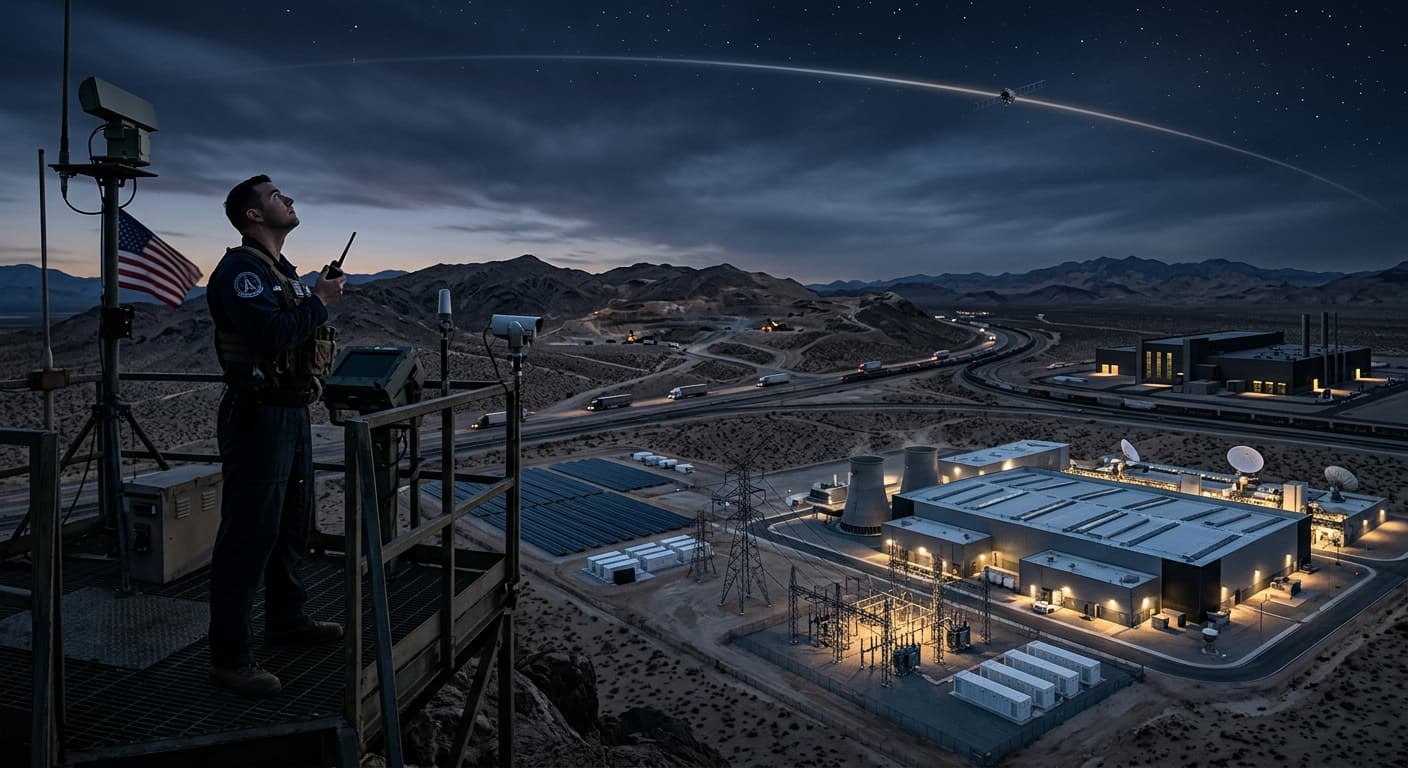
The US Space Force has deployed space control weapons in orbit. This move marks a major escalation in military space capabilities and carries direct consequences for AI data center infrastructure, critical minerals supply chains, and sovereign capital allocation.
Air Force Secretary statements confirm the deployment of systems designed to protect US assets while denying adversaries similar advantages. The technology includes both kinetic and non-kinetic options that can disrupt satellites used for communication, navigation, and Earth observation. For institutional investors tracking technology infrastructure, this development changes risk calculations across multiple sectors.
Key Takeaways
- US Space Force orbital weapons give Washington new tools to protect GPS, communications, and reconnaissance satellites essential to AI training clusters and autonomous systems.
- Heightened space domain awareness increases demand for radiation-hardened semiconductors and specialized critical minerals such as gallium, germanium, and rare earth elements.
- AI data center operators in Northern Virginia and similar hubs now face elevated geopolitical risk premiums on power purchase agreements and backup generation.
- Sovereign wealth funds are accelerating allocations toward dual-use technologies that blend commercial satellite constellations with military-grade resilience.
- China’s response, including accelerated counter-space programs, tightens export controls on minerals critical to both orbital systems and data center GPUs.
What the US Space Force Deployment Actually Means
The deployed systems focus on space control rather than outright destruction in most scenarios. Officials emphasize reversible effects such as jamming, dazzling, or cyber intrusion over permanent kinetic kills. This approach aims to avoid creating dangerous debris fields that could threaten commercial constellations including Starlink, Amazon Kuiper, and OneWeb.
Yet the capability itself changes deterrence dynamics. Satellites now operate in an environment where the US can credibly threaten adversary spacecraft. Russia and China have similar programs, but US officials claim superior integration with terrestrial forces and commercial partners.
For AI infrastructure, the implications are immediate. Training runs for frontier models require uninterrupted high-bandwidth connectivity and precise timing signals from GPS. Any credible threat to these systems forces data center developers to invest in redundant terrestrial fiber, alternative positioning systems, and hardened edge computing facilities.
Direct Impact on AI Data Center Expansion and Grid Constraints
Data centers already consume massive amounts of electricity. Northern Virginia alone accounts for roughly 20% of the world’s hyperscale capacity. Adding military-grade resilience requirements pushes operators toward more nuclear power purchase agreements, on-site generation, and advanced cooling technologies that further increase mineral intensity.
SpaceX’s turbine blade factory illustrates one commercial response to these pressures. Advanced manufacturing techniques developed for orbital systems translate directly into more efficient backup power solutions for data centers facing grid congestion.
Companies like Oracle, already expanding massive AI cloud capacity, must now model scenarios where satellite-dependent synchronization faces interference. This drives demand for specialized chips from NVIDIA, AMD, and custom silicon providers that incorporate radiation hardening originally developed for space applications.
Power and Cooling Requirements Under New Threat Models
Operators now run wargame scenarios that include partial loss of satellite communications for days or weeks. The resulting architecture changes include:
- Greater reliance on terrestrial dark fiber rings with military-grade encryption
- Increased deployment of inertial navigation systems as GPS backups
- Higher requirements for uninterruptible power supplies using advanced battery chemistries dependent on lithium, cobalt, and nickel
- Accelerated timelines for small modular reactor projects to provide dedicated, resilient power to data center campuses
These shifts amplify existing grid constraints. Utilities in high-growth areas already struggle to approve new transmission lines. Military space requirements add another layer of regulatory and security review that slows deployment.
Critical Minerals Angle: From Orbit to Data Center Racks
Space control systems and AI accelerators share a common dependency on a narrow set of critical minerals. Gallium and germanium, already subject to Chinese export controls, are essential for both high-frequency radar components in satellites and for compound semiconductors used in data center networking.
The modified NVIDIA RTX 5090 GPUs with expanded VRAM highlighted earlier supply chain vulnerabilities. Those same constraints now intersect with military space requirements that prioritize domestic or allied sourcing of these materials.
Recent earthquakes in key producing regions have already tightened markets. Any escalation in space domain competition risks further nationalization moves in South America and Africa, where lithium and rare earth projects face increasing resource nationalism. Aurora borealis visibility spikes further expose this critical minerals volatility and the resulting AI data center power risks heading into 2026.
Mineral Supply Chain Overlap Between Space and AI
| Mineral | Space Application | AI Data Center Application | Primary Risk |
|---|---|---|---|
| Gallium | Radar and comms chips | RF amplifiers, power electronics | China export controls |
| Germanium | Infrared sensors, optics | Fiber optics, high-speed networking | Concentrated refining in Asia |
| Tantalum | Capacitors in satellites | High-reliability capacitors | Conflict minerals scrutiny |
| Rare Earths | Magnets for reaction wheels | Hard drives, cooling pumps | Processing dominance by China |
This overlap creates a feedback loop. Greater military demand for these minerals raises costs and lead times for commercial AI infrastructure. Sovereign wealth funds from Gulf states and East Asia are responding by taking direct stakes in mining and refining projects that can guarantee supply to both sectors.
Sanctions Compliance and Cross-Border Technology Flows
The deployment of orbital weapons increases pressure on sanctions regimes. Entities attempting to supply dual-use components to China or Russia now face heightened scrutiny under US export controls. This affects not only traditional defense firms but also the commercial semiconductor supply chain that serves AI data centers.
Chinese responses to US space moves include tighter controls on technology and minerals. Recent statements rejecting “AI fearmongering” from US executives signal Beijing’s intent to accelerate domestic capabilities while limiting outbound flows of critical inputs.
Investors must track secondary sanctions risks for any company with significant exposure to both commercial AI and space-adjacent technologies. Firms like ASML and TSMC already navigate complex compliance environments. New space control realities add another dimension to their risk profiles.
How Sovereign Wealth Funds Are Repositioning
Funds such as Saudi PIF, Singapore’s Temasek, and Norway’s Government Pension Fund Global are adjusting portfolios to reflect the new space-AI nexus. Priorities include:
- Direct investments in US-based AI infrastructure with military dual-use potential
- Joint ventures in critical minerals projects in stable jurisdictions
- Allocations to satellite operators that combine commercial broadband with government contracts
- Increased stakes in nuclear technology firms capable of powering resilient data centers
These moves reflect a broader recognition that space control capabilities now form part of the infrastructure backbone for economic competitiveness in the AI era.
Common Mistakes Investors Make in This Environment
- Treating space and AI infrastructure as separate investment themes rather than tightly linked systems sharing supply chains and geopolitical risk factors.
- Underestimating the mineral intensity of military space programs and the resulting pressure on commercial data center costs.
- Assuming current satellite constellations will remain fully available during heightened tensions without modeling degraded operations.
- Failing to incorporate sanctions compliance costs into forecasts for companies with complex international supply chains.
- Overlooking the accelerating role of sovereign capital in bridging gaps left by private markets wary of geopolitical exposure.
Best Practices for Tracking These Developments
- Monitor Space Force and Air Force budget documents for clues about specific capabilities and their commercial spillover effects.
- Track Chinese and Russian counter-space tests through open-source intelligence and commercial satellite imagery providers.
- Build supply chain maps that highlight shared dependencies between orbital systems and hyperscale data centers.
- Stress-test power purchase agreements against scenarios of heightened space tension and resulting regulatory delays.
- Engage with specialized research that connects space policy to critical minerals strategy and AI infrastructure demand.
Cross-reference developments with related supply chain pressures such as those examined in Houthi advances exposing Bab el-Mandeb risks and Strait of Hormuz disruptions. The same risk premium logic applies across domains. The Vandenberg SpaceX launch provides a concrete example of how specific commercial space events are already reshaping these overlapping power, minerals, and satellite supply chain dynamics.
FAQ
How does US Space Force weapons deployment affect AI companies?
It raises the cost and complexity of building resilient data centers. Satellite-dependent services face new threat models, driving demand for specialized chips, redundant infrastructure, and secure power sources.
Which critical minerals see the biggest impact?
Gallium, germanium, tantalum, and specific rare earth elements face the strongest pressure. These materials serve both space systems and the high-performance computing components inside AI data centers.
Will this accelerate nuclear power adoption for data centers?
Yes. Military requirements for assured power favor small modular reactors and other resilient generation technologies that can operate independently of vulnerable transmission grids.
How are sovereign wealth funds responding?
They are increasing direct investments in dual-use technologies, critical minerals projects with secure jurisdictions, and AI infrastructure that incorporates military-derived resilience standards.
What should investors watch next?
Look for Chinese announcements on counter-space capabilities, changes in US export control lists for space-related technologies, and new power contracts signed by major data center operators in constrained markets.
The convergence of orbital weapons, AI infrastructure, and critical minerals creates a new strategic reality. Institutional investors who map these connections early will hold an advantage as competition in space increasingly determines economic outcomes on the ground.
Track these intersecting risks through specialized analysis that connects space policy to tangible impacts on technology supply chains, energy infrastructure, and capital flows. The next moves in this domain will shape investment landscapes for the next decade.
Share This Article