AI Infrastructure · Jonathan van den Berg · October 10, 2026
How Vandenberg SpaceX Launch Reshapes AI Data Center Power Demand, Critical Minerals Competition, and Satellite Supply Chains
The latest Vandenberg SpaceX launch for the Space Development Agency delivers 21 data transport satellites that strengthen military proliferated architecture. This directly influences AI data center power needs, critical minerals demand, and orbital supply chain resilience.
The Vandenberg SpaceX launch of 21 data transport satellites for the Space Development Agency marks another step in building resilient military space infrastructure. These satellites support proliferated low-Earth orbit architecture that delivers secure, low-latency communications for defense operations. The mission also underscores accelerating demand for advanced computing in orbit, which feeds directly into terrestrial AI data center expansion and the minerals required to build both systems.
Key Takeaways
- The SDA Tranche 1 Transport Layer satellites enhance real-time data relay for military users while increasing overall satellite manufacturing volume.
- SpaceX’s rapid cadence at Vandenberg adds pressure on critical minerals supply chains already strained by AI infrastructure buildout.
- Orbital power and thermal management requirements mirror many challenges faced by ground-based AI data centers in Northern Virginia and similar hubs.
- Investors tracking NVIDIA, Oracle, AMD, and Tesla should monitor how defense-driven satellite demand affects chip and battery mineral availability.
- Geomagnetic storms linked to heightened aurora visibility can disrupt satellite operations, exposing vulnerabilities that parallel grid risks for AI facilities.
What the Vandenberg SpaceX Launch Delivered
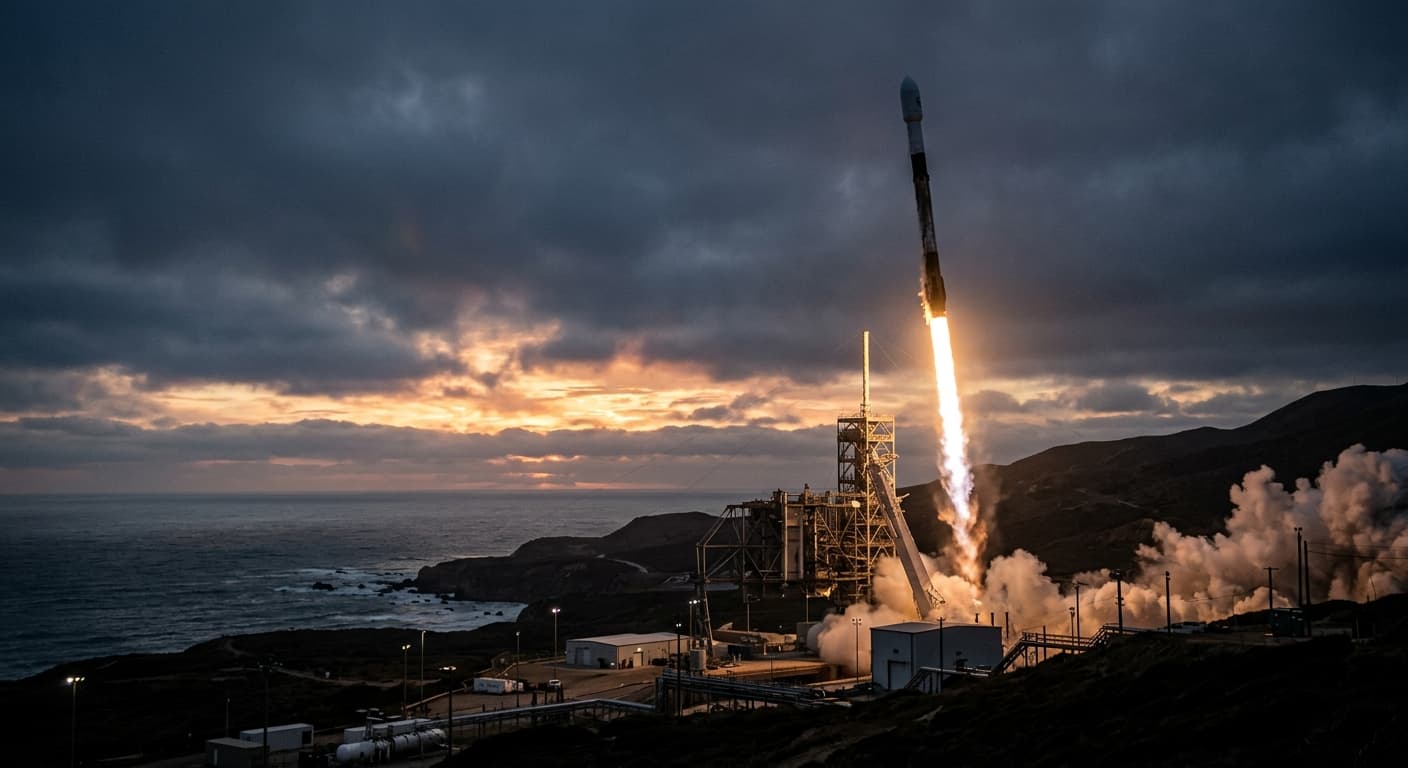
SpaceX used a Falcon 9 from Vandenberg Space Force Base to deploy the SDA’s latest batch of transport layer satellites. These spacecraft form part of a proliferated architecture designed to make military communications harder to jam or destroy. Unlike traditional large, expensive satellites, the approach relies on many smaller, cheaper units that can be replaced quickly.
The 21 satellites join an existing constellation that already provides data transport between low-Earth orbit sensors and ground stations. This layer reduces reliance on vulnerable geostationary assets and cuts latency for tactical users. The launch cadence itself matters: SpaceX has demonstrated turnaround times measured in weeks, not years, forcing the entire supply ecosystem to match that speed.
Each satellite carries radiation-hardened processors, phased-array antennas, and optical inter-satellite links. These components require gallium, germanium, rare earth elements, and high-purity silicon in quantities that overlap with AI chip production. As the Department of Defense scales this architecture toward hundreds of satellites, competition for those materials intensifies.
Link Between Military Satellites and AI Data Center Power Needs
Modern satellites increasingly perform edge computing tasks once reserved for ground stations. Onboard processing of sensor data before transmission reduces bandwidth requirements but demands more electrical power and sophisticated thermal controls in vacuum. These engineering problems echo the power density and cooling challenges inside hyperscale AI data centers.
SpaceX’s own investments in turbine blade manufacturing for efficient power generation directly address AI data center power constraints. The same metallurgical expertise used for rocket engines transfers to high-efficiency generators that help utilities meet surging electricity demand from GPU clusters.
Northern Virginia data center operators already face grid interconnection queues measured in years. Military satellite programs add another vector of demand for the same high-performance power electronics and transformers. When defense budgets accelerate satellite production, they pull forward orders for components that AI developers also need.
Critical Minerals Competition Intensifies
Gallium and germanium dominate discussions around both satellite electronics and AI accelerators. China’s past export controls on these materials demonstrated how quickly supply can tighten. Each SDA satellite batch consumes measurable percentages of quarterly Western production of these specialty metals.
The modified NVIDIA RTX 5090 GPUs with expanded VRAM already exposed underlying shortages in the specialty materials required for high-memory AI training systems. Satellite programs compound that pressure because radiation-hardened variants often require even higher purity levels and additional protective coatings derived from rare earth processing.
Lithium, cobalt, and nickel for satellite batteries and ground support equipment compete with the same metals needed for grid-scale storage that stabilizes power delivery to data centers. When launch cadence increases, so does the draw on these shared supply chains.
Mineral Demand Comparison: AI Data Centers vs. Satellite Programs
| Material | Primary AI Use | Satellite Use | Shared Risk Factor |
|---|---|---|---|
| Gallium | GaN power amplifiers in GPUs | RF components and solar cells | China export controls |
| Germanium | Fiber optics and semiconductors | Infrared sensors and optics | Refining capacity concentration |
| Neodymium | Magnets in cooling pumps | Reaction wheel motors | Mining dominated by few producers |
| Lithium | Grid storage batteries | Satellite power systems | Price volatility from competing demand |
How Aurora Forecasts Reveal Satellite and Grid Vulnerabilities
Moderate G2 geomagnetic storms expected around October 11, 2026, highlight another connection. Aurora visibility spikes often coincide with solar activity that can induce currents in power grids and disrupt satellite electronics. The same ionospheric disturbances that create spectacular auroras can degrade GPS accuracy and increase drag on low-Earth orbit spacecraft.
Operators of both satellite constellations and AI data centers must prepare for these events. Data centers in high-latitude regions or those with long transmission lines face heightened transformer saturation risk during geomagnetic storms. Satellite fleets require autonomous maneuvering capabilities to handle increased atmospheric density.
The article on how aurora borealis visibility spikes expose critical minerals volatility and AI data center power risks details these overlapping operational challenges. Investors should treat space weather forecasts as early indicators of potential supply chain stress across both domains.
Supply Chain Chokepoints in Satellite Manufacturing
The Vandenberg launch schedule reveals several bottlenecks. Payload fairings, second-stage engines, and avionics must be produced at rates that support weekly launches. Many of these components rely on specialized alloys and machining capacity shared with commercial aviation and energy infrastructure projects.
Optical terminals for inter-satellite links represent another pinch point. Only a handful of suppliers worldwide produce space-qualified laser communication systems at the required reliability levels. When the SDA and commercial mega-constellations like Starlink scale simultaneously, lead times stretch.
Geopolitical risks add complexity. While the Malacca Strait remains the dominant shipping chokepoint for physical minerals, intellectual property controls on radiation-hardening techniques create invisible barriers that slow technology transfer to alternative suppliers.
Investment Implications for Tech and Defense Stocks
Companies positioned across the intersection of space, AI, and energy stand to benefit from sustained SDA launches. NVIDIA supplies the core GPU technology that powers both ground AI training and increasingly capable onboard satellite processors. Oracle’s cloud infrastructure supports many defense data analytics workloads that rely on the proliferated architecture.
AMD gains from diversification as satellite manufacturers seek alternatives to single-vendor solutions for radiation-tolerant computing. Tesla’s vertical integration in batteries and power electronics positions it to supply both orbital and terrestrial energy storage systems.
Longer term, successful proliferated architectures reduce perceived risk in space-based services, which could accelerate commercial adoption of satellite data for AI training datasets. This feedback loop further increases total compute demand.
Common Mistakes in Assessing Space-Driven Demand
- Assuming satellite programs use negligible quantities of critical minerals compared to data centers.
- Ignoring the compounding effect of simultaneous commercial and military constellation buildouts.
- Underestimating how space weather events create correlated risks between orbital assets and terrestrial power grids.
- Treating launch cadence as independent from chip supply availability for AI developers.
- Failing to model second-order effects such as increased demand for specialty alloys used in both turbines and rocket engines.
Best Practices for Investors and Operators
- Track quarterly SDA launch manifests and cross-reference against known critical minerals consumption per satellite.
- Monitor SpaceX and competitor vertical integration moves, particularly in power generation and specialty materials.
- Stress-test data center expansion plans against simultaneous defense-driven mineral demand scenarios.
- Build supplier scorecards that evaluate both geographic concentration and exposure to space weather operational risks.
- Consider hedging strategies that pair AI infrastructure equities with companies advancing domestic critical minerals processing capacity.
FAQ
How does the Vandenberg SpaceX launch affect AI data centers?
It increases competition for the same specialized semiconductors, power electronics, and critical minerals required to build and power large GPU clusters. Faster satellite production pulls forward orders that can delay data center equipment deliveries.
What critical minerals are most impacted by military satellite programs?
Gallium, germanium, and specific rare earth elements used in RF components, solar arrays, and radiation-hardened processors face the highest incremental demand. These materials overlap significantly with those needed for advanced AI chips and power management systems.
Why do aurora forecasts matter for satellite launches and data centers?
Geomagnetic storms that produce visible auroras can disrupt satellite communications, increase orbital drag, and induce currents in power grids that serve data centers. Understanding these correlations helps operators anticipate correlated outages and supply stress.
Which companies benefit from increased SDA launches from Vandenberg?
SpaceX itself, plus suppliers of radiation-hardened electronics, high-efficiency power systems, and specialty materials. Public market proxies include NVIDIA for compute, Oracle for cloud infrastructure, and companies advancing efficient power generation technologies.
How do proliferated satellite architectures compare to traditional ones for supply chain resilience?
They trade higher unit volume for lower individual complexity, improving overall resilience to single-point failures. However, the higher volume creates new pressure on raw material supplies and manufacturing throughput that traditional programs avoided.
Conclusion
The Vandenberg SpaceX launch is more than a defense milestone. It signals accelerating integration between space infrastructure, AI compute demand, and critical minerals markets. Organizations that map these overlapping requirements today will hold advantages as both satellite constellations and data center fleets expand through the rest of the decade. Investors should treat each successful launch not as an isolated event but as another data point in the tightening relationship between orbital ambitions and terrestrial power realities.
Monitor upcoming SDA missions closely. The cadence, payload capabilities, and material intensity will continue revealing where the next supply chain constraints will emerge.
Sources
Spacex·Space·Spaceflightnow·Spaceweather·Finance·Bbc·Blog·Blog·Blog
Share This Article