Critical Minerals · Jonathan van den Berg · September 12, 2026
How Modified NVIDIA RTX 5090 GPUs with 96GB VRAM Expose Critical Minerals Shortages and AI Data Center Supply Chain Chokepoints
Chinese-modified NVIDIA RTX 5090 cards with triple the original VRAM highlight how critical minerals constraints and export controls are forcing gray-market innovation that directly impacts AI infrastructure costs and availability.
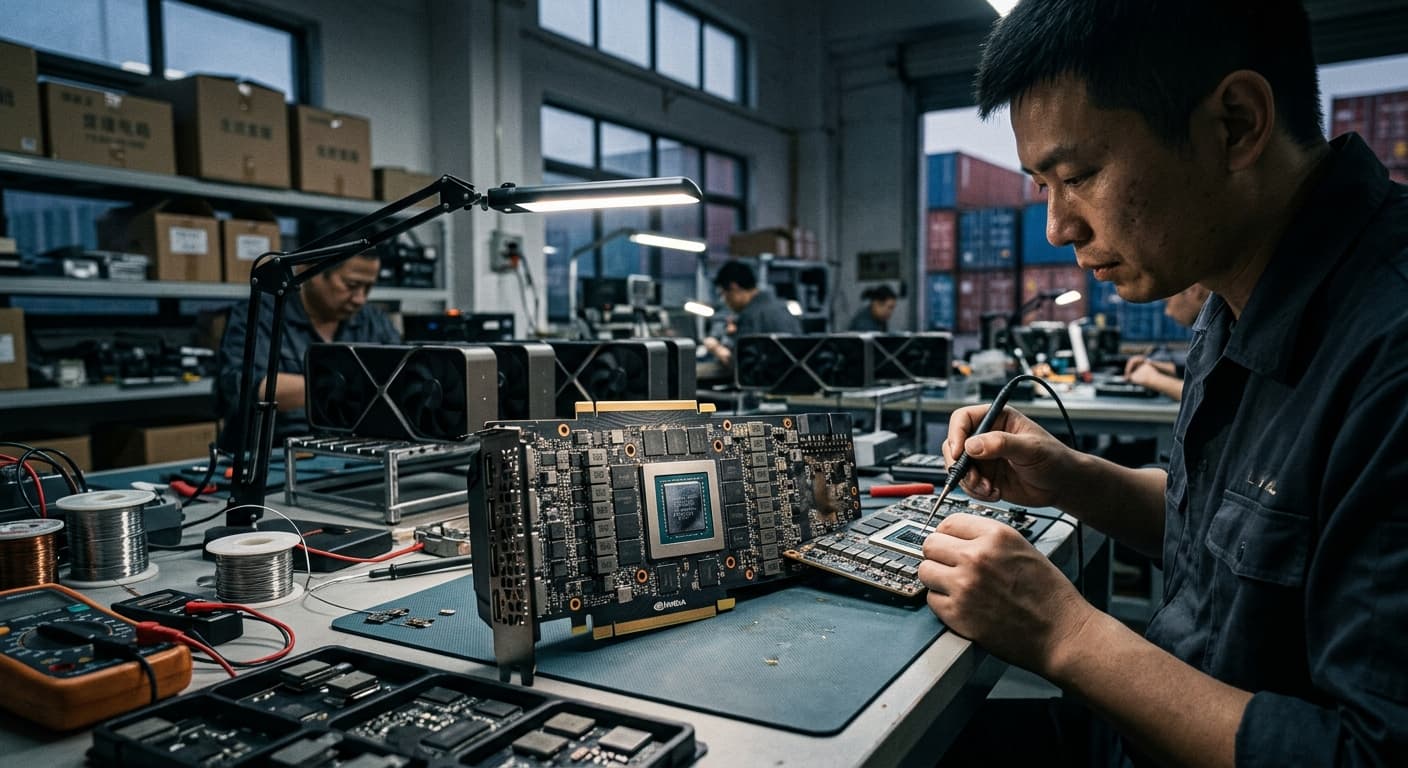
Chinese-modified NVIDIA RTX 5090 cards with 96GB VRAM sell for under $4,000 on Alibaba
These heavily altered GeForce cards deliver three times the memory of the standard 32GB version at roughly 65% of the official price. The modification trend reveals deeper fractures in the global semiconductor supply chain, where tight export controls on advanced GPUs meet insatiable demand from Chinese AI developers facing critical minerals bottlenecks.
The listings show cards with stacked or swapped HBM3e memory modules, custom cooling, and firmware tweaks that bypass NVIDIA’s original design limits. For institutional investors tracking AI infrastructure, this gray-market activity signals both opportunity and escalating risk across the entire compute stack.
Key Takeaways
- Modified RTX 5090 GPUs with 96GB VRAM demonstrate how Chinese firms are circumventing hardware restrictions through hardware-level innovation rather than waiting for legal channels.
- Critical minerals shortages, especially in cobalt, gallium, and rare earth elements used in advanced memory and packaging, are driving these workarounds and inflating long-term AI deployment costs.
- AI data center operators in Northern Virginia and similar hubs face tighter supply and higher power demands as custom configurations consume more electricity per rack.
- Companies like Oracle are seeing cloud revenue surge from AI demand that now outpaces supply, pushing power purchase agreements and grid infrastructure to breaking points.
- Recent earthquakes in Indonesia highlight physical risks to critical minerals supply routes that feed semiconductor manufacturing in Taiwan and South Korea.
What the Modified RTX 5090 Actually Means for AI Training
Standard consumer RTX 5090 cards ship with 32GB of GDDR7 or HBM memory. The modified versions reaching 96GB allow a single GPU to handle larger model inference or smaller fine-tuning jobs that previously required multi-GPU clusters. This reduces interconnect complexity and latency for certain workloads common in Chinese AI labs.
Buyers pay roughly $3,800–$4,000 per card instead of the $6,000+ street price for unmodified units. The savings come with risks: voided warranties, potential instability under sustained load, and questions around long-term reliability of the stacked memory configuration.
For data center operators, the trend accelerates a shift toward heterogeneous compute environments. Instead of waiting for NVIDIA’s next enterprise offering or AMD’s MI series, Chinese entities are building clusters from modified consumer silicon. This pattern mirrors earlier H100-to-A100 conversion waves but at greater scale.
NVIDIA’s $279 billion AI data center exposure now faces additional pressure from these parallel supply chains that bypass official allocation queues.
Critical Minerals Shortages Driving Hardware Innovation
High-bandwidth memory requires specialized substrates, advanced packaging, and rare elements whose supply chains remain concentrated. Gallium and germanium export restrictions from China, combined with cobalt supply risks in the Democratic Republic of Congo, have tightened availability for new memory production.
The modified cards often repurpose memory modules harvested from enterprise or previous-generation AI accelerators. This secondary market reduces immediate pressure on new mining and refining capacity but creates dependency on existing inventory that cannot scale with projected AI demand growth.
Earthquakes near Indonesia’s Maluku and Java islands in recent weeks underscore another layer of vulnerability. Indonesia supplies significant nickel and is an emerging player in battery and electronics minerals processing. Any disruption to shipping through the Malacca Strait or Taiwan Strait amplifies price volatility for the entire semiconductor ecosystem.
Recent seismic activity in Asia directly threatens refining capacity and port infrastructure that supports memory chip production feeding both legitimate and gray markets.
AI Data Center Power Constraints Meet Custom Hardware
Each modified 96GB card draws more power under load than the stock version due to additional memory controllers and thermal demands. When deployed at scale, these configurations push data center racks beyond standard 40–60 kW limits, accelerating the need for liquid cooling and higher-density power delivery.
Northern Virginia, the world’s largest data center market, already struggles with grid interconnection queues measured in years. Oracle’s latest earnings show cloud infrastructure revenue growing faster than expected precisely because customers cannot build their own capacity fast enough.
The company reported AI-related cloud sales that exceeded analyst estimates, yet the stock trimmed gains as investors weighed the reality that supply constraints will persist. Similar dynamics appear across hyperscalers racing to secure nuclear power purchase agreements and natural gas backup to keep racks online.
How Chinese AI models like DeepSeek and GLM reshape data center power demand further intensify this pressure, creating a feedback loop where modified hardware both relieves and exacerbates infrastructure bottlenecks.
How the Gray Market Affects Institutional Investors
Public market exposure breaks down across several vectors:
- NVIDIA (NVDA): Benefits from sustained demand but risks margin pressure if gray-market volume cannibalizes official enterprise sales in Asia.
- Oracle (ORCL): Positioned to capture overflow demand as enterprises turn to cloud providers instead of building on-site clusters using modified cards.
- AMD and TSMC (TSM): Memory and foundry partners face allocation battles as custom configurations compete for the same advanced packaging capacity.
Sovereign wealth funds and pension plans with heavy tech exposure must now model two parallel AI compute markets: the official channel with full software support and ecosystem lock-in, and the gray channel that offers lower upfront cost but higher operational risk and potential compliance headaches.
Common Mistakes in Assessing Modified GPU Risk
- Assuming all 96GB cards perform identically to official enterprise solutions. Firmware differences and thermal throttling often limit sustained performance below theoretical peaks.
- Dismissing minerals constraints as temporary. Refining capacity for gallium and specialized substrates requires years to expand and faces both environmental and geopolitical hurdles.
- Overlooking secondary sanctions exposure. While these cards are consumer-derived, large-scale deployment in restricted AI applications can trigger compliance reviews under evolving export rules.
- Ignoring power density implications. A data center filled with high-VRAM custom cards can exceed grid interconnection limits faster than planners using standard configurations.
Best Practices for Tracking This Trend
- Monitor Alibaba, Taobao, and specialized Chinese forums for volume and pricing trends on modified SKUs rather than waiting for Western news aggregation.
- Cross-reference memory module part numbers against known enterprise salvage pools to estimate remaining inventory runway.
- Model power consumption at the rack level, not per GPU, when stress-testing AI infrastructure forecasts.
- Include critical minerals forward curves and seismic risk data for Indonesia and the Taiwan Strait in quarterly supply chain reviews.
- Evaluate cloud providers’ ability to absorb displaced demand as a hedge against physical hardware constraints.
Investors should also watch regulatory responses. Further tightening of HBM export controls could accelerate modification activity, while any relaxation might flood the market with legitimate higher-memory cards and collapse gray-market premiums.
FAQ
Why are modified RTX 5090 cards reaching 96GB VRAM?
Chinese suppliers harvest and stack HBM3e modules from enterprise cards or previous-generation AI hardware, then integrate them onto consumer PCBs with custom interposers and cooling. This triples memory capacity for workloads that benefit from larger single-GPU context windows.
How much do these modified cards cost compared to official versions?
Listings show prices between $3,500 and $4,000 versus street prices above $6,000 for unmodified 5090 cards. The discount reflects both gray-market sourcing and lack of manufacturer warranty.
Do these modifications affect AI data center expansion plans?
Yes. Higher power draw and custom cooling requirements complicate rack density planning. In power-constrained markets like Northern Virginia, every additional kilowatt per GPU delays new cluster approvals and increases reliance on cloud providers.
What minerals are most at risk in this supply chain?
Gallium, germanium, cobalt, and specialized rare earths used in substrates and advanced packaging face the tightest constraints. Indonesia’s nickel and processing capacity also play growing roles that seismic events can disrupt.
Will this trend continue or fade with new NVIDIA releases?
It will likely persist as long as export controls and memory allocation shortages remain. New official high-memory SKUs would reduce the premium but are themselves constrained by the same critical minerals and manufacturing capacity limits.
Conclusion
The appearance of modified NVIDIA RTX 5090 cards with 96GB VRAM marks another chapter in the global contest for AI compute dominance. Rather than a quirk of the consumer market, it reflects structural shortages in critical minerals, persistent chokepoints in semiconductor manufacturing, and unrelenting power demand from data centers worldwide. Similar dynamics are playing out in how the Cyberpunk 2077 movie reshapes critical minerals demand, AI data center power needs, and semiconductor supply chains.
Institutional investors who treat these developments as isolated arbitrage opportunities will miss the larger picture. The real story is accelerating bifurcation of the AI hardware stack and the rising cost of scaling intelligence infrastructure under resource and geopolitical constraints.
Track both the gray-market pricing signals and the official supply chain metrics. Those data points together offer the clearest view of where AI growth will face its next bottlenecks.
Share This Article