Supply Chain · Jonathan van den Berg · September 13, 2026
Houthi Advances in Yemen Expose Bab el-Mandeb Supply Chain Chokepoints and Red Sea Shipping Risk Premiums
Houthi advances tighten control over key Yemeni territory near the Bab el-Mandeb strait, forcing shipping firms to reroute around Africa and pay steep risk premiums that ripple through global trade, energy prices, and semiconductor supply chains.
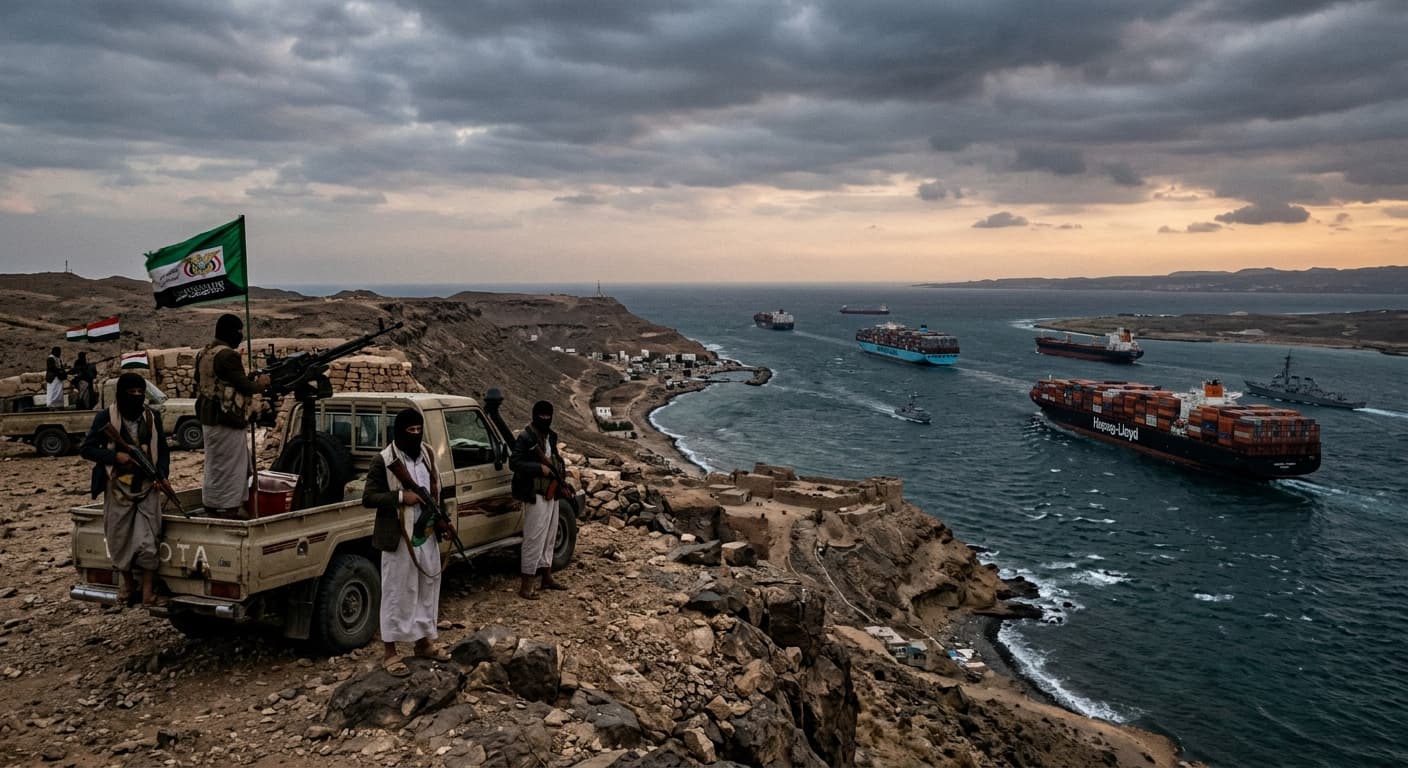
Houthi advances in Yemen have tightened their grip on territory bordering the Bab el-Mandeb strait, forcing shipping companies to weigh the rising cost of attacks against the expense of sailing around the Cape of Good Hope. Insurance premiums for Red Sea transits have climbed sharply, adding hundreds of millions in extra costs that flow directly into higher consumer prices and squeezed corporate margins.
These developments highlight how a regional militia backed by Iranian technology can disrupt one of the world’s most critical maritime chokepoints. Nearly 15 percent of global seaborne trade normally passes through Bab el-Mandeb, including significant volumes of oil, liquefied natural gas, and containerized goods linking Europe, Asia, and the Middle East.
Key Takeaways
- Houthi territorial gains near the Bab el-Mandeb have increased attack frequency and sophistication, prompting most major carriers to reroute around Africa.
- Red Sea shipping insurance premiums have risen 300-500 percent for vessels still transiting, creating a persistent risk premium that affects everything from oil to critical minerals.
- Rerouting adds 10-14 days to Asia-Europe voyages, burning extra fuel and delaying semiconductor components, consumer electronics, and medical supplies.
- Sovereign wealth funds and institutional investors are repricing exposure to companies with heavy Red Sea or Bab el-Mandeb logistics dependencies.
- The situation intersects with existing pressures on critical minerals and AI data center supply chains, amplifying vulnerabilities already exposed by other geopolitical shocks.
The Strategic Importance of Bab el-Mandeb
Bab el-Mandeb, Arabic for “Gate of Tears,” connects the Red Sea to the Gulf of Aden. At its narrowest point the strait is only 18 miles wide, with the shipping channel even tighter. Roughly 6 million barrels of oil and petroleum products move northbound through it daily, while container ships carrying electronics, textiles, and machinery dominate southbound traffic.
Control of the Yemeni side gives the Houthis the ability to launch drones, anti-ship missiles, and small boat attacks with minimal warning. Recent advances have allowed them to position systems closer to the strait’s critical lanes, reducing reaction time for naval escorts and commercial vessels.
This dynamic echoes risks at other maritime chokepoints. Strait of Hormuz risks remain elevated due to parallel Iran-related tensions, while any sustained disruption at Bab el-Mandeb compounds pressure on the longer route via the Malacca Strait.
How Houthi Advances Reshape Red Sea Shipping Patterns
Since the latest escalation, more than 80 percent of container vessels that previously used the Suez Canal-Red Sea route have diverted around Africa. The extra distance increases fuel consumption by up to 40 percent and adds roughly two weeks of transit time.
Major shipping lines including Maersk, MSC, and CMA CGM have declared the Red Sea off-limits for most non-essential cargo. Those that continue operate with armed guards, enhanced hull protections, and higher war-risk insurance. The cumulative effect has pushed global freight rates higher, particularly on Asia-Europe lanes.
Oil tankers have shown more resilience, but many operators now demand letters of indemnity or additional premiums before entering the Bab el-Mandeb. LNG carriers serving European terminals have also faced delays, contributing to volatility in European natural gas prices.
Insurance and Risk Premium Mechanics
War-risk insurance for a single Red Sea transit can now exceed $1 million per voyage for large container ships. Hull and machinery premiums have also climbed. These costs are passed on through freight surcharges that ultimately reach importers and consumers.
Reinsurers in London and Singapore have tightened capacity, forcing primary insurers to raise rates or decline coverage. Some shippers have turned to self-insurance or captive arrangements, but this exposes balance sheets to potentially catastrophic single-event losses.
Impact on Critical Minerals and Semiconductor Supply Chains
Semiconductor manufacturing depends on just-in-time delivery of specialty chemicals, rare earth elements, and advanced components. Delays through the Bab el-Mandeb route affect shipments from Asian refineries to European and U.S. fabrication plants.
Taiwan Semiconductor Manufacturing Company (TSMC) and its suppliers have already absorbed higher logistics costs. NVIDIA’s supply chain, already under pressure from critical minerals shortages, faces compounded risk when gallium, germanium, and neon-related materials encounter Red Sea delays.
These pressures link directly to broader vulnerabilities. Modified high-VRAM GPUs have exposed underlying shortages in the minerals needed for advanced chips, while NVIDIA supply chain gambles now contend with both mineral scarcity and maritime disruption.
Earthquake-related disruptions in Asia have further tightened certain mineral markets. Shipping delays at Bab el-Mandeb add another layer of friction that institutional investors track closely when assessing semiconductor equities.
AI Data Center Implications and Grid Constraints
AI infrastructure buildout in Northern Virginia and other hubs requires massive quantities of imported equipment and components. Rerouted vessels carrying servers, cooling systems, and power infrastructure arrive later and at higher cost.
Data center operators already grappling with power constraints and grid interconnection queues now face inflated capital expenditure from logistics. This dynamic appears in parallel with models showing how Chinese AI releases reshape power demand and semiconductor competition.
Longer shipping times also delay delivery of critical minerals used in transformers, cabling, and battery storage for backup power. The cumulative effect tightens already strained supply chains for the physical infrastructure behind AI growth.
Financial Market and Sovereign Wealth Fund Responses
Energy traders have built in a Bab el-Mandeb risk premium that keeps Brent crude $3-6 per barrel higher than it might otherwise trade. Sovereign wealth funds with exposure to shipping, insurance, and energy have adjusted portfolio allocations accordingly.
Funds linked to Gulf states have increased investments in alternative routes, port infrastructure in Oman and Saudi Arabia, and dual-sourcing strategies for critical minerals. Asian sovereign investors have accelerated diversification away from Red Sea-dependent logistics plays.
Public equity markets reflect the shift. Shipping equities with heavy Red Sea exposure have underperformed, while companies offering overland alternatives or Cape routing capacity have seen inflows. Technology stocks with long Asian-European supply chains trade at wider spreads to account for persistent disruption risk.
Common Mistakes Investors Make in Chokepoint Analysis
- Treating Bab el-Mandeb risk as temporary rather than structural. Houthi capabilities have improved, and resolution depends on broader regional diplomacy.
- Underestimating second-order effects on critical minerals pricing and availability.
- Ignoring insurance market capacity constraints that can suddenly withdraw coverage.
- Failing to model inventory buffers and just-in-time vulnerabilities in semiconductor and data center projects.
- Over-relying on official statements from warring parties without cross-checking shipping telemetry and insurance data.
Best Practices for Tracking and Mitigating Bab el-Mandeb Risk
- Monitor real-time vessel tracking through platforms that aggregate AIS data and insurance filings rather than relying solely on news headlines.
- Build scenario models that stress-test supply chains for 30-day, 90-day, and 180-day Red Sea closures.
- Diversify sourcing of critical minerals beyond single maritime routes, including greater use of air freight for high-value, low-volume materials where feasible.
- Engage directly with logistics providers on their contingency plans and insurance arrangements before committing to large infrastructure projects.
- Track sovereign wealth fund flows into alternative infrastructure such as rail corridors, new ports, and overland mineral transport as leading indicators of long-term adaptation.
| Route | Typical Transit Time (Asia-Europe) | Extra Fuel Cost | Insurance Premium Impact |
|---|---|---|---|
| Via Suez / Bab el-Mandeb | 25-30 days | Baseline | 300-500% spike for willing carriers |
| Around Cape of Good Hope | 35-45 days | +35-40% | Moderate increase |
FAQ
What is the Bab el-Mandeb strait and why does it matter?
It is the narrow waterway linking the Red Sea to the Gulf of Aden. Disruption here forces rerouting around Africa, adding time, fuel, and cost to global trade flows including oil, LNG, and manufactured goods critical to semiconductor and AI supply chains.
How have Houthi advances changed the risk profile?
Recent territorial gains allow shorter-range attacks with less warning, increasing both frequency and accuracy. This has driven most commercial traffic away from the strait and pushed insurance markets to price in higher probabilities of successful strikes.
Which industries face the greatest exposure?
Energy traders, semiconductor fabricators, auto manufacturers, and companies building AI data centers all face higher costs and longer lead times. Critical minerals shipments and components for Northern Virginia data center projects are particularly sensitive.
Will the risk premium disappear if attacks stop?
Markets tend to keep a memory premium even after incidents decline. Insurance underwriters and shipping executives now treat the Bab el-Mandeb as a chronically elevated risk zone until sustained stability is proven.
How does this connect to other geopolitical supply chain risks?
It compounds existing pressures at the Strait of Hormuz, Malacca Strait, and Panama Canal. Investors analyzing falling home prices and supply chain signals or earthquake impacts on minerals now add Red Sea disruption to their risk matrices.
Conclusion
The latest Houthi advances have turned the Bab el-Mandeb from a routine transit point into a high-stakes chokepoint that influences global pricing, investment decisions, and strategic planning. Companies and investors who treat the resulting risk premium as permanent rather than transient will be better positioned as supply chains slowly adapt through rerouting, inventory builds, and new infrastructure.
Tracking insurance data, vessel movements, and sovereign capital flows offers clearer signals than political rhetoric alone. Those signals point to a more fragmented, higher-cost global trade environment where control of narrow maritime passages carries outsized economic weight.
Sources
Share This Article