AI Infrastructure · Jonathan van den Berg · August 7, 2026
Lightning Storm San Diego 2026: How Extreme Weather Disrupts Supply Chains, Energy Infrastructure, and AI Data Center Expansion
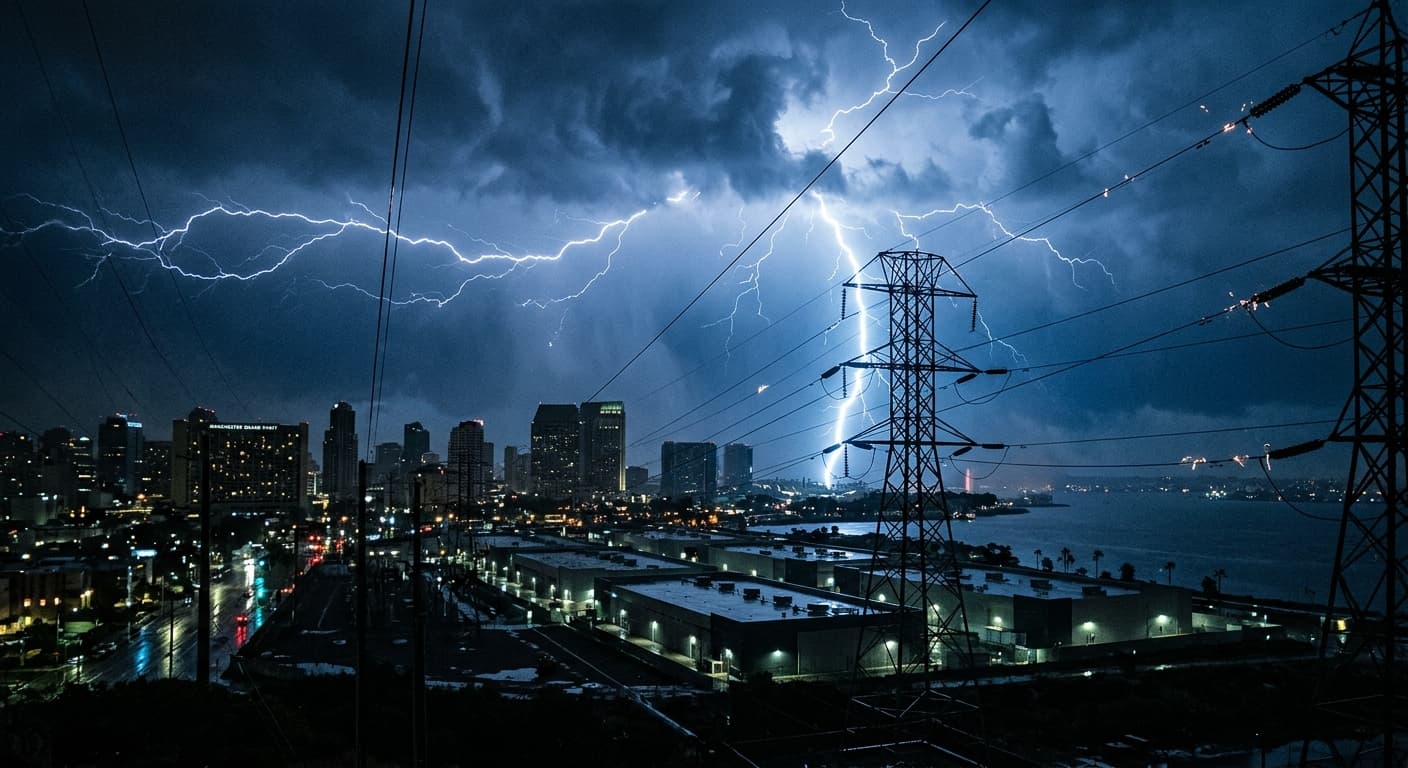
A powerful lightning storm over San Diego highlighted vulnerabilities in California’s aging electrical infrastructure at a time when hyperscale data centers demand reliable gigawatts of carbon-free power.
A powerful lightning storm swept across San Diego, knocking out power to thousands of homes and businesses while exposing deeper weaknesses in California’s electrical grid. The event underscores growing risks for hyperscale operators racing to build AI data centers that need constant, massive supplies of electricity.
Utility crews worked through the night restoring service after lightning strikes ignited small fires and damaged transmission equipment. Videos circulating online captured dramatic cloud-to-ground strikes illuminating the night sky over coastal neighborhoods. For local residents the outage meant spoiled food and darkened streets. For investors tracking tech infrastructure it signaled another warning about grid reliability in a state already struggling to meet surging demand from artificial intelligence.
Key Takeaways
- San Diego lightning storm caused widespread power outages and highlighted vulnerabilities in Southern California’s transmission network.
- AI data centers now consume electricity equivalent to entire cities, intensifying pressure on grids already stressed by extreme weather.
- California faces a widening gap between power supply and demand that could slow hyperscale construction in the Western U.S.
- Investors are shifting capital toward nuclear-powered sites and regions with stronger grid infrastructure such as Northern Virginia.
- Lightning-related outages add to broader supply-chain risks for semiconductor manufacturing that depends on uninterrupted power.
What Happened During the San Diego Lightning Storm
The storm developed rapidly over the Pacific Coast, bringing intense electrical activity unusual for the typically dry San Diego region. Multiple strikes hit substations and overhead lines, triggering automatic safety shutoffs that left neighborhoods without power for up to 12 hours. Fire departments responded to several small brush fires started by the strikes.
San Diego Gas & Electric reported more than 18,000 customers lost service at the peak. Restoration crews prioritized hospitals and critical facilities. While the utility restored most power within a day, the event revealed how even moderate lightning can cascade through an aging system strained by years of underinvestment and increasing load.
Similar incidents have occurred in recent years across California. Each one raises the same question for technology companies: can the state’s grid support the explosive growth of AI infrastructure?
Why AI Data Centers Need Massive, Reliable Power
A single large AI training facility can draw 100 to 500 megawatts—roughly the electricity used by 100,000 average homes. When dozens of these projects come online in the same region, demand spikes dramatically. Northern Virginia already hosts the world’s largest concentration of data centers and faces chronic transmission congestion. California operators hoped to expand in San Diego and the Bay Area to tap talent pools and renewable resources, but grid constraints are forcing reconsideration.
Lightning storms add another layer of risk. Even brief outages can interrupt training runs that cost millions and take weeks to complete. Companies therefore demand power purchase agreements that guarantee 99.999 percent uptime. Many now require backup generation or battery storage capable of bridging multi-hour gaps when storms hit.
Google’s massive off-balance-sheet financing for data centers illustrates how hyperscalers are using creative capital structures to secure power before competitors. Similar strategies appear in deals involving Oracle, Amazon, and Microsoft.
California Grid Constraints Meet Rising Demand
California’s grid operator, CAISO, projects the state will need an additional 50 gigawatts of clean firm power by 2035 to meet existing goals plus data center growth. That equals roughly 50 large nuclear reactors or an enormous expansion of natural gas with carbon capture. Current plans fall short.
Extreme weather compounds the problem. Heat waves drive air-conditioning demand while reducing output from solar panels in the late afternoon. Lightning and high winds damage transmission lines. Wildfires force preemptive shutoffs. Each factor makes utilities cautious about approving new large loads.
Tech companies have responded by exploring sites outside California. Many now target states with nuclear plants or abundant natural gas. Some are signing deals directly with nuclear operators to restart decommissioned reactors or build small modular reactors on-site.
Impact on Semiconductor Supply Chains and Critical Infrastructure
San Diego sits near key semiconductor and defense manufacturing clusters. Companies such as Qualcomm maintain major facilities in the region. These plants require stable power for clean rooms and precision equipment. A lightning-induced outage lasting more than a few minutes can ruin wafers in production and cost millions in scrapped inventory.
The same vulnerability exists across the Pacific Coast. Taiwan, South Korea, and Japan—all critical to global chip supply—face their own natural disaster risks. A major earthquake in Japan last year already demonstrated how seismic events can ripple through semiconductor markets. Puerto Rico water crisis exposing critical infrastructure risks, energy grid constraints, and supply chain vulnerabilities represent a different but parallel threat to domestic U.S. production. The Suisun City cyberattack further demonstrated how municipal ransomware can expose grid vulnerabilities, supply chain risks, and AI data center power constraints.
Investors tracking critical minerals and chip supply chains now factor weather-related outage frequency into their models. Regions with frequent lightning or wildfire risk carry higher insurance premiums and lower expected uptime.
Investment Implications for Data Center Operators and Utilities
Public market reaction to grid risk has been clear. Shares of companies heavily exposed to California power constraints have lagged peers with diversified footprints. Meanwhile, firms developing nuclear solutions or operating in grids with surplus capacity have outperformed.
| Company | Ticker | Key Exposure | Recent Performance Driver |
|---|---|---|---|
| Oracle | NYSE:ORCL | Cloud and data center expansion | Preference for nuclear PPAs |
| NASDAQ:GOOGL | Hyperscale AI infrastructure | Off-balance-sheet power financing | |
| Amazon | NASDAQ:AMZN | AWS data centers | Diversification away from high-risk grids |
| Microsoft | NASDAQ:MSFT | Azure and OpenAI partnership | Direct nuclear reactor deals |
| Nvidia | NASDAQ:NVDA | Chip demand from AI training | Indirect risk from customer power shortages |
Sovereign wealth funds have also taken notice. Temasek and GIC have increased allocations to U.S. power generation assets with long-term contracts to data center operators. These deals offer stable cash flows insulated from retail rate regulation.
Common Mistakes Investors Make When Assessing Grid Risk
- Assuming renewable nameplate capacity equals reliable capacity. Solar and wind require firm backup that is often missing in California.
- Underestimating transmission constraints. New generation capacity means little without lines to deliver power to data center sites.
- Ignoring weather frequency trends. Lightning and heat events have increased measurably over the past decade.
- Over-relying on battery storage. Current lithium-ion technology cannot economically provide multi-day backup at gigawatt scale.
- Failing to model insurance and outage penalties in financial projections for new facilities.
Best Practices for Data Center Site Selection in 2026
- Map local grid congestion and historical outage data for at least ten years before signing leases.
- Prioritize locations with access to nuclear or firm natural gas generation under long-term power purchase agreements.
- Require utilities to provide financial guarantees for uptime and liquidated damages for extended outages.
- Build on-site generation or storage capable of islanding the facility during grid disturbances.
- Factor in local water availability—many cooling systems still rely on it despite efficiency improvements.
- Engage directly with state regulators early rather than relying on standard interconnection queues.
Companies following these steps have secured better pricing and faster deployment. Those that rushed into constrained markets have faced costly delays and renegotiated contracts.
How Prediction Markets View Grid and Weather Risks
Platforms such as Kalshi now offer contracts on regional power prices, outage frequency, and extreme weather events. Traders have priced higher probabilities of California summer blackouts and increased volatility in Western power markets. These markets provide real-time sentiment that often leads traditional utility forecasts.
Kalshi prediction markets in 2026 have proven especially useful for hedging weather-related risks that traditional insurance struggles to cover at scale.
FAQ
How often do lightning storms cause power outages in San Diego?
Lightning is relatively rare in San Diego compared with the Midwest, but when storms do occur they frequently damage aging transmission infrastructure. Outages from single events have affected tens of thousands of customers in recent years.
Will the San Diego lightning storm delay AI data center projects?
Individual storms rarely stop projects outright, but repeated reliability issues are causing developers to reconsider California altogether. Several hyperscalers have quietly shifted incremental capacity to Texas, Arizona, and the Midwest. Self-Driving Uber Robotaxis and Waymo Expansion further illustrate how autonomous vehicle growth is adding new layers of AI-driven electricity demand and urban grid pressure.
What alternative energy sources are data centers turning to?
Nuclear restarts, small modular reactors, and long-term natural gas contracts with carbon capture lead the list. Some operators are also exploring geothermal and advanced geothermal where geology allows.
Which stocks benefit from stronger grid infrastructure?
Companies supplying transformers, transmission equipment, nuclear services, and battery storage have seen rising demand. Utilities with nuclear fleets in stable regulatory environments have also outperformed.
How does extreme weather affect global semiconductor supply chains?
Any disruption to U.S. or Asian manufacturing clusters forces customers to seek alternative sources, driving up spot prices for chips. Prolonged outages can delay everything from consumer electronics to defense systems.
Conclusion
The lightning storm that hit San Diego serves as a visible reminder of invisible infrastructure limits. As artificial intelligence continues its rapid advance, the physical foundations—reliable electricity, resilient transmission, and stable supply chains—will determine which companies and which regions win. Investors who understand these constraints and position capital accordingly stand to benefit as the next wave of data center construction favors locations that can actually deliver the power required.
Those monitoring both weather patterns and power markets will stay ahead of the next surprise outage—whether it arrives as lightning over the Pacific or as a Hawaii tropical cyclone straining Pacific supply chains, energy infrastructure, and AI data center expansion. Police surveillance networks like Flock cameras are increasingly integrated into urban security strategies protecting these same critical supply chains and data center sites.
Sources
Share This Article