AI Infrastructure · Jonathan van den Berg · August 11, 2026
Self-Driving Uber Robotaxis 2026: How Waymo Expansion Reshapes AI Data Center Demand, Grid Constraints, and Urban Supply Chains
Uber's robotaxi rollout in Los Angeles marks a major step for autonomous mobility, but the real story lies in surging electricity demand for supporting AI infrastructure and the resulting pressure on power grids already stretched by data centers.
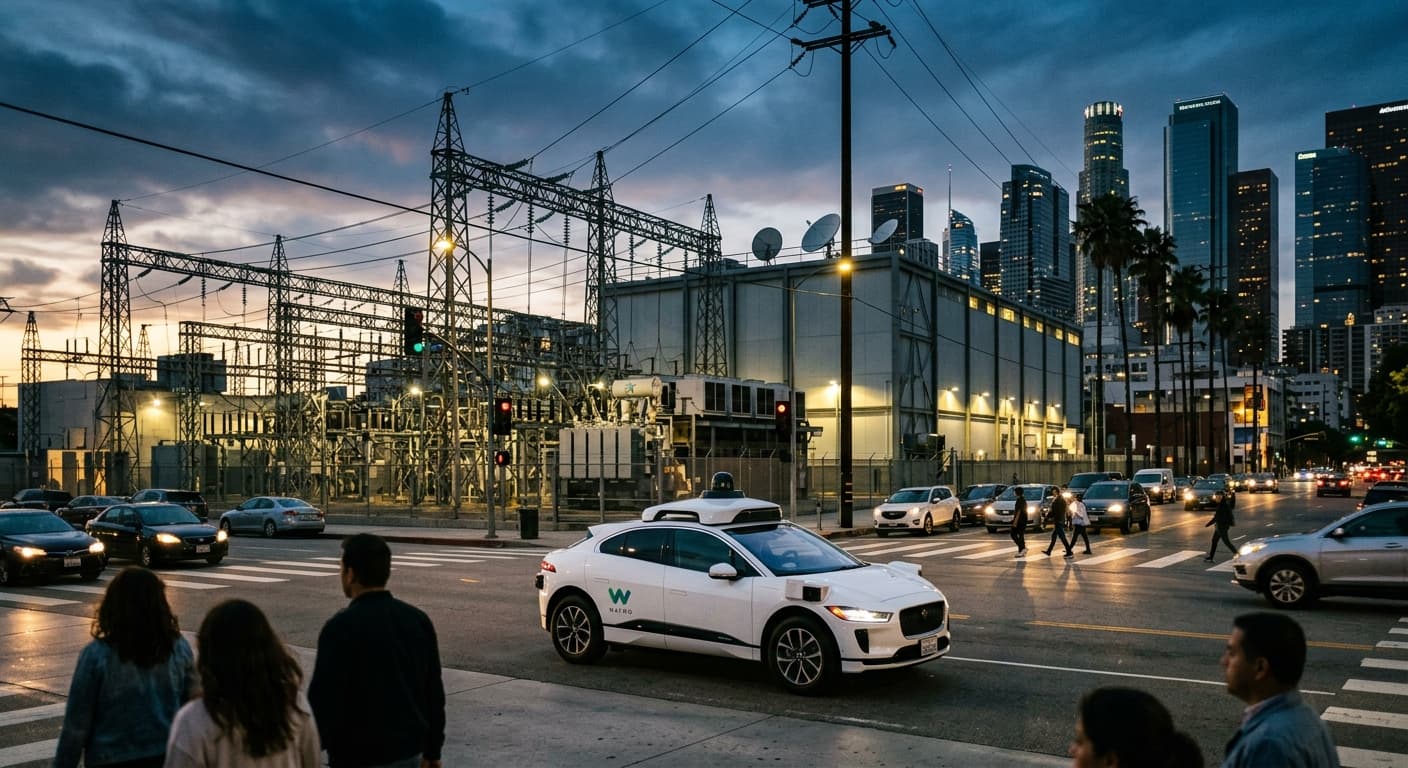
Uber's partnership with Waymo to deploy self-driving robotaxis in Los Angeles this year puts autonomous vehicles into one of America's largest ride-hail markets. The move directly increases demand for always-on AI systems that process sensor data, map updates, and fleet coordination in real time. Those systems run in data centers that already consume massive amounts of electricity and rely on specialized chips made from critical minerals.
The growth of self-driving Uber robotaxis therefore ties three pressure points together: urban mobility, AI infrastructure, and energy reliability. Cities gain fewer traffic incidents and lower emissions from human-driven cars, yet the backend computing load adds strain to power grids already showing signs of stress in key hubs such as Northern Virginia.
Key Takeaways
- Uber plans to integrate Waymo's autonomous vehicles into its app in Los Angeles, expanding beyond current Phoenix and San Francisco operations.
- Each robotaxi generates continuous data streams that require dedicated AI inference clusters, pushing data center utilization higher.
- Northern Virginia data center campuses already account for more than 20 percent of regional electricity demand, with projections showing further growth tied to AI workloads.
- Chip supply for the specialized processors depends on minerals such as gallium and germanium, where export controls from China create price volatility and delivery risk.
- Extreme weather events, like the recent monsoon storms in Phoenix that caused widespread power outages, expose how vulnerable the supporting grid infrastructure remains.
- Supply chain chokepoints in shipping routes such as the Malacca Strait continue to affect delivery of transformers and cooling equipment needed for new data center builds.
How Robotaxis Drive AI Data Center Expansion
Autonomous vehicles do not operate in isolation. Every vehicle on the road equipped with lidar, radar, and multiple cameras produces roughly 4 terabytes of data per day. Much of that data feeds back to centralized or edge computing facilities for model training, real-time decision updates, and fleet optimization.
Waymo's current fleet in Phoenix already demonstrates the pattern. During peak operation, the company maintains constant connectivity to cloud infrastructure. Scaling to Los Angeles, a market roughly three times larger in ride volume, multiplies the computing requirement. Industry estimates suggest each 1,000 robotaxis in service can require the equivalent compute capacity of a mid-sized hyperscale data center.
This demand arrives at a time when AI training and inference clusters already dominate new construction. Google, which owns Waymo, reported significant increases in capital expenditure for data centers in recent quarters. The self-driving Uber robotaxis rollout adds another layer of predictable, 24/7 workload that cannot tolerate latency or downtime.
Recent extreme weather events in California and Arizona have already disrupted data center operations and highlighted the fragility of current power delivery systems when supporting continuous AI workloads.
Grid Constraints in Major Data Center Markets
Northern Virginia stands as the clearest example of the tension. The region hosts the densest concentration of data centers in the world. Dominion Energy, the primary utility, has warned that available substation capacity for new projects has nearly run out. Wait times for new grid connections now stretch beyond four years in some cases.
AI data centers differ from traditional ones because training large models and running inference for robotaxis both require constant high power draw. Unlike batch processing that can be scheduled during off-peak hours, autonomous vehicle fleets need split-second responses at any time of day. This eliminates much of the traditional load flexibility utilities counted on.
Utilities have turned to nuclear power purchase agreements and behind-the-meter generation to meet the surge. Microsoft and others have signed deals for restarted reactors and small modular reactor development. The self-driving Uber robotaxis expansion adds urgency because every new city rollout increases baseline demand without the geographic flexibility of consumer internet traffic.
Phoenix offers a cautionary case study. Monsoon storms in early August knocked out power across Glendale and Avondale, affecting thousands of homes and businesses. Data centers in the region use diesel generators for backup, but prolonged outages strain fuel logistics and raise emissions that conflict with corporate sustainability targets.
Critical Minerals and Semiconductor Supply Risks
The processors that run the perception and planning software for self-driving Uber robotaxis rely on advanced semiconductors. Gallium nitride and silicon carbide components improve efficiency in both the vehicles and the data center accelerators that support them.
China controls roughly 80 percent of global gallium refining capacity. Past export licensing requirements have already caused price spikes of more than 50 percent within weeks. Any escalation in trade tensions could disrupt supply precisely when demand from AI and autonomous systems peaks.
NVIDIA Supply Chain Gamble: How $279 Billion in AI Data Center Bets Face Critical Minerals Shortages and Geopolitical Chokepoints now shapes long-term strategy for companies building autonomous systems. Alternative sources in Australia and Canada remain years from full production scale.
The same mineral constraints affect the transformers, capacitors, and high-voltage equipment required to expand the grid. Delivery lead times for large power transformers have stretched to 24 months in some cases, creating a hard limit on how quickly utilities can respond to data center growth.
Impact on Urban Supply Chains and Last-Mile Logistics
Robotaxis represent only the visible consumer face of a broader autonomous logistics shift. The same technology stack powers delivery robots, autonomous trucks, and warehouse automation. Uber Freight has explored autonomous partnerships, and the data infrastructure overlaps significantly with passenger robotaxi systems.
Cities that embrace self-driving Uber robotaxis often see parallel growth in automated delivery services. This compounds the computing load while also changing traffic patterns and curb usage. Planners in Los Angeles already grapple with how to allocate street space when vehicles no longer need drivers and can circulate more efficiently.
The Puerto Rico water crisis in 2026 demonstrated how tightly energy, water, and supply chain resilience interconnect. Similar dynamics appear in mainland cities where data center cooling competes with residential and industrial needs during heat waves.
Comparison of Major Robotaxi Deployments
| Operator | Primary Cities | Fleet Size (approx.) | Compute Intensity | Grid Impact Concerns |
|---|---|---|---|---|
| Waymo (Alphabet) | Phoenix, San Francisco, Los Angeles | 700+ | High (full autonomy) | Significant in all markets |
| Cruise (GM) | San Francisco, Austin | 400+ | High | Moderate, improving after incidents |
| Motional (Hyundai) | Las Vegas | 100+ | Medium | Lower density market |
| Uber + Waymo | Los Angeles expansion | Scaling to thousands | Very High | Acute due to overlapping AI demand |
Common Mistakes Cities and Companies Make
- Underestimating the 24/7 power profile of AI inference for safety-critical systems, leading to surprise grid overloads during peak summer demand.
- Treating data center expansion as purely local when mineral supply chains and transformer manufacturing operate on global timelines measured in years.
- Assuming extreme weather events remain rare. Recent Phoenix storms that downed trees, smashed cars, and tore off roofs show how quickly infrastructure can fail.
- Failing to coordinate between transportation, energy, and technology departments, creating regulatory confusion that slows beneficial deployments.
Best Practices for Managing the Transition
- Require transparent reporting of compute infrastructure locations and power usage from robotaxi operators as a condition of expanded permits.
- Accelerate permitting for small modular reactors and grid-enhancing technologies such as dynamic line rating to relieve Northern Virginia bottlenecks.
- Diversify critical minerals sourcing through long-term offtake agreements with non-Chinese suppliers and recycling programs for gallium and rare earth elements.
- Design urban curb policies that prioritize shared autonomous vehicles over private cars to maximize efficiency gains and reduce total vehicle miles traveled.
- Integrate weather resilience standards into data center siting decisions, learning from recent outages in Arizona and California linked to monsoon and lightning events.
Investment Implications for Institutional Portfolios
Sovereign wealth funds and pension managers already allocate heavily to AI infrastructure. The self-driving Uber robotaxis rollout reinforces the need for exposure across the full stack: chip designers, data center REITs, utilities with nuclear or renewable PPAs, and critical minerals producers outside dominant single-country control.
Companies positioned to benefit include those developing efficient inference hardware, advanced cooling systems, and grid modernization software. Conversely, pure-play utilities in constrained markets face execution risk if they cannot secure additional generation capacity.
The intersection of autonomous mobility and AI data centers also highlights how Aurora Borealis visibility spikes expose critical minerals volatility and AI data center power risks in 2026. Investors should track transformer backlogs, semiconductor fabrication utilization rates, and shipping delays through the Malacca Strait as leading indicators of potential bottlenecks.
FAQ
When will self-driving Uber robotaxis launch in Los Angeles?
Uber announced plans to offer Waymo vehicles through its app in Los Angeles in 2026, starting with supervised operations before moving to fully driverless service. Exact timing depends on regulatory approval and fleet scaling.
How much electricity do AI systems for robotaxis actually use?
A single large inference cluster supporting thousands of vehicles can consume power equivalent to several thousand homes. Scaled across major metros, the cumulative demand rivals that of small countries when including training and mapping updates.
Will robotaxis reduce overall traffic congestion?
Early data from Phoenix shows mixed results. Deadheading (empty repositioning) can increase vehicle miles, but higher occupancy and smoother flow help offset this. Long-term outcomes depend on pricing, competition with public transit, and urban planning decisions.
What role do critical minerals play in self-driving technology?
Gallium, germanium, and lithium appear in the chips, batteries, and sensors that enable autonomy. Supply concentration in specific countries creates geopolitical risk that directly affects deployment timelines and costs.
How do recent storms in Phoenix affect robotaxi reliability?
Power outages and debris from severe weather disrupt both vehicle charging and backend data centers. Waymo has paused operations during extreme events, showing that physical world resilience remains a limiting factor even as software improves.
Conclusion
The expansion of self-driving Uber robotaxis in Los Angeles represents more than a convenient new transportation option. It accelerates the buildout of AI infrastructure that depends on reliable electricity, specialized minerals, and global supply chains already under strain. Cities, utilities, and investors that recognize these connections early will navigate the transition more effectively than those treating robotaxis as an isolated consumer technology.
Monitor grid utilization in Northern Virginia, mineral export policies out of Asia, and weather resilience investments in operating cities. The winners in the autonomous future will solve the energy and supply chain puzzles, not just the driving ones.
Explore related analysis on municipal ransomware attacks exposing grid vulnerabilities to understand how cyber risks compound the physical infrastructure challenges discussed here. Police surveillance camera networks further reshape these same urban supply chains and AI data center security considerations. The Pakistan hospital nursery fire further illustrates how critical minerals and medical device supply chain vulnerabilities can emerge from seemingly unrelated incidents.
Share This Article