AI Infrastructure · Jonathan van den Berg · August 12, 2026
Flock Camera Map 2026: How Police Surveillance Networks Reshape Urban Supply Chains, AI Data Center Security, and Geopolitical Privacy Risks
Police departments across the United States now operate more than 50,000 Flock cameras that automatically scan and store every passing license plate. The resulting Flock camera map reveals both enhanced public safety capabilities and growing concerns over mass surveillance, data retention, and integration with AI infrastructure.
How Flock Cameras Track Every Vehicle in America
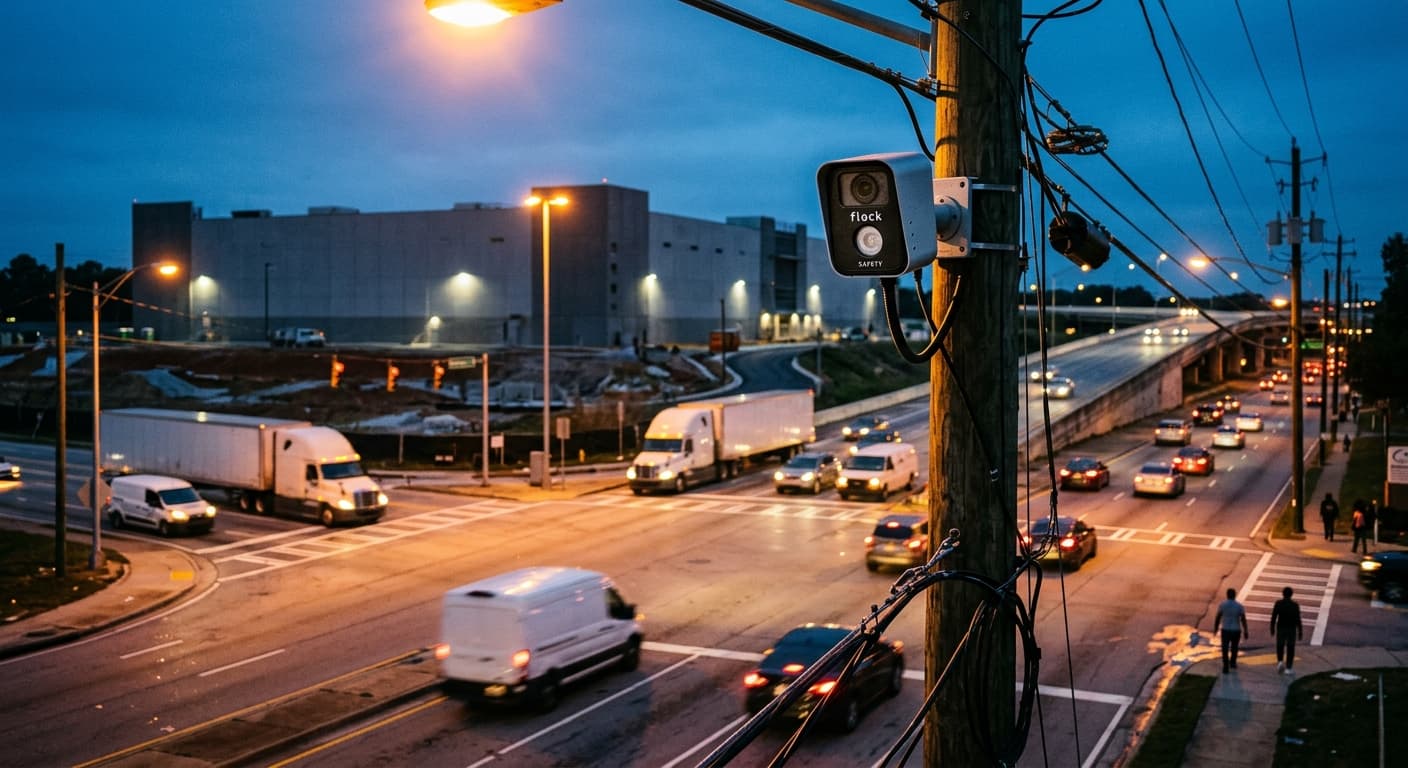
The Flock camera map shows thousands of automated license plate readers (ALPRs) installed on streetlights, utility poles, and private property across U.S. cities and suburbs. These solar-powered cameras capture images 24 hours a day, extract plate numbers, and upload them to cloud databases that law enforcement agencies query in real time.
Police departments report dramatic improvements in stolen vehicle recovery, Amber Alert responses, and felony investigations. Privacy advocates counter that the systems create permanent records of ordinary citizens’ movements without warrants or probable cause. Contracts have already been canceled in 23 states following public backlash and new legislation.
Key Takeaways
- Flock Safety operates one of the largest civilian vehicle tracking networks in the world, with coverage in over 4,000 jurisdictions.
- The average camera reads 5,000 to 10,000 plates per day; data is retained for up to 30 days in most contracts.
- Integration with AI analytics now allows pattern-of-life analysis that extends beyond traditional policing.
- Data center operators in high-surveillance zones like Northern Virginia face new physical security requirements tied to local camera grids.
- Supply chain operators use similar ALPR technology for yard management, creating dual-use infrastructure that blurs lines between public safety and commercial logistics.
- 23 states have terminated or restricted Flock contracts since early 2025 over privacy and Fourth Amendment concerns.
The Scale of the Flock Camera Network in 2026
According to mapping tools released by investigative outlets, certain neighborhoods in Atlanta, Chicago, and Los Angeles sit under continuous coverage from 30 or more cameras within a one-mile radius. Rural interstates and logistics corridors also show dense deployment because cargo theft remains a persistent problem.
Flock’s own data indicates its cameras have helped recover more than 1.2 million stolen vehicles and locate 8,000 missing children since the company’s founding. These numbers drive continued municipal adoption even as lawsuits accumulate.
The company markets its systems as “privacy-forward” because images of drivers and passengers are blurred and deleted after plate extraction. Critics note that metadata—time, location, direction, speed—remains searchable for weeks.
Link Between Flock Cameras and AI Data Center Security
Data centers supporting hyperscale AI training require uninterrupted physical security. Facilities in Northern Virginia now request integration with municipal Flock networks as a condition of their site security plans.
Oracle, Microsoft, and Google have all increased spending on perimeter surveillance that feeds into the same cloud platforms used by local police. This convergence raises questions about data ownership when a criminal incident occurs near a data center campus.
Power constraints already limit new AI builds in Loudoun and Prince William counties. Adding layers of real-time video analytics from hundreds of Flock cameras increases compute demand on the very grids struggling to keep lights on. The Suisun City cyberattack demonstrated how vulnerable these overlapping digital-physical systems can become when ransomware hits municipal networks.
Impact on Urban Supply Chains and Logistics
Trucking companies and warehouse operators have deployed their own Flock-compatible cameras at distribution centers. The resulting shared visibility lets dispatchers track trailer movements without installing additional hardware.
During the 2025 port strikes, logistics firms used public Flock data to reroute trucks around protest zones in real time. Similar tactics now appear in everyday congestion management along Interstate corridors.
This dual-use infrastructure creates a supply chain chokepoint of a different kind: concentrated surveillance data that foreign adversaries could target. Chinese and Russian intelligence services have shown increasing interest in U.S. domestic surveillance feeds, according to declassified assessments.
Privacy Risks and the Geopolitical Dimension
Authoritarian governments already use similar ALPR networks for social control. The export of Flock-style technology to allies raises concerns about standards that could later be turned against democratic movements.
Inside the United States, the systems create detailed mobility profiles that could be subpoenaed in civil cases, used by insurance companies, or leaked in breaches. Several municipalities faced class-action suits after data appeared on dark web marketplaces.
The same cloud providers powering Flock—Amazon Web Services, Microsoft Azure, and Google Cloud—also host sensitive government and military workloads. A single compromise could expose both civilian driving patterns and national security information.
How the Flock Camera Map Works
- Cameras capture vehicle images using infrared and visible light sensors.
- On-device optical character recognition extracts the license plate in under 200 milliseconds.
- Only the plate number, timestamp, GPS coordinates, and travel direction are uploaded; raw images are deleted locally.
- Law enforcement agencies log into a web portal or connect via API to run historical and real-time queries.
- Analytics dashboards highlight “unusual” patterns such as repeated visits to sensitive locations or vehicles matching suspect descriptions.
- Retention policies vary by contract; most default to 30 days, with options for longer storage in active investigations.
Common Mistakes When Interpreting Flock Data
- Assuming every camera sighting means police are actively watching a specific driver. Most queries happen after an incident.
- Believing data is deleted after 30 days. Backup systems and inter-agency sharing often extend effective retention.
- Underestimating accuracy. Modern ALPR systems achieve over 95 percent read rates in good conditions and still exceed 80 percent at night.
- Ignoring commercial use. Private security firms and insurance investigators now purchase access through authorized resellers.
- Overlooking legal shifts. New state laws in California, Virginia, and New York require warrants for certain historical queries.
Best Practices for Communities and Businesses
Cities should publish annual transparency reports detailing query volume, hit rates, and demographic breakdowns of scanned vehicles. Independent audits of data deletion practices build public trust.
Logistics operators can negotiate data-sharing agreements that limit retention to 72 hours for non-incident traffic. AI data center developers should conduct privacy impact assessments before tying internal security to municipal camera grids.
Individuals concerned about tracking can use temporary plates, route through low-camera corridors identified on public maps, or support legislation that caps retention at 14 days and requires probable cause for queries longer than 48 hours.
| Aspect | Police Perspective | Privacy Advocate View | Business Implication |
|---|---|---|---|
| Coverage Density | Essential for rapid response in high-crime areas | Creates digital checkpoints that chill free movement | Improves real-time logistics visibility but raises insurance questions |
| Data Retention | 30 days allows pattern analysis in complex cases | Any retention beyond immediate need violates reasonable expectation of privacy | Shorter windows reduce breach liability for supply chain partners |
| AI Integration | Detects stolen vehicles and wanted persons faster | Enables predictive policing with documented racial bias risks | Increases compute load on already strained Northern Virginia power grid |
| Contract Transparency | Proprietary algorithms protect investigative methods | Secret contracts prevent democratic oversight | Public companies like ORCL and MSFT face ESG pressure from shareholders |
Future Outlook for Surveillance Networks
Flock continues to expand internationally while defending domestic contracts. Newer models incorporate facial recognition (with opt-in municipal settings) and drone integration for temporary events.
The collision of these networks with self-driving vehicle fleets will create even richer data layers. Waymo and Cruise vehicles already generate their own mapping data that could cross-reference with Flock feeds.
Geopolitical competition adds urgency. Nations racing to dominate AI want both the compute infrastructure and the training data that pervasive surveillance can provide. How the United States regulates its domestic camera networks may signal to allies and adversaries what norms will govern smart cities globally.
FAQ
How many Flock cameras are active in the United States?
Estimates range from 50,000 to more than 70,000 as of mid-2026. Exact numbers remain difficult to verify because many systems are installed on private property or under non-disclosure agreements with municipalities.
Can individuals request their own Flock data?
Yes. Most states treat the data as public record, though processing times vary. Requests typically require name, date range, and approximate location. Some departments charge nominal fees.
Do Flock cameras store photos of drivers?
Company policy states that driver and passenger images are blurred or cropped before upload. Independent tests have found occasional failures where partial facial data remains in the system.
How does the Flock camera map affect AI data centers?
Operators in Northern Virginia use the network for perimeter defense and employee vehicle tracking. This adds load to local power grids already constrained by hyperscale computing demand.
Which states have canceled Flock contracts?
At least 23 states have ended, paused, or significantly restricted contracts. California, New York, and Virginia passed laws requiring warrants for historical data access beyond two weeks.
Can supply chain companies access Flock data?
Yes, through authorized partner programs. Trucking firms and warehouse operators use the same platform for yard security and cargo theft prevention, creating shared infrastructure with law enforcement.
Conclusion
The Flock camera map delivers measurable public safety gains while concentrating sensitive mobility data in private cloud systems. As AI data centers expand and urban supply chains digitize, the pressure to integrate these surveillance layers will only grow. Communities that establish clear rules on data retention, query justification, and independent oversight will be better positioned to capture the benefits without sacrificing core civil liberties.
Review your local camera density, understand retention policies, and engage in municipal procurement discussions. The technology is already here. The policies that govern it are still being written.
Sources
Share This Article