Jonathan van den Berg · July 28, 2026
Japan Earthquake 2026: How Magnitude 7.1 Kyushu Quake Impacts Global Supply Chains, Semiconductor Markets, and Energy Politics
A strong magnitude 7.1 earthquake struck Japan's Kyushu region, triggering tsunami warnings and exposing vulnerabilities in the country's critical manufacturing sectors that feed global technology and energy markets.
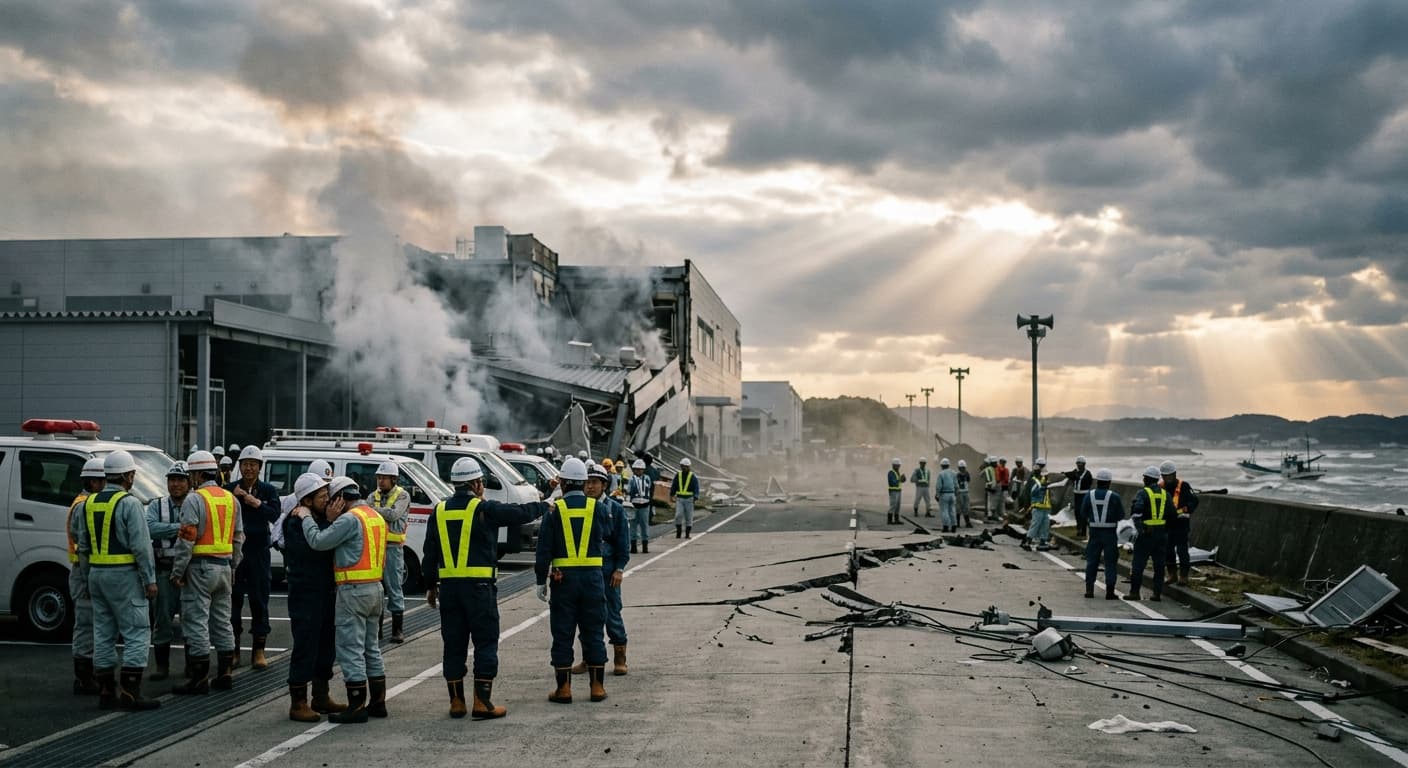
A magnitude 7.1 earthquake struck Japan's Kyushu region on July 28, 2026, causing widespread shaking, triggering a tsunami warning, and immediately threatening production at semiconductor fabrication plants that supply the world with memory chips and advanced components.
This event highlights Japan's central role in global technology supply chains and its exposure to seismic risks that can ripple into higher chip prices, delayed electronics manufacturing, and pressure on energy markets already strained by geopolitical tensions.
Key Takeaways
- The quake hit near Miyazaki Prefecture on Kyushu, one of Japan's key semiconductor manufacturing hubs.
- Initial reports show damage to facilities operated by suppliers to TSMC, SK Hynix, and other major chipmakers.
- Global memory chip prices could rise 8-12 percent in the coming weeks due to production halts.
- Energy infrastructure in the region sustained minor damage, but power outages affected industrial zones.
- The event occurs against a backdrop of heightened geopolitical risk in the Indo-Pacific, amplifying concerns over supply chain resilience.
- Insurance markets and global investors are repricing exposure to natural disasters in critical manufacturing geography.
What Happened During the Japan Earthquake
The Japan Meteorological Agency reported the quake at a depth of 40 kilometers with its epicenter off the coast of Kyushu. Strong shaking lasted nearly a minute in some areas, followed by multiple aftershocks above magnitude 5.0.
Authorities issued a tsunami advisory for coastal regions, though waves remained below one meter. No major casualties have been reported so far, but transportation networks including bullet trains and regional airports suspended operations for safety inspections.
Power outages hit parts of Miyazaki and Kagoshima prefectures, directly affecting industrial parks where electronics and precision manufacturing take place. Japanese officials moved quickly to assess damage at critical facilities.
Immediate Impact on Semiconductor Production
Kyushu hosts a dense cluster of semiconductor plants often called "Silicon Island." Companies including Sony Semiconductor, Renesas Electronics, and multiple suppliers to global foundries maintain fabs in the region.
Early assessments indicate temporary shutdowns at several facilities for equipment inspection and cleanroom recertification. Even brief interruptions in chip production can create bottlenecks because modern fabrication requires weeks of continuous operation.
This disruption comes at a sensitive time. Global demand for high-bandwidth memory used in AI servers and advanced consumer electronics remains elevated. Any shortfall from Japanese suppliers forces buyers to seek alternatives, often at higher cost.
SK Hynix stock surge patterns in recent years already demonstrate how supply shocks in Asia quickly translate into market volatility. The current quake adds another layer of pressure to an industry navigating US-China tech decoupling.
Broader Economic Consequences for Global Supply Chains
Japan produces roughly 20 percent of the world's silicon wafers and a significant share of specialized chemicals used in chip manufacturing. A prolonged outage could slow assembly lines from South Korea to Taiwan to the United States.
Automakers that rely on Renesas microcontrollers for vehicle electronics face particular risk. Past earthquakes have shown how quickly parts shortages cascade into factory stoppages thousands of miles away.
Investors responded swiftly. Shares in several Japanese semiconductor firms dropped in early trading, while certain international chip stocks saw gains on expectations of tighter supply. The episode underscores the fragile geography of modern manufacturing.
Countries aiming to diversify supply chains, including efforts to expand production in the United States and Europe, now face renewed questions about how quickly those investments can reduce dependence on seismic hotspots.
Energy Market Implications and Power Infrastructure Risks
Although the quake did not directly strike major nuclear facilities, it serves as a reminder of Japan's complex energy situation. The country still imports nearly all its fossil fuels and maintains strict safety protocols for nuclear restarts after the 2011 disaster.
Short-term power outages in Kyushu forced some industrial users onto backup generators, increasing immediate diesel and natural gas demand. While the volume remains modest on a global scale, it adds pressure to markets already watching developments in the Middle East.
Longer term, any delay in semiconductor output affects the energy transition itself. Solar inverters, wind turbine controllers, and EV battery management systems all require the precise chips made or designed with Japanese components.
Analysts at the International Energy Agency note that natural disasters in manufacturing nations can indirectly influence energy prices by altering industrial activity and electricity consumption patterns worldwide.
Similar dynamics appeared in previous crises. The Iran conflict oil flow disruptions showed how regional instability compounds with other supply risks to drive energy market volatility. The Japan quake introduces a non-geopolitical but equally material threat.
Geopolitical Context and Supply Chain Resilience
The timing of this natural disaster coincides with ongoing efforts by governments to secure critical mineral and technology supply chains. Japan has worked closely with the United States and allies to reduce reliance on single points of failure, yet Kyushu's concentration of expertise remains difficult to replicate quickly.
China, which consumes large volumes of Japanese semiconductors, may face its own indirect impacts. Any spike in global chip prices could affect Chinese electronics exporters at a moment when trade tensions with the West continue.
Insurance and reinsurance markets will recalibrate premiums for industrial facilities in earthquake-prone areas. This raises costs for manufacturers and ultimately consumers. Governments may need to revisit disaster preparedness funding for strategic industries.
The event also draws attention to broader questions of economic security. When critical production clusters lie along tectonic plate boundaries, nations must weigh the benefits of specialized geography against inherent risks.
Comparison of Recent Major Supply Chain Disruptions
| Event | Year | Primary Impact Sector | Estimated Global Economic Cost | Duration of Disruption |
|---|---|---|---|---|
| Japan Earthquake (Tohoku) | 2011 | Autos & Electronics | $200+ billion | 3-6 months |
| Thailand Floods | 2011 | Hard Disk Drives | $40 billion | 6 months |
| Suez Canal Blockage | 2021 | Global Shipping | $9.6 billion per day | 6 days |
| Kyushu Quake 2026 | 2026 | Semiconductors | Projected $15-25 billion | Ongoing (weeks to months) |
Common Mistakes in Assessing Natural Disaster Economic Risk
- Assuming immediate public casualty figures reflect total economic damage. Infrastructure and production losses often exceed human costs by orders of magnitude.
- Underestimating cascading effects. A chip plant closure in Japan can idle auto plants in Germany within weeks.
- Treating all semiconductor facilities as interchangeable. Specialized processes for certain memory chips cannot be swapped overnight.
- Ignoring insurance market reactions that can raise costs across entire industries for years.
- Overlooking links between tech supply shocks and energy demand. Lower industrial output can temporarily ease electricity consumption but raise costs in other energy segments.
Best Practices for Businesses and Policymakers
- Map tier-two and tier-three suppliers located in high-risk seismic zones to identify hidden vulnerabilities.
- Maintain strategic buffer inventory for critical components, balanced against just-in-time efficiency goals.
- Invest in earthquake-resistant design and rapid recovery protocols for fabrication facilities, including redundant power and water systems.
- Develop diversified sourcing contracts that include incentives for suppliers to maintain multiple production sites.
- Coordinate with governments on critical infrastructure protection, including updated seismic standards for new semiconductor investments.
- Monitor related commodity markets. Chip shortages can influence demand for energy, rare earths, and even cryptocurrency mining equipment.
Companies that learned from the 2011 disasters generally fared better in subsequent events. Those that treat natural disaster risk as a board-level geopolitical and economic issue tend to recover faster.
FAQ
How significant is Kyushu to the global semiconductor industry?
Kyushu accounts for a substantial share of Japan's advanced chip and materials production. It supplies components essential for smartphones, servers, automobiles, and industrial equipment worldwide.
Will this earthquake cause a major spike in consumer electronics prices?
Short-term price increases of 5 to 15 percent are possible for products heavily dependent on affected components. The extent depends on how quickly plants resume full operation and whether alternative suppliers can ramp up.
Does the quake affect Japan's nuclear energy plans?
No direct damage to nuclear plants has been reported. However, the event reinforces public and regulatory caution around seismic safety, which could slow future reactor restarts or new builds.
How does this event connect to current geopolitical tensions?
It highlights the strategic importance of the Indo-Pacific region for both technology and energy security. Any disruption in Japanese production can compound pressures already created by trade disputes, export controls, and military posturing in the Taiwan Strait and South China Sea.
What should investors watch in coming weeks?
Watch for updates on specific plant recovery timelines, revisions to quarterly guidance from chip-dependent companies, movements in memory chip spot prices, and any statements from central banks about potential inflationary effects.
Looking Ahead
The 2026 Kyushu earthquake serves as a live stress test for global supply chain resilience. While Japan has strong disaster response systems, the concentration of high-tech manufacturing in seismically active zones creates persistent economic risk.
Businesses and governments that treat these events as predictable rather than surprising will gain advantage. For markets already navigating energy transitions, tech rivalries, and shifting power balances, this quake adds another variable to an increasingly complex equation.
Companies seeking to understand these intersecting risks can explore related analysis on global economic trends in 2026 and the role of alternative assets during periods of uncertainty.
Share This Article