Jonathan van den Berg · May 2, 2026
Stock Market Volatility and the New Rules of Global Economic Power in 2026
“Markets are sending a clear message,” warned Treasury Secretary Scott Bessent last month. “Policy uncertainty and energy shifts are testing who really holds leverage in the global economy.” From Wall Street swings to central bank moves, today’s market action reveals deeper battles over trade, sanctions, and financial influence.
“Markets are sending a clear message,” warned Treasury Secretary Scott Bessent last month. “Policy uncertainty and energy shifts are testing who really holds leverage in the global economy.”
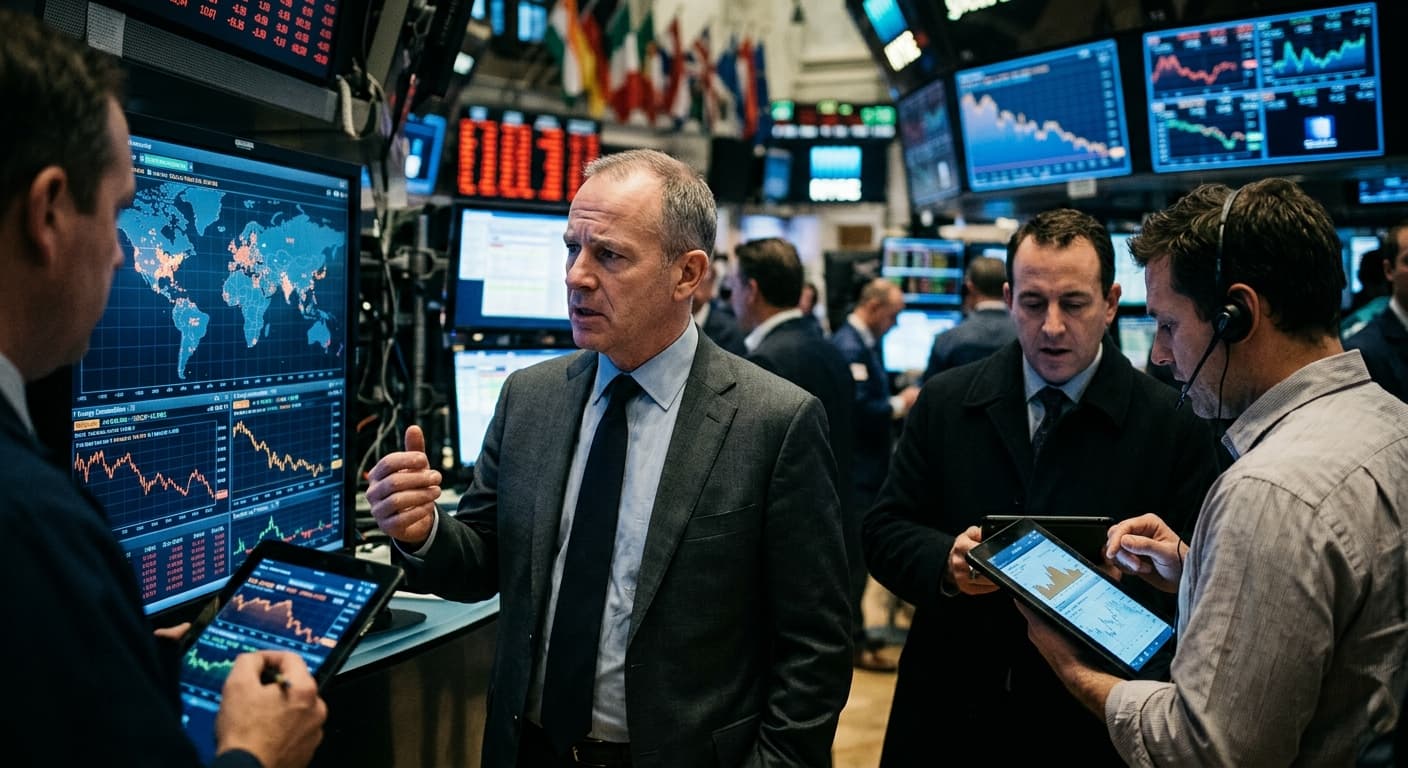
That message has been loud and expensive. Over the past week, the Dow Jones Industrial Average swung more than 800 points in a single session before settling with modest gains. The S&P 500 and Nasdaq showed similar turbulence, with technology shares leading both the rallies and the sell-offs. Oil prices jumped then eased as traders digested mixed signals from producers and consumers. These moves are not random. They reflect a world where economic tools—tariffs, sanctions, energy supplies, and technology access—have become central to how nations compete.
Investors are trying to price in several overlapping pressures at once. Central banks in different countries are moving in opposite directions. Supply chains remain vulnerable to political decisions. And new financial channels, including cryptocurrency markets, are letting some actors sidestep traditional pressure points. The result is a stock market that feels more like a daily referendum on geopolitics than a pure reflection of corporate earnings.
This moment builds directly on patterns seen throughout April’s market volatility. What looked like temporary nerves has hardened into a structural feature of 2026’s financial landscape.
The Immediate Market Picture
On May 1, U.S. stocks opened higher after better-than-feared economic data eased some recession fears. The S&P 500 rose about 0.8 percent while the Nasdaq gained nearly 1.2 percent, helped by semiconductor and software companies. Bond yields moved modestly higher as investors reassessed the odds of aggressive interest rate cuts.
Oil prices told a more complicated story. Brent crude briefly topped $78 per barrel on supply concerns linked to tensions in key shipping routes, then pulled back. This volatility matters for everything from airline tickets to grocery bills. Energy costs flow through the entire economy, affecting both corporate profits and household budgets.
European markets showed similar hesitation. Germany’s DAX and France’s CAC 40 traded in narrow ranges as investors waited for clearer signals from the European Central Bank. In Asia, mixed manufacturing data from China added to uncertainty. When the world’s second-largest economy shows uneven momentum, everyone feels it.
These daily swings connect to larger forces. The global economic outlook for 2026 has shifted from hopes of smooth recovery to expectations of bumpy, regionally divergent growth.
Energy Politics and Market Confidence
Energy remains the clearest link between geopolitics and stock prices. Recent naval policy announcements highlight how seriously major powers take maritime security. The U.S. Navy’s decision to change command structures for amphibious warships signals a broader focus on protecting sea lanes that carry roughly 80 percent of global trade by volume.
Markets watch these developments closely. When shipping routes face disruption—whether from conflict, sanctions enforcement, or piracy—insurance costs rise, delivery times stretch, and commodity prices jump. Oil traders in particular react within minutes to news from the Strait of Hormuz or the Red Sea.
This connects to longer-term patterns examined in analyses of how luxury assets reveal sanctions evasion tactics near critical energy chokepoints. When major producers or consumers find workarounds, traditional price signals become less reliable.
For ordinary people, this means higher and less predictable fuel prices. For companies, it means harder budgeting and greater incentive to invest in alternative energy or more resilient supply chains. Both effects show up in stock valuations.
Sanctions, Crypto, and Financial Power
Traditional financial weapons are facing new challenges. Countries and individuals under sanctions have increasingly turned to digital assets to move value across borders. This trend, explored in depth in how non-fungible tokens are becoming digital sanctions evasion tools, shows that innovation often finds gaps in regulation.
Bitcoin and certain stablecoins have seen sustained trading volumes in regions facing heavy financial restrictions. While governments work to close loopholes, the decentralized nature of blockchain technology makes complete enforcement difficult. This erosion of the petrodollar system through cryptocurrency trading and blockchain innovation, long a cornerstone of U.S. financial influence, continues at a measurable pace.
The linkage between cryptocurrency trading and traditional markets has grown tighter. Major dips in Bitcoin often coincide with sell-offs in technology stocks, suggesting investors treat both as “risk assets” that thrive or suffer together depending on the global mood.
Central banks face a genuine dilemma. They must balance fighting inflation at home with managing the international consequences of their currency policies. When the Federal Reserve holds rates steady while others cut, the dollar strengthens. That helps control import prices but hurts American exporters and emerging markets carrying dollar-denominated debt.
Technology Competition and Supply Chain Realignment
Nowhere is economic competition more visible than in semiconductors. Companies like TSMC and ASML have seen their stock prices move sharply on news related to export controls and new manufacturing investments. Taiwan’s position as the world’s leading chip foundry makes every development there a market-moving event. DRAM stock surge highlights memory chip volatility and its ties to global semiconductor power struggles.
Recent earnings from major technology firms revealed both strength and vulnerability. Artificial intelligence infrastructure spending remains robust, supporting suppliers of everything from processors to data center cooling systems. Yet companies also reported longer sales cycles for products heading to certain Asian markets, reflecting tightened controls on advanced technology transfers.
This technological decoupling affects far more than gadget prices. Modern economies run on computing power. When access to the most advanced chips becomes a strategic issue rather than a commercial one, entire industries must adapt. Auto manufacturers, medical device makers, and renewable energy companies all depend on reliable semiconductor supplies.
The human element matters too. Engineers and specialized technicians have become strategic assets. Countries are competing not just for factories but for the people who know how to make them run at peak efficiency.
China’s Economic Path and Global Ripples
China’s situation deserves particular attention. After years of rapid growth, the country faces slowing momentum, a troubled property sector, and demographic headwinds. Beijing has responded with targeted stimulus measures and renewed emphasis on self-reliance in critical technologies.
These domestic challenges influence global markets in direct ways. When Chinese factories slow down, demand for Australian iron ore, Brazilian soybeans, and German machinery weakens. When Beijing promotes its own technology champions, Western firms lose market share in one of the world’s largest consumer bases.
Yet simple narratives of decoupling miss important nuances. Trade volumes between the United States and China remain substantial even as political rhetoric stays tense. Many companies have adopted a “China plus” strategy—keeping some presence in the Chinese market while building parallel capacity in Vietnam, India, or Mexico.
This realignment creates both winners and losers. Southeast Asian economies have gained factories and jobs. American heartland manufacturers have seen some revival in certain sectors. European luxury brands have had to navigate careful balancing acts between their Chinese customers and Western regulators.
What This Means for Regular People
Behind all these market charts and policy statements are concrete effects on daily life. Pension funds and 401(k) accounts rise and fall with this volatility. When markets drop sharply, retirement dreams get delayed. When they surge, confidence rises and spending often follows.
Younger workers face a job market where skills in artificial intelligence, renewable energy, and supply chain management carry premiums. Those without such skills may find fewer stable opportunities in traditional manufacturing or retail sectors undergoing rapid change.
Homebuyers and renters feel the indirect effects through mortgage rates that respond to bond market moves. Small business owners watch commodity prices because they determine everything from packaging costs to transportation expenses.
Even the prices at the gas pump and grocery store carry a geopolitical component. A decision made in a distant capital about energy exports or import restrictions can add or subtract dollars from family budgets within weeks.
The Naval Dimension
The recent U.S. Navy announcement that aviators will no longer command amphibious warships might seem technical. In reality, it reflects a broader strategic recalibration. Amphibious forces protect key maritime routes and enable rapid response to crises. How they are led and equipped sends signals about what kinds of conflicts planners expect in coming years.
Markets interpret these signals. Defense contractors tied to naval modernization programs often see steadier demand when tensions rise. Companies involved in port security, satellite communications, and autonomous vessels also benefit from heightened focus on maritime domains.
This connects to larger questions about energy security. Much of the world’s oil and liquefied natural gas travels by sea. Protecting those flows—or threatening them—remains one of the most direct ways nations can exert economic pressure without firing shots.
Looking Forward
The stock market in 2026 has become a brutally honest mirror of global power dynamics. It rewards clarity and punishes confusion. When leaders send mixed messages or fail to follow through on commitments, investors react swiftly and often harshly.
Yet markets also reward adaptation. Companies that diversify supply chains, invest in productivity-enhancing technology, and maintain strong balance sheets have generally fared better than those clinging to old models.
For policymakers, the lesson is clear. Economic tools now carry as much weight as traditional military ones. Sanctions, export controls, investment screening, and currency management have become daily features of statecraft. Getting the balance wrong can cause self-inflicted wounds that show up quickly in borrowing costs and currency values.
Individual investors face their own version of this challenge. The days of steady, predictable returns based mainly on corporate earnings growth have given way to a more complex environment where geopolitical awareness matters. Understanding basic relationships between energy prices, interest rates, technology competition, and currency moves has become practical financial knowledge rather than abstract theory.
The coming months will likely bring more tests. Election cycles in major economies, ongoing conflicts in several regions, and the steady march of technological change all point toward continued volatility. Those who treat these shifts as permanent features rather than temporary noise will be better positioned to navigate what comes next.
The core tension remains straightforward. A world with multiple centers of economic power, sophisticated sanctions evasion techniques, rapidly changing energy systems, and digital financial alternatives is inherently more complicated than the relatively stable order of previous decades. Markets are simply reflecting that new reality in real time, trade by trade and swing by swing. Foreign investors fleeing Korean stocks amid these pressures further illustrate how quickly capital can shift when confidence erodes in specific Asian markets.
Success in this environment will belong to those—whether nations, companies, or individuals—who can maintain flexibility without losing focus, who can understand connections between distant events and local consequences, and who recognize that economic strength increasingly depends on adaptability as much as raw size.
The volatility we see today is not a bug in the system. It is the system working as designed in a genuinely multipolar economic world. Learning to read its signals may be one of the most valuable skills of our time.
Share This Article