Jonathan van den Berg · May 15, 2026
Korean Stocks Tumble as Foreign Investors Flee
South Korea’s benchmark KOSPI index has dropped sharply after hitting a milestone, with foreign investors pulling billions out of the market. The sell-off highlights how global money flows can quickly punish even strong economies when confidence shifts.
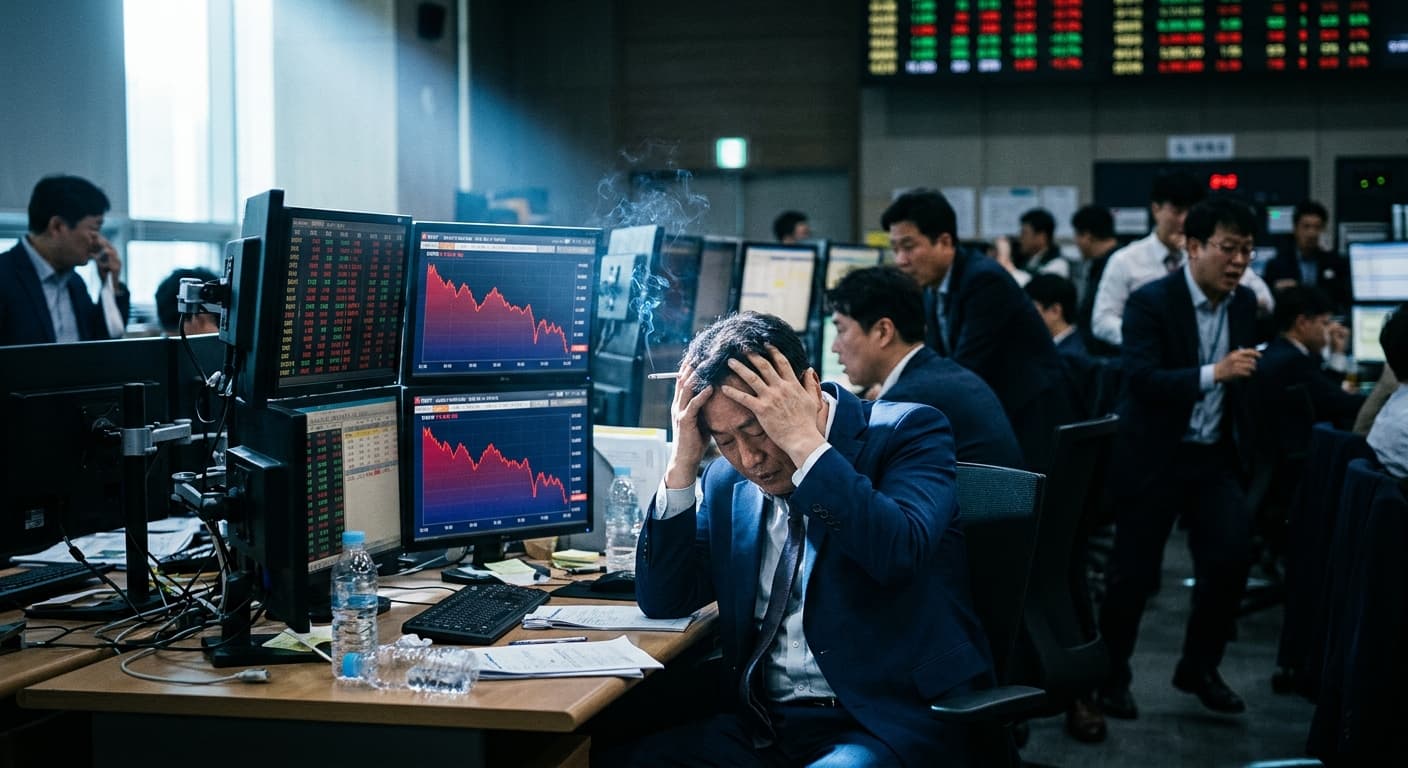
Korean stocks tumbled as foreign investors fled.
The KOSPI index, South Korea’s main stock market gauge, fell more than 2.5 percent in a single session after briefly touching a fresh all-time high. Billions of dollars exited the market in rapid selling by overseas funds. For everyday South Koreans with retirement savings or pension funds tied to these stocks, the drop stings. It also sends a warning to governments and companies across Asia about how quickly global capital can reverse course.
This sell-off comes at a delicate moment in international finance. The Trump-Xi summit produced only a fragile pause in US-China trade tensions, with both sides still far apart on core issues like technology access and Taiwan. At the same time, South Korean companies remain deeply embedded in the global semiconductor supply chain that sits at the center of that rivalry.
What Happened in the Market
According to trading data, foreign investors sold a net $1.8 billion worth of South Korean shares on the day the reversal occurred. That marked one of the largest single-day outflows in months. The selling hit technology and semiconductor names especially hard. Samsung Electronics and SK Hynix, two of the world’s biggest memory chip makers, both dropped over 4 percent.
The timing is notable. The KOSPI had just crossed the 2,700 level for the first time in years, fueled by earlier optimism around artificial intelligence demand and expected rate cuts from major central banks. That milestone appears to have triggered profit-taking on a grand scale. Technical analysts pointed to a “key reversal” pattern on the charts — a warning sign where prices hit a new high but then close sharply lower with heavy volume.
Domestic investors tried to cushion the blow by buying on the dip, but they lacked the firepower to offset the foreign exodus. South Korea’s pension fund and retail traders can only do so much when global asset managers decide to reduce exposure.
Why Foreign Money Is Leaving
Several forces are at work. First, uncertainty around US-China relations continues to loom large. Even after the recent Trump-Xi meeting, Chinese officials emphasized different priorities than their American counterparts. Beijing wants more guarantees on technology exports and less pressure on its state-owned firms. Washington wants clearer commitments on intellectual property and reduced military activity near Taiwan.
South Korea sits directly in the middle. Its companies supply critical components to both Chinese and American tech giants. When tensions rise, investors often reduce holdings in Korean stocks to limit their indirect exposure to that flashpoint. This pattern repeated itself several times over the past few years.
Second, global interest rate expectations have shifted. Stronger-than-expected US economic data has made traders less confident that the Federal Reserve will cut rates aggressively this year. Higher-for-longer rates in America tend to pull money back toward US assets and away from emerging markets like South Korea.
Third, the semiconductor cycle itself shows signs of volatility. While demand for memory chips used in AI servers remains robust, concerns about oversupply later in the year have grown. Memory chip prices can swing wildly depending on production decisions in South Korea, Taiwan, and China. Investors hate that uncertainty.
The Semiconductor Link to Global Power
South Korea’s economic strength and vulnerability both stem from the same place: chips. The country produces roughly 20 percent of the world’s semiconductors and dominates the memory segment through Samsung and SK Hynix. These firms have invested tens of billions in new fabrication plants expected to come online in the next two years.
Yet that success makes the economy a hostage to global politics. US export controls on advanced chips to China have already forced Korean companies to navigate complex compliance rules. Any further tightening — or Chinese retaliation — could hurt sales. At the same time, Korean firms benefit when American tech companies look to diversify supply chains away from Taiwan.
Taiwan’s own chip champion TSMC has seen its stock react sharply to every twist in cross-strait relations. South Korean names often move in tandem. This creates a regional domino effect that global investors watch closely. When one major player looks shaky, money flows out of the entire sector.
Broader Economic Picture in Asia
The Korean sell-off did not happen in isolation. Japan’s Nikkei also gave back gains on the same day, though less dramatically. Hong Kong’s Hang Seng index showed mixed performance as investors weighed fresh data on China’s property market and consumer spending.
China’s economy continues to face headwinds despite official growth targets. Real estate prices in major cities remain under pressure, and local government debt levels limit new stimulus options. These domestic challenges make Beijing more determined to protect its strategic industries — including semiconductors — from foreign pressure.
For ordinary people, these market moves matter. A weaker Korean stock market can weigh on consumer confidence and spending. It also affects the value of the won, South Korea’s currency. A weaker won makes imports more expensive, hitting households that rely on foreign goods and energy.
Energy remains another pressure point. South Korea imports nearly all its oil and gas. Any disruption in global energy markets — whether from Middle East tensions or new sanctions — raises costs for Korean manufacturers and consumers alike. The country’s export model depends on stable commodity prices and smooth trade routes.
Investor Behavior and Market Psychology
Andrew Left, the short seller whose trial has drawn attention recently, has highlighted how quickly sentiment can turn in individual stocks. While his cases involve specific companies, the same principle applies to entire markets. Once a critical mass of investors decides the risk/reward balance has deteriorated, selling can feed on itself.
Retail investors in South Korea have become more active in recent years through apps and easy trading platforms. Many bought during the recent rally. They now face paper losses and must decide whether to hold or sell. Their behavior will help determine how deep this correction goes.
Global hedge funds and pension funds operate on different timetables. They rebalance portfolios based on risk models, currency hedges, and mandates from clients. When those models flash warning signs — rising volatility, changing correlations, geopolitical risk — they reduce positions without much regard for the human impact on the ground.
What This Means for Everyday People
A pensioner in Seoul whose retirement fund holds Korean blue-chip stocks now has less security than a week ago. A factory worker at a parts supplier for Samsung worries about potential cutbacks if export orders slow. A student hoping to land a job at one of the big tech conglomerates (the chaebol) senses that the economic tailwinds may be fading.
These effects ripple outward. Lower stock prices can reduce corporate investment. Companies may delay new factories or research projects. That slows job creation in a country where youth unemployment remains a political issue.
On the positive side, Korean companies have strong balance sheets compared with many global peers. They survived past crises through disciplined cash management. Many still generate solid profits from AI-related demand. The current sell-off could present buying opportunities for long-term investors if the underlying business trends remain intact.
Policy Responses and Government Options
South Korean officials have tools at their disposal. The central bank can adjust interest rates or provide liquidity if needed. The government has in the past intervened directly in currency markets to limit won volatility. Regulators can also encourage domestic institutions to act as stabilizers during heavy foreign selling.
Yet over-reliance on such measures creates its own risks. Markets work best when prices reflect genuine supply, demand, and risk assessments. Heavy-handed intervention can distort signals and reduce investor confidence over time.
The bigger picture involves diplomacy. Seoul maintains close security ties with Washington while preserving vital economic links with Beijing. That balancing act grows harder as US-China competition intensifies. How Korean leaders navigate the next round of trade talks and technology restrictions will matter more for stock prices than any single day of trading.
Connections to Larger Global Trends
This episode fits into a larger story about shifting economic power. For decades, foreign capital flowed into Asian markets seeking growth. Now investors appear more selective. They want clear rules, predictable policy, and lower exposure to great-power conflict.
The new rules of global economic power reward countries that can insulate themselves from external shocks while still participating in global trade. South Korea scores well on technology and governance but remains exposed due to its export dependence and geographic location.
Meanwhile, cryptocurrency advocates point to these episodes as evidence that traditional markets remain too tied to government policy and geopolitical risk. Some argue blockchain-based assets offer an alternative store of value less vulnerable to capital flow reversals. That debate continues as both systems coexist and sometimes compete.
Energy politics also play a role. Stable oil prices help Korean manufacturers keep costs down. Any spike caused by conflict in the Strait of Hormuz or new sanctions would compound the pressure from falling stock prices.
Looking Ahead
The immediate question is whether this sell-off marks the start of a deeper correction or simply a healthy pullback after a strong run. Technical indicators suggest further downside is possible if foreign selling continues. Economic data from China and the United States over the next few weeks will likely set the tone.
Longer term, South Korea’s success depends on its ability to maintain technological leadership in memory chips, batteries, and next-generation industries while managing relations with its two largest trading partners. Companies are investing heavily in research and new facilities. The question is whether global demand and political stability will support those bets.
Investors, workers, and policymakers are all watching closely. A market drop of a few percentage points rarely makes headlines for long. But when it reflects deeper tensions in global trade, technology competition, and capital allocation, its lessons matter.
South Korea built one of the world’s most successful export economies through hard work, smart policy, and openness to foreign investment. That same openness now exposes it to forces beyond its control. How leaders and citizens respond to this latest reminder of interconnected risk will shape the country’s economic path for years ahead.
The recent volatility serves as a timely case study in how financial markets, great-power politics, and corporate strategy collide in 2026. For anyone with savings, a job, or business interests tied to Asian growth, ignoring these signals is not an option.
Share This Article