Jonathan van den Berg · June 8, 2026
Nifty 50 Crash 2026: Why Indian Stocks Plunged Below 23,100 Amid Oil Spike and Global Risk-Off
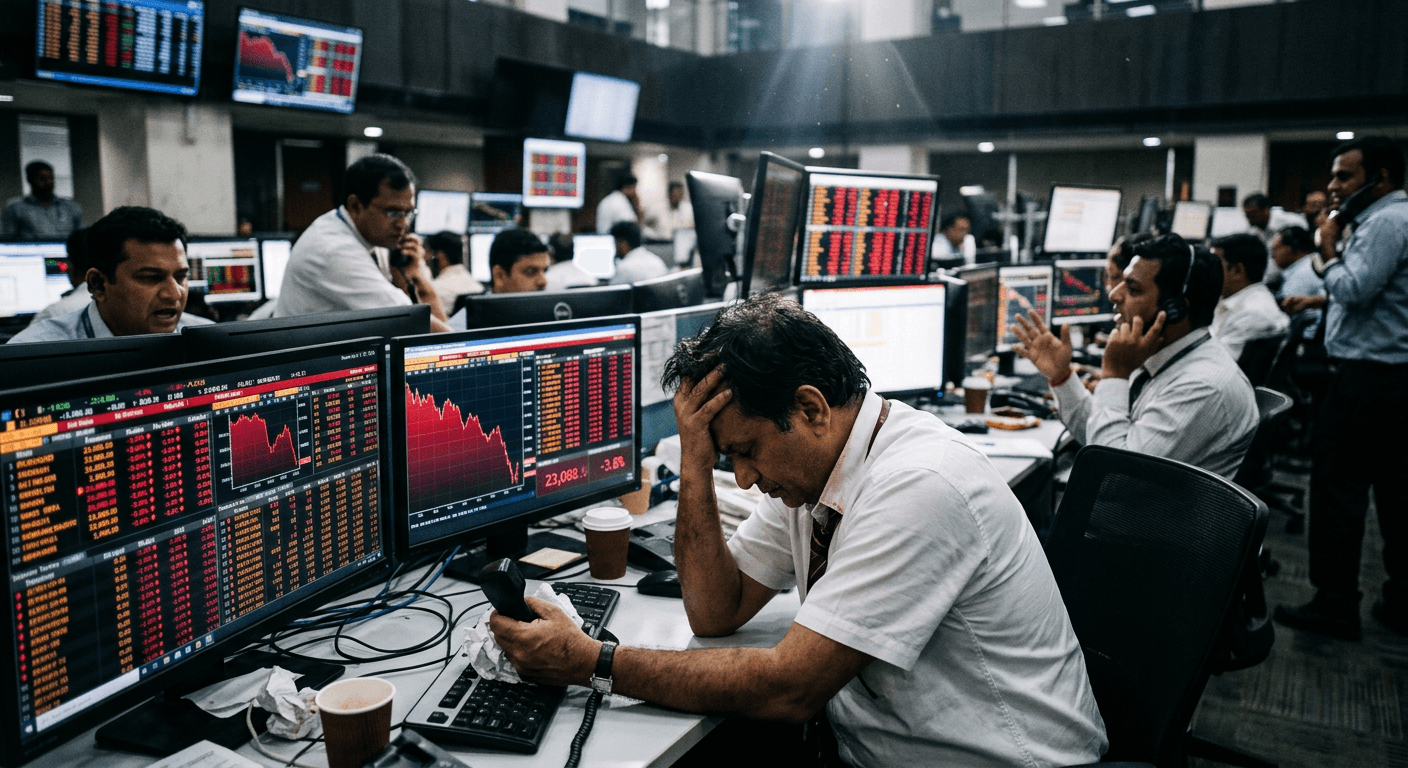
India's benchmark Nifty 50 index plunged more than 800 points in a single session, dropping below the psychologically important 23,100 level as a sharp rise in crude oil prices combined with broader Asian selloffs triggered a widespread risk-off move.
The Nifty 50 crashed below 23,100 as oil prices surged on renewed Middle East tensions and foreign institutional investors accelerated their exit from Indian equities. The selloff reflected a classic risk-off environment where higher energy costs threaten corporate margins and inflation targets while global growth fears prompt capital flight to safer assets.
Key Takeaways
- Nifty 50 dropped over 800 points in one session, breaching the 23,100 support level amid an oil price spike.
- Foreign institutional investors (FIIs) turned net sellers for the seventh straight week, pulling billions out of Indian stocks.
- Rising crude prices directly pressure India's import bill, rupee stability, and inflation outlook.
- The selloff mirrors broader Asian market weakness triggered by US-Iran diplomatic uncertainty and global growth concerns.
- Domestic institutional investors (DIIs) continued to provide some buying support but could not offset the FII exodus.
- Analysts now watch the 22,500–22,800 zone as critical support and 24,000 as immediate resistance.
What Triggered the Nifty 50 Crash
The immediate catalyst was a sharp rise in Brent crude above $85 per barrel following reports of stalled US-Iran nuclear talks and increased tanker traffic risks near key chokepoints. India imports over 85% of its crude requirements, so every $10 increase in oil prices adds roughly $20–25 billion annually to the country's import bill.
This energy shock came on top of already fragile global sentiment. Asian markets opened lower after Wall Street closed in the red on technology sector weakness and renewed concerns over central bank policy divergence. The combination created a perfect storm for emerging-market equities, with India hit particularly hard because of its high foreign ownership in large-cap stocks.
According to market data, FIIs sold more than ₹8,500 crore in a single day—the heaviest single-session outflow in nearly three months. This accelerated the breach of several technical levels on the Nifty 50 chart, including the 50-day moving average.
Oil Prices, Geopolitics, and India's Vulnerability
India's economic sensitivity to oil prices remains acute despite years of diversification efforts. Higher energy costs flow directly into transportation, manufacturing, and fertilizer prices—pushing up the cost of goods across the economy.
The current spike links directly to developments in the Middle East. Renewed uncertainty around Iran's nuclear program and potential supply disruptions through the Strait of Hormuz have traders pricing in a meaningful risk premium. This echoes patterns seen in previous episodes of regional tension that drove global energy prices higher.
For context, similar oil-driven selloffs occurred in 2022 when Brent briefly exceeded $120 per barrel. While current levels remain below those peaks, the speed of the recent increase caught many investors off guard, particularly as India's core inflation had only recently stabilized within the Reserve Bank of India's target band.
Related regional dynamics, including ongoing Iran conflict and Middle East oil politics, continue to shape global energy flows and pricing expectations for 2026 and beyond.
Broader Economic Forces at Play
The Nifty 50 decline cannot be viewed in isolation. Several structural and cyclical factors amplified the move:
- FII outflows: Global portfolio managers reduced exposure to emerging markets as US yields rose and the dollar strengthened.
- Valuation concerns: Indian large-cap stocks traded at forward price-to-earnings ratios above 22x before the correction—among the highest in major markets.
- Corporate margin pressure: Rising input costs from energy and imported commodities threaten earnings growth for sectors like autos, chemicals, and consumer goods.
- Rupee weakness: The currency slipped toward 84 per dollar, adding to imported inflation concerns.
Domestic institutions stepped in with buying support, absorbing roughly 60% of the FII selling pressure. This pattern—FII selling met by DII buying—has characterized much of the Indian market action over the past 18 months but appears increasingly strained at current levels.
Sector Impact: Who Got Hit Hardest
The Nifty 50 crash showed clear sectoral divergence:
| Sector | 1-Day Change | Primary Driver |
|---|---|---|
| Oil & Gas | -4.8% | Higher input costs despite elevated crude prices |
| Automobiles | -3.9% | Rising raw material and logistics expenses |
| Banking & Financials | -3.2% | Concerns over higher credit costs and slower loan growth |
| IT Services | -2.1% | Global growth fears and stronger dollar |
| FMCG | -1.8% | Input cost inflation pressuring margins |
| Pharmaceuticals | +0.4% | Defensive safe-haven buying |
Energy and materials stocks showed mixed performance. While upstream producers benefited from higher crude, downstream refiners and petrochemical firms faced margin compression from rapidly rising feedstock costs. This environment also intersects with shifting consumer spending patterns and fast food pricing wars that are reshaping restaurant stocks and broader supply chain dynamics.
Technical Picture for the Nifty 50
From a charting perspective, the index broke below a multi-month ascending channel and the key 23,500 support zone. Immediate support sits at 22,800—coinciding with the 200-day moving average and previous swing lows.
A decisive close below 22,500 would open the door to a deeper correction toward 21,800–22,000. On the upside, reclaiming 23,600 would ease immediate bearish pressure, while a move back above 24,000 would signal resumption of the primary uptrend.
Options data showed heavy put writing at the 23,000 and 22,500 strikes, suggesting some institutional players view the current dip as a buying opportunity. However, elevated India VIX levels above 18 indicate continued nervousness in the near term.
Global Context: Not Just an Indian Story
The Nifty 50 crash occurred alongside similar declines across Asian markets. South Korean stocks fell sharply as foreign investors fled the region, while Chinese benchmarks also posted losses amid property sector concerns and slowing industrial output.
This synchronized selling reflects a broader reassessment of global growth prospects. Higher-for-longer oil prices threaten to rekindle inflation just as several central banks had begun signaling potential rate cuts. The resulting policy uncertainty has weighed heavily on risk assets worldwide.
Investors seeking deeper context on these dynamics may examine how Iran nuclear optimism and Middle East tensions drive global volatility or review patterns in stock market volatility and the new rules of global economic power.
Common Mistakes Investors Made During the Selloff
- Chasing the falling knife without waiting for technical confirmation or reduced volatility.
- Ignoring company-specific fundamentals while focusing solely on macro headlines.
- Over-allocating to high-valuation sectors without adequate hedges against rupee or oil volatility.
- Reacting emotionally to FII flow data rather than viewing it within a multi-week trend.
- Neglecting portfolio rebalancing opportunities created by the sharp sectoral rotation.
Best Practices for Navigating This Environment
- Maintain quality focus: Prioritize companies with strong balance sheets, pricing power, and lower sensitivity to energy costs.
- Use rupee cost averaging: Deploy fresh capital systematically rather than attempting to time the exact bottom.
- Consider sector rotation: Shift exposure toward domestic consumption themes, technology with strong US exposure, and selective defense plays less vulnerable to oil shocks.
- Monitor oil closely: Track Brent prices, OPEC+ decisions, and Strait of Hormuz developments as leading indicators for Indian market direction.
- Stay diversified: Maintain exposure to gold, certain fixed-income segments, and international equities to offset domestic equity volatility.
Investors should also watch policy responses from the Reserve Bank of India and Finance Ministry. Any signals of accelerated fiscal support for domestic manufacturing or targeted energy subsidies could limit the downside for affected sectors.
FAQ
Why did the Nifty 50 fall so sharply in one day?
A combination of surging global oil prices, heavy FII selling, technical breakdowns, and broader Asian market weakness created a self-reinforcing selloff. No single factor dominated—rather, multiple pressures hit simultaneously.
Is this the start of a larger bear market for Indian stocks?
Not necessarily. The move represents a healthy correction from stretched valuations amid external shocks. Structural growth drivers in India's economy remain intact, though near-term volatility is likely to persist until oil prices stabilize and FII flows improve.
How high could oil prices go and what would that mean for India?
Analysts see a near-term range of $82–$92 per barrel. Sustained prices above $90 would likely add 50–75 basis points to India's inflation rate and pressure the current account deficit toward 2.5% of GDP or higher.
Should retail investors buy the dip in the Nifty 50?
Selective buying in fundamentally strong companies during periods of elevated fear has historically produced attractive long-term returns in India. However, investors should size positions conservatively and maintain strict risk management rather than deploying large lump sums immediately.
What role do DIIs play when FIIs sell aggressively?
Domestic institutions, particularly mutual funds and insurance companies, have provided consistent counterbalancing demand. Their continued inflows—driven by systematic investment plans—have prevented deeper collapses during previous FII-led selloffs.
Looking Ahead
The Nifty 50 crash serves as a reminder of India's embedded sensitivities to global energy markets and foreign capital flows. While the current episode appears primarily event-driven rather than the start of a structural downturn, it highlights the need for vigilance around geopolitical developments that can rapidly reshape economic conditions.
Market participants who maintain discipline, focus on quality, and monitor key global indicators will be best positioned to navigate the period ahead. The coming weeks will reveal whether this represents a temporary setback or the beginning of a more prolonged consolidation phase for Indian equities.
Stay informed on how these forces interact with broader shifts in global economic outlook and energy politics.
Sources
Share This Article