Jonathan van den Berg · July 3, 2026
SK Hynix Stock Surge: How Memory Chip Demand Reshapes Global Semiconductor Rivalry and Economic Power
SK Hynix stock has drawn fresh investor attention as the South Korean memory giant prepares for a Nasdaq listing amid explosive demand for high-bandwidth memory chips used in AI servers.
SK Hynix stock is climbing as the company files for a Nasdaq listing to expand its footprint in the United States while capitalizing on surging demand for high-bandwidth memory chips that power artificial intelligence systems. The move comes at a time when memory semiconductor markets are central to the broader US-China technology competition, affecting everything from data center costs to national security priorities.
This dual listing strategy reflects SK Hynix’s ambition to tap deeper into American capital markets and strengthen partnerships with US tech giants building massive AI infrastructure. For investors, the development highlights how memory chip makers have become pivotal players in global economic power struggles.
Key Takeaways
- SK Hynix plans a Nasdaq debut to complement its primary Korea listing and attract more US institutional investors.
- High-bandwidth memory (HBM) demand tied to AI training has driven strong revenue growth and lifted the company’s valuation.
- The semiconductor sector remains a flashpoint in US-China relations, with export controls and supply chain security shaping competitive dynamics.
- Memory chip pricing volatility continues to influence broader technology stock performance and corporate capital expenditure plans.
- South Korea’s currency authorities are preparing for potential capital flows triggered by the US listing.
Why SK Hynix Is Pursuing a Nasdaq Listing
The company formally filed paperwork for a US listing in late June 2026. Executives cited the need to increase visibility among American investors and improve access to capital for multibillion-dollar fabrication plant expansions. Unlike pure secondary offerings, this dual-listing approach allows existing Korean shareholders to maintain primary trading liquidity while opening new pools of capital.
Analysts estimate the Nasdaq move could generate significant cross-border investment inflows. Bloomberg reported that Korean authorities are already preparing for associated currency movements that might affect the won. For a company whose market value now exceeds many traditional industrial giants, the listing represents both a financial and geopolitical statement.
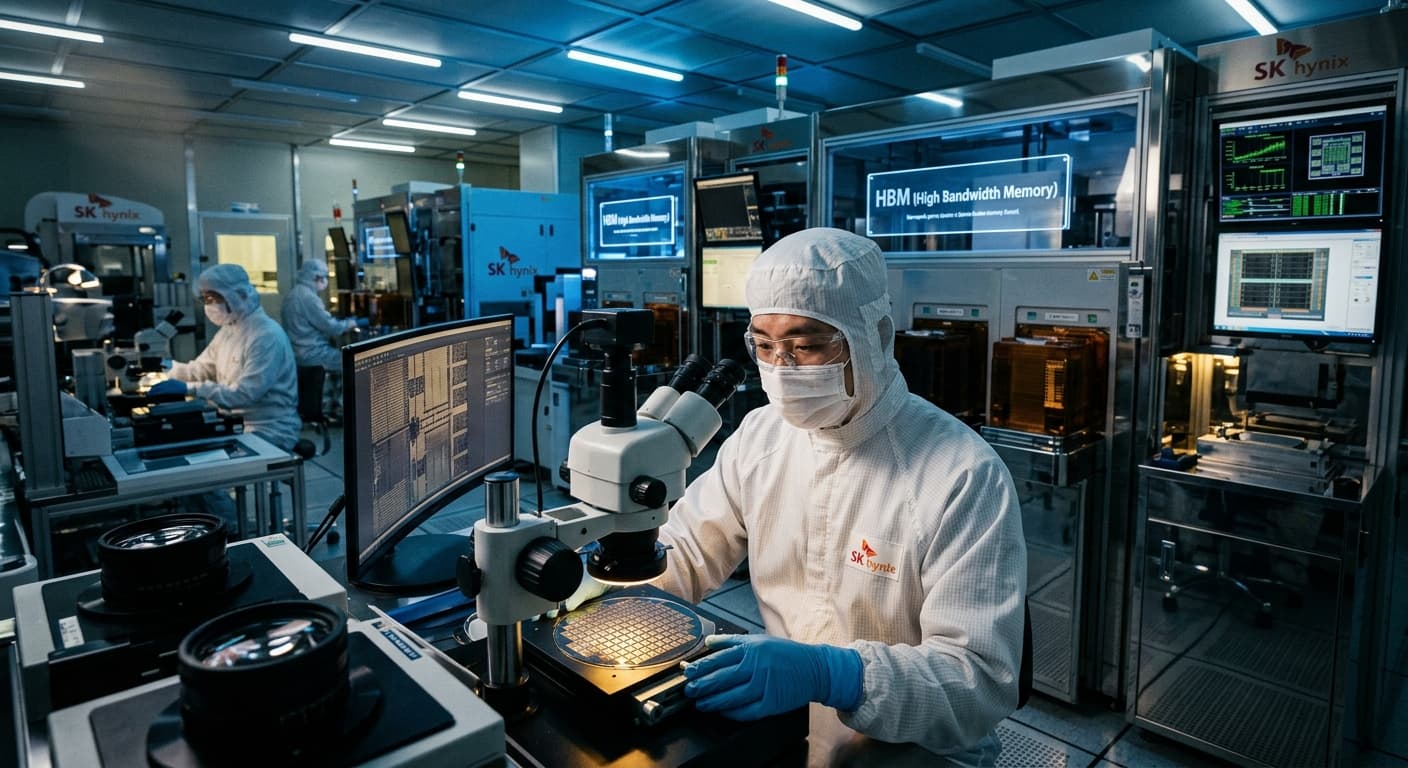
SK Hynix has aggressively expanded production of HBM chips, which stack memory layers to deliver the massive bandwidth required by Nvidia and other AI accelerator makers. This specialization has distanced the firm from traditional DRAM cycles that once caused painful boom-and-bust swings.
AI Compute Boom Drives Memory Demand
Meta’s recent decision to build an internal cloud business to sell excess AI compute capacity underscores how rapidly hyperscalers are scaling infrastructure. The company’s move, covered extensively by financial outlets, signals that even social media giants now view AI infrastructure as a core revenue stream rather than just a cost center.
Each new wave of large language model training requires exponentially more memory bandwidth. SK Hynix’s HBM3E and upcoming HBM4 products have become essential components in these systems. Industry forecasts from SemiAnalysis project continued tight supply through at least 2028, supporting elevated pricing and margins for leading suppliers.
This demand environment creates ripple effects across global markets. When memory chip availability tightens, data center operators delay deployments or pay premiums. That directly influences corporate earnings in the broader technology sector and, by extension, major stock indices.
Geopolitical Context: Semiconductor Competition and Supply Chain Risks
The memory chip industry sits at the heart of US efforts to maintain technological superiority over China. Export controls on advanced manufacturing equipment have slowed Beijing’s progress in cutting-edge logic chips, but memory technology has proven harder to contain completely.
SK Hynix, along with Samsung and Micron, controls the vast majority of global DRAM and NAND production. Any disruption to South Korean facilities—whether from natural disaster, regional conflict, or escalated trade measures—would send shockwaves through AI development worldwide.
This reality has prompted Western governments to encourage “friendshoring” of critical supply chains. SK Hynix’s increased US presence through the Nasdaq listing and planned American research facilities aligns with these policy goals. The company already operates packaging facilities in the United States and has signaled further investment pending clarity on federal semiconductor incentives.
Related supply chain vulnerabilities appear in other strategic sectors. The recent Nifty 50 crash demonstrated how energy price spikes and global risk-off sentiment can compound technology sector pressures in emerging markets.
Competitive Landscape: SK Hynix vs Micron and Samsung
Micron Technology has also benefited from the AI tailwind but faces different margin dynamics. Recent analysis suggested Micron stock could face near-term pressure after strong July performance as investors take profits. SK Hynix, by contrast, has maintained more consistent momentum due to its earlier and more aggressive ramp of next-generation HBM products.
Samsung Electronics remains the largest overall memory producer but has trailed in HBM market share. The South Korean giant is investing heavily to close that gap, creating a national three-horse race that benefits from government support and coordinated research efforts.
Table: Global DRAM Market Share Estimates (Q2 2026)
| Company | Market Share | HBM Focus | Notable Strength |
|---|---|---|---|
| SK Hynix | 28% | Very High | Early HBM4 leadership |
| Samsung | 42% | High | Scale and vertical integration |
| Micron | 23% | Medium-High | US-based manufacturing incentives |
| Others | 7% | Low | Niche applications |
Investment Implications for SK Hynix Stock
Investors evaluating SK Hynix stock should consider several factors beyond headline revenue growth. The company’s heavy capital expenditure cycle means free cash flow can swing dramatically with memory pricing. Current HBM margins are exceptionally attractive, but new fabrication facilities coming online in 2027 and 2028 could increase supply and pressure prices if AI adoption slows.
The Nasdaq listing itself may improve liquidity and valuation multiples. US-listed technology hardware peers often trade at higher forward earnings multiples than their Asian counterparts due to perceived governance standards and easier access for American funds.
Currency movements represent another variable. A stronger Korean won can hurt export competitiveness, while the anticipated capital flows from the US listing could support the currency in the short term. South Korean officials are reportedly modeling various scenarios to manage volatility.
Broader market context matters too. The ongoing semiconductor cycle remains tightly linked to capital spending by a handful of hyperscalers. Any pullback in Meta, Google, Microsoft, or Amazon cloud budgets would quickly translate into reduced orders for memory chips.
Common Mistakes When Analyzing Semiconductor Stocks
- Treating all chip companies as interchangeable. Logic chips, analog components, and memory each follow distinct cycles and competitive dynamics.
- Ignoring inventory levels across the supply chain. Memory prices can collapse rapidly when customers overstock during boom periods.
- Underestimating geopolitical risk. Export license changes or regional tensions can alter competitive positioning overnight.
- Focusing solely on revenue growth without examining capital intensity and resulting free cash flow trends.
Best Practices for Investors Following Memory Chip Markets
- Track quarterly HBM supply and demand updates from industry researchers like SemiAnalysis and TrendForce rather than relying only on company guidance.
- Monitor capital expenditure announcements from major cloud providers and AI startups. Their spending directly predicts memory demand six to nine months later.
- Watch US export control lists and Entity List additions. These policy moves can shift market share between suppliers.
- Compare valuation multiples across the memory sector while adjusting for each company’s exposure to high-margin AI products versus legacy DRAM and NAND.
- Consider correlated assets. Movements in copper prices, electricity consumption data, and server shipment forecasts often provide leading indicators.
Memory technology also intersects with other critical technology domains. The race for advanced computing capabilities appears in quantum computing breakthroughs that promise to complement rather than replace classical AI systems. Similarly, satellite-based connectivity projects like Amazon’s Kuiper constellation will require substantial data center capacity, further driving memory requirements.
FAQ
What is driving the recent interest in SK Hynix stock?
Strong demand for high-bandwidth memory chips used in AI servers, combined with the company’s Nasdaq listing plans, has attracted fresh investor attention. The firm’s technology leadership in HBM products positions it to capture significant market share during the current AI infrastructure buildout.
How does the US-China chip competition affect SK Hynix?
Export controls have limited Chinese access to the most advanced manufacturing tools, indirectly benefiting non-Chinese memory suppliers. However, Beijing continues investing heavily in domestic alternatives, creating long-term uncertainty. SK Hynix must balance growing US partnerships with its substantial Chinese revenue base.
Will the Nasdaq listing change how investors should evaluate SK Hynix stock?
The dual listing should improve liquidity and potentially support higher valuation multiples by broadening the investor base. However, fundamental performance—particularly HBM margins and overall memory pricing—will remain the primary drivers of the stock’s direction.
What other factors could impact memory chip prices and SK Hynix performance?
Key variables include hyperscaler capital spending plans, new fabrication capacity coming online, potential changes to US export policies, and macroeconomic conditions that influence corporate technology budgets. Energy costs for data centers have also become an increasingly important consideration.
How does SK Hynix compare to Micron as an investment?
Both companies benefit from AI memory demand, but SK Hynix currently holds a lead in next-generation HBM technology. Micron offers more direct US manufacturing exposure and benefits from CHIPS Act incentives. Investors often hold both names to diversify within the memory sector.
Conclusion
The SK Hynix Nasdaq filing marks another chapter in the ongoing reconfiguration of global semiconductor power. As nations compete for technological and economic advantage, memory chips have moved from cyclical commodity products to strategic assets that influence AI progress and national capabilities.
Investors who understand the complex interplay between technology cycles, geopolitical constraints, and capital expenditure trends will be best positioned to navigate this evolving landscape. The coming years will test whether SK Hynix can convert its current HBM leadership into sustained competitive advantage while managing the risks inherent in operating at the center of great power technological competition.
Stay informed on how memory markets intersect with energy politics, trade policy, and AI infrastructure spending—the factors that will ultimately determine long-term winners in the semiconductor sector.
Share This Article