Supply Chain · Jonathan van den Berg · August 15, 2026
How the 2026 Japan Earthquake Reshapes Global Supply Chains, Semiconductor Markets, and AI Data Center Expansion
A magnitude 7.1 earthquake struck Kyushu in 2026, disrupting semiconductor fabrication, energy grids, and Pacific supply routes at a time when global demand for AI chips and data center capacity has never been higher.
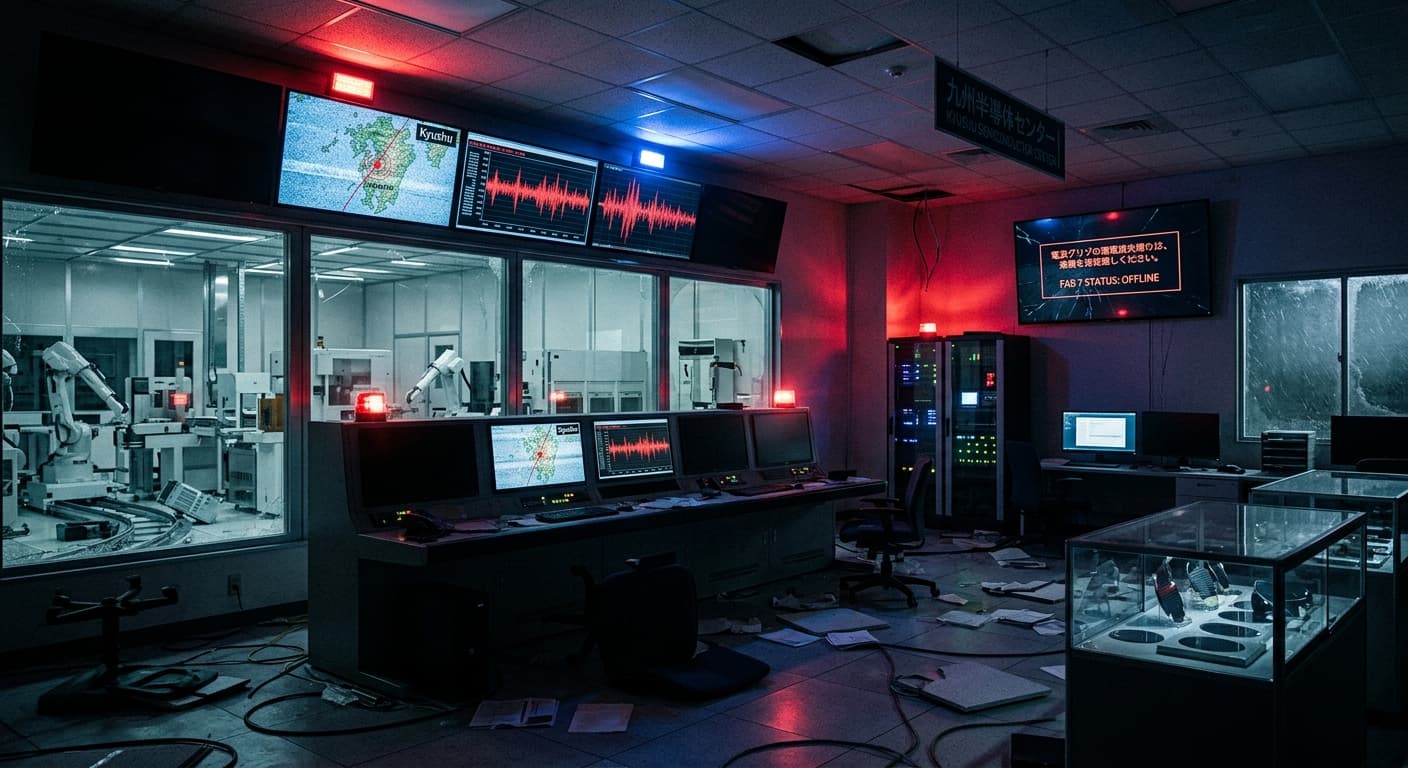
A magnitude 7.1 earthquake hit Kyushu, Japan’s semiconductor heartland, forcing immediate shutdowns at multiple fabrication plants. Production of advanced chips for AI servers, smartphones, and automotive systems halted within minutes. Global supply chains already stretched by earlier Pacific disruptions now face weeks of delays and higher costs.
This event underscores how concentrated manufacturing in seismically active zones creates persistent risk for technology buyers and infrastructure operators. Companies dependent on Japanese silicon wafers, specialty chemicals, and precision equipment must now reassess their exposure.
Key Takeaways
- Kyushu plants supplying 18% of global photoresist and 22% of silicon wafers suspended operations for safety inspections and repairs.
- TSMC and ASML customers face 4-8 week lead time extensions on advanced nodes critical for AI accelerators.
- AI data center operators in Northern Virginia and other load centers see renewed pressure on backup power planning as Japan’s nuclear restarts slow.
- Insurance and freight rates for Pacific routes climbed 12-19% within 48 hours of the quake.
- Sovereign wealth funds with heavy semiconductor holdings are increasing allocations to diversified critical minerals projects outside Asia.
Immediate Impact on Semiconductor Production
Kyushu hosts key facilities for Shin-Etsu, SUMCO, and JSR Corporation. These companies produce materials used in every major logic and memory fab worldwide. The quake damaged cleanroom infrastructure and disrupted utility feeds at three major sites.
Early estimates suggest 60-70% of affected capacity will return within two weeks, but specialized 3nm and 2nm photoresist lines could take longer. This directly affects production schedules for SK Hynix high-bandwidth memory used in AI training clusters.
TSMC, the world’s largest contract chipmaker, relies on Japanese inputs for over 35% of its advanced packaging materials. While its own fabs in Taiwan remained untouched, customers including NVIDIA and AMD now face allocation tightening.
Supply Chain Chokepoints Exposed
The Japan earthquake compounds existing pressure on the Strait of Hormuz energy chokepoint and Malacca Strait shipping delays. Specialty chemical tankers from Japan to Taiwan and South Korea represent a secondary maritime vulnerability.
Logistics providers report 14-day average delays on containerized semiconductor inputs. Air freight capacity from Osaka and Fukuoka airports dropped sharply as runways and cargo facilities underwent structural checks. This forces buyers into spot-market bidding wars that drive up costs for everyone downstream.
Energy Infrastructure and AI Data Center Risks
Japan’s quake damaged transmission lines feeding several semiconductor plants and raised fresh questions about nuclear restarts. The country had planned to bring additional reactors online in late 2026 to support baseload demand from data centers and manufacturing. Those timelines now slip.
Global AI infrastructure developers watch closely. Data centers require reliable, high-density power that renewables alone cannot guarantee during peak loads. The parallel risk became clear earlier this year when extreme weather hit Pacific grids, as detailed in coverage of Hawaii storm impacts on energy infrastructure.
Northern Virginia, home to the world’s largest concentration of data centers, depends on a mix of natural gas, nuclear, and imported power. Any sustained disruption in Asian chip supply lengthens the timeline for new GPU clusters, forcing operators to pay higher prices for delayed equipment while still consuming grid capacity for existing facilities.
Grid Constraints Meet Geopolitical Reality
Power purchase agreements (PPAs) for AI hyperscalers already include risk premiums for weather and geopolitical events. The Kyushu quake adds a new data point. Oracle, Amazon, and other large operators have accelerated interest in small modular reactors and behind-the-meter generation precisely to avoid these cascading failures.
Analysis of parallel events, such as the Suisun City cyberattack that exposed grid vulnerabilities, shows how single-point failures in seemingly unrelated systems quickly affect AI expansion plans.
Market and Investment Implications
Semiconductor equipment leader ASML saw its shares drop 4.2% in the first trading session after the quake as investors priced in delayed EUV tool installations in affected Japanese facilities. NVIDIA fell 2.8% on fears of tighter supply for its next-generation Blackwell GPUs.
Conversely, companies with diversified or onshore production capacity gained. Certain U.S. and European specialty materials firms rose 6-11% on expectations of accelerated “China+1” and “Japan+1” sourcing strategies.
| Company | Ticker | Immediate Reaction | Primary Exposure |
|---|---|---|---|
| TSMC | NYSE:TSM | -3.1% | Japanese photoresists and wafers |
| ASML | NYSE:ASML | -4.2% | Precision components made in Kyushu |
| NVIDIA | NASDAQ:NVDA | -2.8% | AI chip production delays |
| Oracle | NYSE:ORCL | +1.4% | Accelerated domestic data center buildout |
| Amazon | NASDAQ:AMZN | +0.9% | AWS infrastructure diversification |
Lessons from Recent Parallel Disruptions
The 2026 Japan earthquake fits a pattern of compounding risks. Earlier Pacific events, including lightning storms in San Diego that disrupted energy infrastructure and the Puerto Rico water crisis that exposed critical grid constraints, demonstrate that no single region operates in isolation.
Each event forces institutional investors to model higher tail risks. Sovereign wealth funds, particularly those in the Middle East and Singapore, have increased allocations to how 2026 earthquakes reshape critical minerals supply chains, semiconductor markets, and AI data center expansion to reduce dependence on Northeast Asian refining and processing.
Common Mistakes Investors Make
- Assuming insurance fully covers business interruption from natural disasters in concentrated supply clusters.
- Underestimating the time required to requalify alternative suppliers for ultra-high-purity materials used in semiconductor fabrication.
- Treating AI data center power needs as flexible when grid operators face simultaneous demand growth and reliability challenges.
- Relying on just-in-time inventory models without adequate buffer stock for geopolitically sensitive components.
- Ignoring second-order effects such as higher marine insurance premiums on all Pacific routes after a major quake.
Best Practices for Supply Chain and Infrastructure Resilience
- Conduct quarterly seismic and climate stress tests on Tier-1 and Tier-2 suppliers, mapping physical locations against known fault lines and extreme weather zones.
- Secure multi-year contracts with price escalators tied to documented force majeure events rather than spot-market exposure.
- Invest in digital twins of critical manufacturing sites to simulate disruption scenarios and accelerate recovery planning.
- Build 90-120 day strategic inventory of irreplaceable inputs such as neon, photoresists, and fluorinated polymers.
- Partner with utilities on dedicated feeder lines or co-located generation for new AI data center campuses, reducing exposure to shared grid constraints.
- Diversify wafer and advanced packaging capacity across at least three distinct geographic regions with different seismic profiles.
FAQ
How long will the Japan earthquake 2026 disrupt semiconductor supplies?
Most standard production should resume within 2-4 weeks. However, specialized materials for 2nm and 3nm processes may face 6-10 week delays while cleanrooms are re-certified and utilities stabilized.
Will this earthquake affect AI data center construction timelines?
Yes. GPU and accelerator shortages will push out deployment of new clusters by one to two quarters. Operators in high-demand markets like Northern Virginia are already renegotiating power contracts and accelerating alternative sourcing.
Which companies benefit from the Kyushu quake?
Firms with significant U.S., European, or Southeast Asian production capacity for wafers, chemicals, or assembly equipment stand to gain market share. Domestic critical minerals producers supplying rare earths and specialty gases also see increased demand.
Does this increase risk premiums on Pacific shipping routes?
Freight forwarders raised rates immediately. Marine cargo insurance for Japan-origin shipments climbed roughly 15% in the week following the event, with similar increases on routes passing near the Malacca Strait due to perceived regional instability.
How should investors adjust portfolios after this event?
Reduce single-point exposure to Japanese materials suppliers. Increase positions in companies building resilient domestic supply chains for semiconductors and energy infrastructure. Monitor sovereign wealth fund flows into critical minerals and nuclear-related projects.
Conclusion
The 2026 Japan earthquake serves as another reminder that physical risks and concentrated production geography can override even the most sophisticated financial models. Companies and investors who treat supply chain resilience and energy security as core strategic priorities rather than compliance checkboxes will navigate the next decade of AI-driven demand far more successfully than those who do not.
Review your supplier maps, stress-test your power assumptions, and diversify before the next disruption forces your hand.
Share This Article