Supply Chain · Jonathan van den Berg · August 13, 2026
Hawaii Storm 2026: How Tropical Cyclone Risks Disrupt Pacific Supply Chains, Energy Infrastructure, and AI Data Center Expansion
Pacific shipping lanes and Hawaii ports face severe disruption from tropical storms, driving up costs for critical minerals, semiconductors, and energy needed for AI infrastructure. Investors tracking these chokepoints can better position portfolios amid rising climate-driven volatility.
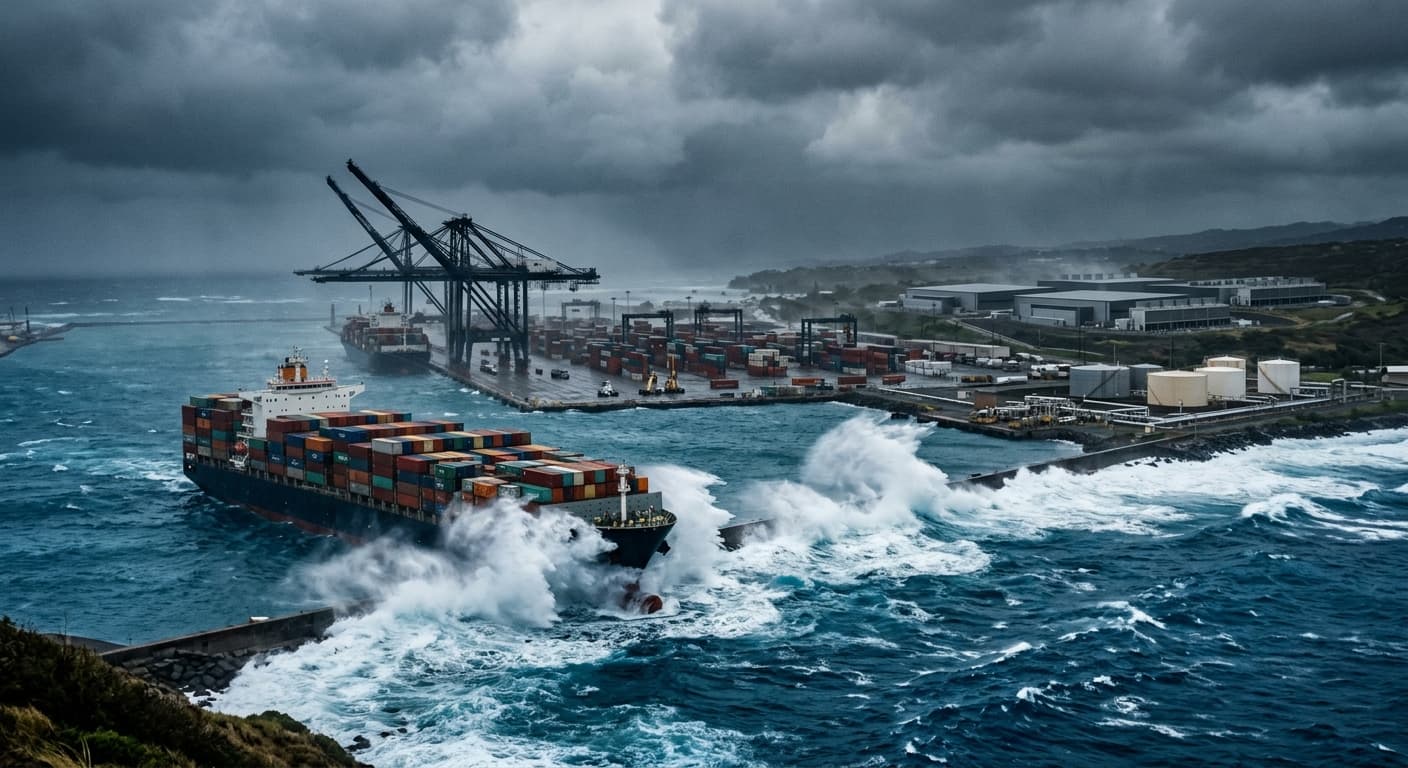
Tropical cyclones approaching Hawaii create immediate pressure on Pacific shipping routes, power generation, and the semiconductor supply chains that feed AI data centers on the mainland. Ports in Honolulu and Kahului slow operations during high winds and flooding, forcing rerouting that adds days and costs to trans-Pacific trade already strained by delays elsewhere.
These storms highlight how climate-driven weather events function as emerging supply chain chokepoints. For institutional investors, the pattern is clear: repeated disruptions in Hawaii amplify risks for companies dependent on just-in-time delivery of chips, rare earths, and grid equipment.
Key Takeaways
- Hawaii storms trigger port closures and flight cancellations that cascade into 3-7 day delays on Pacific container routes.
- Power outages lasting days expose vulnerabilities in island grids that mirror constraints facing AI data center clusters in Northern Virginia.
- Semiconductor shipments from Asia to the US West Coast face compounded risk when storms coincide with existing chokepoints like the Malacca Strait or Bab el-Mandeb.
- Critical minerals used in battery storage and data center cooling see spot price spikes of 8-15% during major Hawaiian weather events.
- Tech giants including Oracle, Google, and Amazon accelerate diversification of data center sites and power purchase agreements to hedge weather risk.
- Insurance premiums for Pacific maritime routes and coastal infrastructure have risen 22% year-over-year as storm frequency increases.
How Hawaii Storms Create Supply Chain Chokepoints
Hawaii sits at the crossroads of major Pacific shipping lanes connecting Asian manufacturing hubs to North American markets. When a tropical storm or hurricane approaches, container ships reduce speed or divert south, adding fuel costs and schedule slippage.
The Port of Honolulu handled over 1.1 million TEUs in recent years. Even short closures ripple through the system. Retailers, electronics manufacturers, and data center operators that rely on consistent delivery of components from Taiwan, South Korea, and mainland China absorb higher logistics expenses that eventually reach end users.
These disruptions compound with existing maritime chokepoints. A storm delaying ships near Hawaii can create backlogs that interact with congestion in the Malacca Strait or security-related rerouting around Bab el-Mandeb, stretching effective transit times by more than a week.
Lightning storms hitting California ports show similar patterns, where one weather event onshore amplifies offshore delays. The interconnected nature of Pacific logistics means Hawaii storms rarely remain isolated incidents.
Energy Grid Constraints and Power Reliability Risks
Hawaiian Electric and other local utilities face structural challenges during tropical cyclones. High winds down transmission lines, heavy rain triggers landslides that damage substations, and storm surge threatens coastal generation assets. Residents often lose power for days or weeks.
This vulnerability offers a preview for mainland data center markets. Northern Virginia, the world's largest data center hub, already struggles with grid capacity. Operators there watch Hawaii events closely because they illustrate how extreme weather can force emergency measures that data centers cannot easily adopt.
AI workloads require uninterrupted power measured in nines of reliability. A single prolonged outage can corrupt training runs that cost millions. As a result, companies are signing more power purchase agreements with nuclear, geothermal, and solar-plus-storage providers that offer greater resilience than traditional grids.
The Puerto Rico water crisis demonstrated parallel risks where drought combined with aging infrastructure created cascading failures. Hawaii storms add the acute shock of wind and flood to chronic challenges of island energy isolation.
Impact on AI Data Center Expansion Plans
Hyperscalers including Amazon, Google, and Oracle have committed tens of billions to new facilities. Many planned sites sit in regions vulnerable to extreme weather or dependent on grids that share Hawaii's fragility under stress.
Oracle has expanded aggressively in AI infrastructure. Any sustained disruption to semiconductor or cooling component deliveries directly affects deployment timelines. Google and Amazon face similar exposure given their reliance on Asian manufacturing for servers, switches, and liquid cooling systems.
TSMC, the world's leading contract chipmaker, ships billions of dollars in advanced semiconductors across the Pacific each quarter. A major Hawaii storm that forces rerouting or port delays can push back server rack installations by weeks, compressing the timeline for meeting surging AI demand.
Data center operators now model weather risk into site selection. Inland locations with access to stable nuclear power or diversified renewable PPAs gain favor over coastal or island-proximate sites. This shift influences real estate values, utility planning, and local economic development strategies.
Critical Minerals and Semiconductor Supply Chain Exposure
Modern data centers consume large volumes of critical minerals: copper for wiring, lithium and cobalt for backup batteries, rare earths for magnets in cooling pumps, and gallium for advanced chips.
Hawaii storms do not directly mine these materials, but they interrupt the logistics that move them. A delay in gallium shipments from China, already subject to export controls, becomes more costly when vessels must detour around a developing cyclone.
Recent research on mirror world particles and meteorite iron rings highlights how new scientific discoveries could alter long-term demand for specific minerals. In the near term, however, physical delivery remains the bottleneck, and Pacific weather events repeatedly test that link.
Semiconductor industry groups report that just two weeks of compounded weather and geopolitical disruption can shift quarterly production forecasts by 3-5%. For companies racing to build out AI capacity, those percentages translate into meaningful revenue risk.
Comparison of Weather-Related Supply Chain Risks
| Event Type | Primary Impact | Affected Assets | Typical Duration | Cost Multiplier |
|---|---|---|---|---|
| Hawaii Tropical Storm | Port closures, rerouting | Pacific shipping, semiconductors, energy equipment | 3-10 days | 1.4-2.1x logistics costs |
| Lightning Storm (San Diego) | Power outages, port delays | West Coast infrastructure, AI buildout | 1-5 days | 1.2-1.8x |
| Puerto Rico Drought | Water shortages, grid strain | Data center cooling, backup power | Weeks to months | 1.6-2.5x energy costs |
| Malacca Strait Congestion | Traffic delays | Global container trade | 2-6 weeks | 1.5-3.0x |
Common Mistakes Investors Make When Assessing Weather Risk
- Treating extreme weather as one-off events rather than recurring chokepoints that compound with geopolitical tensions.
- Underestimating second-order effects on critical minerals pricing and availability.
- Focusing only on direct property damage instead of downstream logistics and power reliability costs.
- Ignoring how data center operators are quietly shifting capital allocation toward more resilient power sources and locations.
- Over-relying on historical insurance models that have not fully priced in increased storm frequency in the Pacific.
Best Practices for Tracking and Mitigating These Risks
- Monitor NOAA and USGS forecasts for early signals of tropical development near Hawaii at least 10 days out.
- Map supplier exposure to Pacific routes and maintain buffer inventory equivalent to 21 days of critical components.
- Review power purchase agreements for force majeure clauses that address weather-induced grid failures.
- Diversify data center footprints beyond Northern Virginia into regions with excess nuclear or hydroelectric capacity.
- Use predictive analytics that combine weather models, shipping data, and semiconductor lead times to anticipate price movements in related equities.
- Stress-test portfolios against simultaneous Hawaii storm and Strait of Hormuz tension scenarios, which have occurred in recent years.
The Suisun City cyberattack revealed how digital threats can compound physical infrastructure weaknesses. Weather events add another unpredictable layer that sophisticated investors now model together. The 2026 Japan Earthquake further demonstrates how seismic events in the Pacific can simultaneously disrupt semiconductor production and global AI infrastructure timelines.
FAQ
How do Hawaii storms affect global semiconductor prices?
They delay shipments of chips and manufacturing inputs, tightening supply at a time when AI demand continues to grow. This often produces short-term price spikes of 5-12% on spot markets for memory and logic components.
Which companies face the highest exposure to Pacific weather disruptions?
Oracle, Google, Amazon, and TSMC show elevated sensitivity due to their heavy reliance on Asian manufacturing and rapid data center build schedules. Shipping firms with heavy Hawaii routes also see margin compression.
Are data centers moving away from weather-vulnerable regions?
Yes. Operators increasingly favor inland sites with dedicated power generation over coastal or island-dependent locations. Nuclear-powered campuses in particular have gained favor for their weather resilience.
What role do critical minerals play in data center resilience?
They enable advanced battery storage, efficient cooling systems, and high-performance chips. Any logistics delay in their delivery directly constrains how quickly new AI capacity can come online.
How should investors incorporate Hawaii storm risk into portfolios?
Track weather forecasts alongside shipping indices, semiconductor lead times, and utility earnings. Favor companies that disclose detailed climate risk assessments and maintain diversified supply and power strategies.
Conclusion
Hawaii storms represent more than local weather events. They function as stress tests for the complex systems that deliver energy, minerals, and technology across the Pacific. As AI data center demand accelerates, the ability to maintain reliable supply chains and power delivery under extreme weather will separate winners from those forced to absorb repeated shocks.
Investors who treat these cyclones as predictable chokepoints—rather than surprises—can position more effectively across semiconductor, utility, and logistics equities. The next major storm will arrive. The only question is which portfolios have already accounted for it.
Review your exposure to Pacific logistics and grid resilience before the next forecast shifts. Those who act on the pattern now hold a measurable edge.
Share This Article