Supply Chain · Jonathan van den Berg · September 30, 2026
Flydubai Incident 2026: How Israel Aviation Emergency Exposes Middle East Airspace Chokepoints and Aviation Supply Chain Risks
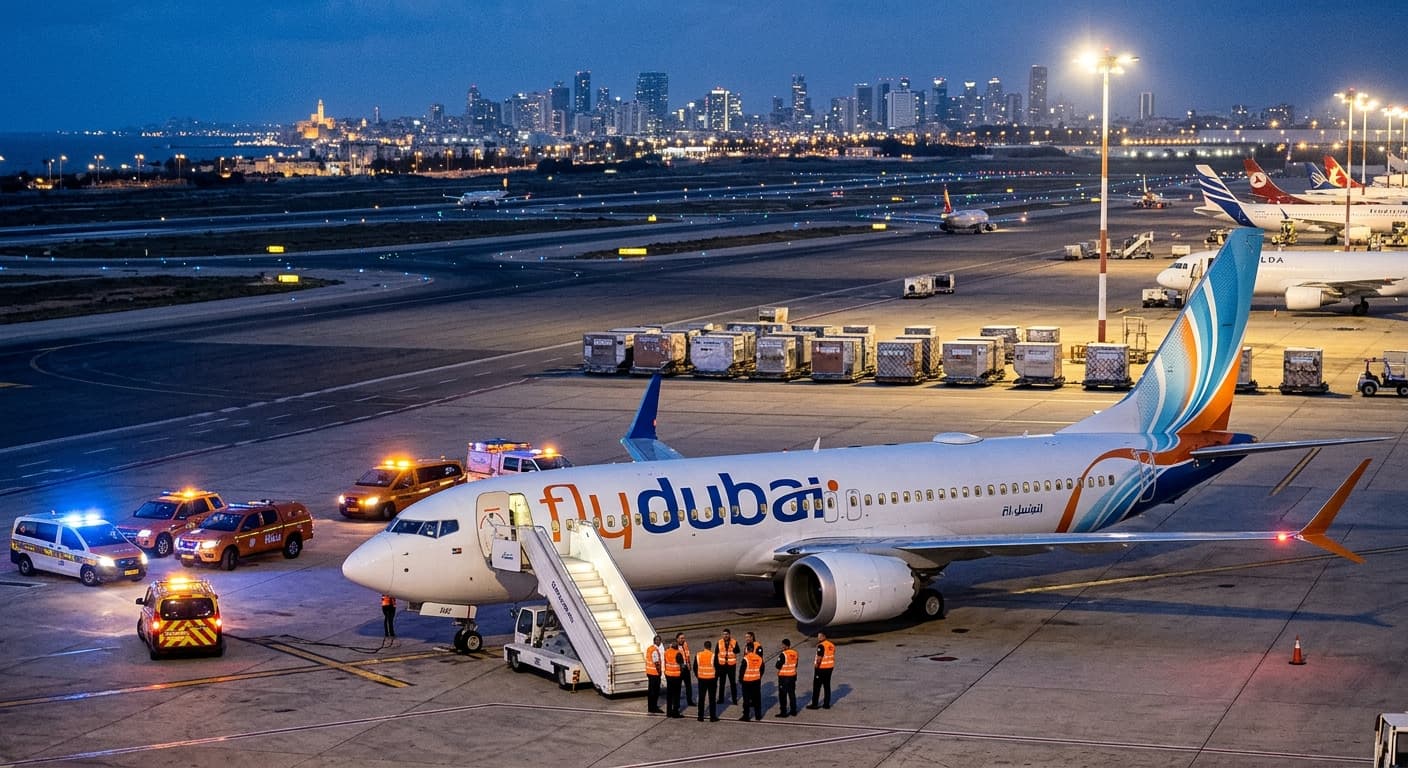
A diverted Flydubai flight triggered an aviation emergency over Israel, highlighting fragile Middle East airspace routes that carry billions in daily trade and energy-linked cargo. The event underscores growing risks to aviation supply chains already strained by regional tensions and resource nationalism.
The Real Impact of the Flydubai Diversion
A single diverted Flydubai flight created an aviation emergency over Israel that exposed deep weaknesses in Middle East airspace management. Israeli authorities quickly ruled out a hijacking, but the incident revealed how fragile commercial air routes have become amid ongoing regional conflicts. For airlines, logistics firms, and institutional investors, the event signals rising insurance costs, rerouting expenses, and broader supply chain pressure on aerospace components and fuel delivery.
The episode connects directly to larger patterns of disruption. Commercial flights now navigate tighter corridors near conflict zones, increasing fuel burn and maintenance demands on aircraft. These pressures ripple into Strait of Hormuz oil flow risks because many flights in the region rely on jet fuel sourced from Gulf producers.
What Happened with the Flydubai Flight
Israeli officials confirmed the incident involved a Flydubai aircraft diverted from its planned path. Early unconfirmed reports suggested one pilot may have attempted to crash the plane, only to be stopped by the second pilot and passengers. Authorities later clarified it was not a hijacking but an in-flight security or medical event requiring emergency landing protocols.
The diversion forced nearby air traffic to adjust in real time. Flights bound for Dubai, Tel Aviv, and Amman faced delays. Ground operations at Ben Gurion Airport activated contingency plans. While no injuries were reported, the event triggered a review of cockpit procedures and passenger screening for UAE-based carriers operating near Israeli airspace.
This was not an isolated mechanical failure. It occurred against a backdrop of heightened military activity in the region, where civilian and military air traffic increasingly share congested corridors. The overlap creates both safety risks and operational friction that raise costs for every carrier flying these routes.
Why Middle East Airspace Functions as a Chokepoint
Middle East airspace serves as a critical bridge between Europe, Asia, and Africa. Over 15% of global commercial flights cross this zone annually. The routes carry high-value cargo, including semiconductors, pharmaceuticals, and aerospace parts that depend on just-in-time delivery.
Key vulnerabilities include:
- Proximity to conflict zones: Flights must skirt areas with active missile threats and drone activity.
- Limited alternate corridors: Political restrictions prevent wide detours over certain countries.
- Fuel dependency: Most aircraft on these routes refuel in Gulf hubs tied to Strait of Hormuz tanker traffic.
- Insurance spikes: War-risk premiums for aviation have climbed sharply since 2024.
These constraints mirror maritime chokepoints. Just as Houthi advances in Yemen forced shipping companies to reroute around the Bab el-Mandeb, aviation operators now face similar cost inflation from airspace avoidance maneuvers.
Connection to Critical Minerals and Aerospace Manufacturing
Aviation relies heavily on titanium, rare earth elements, and specialty alloys. These materials often originate in regions with rising resource nationalism. China controls over 60% of refined rare earth processing. Any escalation that disrupts air cargo from Asia directly affects Boeing and Airbus production lines.
The Flydubai incident highlights how a single airspace event can delay shipments of these minerals. Delayed titanium deliveries, for example, slow aircraft maintenance schedules. Airlines then burn more fuel on older, less efficient planes. This creates a feedback loop: higher fuel demand tightens oil markets already sensitive to Hormuz risks.
Recent earthquakes in Asia have compounded these pressures. Disruptions to semiconductor fabrication also affect avionics systems. Airlines face longer lead times for replacement parts, forcing them to keep older aircraft in service longer than planned. See how similar dynamics played out in how 2026 earthquakes reshaped critical minerals supply chains.
Sovereign Wealth Funds and Aviation Exposure
Gulf sovereign wealth funds hold significant stakes in aviation. The Public Investment Fund of Saudi Arabia, Temasek of Singapore, and Mubadala of Abu Dhabi have poured capital into airlines, airports, and aerospace suppliers. The Flydubai event, involving a Dubai-based carrier, directly touches these portfolios.
Funds now face decisions on:
- Increasing allocations to alternative routes through Turkey or Central Asia
- Investing in next-generation aircraft that use less fuel
- Hedging against rising war-risk insurance through derivatives markets
The incident also affects defense contractors. Heightened airspace tensions drive demand for advanced radar and electronic warfare systems. Companies supplying these technologies see order backlogs grow, but they compete for the same critical minerals used in commercial aviation.
Impact on Global Supply Chains and Fuel Markets
Every extra minute an aircraft spends in the air burns roughly 4-5 gallons of jet fuel per engine. Rerouting to avoid sensitive airspace adds measurable cost. For major carriers, these expenses compound quickly across hundreds of daily flights.
Airlines have responded by:
- Adjusting flight paths to stay farther from high-risk zones
- Carrying additional contingency fuel, which increases takeoff weight and fuel burn
- Passing higher costs to cargo customers and premium passengers
- Reviewing insurance coverage with specialized aviation underwriters
These adjustments tighten global jet fuel markets. Since jet fuel derives from the same crude slate as diesel, pressure in one segment affects the other. This linkage explains part of the volatility seen in energy prices when Middle East tensions rise.
| Factor | Impact on Airlines | Impact on Supply Chains |
|---|---|---|
| Airspace Rerouting | +8-12% fuel burn on affected routes | Delays in time-sensitive cargo (electronics, perishables) |
| Insurance Premiums | Up 25-40% for war-risk coverage | Higher logistics costs passed to manufacturers |
| Maintenance Backlogs | Older aircraft kept in service longer | Increased demand for titanium and specialty alloys |
| Cargo Diversion | Shift to sea or longer air routes | Inventory buffers grow, raising working capital needs |
Lessons from Related Disruptions
The Flydubai event fits a pattern of converging risks. Similar dynamics appear in other sectors. For instance, Starbucks store closures revealed how even consumer-facing businesses suffer when logistics networks face simultaneous pressure from geopolitics and resource constraints.
In aviation, the stakes are higher because safety margins are non-negotiable. Regulators in Europe, the US, and Asia now demand more detailed risk assessments from carriers operating near conflict zones. This scrutiny adds compliance costs that smaller airlines struggle to absorb.
Common Mistakes Investors Make
Many institutional investors treat aviation disruptions as short-term noise. They underestimate how airspace chokepoints compound with mineral shortages and energy price volatility. Three frequent errors include:
- Assuming insurance will fully cover rerouting costs (most policies have strict sub-limits for geopolitical events)
- Focusing only on direct airline stocks while ignoring upstream suppliers of titanium, composites, and avionics
- Underweighting the secondary effects on sovereign wealth fund allocations and their influence on regional stability
Smart money tracks not just the airlines but also the mineral producers, fuel refiners, and reinsurance companies that absorb these shocks.
Best Practices for Managing Aviation Supply Chain Risk
Companies and investors can take concrete steps to build resilience:
- Diversify routing options. Build contingency plans that include Turkish, Egyptian, and Central Asian corridors even if they add distance.
- Secure long-term mineral contracts. Lock in titanium and rare earth supplies with multiple producers outside dominant single-country sources.
- Model fuel price scenarios. Stress-test balance sheets against 30-50% spikes in jet fuel driven by Hormuz or airspace disruptions.
- Engage with sovereign investors. Gulf funds often provide patient capital for fleet modernization that improves fuel efficiency and reduces exposure.
- Invest in predictive analytics. Use real-time airspace monitoring tools to adjust routes before incidents occur.
Carriers that adopted these practices after earlier Red Sea shipping crises recovered faster than peers when new disruptions hit.
FAQ
Was the Flydubai incident a hijacking?
Israeli authorities explicitly stated it was not a hijacking. Initial reports of a pilot attempting to crash the plane were unconfirmed and later clarified as an in-flight security or medical situation requiring diversion.
How does this affect oil prices and jet fuel costs?
Any event that increases perceived risk in the Middle East tends to lift war-risk premiums and prompt precautionary buying of crude and refined products. Airlines facing longer routes burn more fuel, adding demand pressure that can push prices higher in already tight markets.
Which companies are most exposed?
Airlines with heavy Middle East exposure such as Emirates, Qatar Airways, Etihad, and Flydubai itself face direct operational risk. Manufacturers like Boeing and suppliers of specialty metals also feel the impact through delayed deliveries and higher input costs.
What role do sovereign wealth funds play?
Gulf sovereign wealth funds own large stakes in regional aviation infrastructure. They must balance growth ambitions against rising geopolitical risk, often directing capital toward more fuel-efficient aircraft and diversified route networks.
Could this lead to permanent changes in flight paths?
Yes. Carriers have already adjusted paths to avoid certain zones following previous incidents. Sustained tension could lead to semi-permanent northern or southern detours that become standard operating procedure, raising baseline costs for years.
Why This Matters for Long-Term Strategy
The Flydubai aviation emergency serves as a live stress test for global supply chain assumptions. It shows how a single flight incident in a crowded airspace can amplify pressures across fuel markets, critical minerals, insurance, and sovereign capital deployment.
Investors who treat these events as isolated miss the larger pattern. Airspace chokepoints now interact with maritime chokepoints, mineral nationalism, and energy security in ways that reward preparation and punish complacency.
Businesses and funds that map these overlapping risks, secure alternative sources, and maintain operational flexibility will navigate the next decade far more successfully than those who wait for the next headline before acting.
Share This Article