Supply Chain · Jonathan van den Berg · September 24, 2026
How Houthi Advances in Yemen Expose Bab el-Mandeb Supply Chain Chokepoints and Red Sea Shipping Risk Premiums
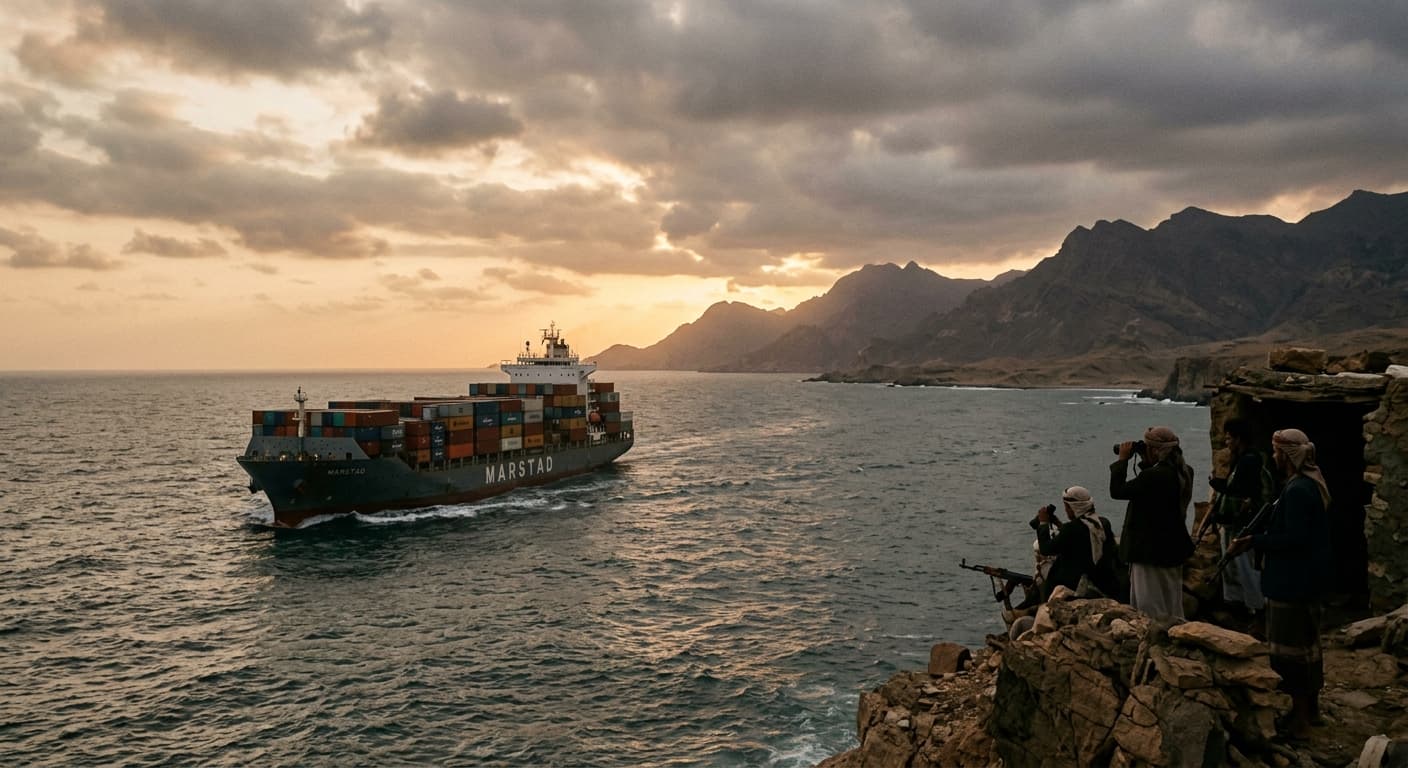
Houthi militants have expanded operations in Yemen, directly targeting vessels in the Bab el-Mandeb Strait and pushing shipping companies to avoid the Red Sea entirely. The resulting risk premiums, longer transit times, and higher fuel costs ripple through global supply chains and critical minerals markets.
Houthi advances in Yemen have turned the Bab el-Mandeb Strait into one of the world's most dangerous maritime passages. Shipping companies now face war-risk insurance premiums as high as 1.5 percent of hull value per transit, forcing many to reroute around the Cape of Good Hope and adding 10 to 14 days to Asia-Europe voyages.
This disruption directly affects an estimated 12 percent of global seaborne trade that normally passes through the Red Sea and Suez Canal. For critical minerals and components used in semiconductors and AI infrastructure, the added costs and delays compound existing supply chain vulnerabilities.
Key Takeaways
- Houthi drone and missile attacks have reduced Red Sea transits by more than 70 percent since early 2024, with the trend accelerating in 2026.
- Insurance premiums for vessels transiting the Bab el-Mandeb have risen from 0.1 percent to as much as 1.5 percent of insured value per voyage.
- Rerouting via the Cape of Good Hope adds roughly 3,500 nautical miles and increases fuel consumption by 40 percent on Europe-Asia routes.
- Critical minerals shipments, including cobalt and rare earth precursors from Africa, face the highest relative cost increases.
- Sovereign wealth funds and shipping investors are repricing exposure to Red Sea risk, with knock-on effects for AI data center component costs.
- Alternative routes increase pressure on global diesel supplies already strained by other geopolitical tensions.
The Strategic Importance of the Bab el-Mandeb Strait
The Bab el-Mandeb Strait forms the southern gateway to the Red Sea. At its narrowest point, the passage is only 18 miles wide, creating a natural choke point between the Horn of Africa and the Arabian Peninsula. Roughly 6 million barrels of oil and vast quantities of containerized goods pass through it daily under normal conditions.
Control of this waterway gives the Houthis leverage over both energy flows to Europe and Asia-Europe supply chains. Their advances in western Yemen have allowed them to position mobile launchers closer to the strait, reducing warning time for commercial vessels and complicating naval protection efforts.
This situation echoes risks in the Strait of Hormuz, where similar dynamics affect a much larger share of global oil. Together, these two chokepoints control access to nearly 40 percent of seaborne crude oil and a significant portion of container traffic.
How Houthi Advances Have Changed the Risk Landscape
Since 2023, Houthi forces have launched over 100 attacks on commercial shipping. In 2026, their capabilities have improved with better targeting systems and longer-range drones supplied through regional networks. Recent strikes have hit vessels even when escorted, demonstrating the limits of current naval deterrence.
Shipping companies have responded by avoiding the Red Sea entirely. Data from vessel tracking services shows Red Sea transits down more than 70 percent year-over-year. Major carriers including Maersk (NYSE:MAERSK) and Hapag-Lloyd have publicly committed to the Cape route for the foreseeable future.
The result is a sharp increase in war risk premiums. Lloyd's of London syndicates now charge up to 1.5 percent of vessel value for single transits through the area, compared to 0.05-0.1 percent before the crisis escalated. For a $200 million container ship, that adds $3 million per one-way trip.
Impact on Global Supply Chains and Critical Minerals
The rerouting has cascading effects across multiple sectors. For critical minerals, the impact is particularly acute. Many cobalt, copper, and lithium shipments originate in African ports and previously used the Red Sea route to reach Asian processing facilities.
Longer voyages increase exposure to weather risks and raise the chance of delays in just-in-time manufacturing. Semiconductor producers already dealing with tight gallium and germanium supplies face additional pressure when shipments from African mines take two extra weeks.
AI data center operators feel this indirectly. Higher shipping costs for copper used in transformers and rare earths used in magnets contribute to rising infrastructure expenses. One analysis estimates that sustained Red Sea disruption adds 4-7 percent to the delivered cost of key data center components.
Links to broader volatility appear in related analyses of how climate patterns amplify supply chain disruptions and how natural disasters compound critical minerals shortages.
Insurance Market Response and Risk Premiums
Marine insurers have segmented the Red Sea into high, medium, and low risk zones. The Bab el-Mandeb itself now carries the highest premiums. Some underwriters refuse coverage entirely without specific security arrangements.
This has created a two-tier market. Large carriers with scale can absorb higher costs or self-insure portions of risk. Smaller operators face prohibitive premiums or simply cannot obtain coverage, leading to consolidation in the industry.
Reinsurance markets in London and Singapore have tightened terms. Several major reinsurers have reduced their exposure to Red Sea war risks by 30-50 percent, pushing primary insurers to raise rates further.
Economic Costs of Rerouting
| Route | Distance Added (nautical miles) | Extra Time (days) | Fuel Cost Increase | Estimated Cost per TEU |
|---|---|---|---|---|
| Asia-Europe via Suez | 0 | 0 | baseline | $1,800-2,200 |
| Asia-Europe via Cape | 3,500 | 10-14 | +40% | $3,500-4,800 |
| Asia-East Coast US via Suez | 0 | 0 | baseline | $2,900-3,400 |
| Asia-East Coast US via Cape | 2,800 | 9-12 | +35% | $4,200-5,100 |
These added costs flow through to consumers and businesses. Retailers importing goods from Asia report freight costs consuming an extra 2-3 percent of product value. Manufacturers using just-in-time inventory face higher safety stock requirements and working capital needs.
Effects on AI Data Centers and Technology Supply Chains
Data center expansion in regions like Northern Virginia depends on reliable delivery of electrical equipment, servers, and cooling components. Many of these items or their subcomponents travel through the Red Sea.
Higher shipping costs and longer lead times contribute to project delays. Power infrastructure projects already facing grid constraints see additional pressure when transformers and switchgear take longer to arrive.
The connection to critical minerals becomes clear when examining copper and rare earth supply chains. Copper cathodes from African mines often route through Red Sea ports. Extended transit times reduce effective supply and contribute to price volatility that affects data center construction budgets.
Related research on critical minerals shortages affecting AI hardware shows how these maritime disruptions amplify existing bottlenecks.
Investor Implications and Corporate Exposure
Shipping companies with significant Red Sea exposure have seen share price volatility. Maersk (NYSE:MAERSK) has traded with elevated beta as investors weigh rerouting costs against potential rate increases on alternative routes.
Tanker operators like Teekay (NYSE:TK) and Matson (NASDAQ:MATX) face mixed effects. Longer voyages increase demand for vessels but also raise operating costs. Insurance and security expenses have risen sharply.
Logistics and freight forwarding firms report higher margins on rerouted cargo but warn of capacity constraints at African ports not designed for the sudden increase in traffic.
Sovereign wealth funds monitoring these developments adjust allocations. Funds with exposure to European importers or Asian exporters have increased hedging against freight rate volatility.
Common Mistakes in Assessing Red Sea Risk
- Assuming naval task forces can fully secure the Bab el-Mandeb. Mobile Houthi launchers and drone swarms have proven difficult to neutralize completely.
- Underestimating the insurance multiplier effect. A 1 percent premium on a $200 million vessel adds real millions per voyage.
- Ignoring second-order effects on diesel and fuel markets. Rerouting burns millions of extra tons of marine fuel, tightening global distillate supplies.
- Treating the risk as temporary. Houthi advances suggest a protracted challenge rather than a short-term flare-up.
- Overlooking links to critical minerals markets. Many investors analyze shipping in isolation rather than as part of the broader resource supply chain.
Best Practices for Supply Chain and Investment Risk Management
- Model multiple disruption scenarios. Include both full Bab el-Mandeb closure and sustained high-risk premiums in planning models.
- Diversify sourcing for critical minerals. Develop suppliers outside primary Red Sea-dependent routes where possible.
- Build inventory buffers strategically. Calculate the true cost of delays for high-value components used in AI infrastructure and semiconductors.
- Engage directly with insurers early. Companies that demonstrate robust security protocols and voyage planning can sometimes negotiate better rates.
- Monitor sovereign wealth fund flows into alternative logistics infrastructure. Investments in African port capacity or overland rail corridors may signal long-term shifts.
- Use freight derivatives and commodity hedges to offset increased volatility in both shipping rates and underlying mineral prices.
FAQ
How long will Houthi attacks continue to affect the Bab el-Mandeb?
The conflict in Yemen shows no signs of quick resolution. Most analysts expect meaningful disruption to persist through 2027 unless a broader regional settlement is reached.
Which commodities face the highest risk from Red Sea disruption?
Critical minerals including cobalt from the Democratic Republic of Congo, copper concentrates, and certain rare earth feedstocks show the greatest relative exposure due to their African origin and processing patterns.
Will shipping rates stay elevated even on alternative routes?
Yes. The sudden increase in demand for Cape of Good Hope tonnage has pushed container and tanker rates higher. Capacity constraints at alternative ports add further pressure.
How does this compare to risks in the Strait of Hormuz?
The Hormuz Strait carries far more oil volume, but the Bab el-Mandeb affects a broader mix of containerized goods and critical minerals. Both chokepoints contribute to overlapping risk premiums in energy and metals markets.
What role do sovereign wealth funds play in mitigating these risks?
Several funds, particularly those from Gulf states and Asia, have increased direct investments in port infrastructure, shipping assets, and alternative logistics corridors to reduce dependence on vulnerable maritime routes.
The Bab el-Mandeb supply chain chokepoints represent more than a regional security issue. They highlight the fragility of globalized trade in an era of persistent low-intensity conflict. Companies and investors that treat these risks as structural rather than temporary will be better positioned as similar pressures appear in other strategic waterways.
Understanding these dynamics helps decision-makers allocate capital, adjust supply chains, and protect margins in an increasingly contested maritime environment.
Share This Article