Jonathan van den Berg · April 27, 2026
Qatar Airways' Ultra-Long-Haul Expansion: How Aviation Mega-Routes Are Reshaping Global Trade, Energy Politics, and Geoeconomic Influence
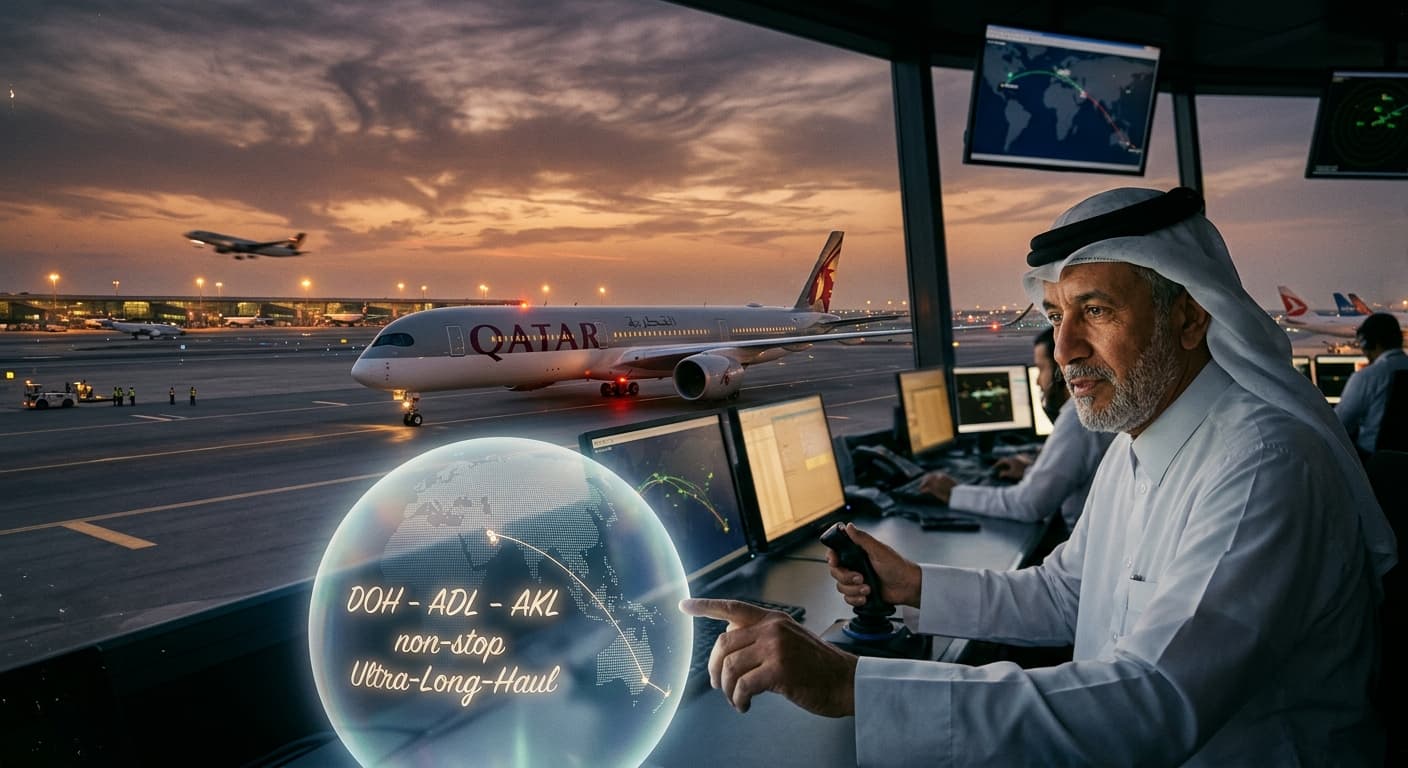
What does a planned 20-hour non-stop flight from Doha to Adelaide and Auckland reveal about the shifting architecture of global commerce, energy security, and great-power competition in international aviation?
Global aviation now supports roughly 3.5 percent of world GDP and facilitates over $6 trillion in annual economic activity, yet the launch of ultra-long-haul routes exceeding 20 hours signals a deeper transformation: the strategic weaponization of connectivity itself in an era of intensifying geopolitical rivalry.
Qatar Airways’ ambitious plan to operate direct flights between Doha and the Australian and New Zealand cities of Adelaide and Auckland represents far more than a commercial milestone. It exemplifies how Gulf carriers, backed by sovereign wealth and strategic geography, are rewriting the rules of global economic integration. These routes compress what were once multi-stop journeys into single flights, promising to accelerate trade in high-value perishables, strengthen tourism linkages, and—most critically—reconfigure energy and diplomatic relationships across hemispheres.
The Strategic Calculus Behind Ultra-Long-Haul Flights
Operating a commercial flight for nearly 20 hours demands breakthroughs in aircraft technology, crew management, fuel efficiency, and airport infrastructure. Qatar Airways’ move builds upon its existing record of operating some of the world’s longest routes, leveraging the Airbus A350-1000 and Boeing 777 families optimized for extended range. The addition of Adelaide and Auckland extends Qatar’s network deeper into Oceania, a region whose economic gravity has grown as supply chains diversify away from traditional Asian manufacturing hubs.
From a pure commercial standpoint, these routes target premium passengers and time-sensitive cargo. Australian wine, New Zealand dairy and seafood, and high-tech medical equipment gain faster, more reliable access to Middle Eastern and European markets. Conversely, Gulf investment capital, luxury goods, and Islamic finance products reach Southern Hemisphere consumers more efficiently. Yet the deeper story lies in energy politics and geoeconomic positioning.
Qatar sits atop the world’s third-largest natural gas reserves. Its liquefied natural gas (LNG) exports already form a cornerstone of Asian energy security. By tightening aviation links with Australia—a major LNG exporter itself—Qatar Airways indirectly reinforces a symbiotic energy relationship. Both nations benefit from diversified export markets that reduce dependence on any single buyer, particularly amid volatile global energy markets where traditional suppliers face increasing scrutiny.
Geopolitics at 35,000 Feet: Gulf Carriers as Instruments of Statecraft
Gulf aviation strategy has long transcended transportation. Emirates, Etihad, and Qatar Airways function as extensions of national foreign policy, projecting soft power, securing diplomatic overflight rights, and cementing economic partnerships. Qatar’s alignment with Turkey, its complex relationship with Saudi Arabia and the UAE, and its hedging between Western allies and emerging powers such as China make its airline’s network a barometer of broader geopolitical currents.
The new Oceania routes arrive at a moment when traditional transatlantic and transpacific orders face strain. Airlines from the United States and Europe have retrenched on certain long-haul routes due to high fuel costs, labor shortages, and post-pandemic balance sheet caution. Gulf carriers have filled the vacuum, capturing sixth-freedom traffic—passengers and cargo traveling between third countries via their hubs. Doha’s Hamad International Airport has become a critical node connecting Europe, Africa, South Asia, and now deeper into the Pacific.
This expansion carries implicit challenges to established aviation powers. Australia’s Qantas has historically dominated routes between Oceania and Europe through its partnership with Emirates. New Zealand’s Air New Zealand faces similar competitive pressure. The entry of Qatar Airways intensifies debates over “fair competition,” subsidy allegations, and market access that have defined international aviation diplomacy for decades. These tensions echo larger questions about state capitalism versus liberal markets that animate discussions from semiconductors to critical minerals.
Economic Realignment and the Pacific Century
Australia and New Zealand sit at the frontier of the emerging Indo-Pacific economic order. Both nations have deepened security partnerships with the United States through AUKUS while simultaneously expanding trade relationships with China. Qatar’s direct flights introduce another vector of influence: Islamic investment, Halal trade certification networks, and exposure to Gulf sovereign wealth funds increasingly active in Pacific real estate, critical minerals, and renewable energy projects.
The timing aligns with global efforts to diversify supply chains. As manufacturers seek alternatives to concentrated production in East Asia, Australia’s rare earth minerals, lithium deposits, and agricultural bounty become strategically vital. Faster air connections reduce inventory holding times for high-value goods and enable just-in-time delivery models previously impractical over such distances. This development parallels broader infrastructure investments aimed at tightening economic bonds across the Global South and middle powers.
Furthermore, these routes enhance people-to-people ties with significant diaspora implications. South Asian communities in Australia and New Zealand maintain strong links to the Gulf, where millions work in construction, finance, and services. Improved connectivity strengthens remittance flows, cultural exchange, and skills circulation—factors increasingly recognized as components of national economic resilience.
Energy Security and the Future of Aviation Fuel
Ultra-long-haul flights consume enormous quantities of fuel, making them focal points in the global transition toward sustainable aviation. Qatar Airways has invested heavily in sustainable aviation fuel (SAF) research and carbon offset programs, yet the fundamental physics of 20-hour flights underscores the tension between connectivity ambitions and climate commitments.
This reality intersects with wider shifting sands of transatlantic energy security. European nations, facing their own energy transition challenges and reduced Russian supplies, increasingly look toward diversified LNG sources. Qatar’s ability to maintain reliable deliveries while expanding its aviation footprint demonstrates the multifaceted nature of energy statecraft. The same pipelines of trust and infrastructure that deliver LNG can, in a different form, deliver passengers, ideas, and capital.
Meanwhile, the erosion of traditional petrodollar mechanisms continues to reshape global finance. As nations explore alternatives to dollar-denominated energy trade and blockchain increasingly influences cross-border settlements, aviation networks provide physical connectivity that underpins trust in new financial architectures. The movement of executives, diplomats, and technologists on these flights facilitates the quiet negotiations that determine future standards in everything from carbon markets to digital identity verification for travel.
Technological and Operational Challenges
Successfully operating 20-hour flights requires more than powerful engines. Crew fatigue management demands innovative rostering and rest facilities. Cabin air quality, psychological passenger experience, and medical preparedness must meet elevated standards. Qatar Airways’ investment in these areas positions it as an industry leader while setting new benchmarks that competitors must match.
Aircraft maintenance schedules for ultra-long-haul operations strain global supply chains for spare parts and specialized technicians. The concentration of such capabilities in a handful of hubs—including Doha—further amplifies the strategic importance of certain locations in the global aviation ecosystem. This mirrors parallel dynamics in semiconductor manufacturing and other critical technologies where geography, expertise, and geopolitics intersect. The Flydubai Incident 2026 and its exposure of Middle East airspace chokepoints and aviation supply chain risks further illustrates how fragile these systems remain.
Implications for Global Economic Architecture
The expansion of ultra-long-haul aviation networks contributes to the broader fragmentation and reconfiguration of globalization often described as “slowbalization” or “friend-shoring.” Rather than reducing connectivity, this process redirects and deepens specific linkages between nations sharing strategic interests or complementary economic profiles.
For smaller economies like Qatar, aviation represents one of the few sectors where scale, geographic position, and capital reserves create genuine comparative advantage on the global stage. Success in this domain translates into diplomatic leverage, enhanced sovereign creditworthiness, and the ability to shape international regulatory conversations ranging from emissions standards to digital passenger data exchange.
Australia and New Zealand gain from increased competition in their aviation markets, potentially lowering fares and improving service quality. Yet they must also navigate the complexities of balancing relationships with traditional Western allies, rising Asian powers, and now more assertive Gulf actors. The economic benefits of direct connectivity must be weighed against potential over-reliance on foreign carriers for critical international links.
Looking Forward: Aviation as Geopolitical Infrastructure
As climate pressures mount and technological disruption accelerates, the airlines that master ultra-long-haul operations while reducing their environmental footprint will command significant influence. Qatar Airways’ bet on routes to Adelaide and Auckland tests the proposition that even in an age of virtual meetings and advanced telecommunications, physical presence and rapid mobility retain strategic value.
The success or limitations of these flights will inform future decisions about airport infrastructure investment, bilateral air service agreements, and the regulatory treatment of state-backed carriers. They also highlight the enduring importance of energy politics. Whether powered by conventional jet fuel, synthetic SAF, or eventual hydrogen propulsion, these aircraft will continue burning molecules whose provenance and environmental cost carry geopolitical weight.
In this context, Qatar’s aviation strategy forms part of a larger pattern observable across multiple domains—from critical minerals to undersea cables to satellite networks. Nations and corporate champions are competing to control chokepoints and establish preferential connections that confer long-term economic and strategic advantage. Similar dynamics are visible in the Pan Am Flight Discovery 2026 and its impact on aviation history and geopolitical memory, where low-cost carrier growth is reconfiguring North American connectivity and cross-border commerce.
Conclusion: The New Geography of Power
Qatar Airways’ 20-hour flights from Doha to Adelaide and Auckland exemplify how seemingly technical advances in transportation can reshape international relations and economic geography. By collapsing distance between the Persian Gulf and Oceania, these routes create new corridors for capital, talent, energy cooperation, and cultural exchange at a time when traditional alliances are being tested and new partnerships are forming.
The initiative underscores a central truth of 21st-century geopolitics: connectivity itself has become a domain of competition and cooperation. Those who build and control the most efficient, resilient, and strategically positioned networks—whether in aviation, finance, energy, or data—will exercise outsized influence in the emerging multipolar order.
As global economic outlook remains clouded by energy transition challenges, geopolitical risk, and fragmented growth patterns, investments in physical infrastructure that transcend political cycles take on heightened importance. Qatar Airways’ ultra-long-haul ambitions do not merely reflect current realities; they actively participate in constructing the future architecture of global commerce and power.
The true measure of success will not be found only in load factors and profitability statements. It will be measured in the new relationships formed, the diplomatic doors opened, the energy deals facilitated, and the contribution these flights make to a more complex, interconnected, yet strategically competitive global economy. In an era where economic statecraft has become the primary theater of great-power competition, even the humble (or not-so-humble) airplane seat emerges as an instrument of national strategy.
Source: Trending on Google News
Share This Article