Jonathan van den Berg · April 20, 2026
Colombia's Energy Crossroads: How Petro's Policies Are Reshaping Latin American Geopolitics and Global Oil Markets
Colombia's oil production has fallen 8% since President Gustavo Petro took office in 2022, accelerating a national debate over whether the country's vast untapped reserves should remain in the ground as the world transitions to cleaner energy sources.
"The time has come for Colombia to lead the energy transition in Latin America, not follow the mistakes of the past." These words from President Gustavo Petro in a 2023 address to the United Nations General Assembly capture the ideological core of his administration's controversial energy strategy, one that has placed the Andean nation at the center of a global debate over resource sovereignty, climate policy, and economic development.
Colombia's energy policy under Petro represents far more than a domestic political experiment. It sits at the intersection of Latin American geopolitics, global energy security, and the accelerating transition away from fossil fuels. As one of South America's most important oil producers, Colombia's decisions reverberate through international markets, regional alliances, and multilateral climate negotiations. The country's experience offers critical lessons for other emerging economies grappling with similar tensions between immediate economic needs and long-term environmental imperatives.
The Petro Doctrine: From Oil Dependency to "Energy Transition"
Since assuming office in August 2022 as Colombia's first left-wing president, Gustavo Petro has pursued an ambitious agenda to reduce the country's reliance on fossil fuel extraction. His administration has implemented a de facto moratorium on new oil exploration contracts, dramatically scaled back auction rounds for new drilling rights, and prioritized renewable energy development and agricultural reform.
This shift represents a radical departure from Colombia's historical economic model. For decades, oil has been a cornerstone of the national economy. In 2021, petroleum and its derivatives accounted for approximately 40% of Colombia's total exports and roughly 15% of government revenue. The country's proven reserves stood at around 2.1 billion barrels as of late 2022, with daily production hovering near 750,000 barrels per day before Petro's election.
The government's approach has been both ideological and pragmatic. Petro and his allies argue that continued dependence on oil exports exposes Colombia to volatile global commodity prices, environmental degradation, and the inevitable decline of fossil fuel demand as major economies implement net-zero commitments. They point to the success of countries like Costa Rica and Uruguay in developing renewable energy infrastructure as models for a post-oil Colombia.
Economic Realities and Immediate Challenges
Critics, however, warn that the rapid transition is creating dangerous economic vulnerabilities. Colombia's fiscal budget relies heavily on oil revenues to fund social programs, infrastructure projects, and security operations against remaining guerrilla groups. The 8% decline in production since 2022 has already strained public finances, forcing the government to increase borrowing and consider tax reforms that have faced stiff opposition in Congress.
Foreign investment in the energy sector has plummeted. Major international oil companies, including ExxonMobil, Chevron, and Spain's Repsol, have expressed concerns about policy uncertainty. Several exploration projects have been suspended or canceled, leading to job losses in oil-producing regions like Arauca, Casanare, and Meta. These departments, which have historically benefited from oil royalties, now face rising unemployment and social tensions.
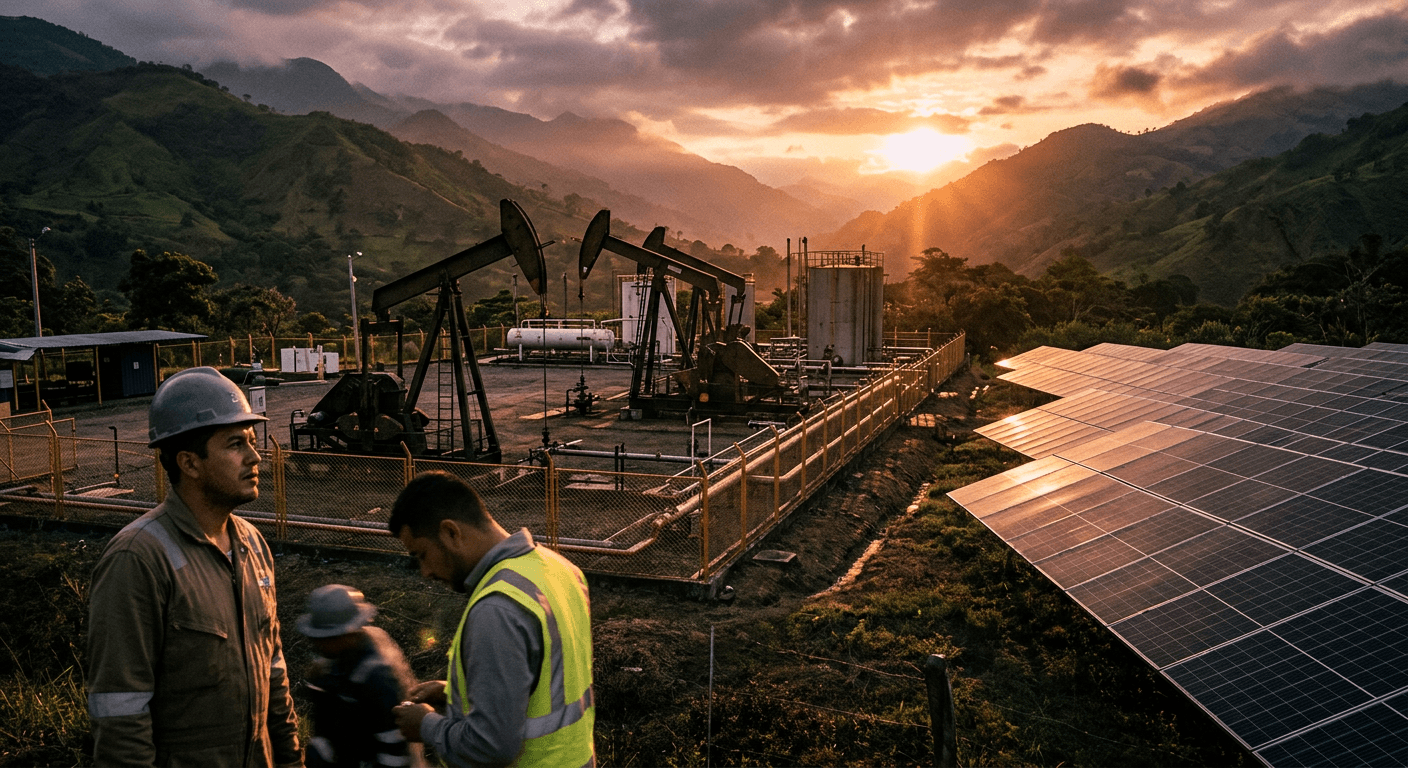
The government's response has been to promote "just transition" initiatives, including investments in green hydrogen, solar and wind projects, and sustainable agriculture. However, analysts question whether these sectors can generate sufficient revenue and employment to replace the oil industry's economic contribution in the near term. Colombia's renewable energy potential is significant, particularly in solar resources along the Caribbean coast and wind power in the Guajira peninsula, but infrastructure development has lagged behind ambitious targets.
Regional Geopolitical Implications
Colombia's energy policy shift has profound implications for Latin American geopolitics. The country has traditionally served as a reliable oil supplier within the region and a strategic partner for the United States in countering leftist movements and drug trafficking. Under Petro, Colombia has moved closer to other progressive governments in the region, strengthening ties with Brazil under President Luiz Inácio Lula da Silva and maintaining dialogue with Venezuela's Nicolás Maduro despite historical tensions.
This realignment has been particularly evident in energy diplomacy. While Petro criticizes fossil fuel dependency, neighboring Venezuela possesses the world's largest proven oil reserves. The potential for energy cooperation between Bogotá and Caracas, including possible joint ventures or technical exchanges, represents a significant shift in regional dynamics. At the same time, Colombia's reduced oil output has created opportunities for other producers, notably Guyana, whose massive offshore discoveries have transformed it into one of the world's fastest-growing oil economies.
Brazil's position as both a major oil producer and a leader in renewable energy makes it a key reference point. Lula's government has pursued a more balanced approach, maintaining oil production while aggressively expanding biofuels, hydroelectric power, and green hydrogen initiatives. Many analysts view Brazil's model as more viable for Colombia than Petro's more radical departure from fossil fuels.
The Role of Multinational Energy Companies
International energy companies have responded to Colombia's policy changes with a mixture of caution and strategic repositioning. Some firms have redirected investments toward more stable jurisdictions, while others have sought to align with the government's green energy priorities. European companies, in particular, have shown interest in Colombia's renewable energy potential, driven by their own decarbonization commitments and European Union climate policies.
Chinese state-owned enterprises have also increased their presence in Latin America, including Colombia. While Beijing has historically focused on oil and mining investments, Chinese firms have demonstrated growing expertise in renewable energy technologies, creating potential partnership opportunities. However, Colombia's complex regulatory environment and history of political instability continue to pose challenges for foreign investors of all nationalities.
Global Energy Markets and Climate Politics
Colombia's changing energy landscape must be understood within the broader context of global energy markets and climate diplomacy. As OPEC+ nations continue to manage production quotas and major consumers like China and India balance energy security with decarbonization goals, every major producer's decisions affect global supply dynamics.
Colombia's reduced output, while relatively small on a global scale, contributes to tighter oil markets at a time when geopolitical tensions in the Middle East and the Russia-Ukraine conflict have already created volatility. This has benefited other producers, including the United States, which has seen its shale oil sector maintain high output levels despite fluctuating prices.
From a climate perspective, Petro's government has positioned Colombia as a moral leader in the Global South's push for climate justice. The president has repeatedly called for wealthier nations to provide financial support for developing countries' energy transitions, arguing that historical emitters bear primary responsibility for addressing climate change. Colombia has been an active participant in forums such as the Conference of the Parties (COP) meetings, advocating for stronger commitments to phase out fossil fuels.
However, this stance has created tensions with other oil-producing developing nations that view premature abandonment of fossil fuels as economically suicidal. Countries like Nigeria, Angola, and several Middle Eastern states have criticized what they see as unrealistic timelines for transition that fail to account for development needs in the Global South.
The Lyrids Meteor Shower and homes: A Metaphorical Aside on Perspective
Just as the annual Lyrids meteor shower offers a momentary glimpse of celestial forces far beyond human control, Colombia's energy debate reflects deeper tectonic shifts in the global economy and climate system. The question of homes—both literal housing for displaced communities and metaphorical "homes" for economic models—lies at the heart of these discussions. Can Colombia build sustainable economic homes for its people without relying on the very resources that have funded development for generations?
Domestic Political Battles and Public Opinion
Within Colombia, energy policy has become a deeply polarizing issue. Petro's approval ratings have fluctuated significantly, with energy and economic management often cited as primary concerns. Opposition parties, business associations, and regional governors from oil-producing areas have mounted fierce resistance to the government's approach.
Public opinion polls suggest a complex picture. Many Colombians support environmental protection and recognize the risks of climate change, particularly in vulnerable areas like the Caribbean coast threatened by rising sea levels. At the same time, concerns about employment, inflation, and economic stability often take precedence in daily life. The government's challenge lies in convincing citizens that the promised benefits of transition will materialize before the costs become politically unsustainable.
Indigenous and Afro-Colombian communities have played important roles in these debates. Many have suffered the environmental and social impacts of oil extraction while seeing limited benefits from resource revenues. Their demands for consultation and consent under international law (including ILO Convention 169) have added another layer of complexity to energy policymaking.
Future Scenarios and Strategic Options
Looking ahead, Colombia faces several possible pathways. The most optimistic scenario for the Petro administration envisions a successful diversification of the economy, with renewable energy, ecotourism, sustainable agriculture, and technology sectors creating new engines of growth. This would require substantial international financial support, careful policy implementation, and favorable global economic conditions.
A more pessimistic scenario involves prolonged economic difficulties, increased fiscal deficits, declining foreign investment, and potential political instability. In this case, a future government might reverse course, reopening exploration and prioritizing short-term revenue generation over long-term transition goals.
Most analysts expect a middle path: partial continuation of Petro's green agenda with pragmatic adjustments to maintain oil production at viable levels while gradually developing alternative industries. The discovery and development of new reserves, particularly in offshore areas, could provide additional time and resources for this transition.
Colombia's lithium resources represent another important element in the global energy transition. As demand for electric vehicle batteries surges, the country's potential lithium deposits could position it as a key player in the clean energy supply chain. However, developing these resources responsibly while avoiding the environmental pitfalls associated with traditional mining remains a significant challenge.
International Relations and Diplomatic Considerations
Colombia's energy policies have attracted attention from major global powers. The United States, traditionally Colombia's closest ally, has expressed concerns about energy security while simultaneously supporting climate initiatives. The Biden administration's emphasis on clean energy has created some alignment with Petro's goals, but Washington remains wary of reduced oil production affecting hemispheric energy stability. Similar dynamics are visible in Mexico's accusations of US meddling and Claudia Sheinbaum's foreign interference amendment, which have reshaped bilateral relations and trade frameworks.
European governments have generally been more supportive of Colombia's transition agenda, offering technical assistance and climate finance. However, European companies also seek policy predictability for their investments. China's growing influence in Latin America adds another dimension, as Beijing pursues both traditional energy projects and new opportunities in renewables and critical minerals.
Regional organizations including the Community of Latin American and Caribbean States (CELAC) and the Pacific Alliance have become important venues for discussing energy cooperation. Colombia's ability to shape these discussions will depend on its economic performance and diplomatic effectiveness in the coming years.
Conclusion
Colombia's energy transition under President Petro represents one of the most significant experiments in resource governance in the Global South. The country's choices will not only determine its own economic future but will influence policy debates across Latin America and beyond. As the world grapples with the dual challenges of climate change and energy security, Colombia's experience offers valuable insights into the practical difficulties of balancing environmental aspirations with economic and social realities.
The fundamental question remains whether a country with substantial oil reserves can successfully pivot to a post-oil economy without sacrificing development gains achieved over decades. The answer will emerge not through ideological pronouncements but through the complex interplay of policy implementation, market responses, technological innovation, and political adaptation.
For Colombia, as for many nations, the energy transition is not merely a technical or environmental challenge but a profound test of governance capacity and national vision. The decisions made in Bogotá today will shape the country's geopolitical position and economic prospects for generations to come. As global pressure for decarbonization intensifies, Colombia's ability to navigate these turbulent waters will be watched closely by governments, investors, and citizens across the developing world.
The stakes could hardly be higher. Success could position Colombia as a model for sustainable development in the 21st century. Failure might serve as a cautionary tale about the perils of overly ambitious transitions disconnected from economic realities. Between these extremes lies the more likely path of incremental, sometimes contradictory progress—a path that reflects both the complexity of the challenge and the resilience of the Colombian people.
Share This Article