The Inner Path · April 16, 2026
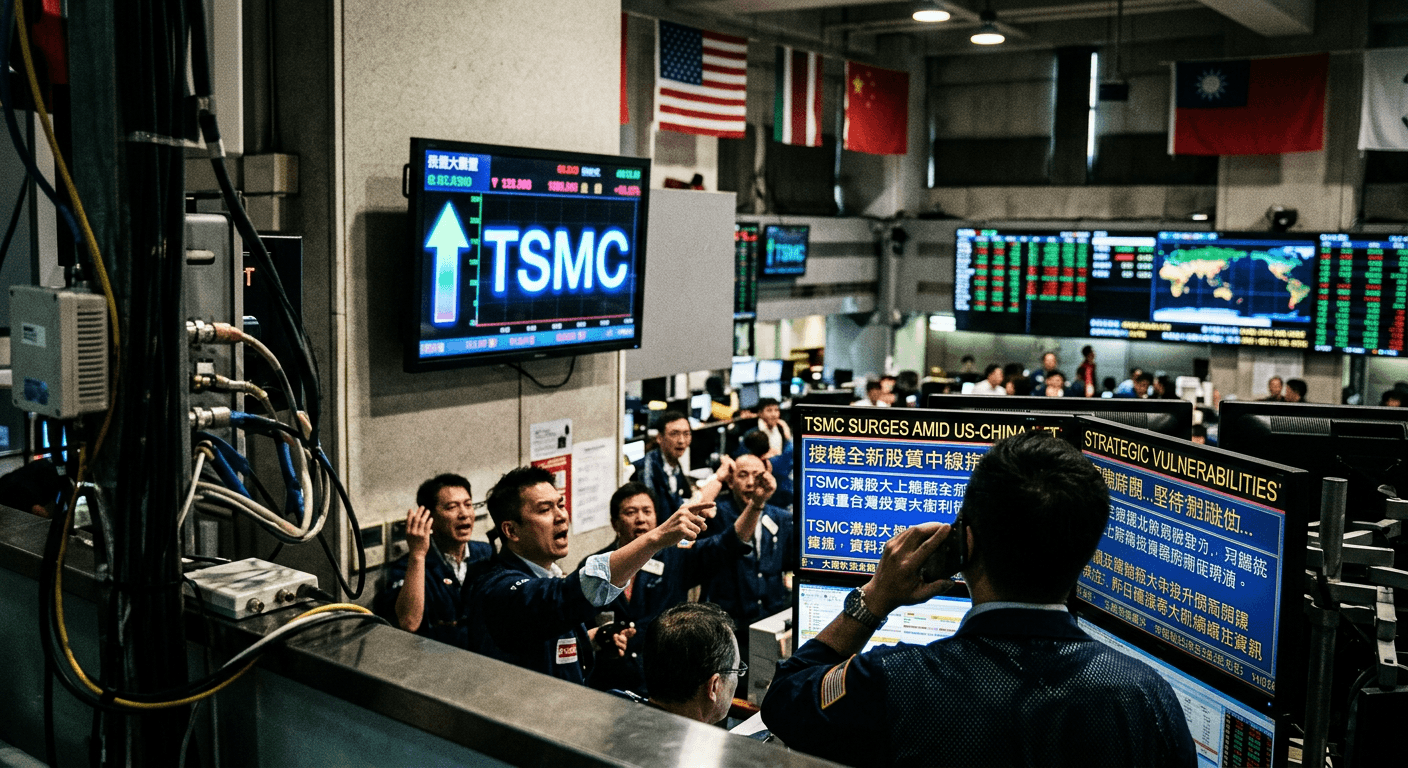
TSMC Stock Surges Amid Geopolitical Tensions: Taiwan's Chip Giant at the Center of US-China Economic Rivalry
Taiwan Semiconductor Manufacturing Company (TSMC) has emerged as one of the most critical assets in the escalating US-China technological and geopolitical contest, with its stock reflecting both massive investor optimism and acute strategic vulnerabilities in the global semiconductor supply chain.
As of April 2026, TSMC stock continues to command global investor attention amid persistent geopolitical uncertainties surrounding Taiwan. The world’s largest contract chipmaker has become far more than a technology stock — it represents a strategic chokepoint in the 21st-century contest for technological supremacy between the United States and China. Recent market movements in TSMC shares reflect both the company’s extraordinary financial performance and the persistent risk of military conflict in the Taiwan Strait.
Founded in 1987 by Morris Chang, TSMC pioneered the pure-play semiconductor foundry model. Today it manufactures over 60% of the world’s most advanced logic chips and maintains a near-monopoly on chips at the 3nm and 2nm process nodes. Its clients include Apple, Nvidia, AMD, Intel, Qualcomm, and virtually every major technology firm on Earth. This dominance has transformed TSMC from a regional manufacturer into a geopolitical asset whose fate could reshape the global economy.
The Strategic Importance of TSMC in US-China Rivalry
The semiconductor industry sits at the intersection of economic power, military capability, and technological leadership. Advanced semiconductors are essential for artificial intelligence, 5G/6G communications, autonomous vehicles, aerospace systems, and modern weapons platforms. In this context, TSMC’s position creates what analysts have termed “the silicon shield” — the idea that both Washington and Beijing have powerful incentives to prevent any disruption to Taiwan’s semiconductor production.
China has made semiconductor self-sufficiency a national priority under its “Made in China 2025” initiative and subsequent policies. Despite massive state subsidies exceeding $100 billion, Chinese foundries remain years behind TSMC in cutting-edge process technology. According to the Semiconductor Industry Association, as of early 2026, Chinese firms can produce 7nm chips at scale with difficulty, while TSMC has already moved into risk production of 2nm chips scheduled for commercial availability in late 2026.
The United States has responded with sweeping export controls on advanced semiconductor manufacturing equipment to China, particularly targeting ASML’s extreme ultraviolet (EUV) lithography machines. These restrictions, expanded under both the Biden and subsequent administrations, have slowed China’s technological ascent while increasing global demand for TSMC’s limited production capacity.
Recent Stock Performance and Market Context
TSMC’s American Depositary Receipts (NYSE: TSM) have shown remarkable resilience. Despite periodic sell-offs triggered by Taiwan Strait tensions, the stock has substantially outperformed broader markets over the past five years. Strong demand for AI accelerators — particularly Nvidia’s GPUs manufactured almost exclusively at TSMC — has driven record revenues.
In its most recent quarterly results prior to April 2026, TSMC reported approximately 27% year-over-year revenue growth, with particularly strong performance in its High Performance Computing segment. Gross margins have remained above 50%, exceptional for a capital-intensive manufacturing business. Analysts at firms including Goldman Sachs and Morgan Stanley have maintained overweight ratings, citing TSMC’s technological lead and structural AI demand as key drivers.
However, valuation remains a concern for some investors. With a market capitalization exceeding $1 trillion, TSMC trades at forward price-to-earnings multiples that reflect both its growth prospects and the geopolitical risk premium. Any escalation in cross-strait tensions typically triggers immediate volatility in TSM shares, demonstrating how financial markets price in tail risks related to potential Chinese military action.
Taiwan’s “Silicon Shield” and Military Calculations
The concept of the silicon shield suggests that China would be reluctant to invade Taiwan because such an action would likely destroy or severely impair TSMC’s facilities. A 2022 report by the Center for Strategic and International Studies (CSIS) estimated that a conflict over Taiwan could reduce global semiconductor production by up to 45% in the first year. The economic consequences would dwarf those of the Russia-Ukraine war.
TSMC has taken deliberate steps to reduce this vulnerability. Under pressure from both the Taiwanese government and major customers, the company has expanded its geographic footprint. Its Fab 21 in Arizona began limited production in 2025, though yields and costs have reportedly lagged behind Taiwanese facilities. A new facility in Japan and expanded operations in Germany further diversify risk, though experts note that the most advanced process technologies remain concentrated in Taiwan.
Chinese military exercises around Taiwan have become routine. The People’s Liberation Army conducted major drills in May 2024 and again in late 2025, simulating blockade and invasion scenarios. Each episode creates short-term pressure on TSMC stock and broader semiconductor shares. Yet Beijing’s continued restraint reflects an understanding of the catastrophic economic self-harm that would result from disrupting Taiwan’s chip production.
The “Red Supply Chain” Risk
Despite the strategic standoff, economic integration between Taiwan and mainland China remains deep. TSMC itself maintains certain operations and supplier relationships across the strait. Beijing has cultivated what analysts call the “red supply chain” — Chinese companies with close ties to the Chinese Communist Party that have gradually increased their role in the semiconductor ecosystem.
US intelligence assessments have reportedly warned that some Taiwanese semiconductor executives and suppliers maintain concerning relationships with mainland entities. This creates ongoing counterintelligence challenges for both Taipei and Washington. The CHIPS and Science Act passed by the United States in 2022 explicitly restricts recipients of federal subsidies from expanding advanced manufacturing in China, directly affecting TSMC’s expansion plans.
US Policy: Onshoring, Friendshoring, and Export Controls
The United States has pursued a multi-pronged strategy to reduce dependence on Taiwanese semiconductors while avoiding direct provocation. The CHIPS Act allocated nearly $53 billion for domestic semiconductor manufacturing, research, and workforce development. Major recipients include Intel, Samsung, and TSMC’s Arizona facility.
However, progress has been slower than anticipated. Construction delays, skilled labor shortages, and higher operating costs in the United States have challenged the economics of new fabs. TSMC reportedly increased its capital expenditure guidance for 2026 partly due to these overseas expansion efforts.
Simultaneously, Washington has strengthened export controls through the Wassenaar Arrangement and unilateral measures. The October 2023 and subsequent updates to the Entity List and Foreign Direct Product Rule have significantly restricted China’s access to advanced AI chips and manufacturing tools. These policies have increased TSMC’s importance as virtually the only manufacturer capable of producing the highest-end chips that American and allied nations require. Trump-Xi Summit Signals Fragile Pause in US-China Trade War as Taiwan Remains the Core Flashpoint
Economic Implications Beyond Geopolitics
TSMC’s centrality creates both opportunities and vulnerabilities for the global economy. On one hand, the company’s technological leadership has enabled the explosive growth of artificial intelligence applications. Nvidia’s market capitalization surge is directly connected to TSMC’s ability to manufacture its sophisticated GPUs at scale. Google’s recent overtaking of OpenAI as the dominant force in consumer AI is further intensifying competition for advanced chips produced by TSMC.
On the other hand, the concentration risk is extraordinary. A major earthquake in Taiwan — a seismically active region — could disrupt global chip supplies for months. The 2022 COVID lockdowns in Shanghai and the earlier 2011 Japan earthquake both demonstrated how fragile global supply chains can be. TSMC’s “earthquake now” mentions in trending topics often correlate with immediate investor concern about potential production impacts.
Central banks and financial regulators have begun incorporating semiconductor supply risk into their macroeconomic models. The International Monetary Fund has warned that a serious disruption to Taiwanese semiconductor production could shave 1-2 percentage points off global GDP growth in the first year following such an event.
Investment Considerations for TSMC Stock
For investors, TSMC represents a unique combination of exceptional business quality and geopolitical risk. The company’s technological moat appears formidable in the near term. Its capital investments — exceeding $30 billion annually — continue to widen the gap with competitors including Samsung and Intel. SK Hynix Stock Surge and Memory Chip Demand
Yet the risk of Chinese military action, while not considered the base case by most analysts, cannot be dismissed. A Taiwan contingency would likely trigger immediate capital flight from TSM shares and related technology stocks. Some investors have begun utilizing options strategies or geopolitical risk hedges when constructing positions in TSMC.
Longer-term, successful geographic diversification and continued technological leadership could reduce the risk premium currently embedded in TSMC’s valuation. The company’s move into 2nm and eventually 1.6nm processes, coupled with its entry into advanced packaging technologies critical for AI, positions it at the center of multiple secular growth trends.
Conclusion
TSMC stands as one of the most important companies in the global economy and a central character in the unfolding US-China geopolitical drama. Its stock price reflects both the extraordinary value of its technological leadership and the persistent risk that its primary manufacturing base sits just 100 miles from the Chinese mainland. National security concerns driving TikTok Spinoff Deal and US-China Tech Trade further illustrate how data sovereignty and technology decoupling are accelerating across multiple sectors.
The coming years will test whether the silicon shield holds. Beijing’s patience with its “core interest” regarding Taiwan appears limited, while Washington has signaled its determination to maintain the military balance across the strait. For investors, policymakers, and corporate strategists alike, understanding TSMC’s strategic position has become essential to navigating the increasingly fractious global economic order.
As artificial intelligence capabilities accelerate and military applications of advanced chips expand, the stakes surrounding TSMC will only grow. The company that began as a visionary experiment by Morris Chang has become an indispensable pillar of the modern world — and a potential flashpoint for great power conflict. Its stock will continue to serve as a barometer for both technological optimism and geopolitical anxiety in the years ahead.
Share This Article