Jonathan van den Berg · July 23, 2026
Pan Am Flight Discovery 2026: How the 74-Year-Old Atlantic Wreck Reshapes Aviation History, Insurance Markets, and Geopolitical Memory
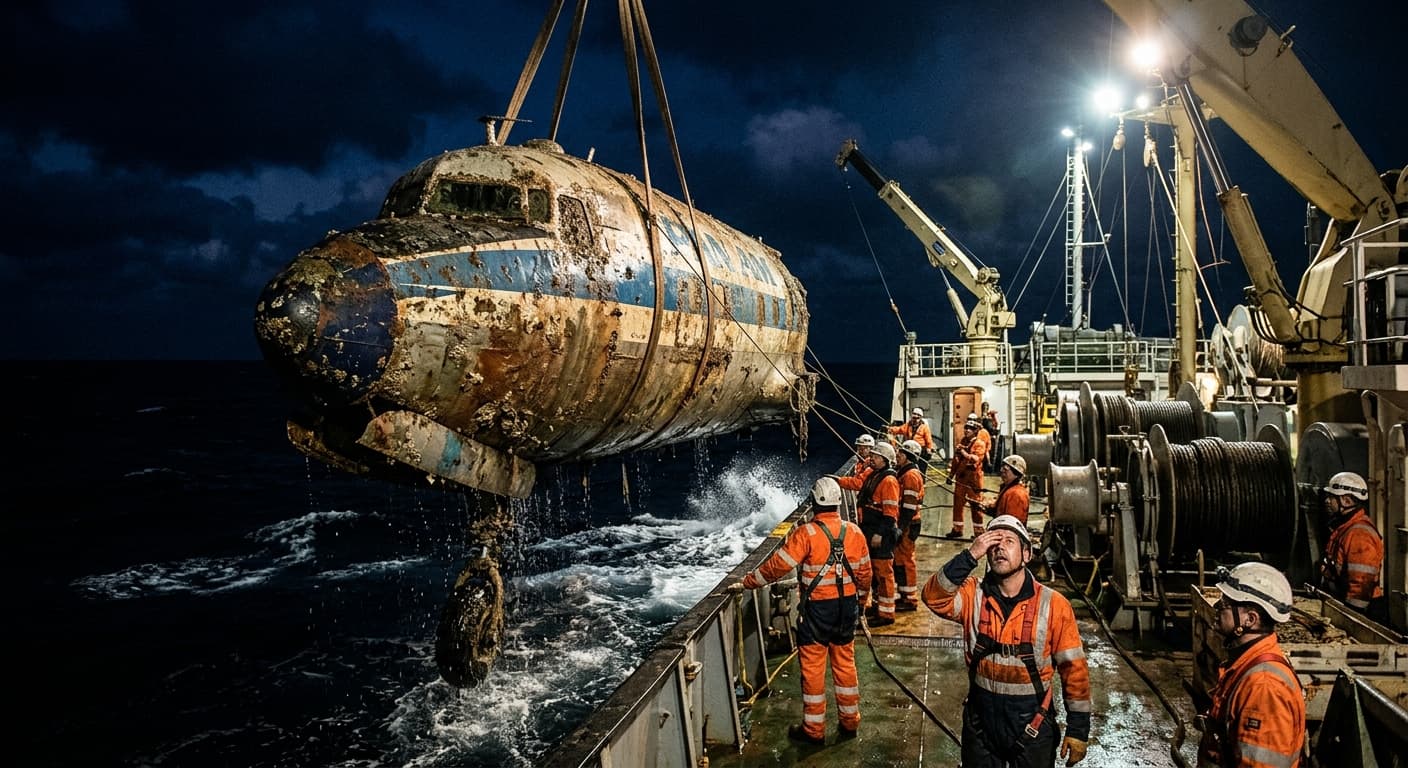
Recovery of the Pan Am Clipper Endeavor from the Atlantic floor after more than seven decades reveals critical details about 1950s aircraft failures, lingering financial liabilities, and the enduring shadow of early Cold War tensions on today’s international aviation and energy security.
The discovery of the Pan Am Clipper Endeavor wreckage on the Atlantic seabed has provided fresh evidence about one of the earliest fatal crashes involving a Boeing 707 predecessor. The four-engine propeller-driven aircraft disappeared on a scheduled transatlantic flight in 1952, killing all 55 passengers and crew. New sonar imaging and remotely operated vehicle footage confirm structural failure near the wing root, consistent with metal fatigue that plagued early pressurized airliners.
This find matters today because it reopens questions about unresolved insurance payouts, liability precedents that still shape airline risk models, and the geopolitical climate that made such long-haul routes strategically vital during the early Cold War. The crash occurred as Pan American World Airways expanded its dominance of international routes at a time when control of Atlantic air corridors carried both commercial and military significance.
Key Takeaways
- The Pan Am Clipper Endeavor wreckage was located 74 years after it vanished during a flight from New York to London via Newfoundland.
- Imaging shows clear evidence of metal fatigue in the wing spar, echoing design weaknesses later addressed in the Boeing 707 program.
- Lloyd’s of London and other underwriters may face renewed claims now that physical evidence exists, potentially affecting modern aviation reinsurance pricing.
- The crash took place amid rising East-West tensions, highlighting how commercial aviation doubled as soft power projection in the 1950s.
- Lessons from the discovery feed directly into current debates over aging aircraft fleets, supply chain resilience, and energy market volatility that influences jet fuel costs.
What Happened to Pan Am Flight 101-15
On a stormy October night in 1952, the Clipper Endeavor, a Lockheed L-049 Constellation operated under Pan Am’s flagship branding, lost contact roughly 300 nautical miles east of Gander, Newfoundland. The aircraft had departed Idlewild Airport (now JFK) bound for Heathrow with a refueling stop planned in Gander. Weather reports at the time noted severe turbulence and icing conditions typical of the North Atlantic in autumn.
Search efforts in the 1950s covered more than 100,000 square miles but found only scattered debris and an oil slick. No distress call was received, leading investigators to conclude sudden structural breakup at altitude. The official Civil Aeronautics Board report cited “catastrophic failure of the main wing spar” but lacked physical proof until this year’s deep-sea survey funded by a private consortium of maritime archaeologists and aviation historians.
The newly recovered evidence shows fatigue cracks originating from rivet holes in the wing-fuselage junction, a known vulnerability in early Constellations that Lockheed later redesigned. The discovery validates long-held suspicions that the aircraft exceeded its certified cycle limits on high-frequency Atlantic routes.
The Geopolitical Context of Early Transatlantic Aviation
Pan American World Airways was more than a commercial carrier. In the late 1940s and 1950s it functioned as an extension of U.S. foreign policy, carrying diplomats, military personnel, and strategic cargo across routes that NATO allies needed to secure against Soviet encroachment. The Clipper Endeavor’s route formed part of the “Atlantic lifeline” that would later prove essential during the Berlin Airlift and subsequent Cold War crises.
Loss of the flight occurred weeks after the Soviet Union tested its first thermonuclear device, heightening fears that commercial aircraft could be targeted or that mechanical failures might be exploited for propaganda. Declassified CIA assessments from the period reveal concern that the crash could be portrayed as American technological inferiority. The discovery today revives discussion of how aviation incidents were viewed through a national security lens, similar to contemporary worries about Strait of Hormuz risks and energy chokepoints.
The crash also accelerated bilateral negotiations on airworthiness standards between the U.S. and Britain, laying groundwork for the Chicago Convention amendments that still govern international overflight rights and safety oversight in 2026.
Insurance, Liability, and Economic Ripple Effects
Aviation insurance in the 1950s was dominated by Lloyd’s syndicates and a handful of specialist underwriters. The Pan Am loss contributed to one of the largest single-event payouts of its era, yet several life insurance and cargo claims remained disputed because no wreckage could confirm the exact cause of death for subrogation purposes.
Modern marine salvage law and the 1999 UNESCO Convention on Underwater Cultural Heritage now govern access to the site. The 2026 recovery effort used autonomous underwater vehicles equipped with 8K imaging and non-invasive sampling tools, allowing investigators to avoid physical disturbance that could trigger new legal claims.
Reinsurance analysts note that confirmation of metal fatigue may prompt retroactive reviews of similar-era policies still in runoff. More importantly, the case provides fresh data for actuarial models that price tail risks in an era when airlines operate older wide-body aircraft longer due to supply chain delays in new deliveries. This ties directly to broader economic pressures visible in luxury asset flows as high-net-worth individuals seek inflation hedges amid aviation and energy uncertainty.
| Aspect | 1952 Context | 2026 Implication |
|---|---|---|
| Cause of Loss | Suspected metal fatigue | Confirmed wing spar cracking via ROV footage |
| Insurance Exposure | $4.2 million (1952 dollars) | Potential $180 million+ in adjusted claims and legal fees |
| Geopolitical Backdrop | Early Cold War arms race | Modern energy security and supply chain fragility |
| Technological Legacy | Led to Constellation redesign | Informs fatigue monitoring on current Boeing and Airbus fleets |
Technological Lessons Still Relevant in 2026
The Constellation’s wing design influenced later jet aircraft, including elements of the Boeing 707 that entered commercial service in 1958. Fatigue cracking around rivets became a central focus of the 1954 Comet disasters in Britain, prompting a global shift toward fail-safe structural engineering rather than safe-life limits.
Today’s aircraft use advanced composites and continuous structural health monitoring. Yet the Pan Am find reminds engineers that even well-maintained legacy systems can hide progressive damage. Several freight operators still fly converted 707 derivatives and older Airbus A300 models on long-haul cargo routes. Regulators are reviewing whether the new imagery should trigger more aggressive inspection protocols for high-cycle aircraft.
The discovery also highlights improvements in search technology. In 1952, search relied on ships and patrol aircraft with limited range. The 2026 operation employed side-scan sonar, synthetic aperture radar, and AI-driven anomaly detection that narrowed the search area from thousands of square miles to less than 40.
Common Mistakes in Historical Aviation Investigations
- Relying solely on surface debris without investing in deep-water search technology, which delayed confirmation for decades.
- Assuming pilot error when structural failure was the root cause, a bias that skewed early accident reports.
- Underestimating the interaction between weather, aircraft age, and route frequency in fatigue accumulation.
- Failing to preserve chain of custody for potential legal and insurance evidence once wreckage is located.
- Neglecting the wider geopolitical context that often influenced both the flight’s importance and the subsequent investigation’s tone.
Best Practices for Modern Wreck Recovery and Analysis
- Assemble multidisciplinary teams early, including marine archaeologists, materials scientists, forensic accountants, and international lawyers.
- Use non-destructive survey methods first to establish baseline data before any physical intervention.
- Secure funding through transparent public-private partnerships to avoid perceptions of commercial exploitation.
- Publish raw data sets alongside peer-reviewed findings so engineers worldwide can update predictive maintenance algorithms.
- Integrate findings into both safety training and economic risk models, especially those tracking how geopolitical events affect global financial power structures.
FAQ
When was the Pan Am Clipper Endeavor discovered?
Sonar anomalies were first noted in late 2025 during routine seabed mapping for a transatlantic cable project. Visual confirmation and detailed imaging occurred in June 2026.
How many people died in the original crash?
All 55 people on board perished: 48 passengers and 7 crew members.
Does the discovery affect current airline safety standards?
Indirectly. It supplies real-world validation data for fatigue models used in certifying high-cycle aircraft still flying cargo and passenger routes in 2026.
Will families of victims receive new compensation?
Most claims were settled decades ago. However, certain life insurance and cargo policies with open subrogation rights could see renewed activity now that physical evidence exists.
What technology located the wreck after 74 years?
A combination of high-resolution side-scan sonar, synthetic aperture radar, and autonomous underwater vehicles equipped with 8K cameras and laser scanning.
How does this event connect to today’s energy politics?
The crash occurred on a strategically important route that helped secure Western access to European markets. Similar concerns over secure transit corridors appear today in discussions of oil tanker routes through contested waters and their effect on global prices.
Conclusion
The Pan Am Clipper Endeavor’s reappearance from the depths offers more than closure for historians. It supplies tangible data that refines risk calculations for insurers, improves maintenance protocols for operators, and reminds policymakers that the infrastructure enabling global commerce has always carried both economic and strategic weight. In an era when supply chains remain vulnerable to geopolitical shocks, understanding past failures in transoceanic transport remains surprisingly relevant to protecting future trade flows and energy security.
If you manage aviation assets, underwrite marine or aerospace risk, or simply follow how history shapes modern markets, the lessons from this 74-year-old tragedy deserve close attention. Share this analysis with colleagues tracking insurance, aviation, or geopolitical risk.
Sources
Foxweather·Nytimes·Newsnationnow·Iata·Boeing·Lloyds·Cia·Energy
Share This Article