Jonathan van den Berg · July 10, 2026
Joe Rogan on Trump Iran War: How the Conflict Reshapes Global Oil Markets and Energy Security
Joe Rogan has used his platform to examine the Trump administration’s military actions against Iran, focusing on threats to the Strait of Hormuz and the resulting spikes in global oil prices that affect everyday consumers and economies worldwide.
Joe Rogan has spotlighted the Trump administration’s strikes on Iran, zeroing in on the immediate danger to oil tanker traffic through the Strait of Hormuz and the resulting jump in global energy costs. His conversations frame the conflict not as abstract geopolitics but as a pocketbook issue that hits drivers, manufacturers, and governments simultaneously.
Key Takeaways
- Trump-ordered strikes on Iranian targets have raised fears of deliberate disruption in the Strait of Hormuz, through which roughly 21 million barrels of oil move daily.
- Oil prices climbed more than 12 percent in the first week after major strikes, according to trading data cited across financial desks.
- Joe Rogan’s episodes with former officials and analysts have reached millions, amplifying public focus on energy security and inflation risks.
- Asian economies importing over 70 percent of their crude through the strait face the steepest exposure to supply shocks.
- Alternative routes and strategic petroleum reserves offer only temporary relief before sustained higher prices ripple into consumer goods and transport costs.
The Trump Iran Conflict and Joe Rogan’s Take
Joe Rogan’s podcast has become an unlikely clearinghouse for detailed discussion of the Trump administration’s decision to strike Iranian nuclear sites and port facilities. Guests ranging from ex-intelligence officers to energy traders have walked listeners through the mechanics of closing the Strait of Hormuz and the limited options available to the U.S. Navy for keeping the channel open.
Rogan repeatedly returns to a simple question: how quickly do higher fuel costs reach the grocery store and the airport? That framing has resonated. Clips from recent episodes circulated widely on social platforms, coinciding with reports of tanker insurance rates doubling in the Persian Gulf.
The host has avoided partisan cheerleading. Instead he presses guests on timelines, asking how long Iran could sustain mine-laying operations before U.S. and allied minesweepers clear a path. These exchanges have drawn criticism from both hawks who want simpler messaging and doves who see the platform as too tolerant of military voices.
Strategic Importance of the Strait of Hormuz
The Strait of Hormuz measures roughly 21 nautical miles at its narrowest point. Tankers carrying Saudi, Iraqi, Kuwaiti, and Emirati crude must pass through it. Qatar’s liquefied natural gas exports also transit the same waters. Any credible threat to close the strait immediately removes about one-fifth of global oil supply from the market.
Iran has practiced swarm-boat tactics and anti-ship missile launches in these waters for years. Military analysts note that even sporadic attacks on commercial shipping would force shipping companies to reroute around Africa or halt voyages altogether while insurers reassess risk.
Earlier analysis of the Iran war details how past threats to the strait produced oil price spikes that lasted months even when the channel stayed physically open. The current situation carries higher stakes because multiple Iranian proxy groups have signaled willingness to join the fight.
Oil Price Reaction and Market Mechanics
Brent crude jumped from the low $70s to above $85 per barrel within days of the first reported U.S. strikes. West Texas Intermediate followed a similar trajectory. Futures markets showed steep contango, indicating traders expect elevated prices to persist for several months.
Refiners in Europe and Asia scrambled to secure cargoes from Atlantic Basin sources. U.S. shale producers increased drilling permits, yet the lag between drilling and actual new barrels reaching market limits immediate relief. Strategic petroleum reserves in the United States, Japan, and South Korea have begun coordinated releases, but these are finite tools.
Joe Rogan’s guests have pointed out that sustained prices above $90 could tip several emerging economies into balance-of-payments crises. India and Pakistan, both heavy buyers of discounted Russian and Iranian crude before the latest escalation, now face sharply higher import bills.
Broader Economic and Geopolitical Ripple Effects
Higher energy costs feed directly into inflation readings. Central banks already navigating sticky services inflation must decide whether to raise rates further or accept slower growth. European manufacturers, already squeezed by past energy shocks, face renewed pressure on margins.
Asian stock markets reacted negatively. Korean and Japanese equities fell as investors repriced the cost of imported energy. Shipping shares showed mixed performance: tanker owners benefited from higher rates while container lines worried about reduced consumer demand.
The conflict has also complicated negotiations on other fronts. Russia, a major beneficiary of higher oil prices, has limited incentive to push for rapid de-escalation. China, the largest single buyer of Iranian crude before sanctions tightened, must now balance its need for stable energy supplies against its strategic partnership with Tehran.
Analysis of long-term oil flow changes shows that repeated disruptions accelerate the shift toward diversified supply chains and faster uptake of non-oil transport fuels, though the transition remains measured in decades rather than years.
Joe Rogan’s Influence on Public Understanding of Energy Politics
With an audience that spans truck drivers, tech workers, and small business owners, Rogan’s long-form conversations translate complex logistics into relatable terms. Listeners hear about the difference between light sweet crude and heavier Iranian grades, why insurance costs matter more than headline barrel counts, and how quickly strategic reserves can actually reach refineries.
Critics argue the podcast sometimes gives airtime to overly pessimistic scenarios. Supporters counter that mainstream outlets have underplayed the economic consequences in favor of purely military analysis. The result is a parallel conversation that reaches demographics traditional news rarely touches.
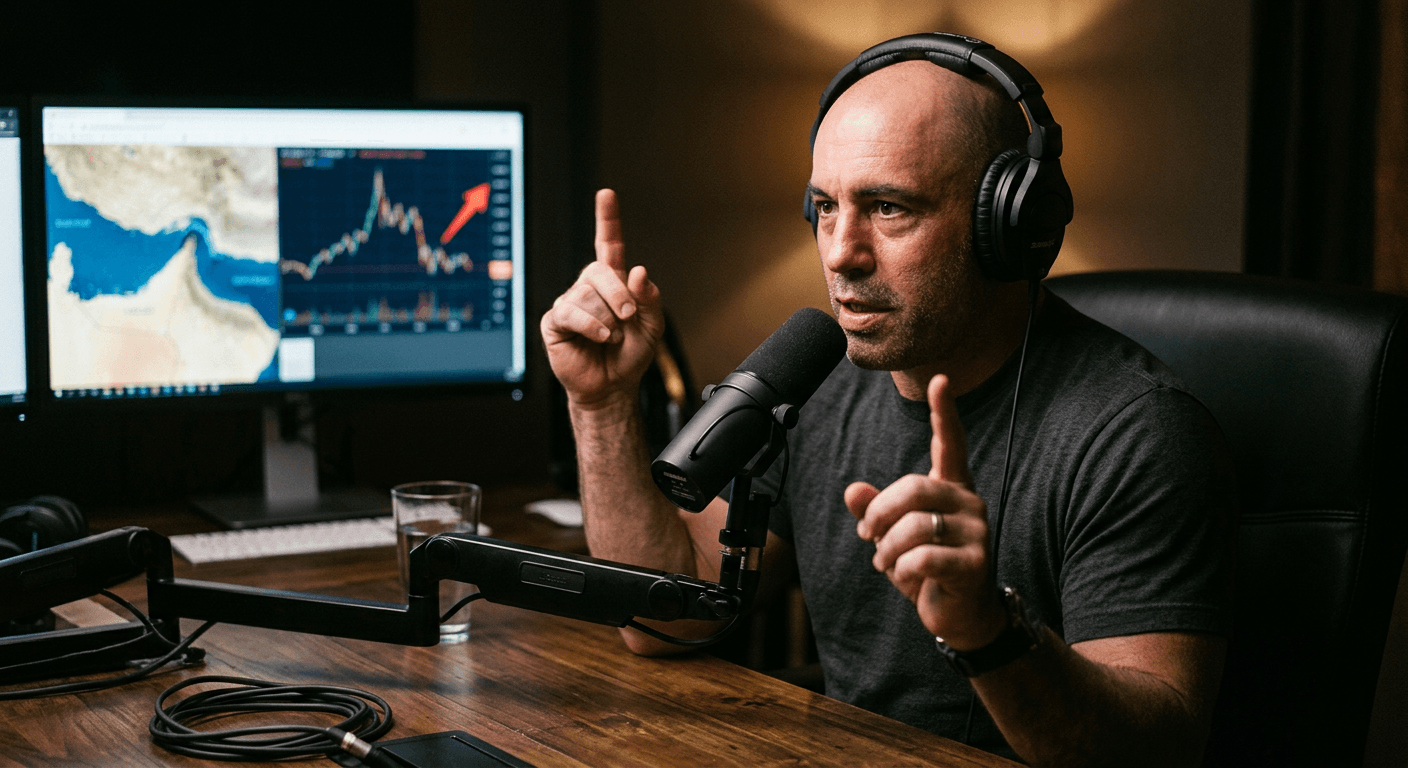
Recent episodes have featured detailed maps of the strait, explanations of mine countermeasures, and discussions of sanctions enforcement on shadow tanker fleets. These segments function as informal briefings for millions who otherwise encounter the story only in 30-second television hits.
Regional Flashpoints and Connected Conflicts
The Iran strikes have not occurred in isolation. Recent explosions in Damascus raised questions about coordinated pressure across multiple theaters. Observers note that instability in Syria can affect overland routes that serve as partial alternatives to the strait.
Coverage of the Damascus strikes illustrates how regional instability compounds the primary risk in the Persian Gulf. When multiple chokepoints appear vulnerable at once, risk premiums in energy markets compound.
Kuwait, sitting at the northern end of the Gulf, has quietly accelerated talks on additional pipeline capacity to bypass the strait. These infrastructure decisions, once seen as expensive insurance policies, now look like prudent hedging.
Kuwait’s position in the current crisis highlights how smaller Gulf states must balance relations with Washington, Tehran, and their own economic survival.
Common Mistakes in Assessing the Crisis
- Assuming the strait can be closed indefinitely: Iran lacks the naval capacity for a permanent blockade but can impose costly intermittent disruption.
- Believing U.S. strategic reserves solve the problem: Releases buy time but do not replace lost daily flows of 21 million barrels.
- Underestimating insurance and freight rate effects: Even when oil physically moves, the cost of moving it can double shipping expenses overnight.
- Overlooking substitution lags: Switching power plants from oil to gas or accelerating electric vehicle adoption takes years, not weeks.
Best Practices for Businesses and Consumers
- Lock in fuel contracts where possible. Many large fleet operators have shifted to fixed-price agreements for the next six to twelve months.
- Diversify supply chains. Manufacturers dependent on Asian components should model scenarios with 20-30 percent higher logistics costs.
- Review energy efficiency investments. Payback periods for LED lighting, insulation, or more efficient HVAC shorten when energy prices rise.
- Monitor futures curves. Steep backwardation often signals acute near-term shortages that may ease later; contango suggests longer-term pressure.
- Consider geographic exposure. Companies with heavy reliance on European or East Asian markets should prepare for weaker consumer demand as fuel and utility bills climb.
FAQ
How high could oil prices go if the Strait of Hormuz is disrupted?
Analysts have modeled scenarios ranging from $110 to $150 per barrel for Brent if sustained attacks reduce throughput by half for more than a month. Exact levels depend on how quickly alternative supplies ramp up and how aggressively consuming nations tap reserves.
What has Joe Rogan said about the likelihood of wider war?
Rogan has expressed skepticism that either side wants total regional war but has highlighted how miscalculation or proxy escalation could produce exactly that outcome. He repeatedly asks guests to quantify probabilities rather than offer vague assurances.
Will gas prices in the United States reach record highs?
Current forecasts suggest national average prices could climb toward $4.50-$5.00 per gallon if the crisis drags into autumn, though regional differences remain large. States dependent on Gulf Coast refining would feel the impact first.
How are Asian economies preparing for higher energy costs?
Japan, South Korea, and China have increased coal and LNG imports while accelerating domestic nuclear restarts where politically feasible. Long-term plans include faster rollout of renewables, but immediate relief comes mainly from strategic stockpiles.
Could cryptocurrency or gold serve as hedges against this instability?
Both assets have shown positive correlation with oil price spikes in past crises. However, liquidity and regulatory risks remain. Several analysts cited on Rogan’s show recommend modest allocations within diversified portfolios rather than outright replacement of traditional safe havens.
Conclusion
The Trump Iran war has moved energy security from abstract policy papers back into daily headlines and household budgets. Joe Rogan’s lengthy, unfiltered discussions have helped millions connect the dots between distant naval maneuvers and the price at the pump. While military outcomes remain uncertain, the economic consequences are already measurable and will shape policy choices for years. Businesses and individuals who treat sustained higher energy prices as a baseline rather than a temporary shock will be better positioned to navigate the new reality.
Understanding these linkages matters whether you run a logistics company, manage an investment portfolio, or simply fill up your tank each week. The conversation Joe Rogan has amplified is ultimately about translating geopolitical risk into practical decisions that affect real economies and real lives.
Share This Article