Jonathan van den Berg · July 7, 2026
Explosions in Damascus 2026: How Middle East Strikes Reshape Syria's Future, Global Oil Markets, and Energy Politics
Recent explosions in Damascus during French President Macron's visit highlight escalating tensions in post-Assad Syria. These strikes carry direct consequences for global energy flows, oil market volatility, and the delicate balance of Middle East power.
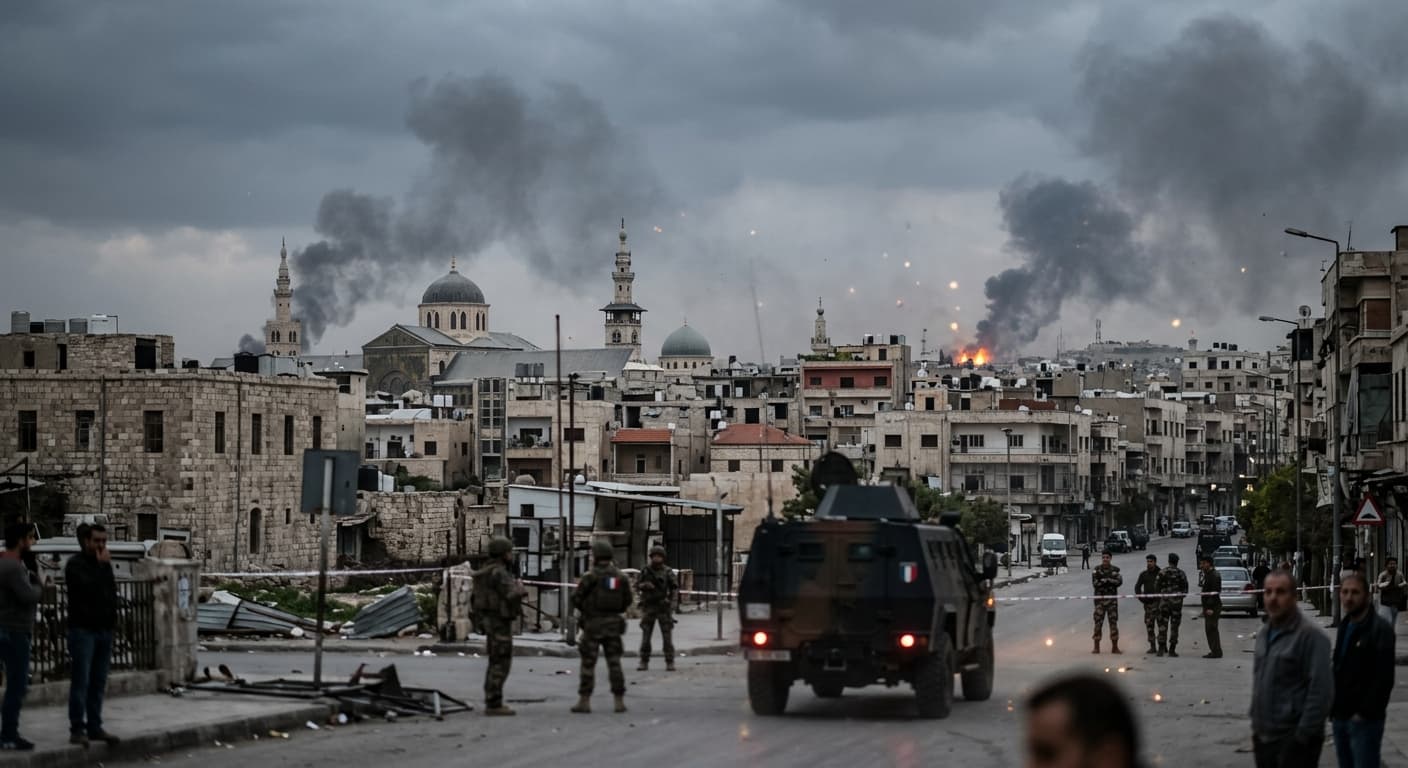
Explosions in Damascus struck during French President Emmanuel Macron's high-profile visit to Syria, sending immediate shockwaves through an already fragile region. The blasts, heard across the capital with unknown perpetrators, underscore the persistent volatility in post-Assad Syria and its direct ties to global energy security and economic stability.
These incidents occur against a backdrop of competing foreign interests, reconstruction challenges, and energy politics that ripple into oil markets worldwide. For investors, businesses, and policymakers, the events highlight how local instability in strategic Middle East locations can quickly influence commodity prices, trade routes, and broader geopolitical calculations.
Key Takeaways
- Explosions in Damascus coincided with Macron's visit, raising questions about targeted disruption of diplomatic efforts in Syria.
- The strikes expose vulnerabilities in Syria's transition, with multiple actors—including regional powers and non-state groups—vying for influence.
- Global oil markets remain sensitive to any escalation in the Levant, with potential spillover into the Strait of Hormuz and other energy chokepoints.
- Bitcoin and other cryptocurrencies continue acting as alternative stores of value during periods of Middle East uncertainty, as seen in recent market behavior.
- Reconstruction and stabilization in Syria carry significant implications for European energy diversification and global supply chain resilience.
What Happened in Damascus
Witnesses reported multiple explosions near key government and diplomatic areas in the Syrian capital. The timing—during Macron's visit aimed at supporting political transition and economic recovery—suggests possible attempts to undermine international engagement.
French officials have not confirmed targets, but the incidents echo patterns of proxy conflicts where external powers signal opposition to shifting alliances. Syrian security forces quickly secured the sites, yet the lack of immediate claims of responsibility leaves room for speculation involving residual regime elements, Islamist factions, or rival foreign intelligence operations.
Macron's presence itself marks a bold European move into a space traditionally dominated by Russian, Iranian, Turkish, and American interests. His agenda reportedly included discussions on refugee returns, counterterrorism cooperation, and opening economic pathways—topics that directly intersect with energy politics given Syria's geographic position between major oil and gas transit routes.
Geopolitical Context: Syria After Assad
Syria's political landscape remains fractured years after the fall of Bashar al-Assad. Various factions control different territories, with Turkey focused on Kurdish areas, Russia maintaining naval and air assets, and Iran seeking to preserve land corridors to Hezbollah in Lebanon.
The explosions highlight the difficulty of establishing stable governance. Any power vacuum invites opportunistic strikes designed to derail reconstruction or influence the balance of power. For Europe, a stable Syria could reduce migration pressures and open new avenues for natural gas imports, lessening dependence on volatile suppliers.
These dynamics connect directly to broader regional tensions. Recent Kuwait tensions linked to Iran conflict demonstrate how seemingly isolated incidents can rapidly affect energy calculations across the Middle East.
Impact on Global Oil Markets and Energy Prices
Middle East instability consistently drives oil price volatility. Even when explosions occur far from major oil fields, markets price in risk premiums. Analysts note that any escalation involving Syria can indirectly pressure shipping routes and investor sentiment toward energy assets.
The International Energy Agency's latest oil market report shows global spare capacity remains tight. Additional disruptions—whether physical or psychological—can push Brent crude above key resistance levels. European nations, still recovering from previous energy shocks, watch these developments closely as they affect winter heating costs and industrial competitiveness.
Related incidents, such as past US strikes on Iran that threatened the Strait of Hormuz, illustrate how quickly regional conflicts translate into higher prices at the pump and increased costs for businesses worldwide.
Current Oil Market Dynamics
Recent data indicates:
- Global oil demand growth slowing due to extreme heat impacts on economic activity in major Asian markets.
- OPEC+ production policy remaining a key variable amid uncertain demand forecasts.
- Increased diversification efforts by importers seeking alternatives to traditional Middle East suppliers.
These factors explain why seemingly peripheral events in Damascus register quickly in trading rooms from London to Singapore.
Connections to Cryptocurrency Markets
Periods of geopolitical tension often drive interest in bitcoin as a non-sovereign asset. Recent analysis shows Michael Saylor's strategy helped stabilize bitcoin during market drawdowns, positioning it as a balancing force when traditional markets face risk-off sentiment driven by Middle East events.
Despite a 54% drawdown earlier this year, Bernstein analysts maintain ambitious $150,000 year-end targets for bitcoin, citing its role during times of fiat currency uncertainty and geopolitical stress. The explosions in Damascus add another data point supporting the narrative that bitcoin serves as a hedge against instability in energy politics.
This pattern aligns with broader themes explored in discussions around cryptocurrency trading and the erosion of the petrodollar.
Macron's Syria Visit: Strategic Calculations
France's re-engagement with Syria reflects broader European efforts to assert independent foreign policy in the Mediterranean. Macron aims to position France as a mediator and investor in Syrian reconstruction, potentially securing contracts for French companies in energy, infrastructure, and security sectors.
Success depends on navigating relationships with Turkey, which controls significant territory in northern Syria, and the United States, which maintains a military presence in the east to counter ISIS remnants. The explosions may represent an attempt to deter such Western involvement or to shift the narrative around Syria's stability.
Risks to Regional Stability and Global Trade
Beyond immediate security concerns, the incidents threaten several critical areas:
- Refugee flows that could again strain European borders and budgets.
- Disruption of emerging trade corridors connecting the Gulf to the Mediterranean.
- Increased military posturing by multiple powers, raising the risk of miscalculation.
- Impact on reconstruction financing, as donors hesitate amid fresh violence.
These risks connect to larger patterns of how conflicts in the region affect everything from semiconductor supply chains to agricultural commodity prices. The ongoing threats from groups like Boko Haram demonstrate how instability in one area compounds global economic pressures.
Common Mistakes in Assessing Middle East Risk
- Assuming events in Damascus have purely local implications without considering global energy and financial market reactions.
- Overlooking the proxy nature of many conflicts, where local explosions serve larger strategic messages between major powers.
- Failing to monitor cryptocurrency markets as leading indicators of risk sentiment during geopolitical flare-ups.
- Underestimating the speed with which energy traders adjust positions based on news from secondary Syrian cities.
- Ignoring the interconnection between climate factors, such as extreme heat waves, and social instability that can fuel political violence.
Best Practices for Monitoring Syria-Related Risks
- Track multiple intelligence sources rather than single narratives about responsibility for attacks.
- Monitor both traditional energy benchmarks and bitcoin correlation during Middle East news cycles.
- Assess supply chain exposure to Mediterranean routes that could face disruption from Syrian instability.
- Evaluate diplomatic moves, such as high-level visits, as potential triggers for opposing actions.
- Consider second-order effects on allied nations like Lebanon, Jordan, and Iraq when Syria experiences violence.
FAQ
Who is responsible for the explosions in Damascus?
No group has claimed responsibility. Analysts point to several possibilities including remnants of the former regime, rival militias, or external actors seeking to disrupt the political transition and Macron's diplomatic initiative.
How do explosions in Damascus affect global oil prices?
While Syria itself is not a major oil producer, the country sits near critical transit routes and serves as a barometer for regional stability. Markets often react to any escalation in the Levant with higher risk premiums on crude oil futures.
Why was Macron visiting Syria at this time?
The French president sought to support the country's political transition, encourage refugee returns, and open economic opportunities for European companies in reconstruction projects, including potential energy infrastructure development.
What does this mean for bitcoin and cryptocurrency investors?
Geopolitical tensions in the Middle East frequently drive flows into perceived safe-haven assets like bitcoin. Recent market behavior shows institutional strategies using bitcoin to balance portfolios during periods of elevated traditional market risk.
How might these events affect European energy security?
Continued instability in Syria complicates European efforts to diversify natural gas supplies and reduces prospects for stable Mediterranean energy corridors, potentially keeping reliance on other suppliers higher for longer.
Conclusion
The explosions in Damascus serve as a stark reminder that Syria's path to stability remains uncertain and closely watched by global markets. For businesses and investors, these events underscore the need to incorporate geopolitical risk into energy, commodity, and cryptocurrency strategies.
Understanding the connections between local incidents and worldwide economic consequences helps separate noise from genuine shifts in the global order. Those positioned to track both diplomatic developments and market reactions stand to navigate the uncertainty more effectively.
Stay informed on how energy politics, regional conflicts, and financial markets intersect by exploring our analysis of related developments shaping the global economy.
Share This Article