AI Infrastructure · Jonathan van den Berg · September 19, 2026
How Unauthorized Drone Incidents Over DCA Expose AI Data Center Grid Constraints and Critical Minerals Supply Chain Risks
A single unauthorized drone over Washington National Airport halted flights and exposed systemic weaknesses that now ripple through AI infrastructure planning, electricity demand forecasts, and the mineral resources needed to build next-generation chips.
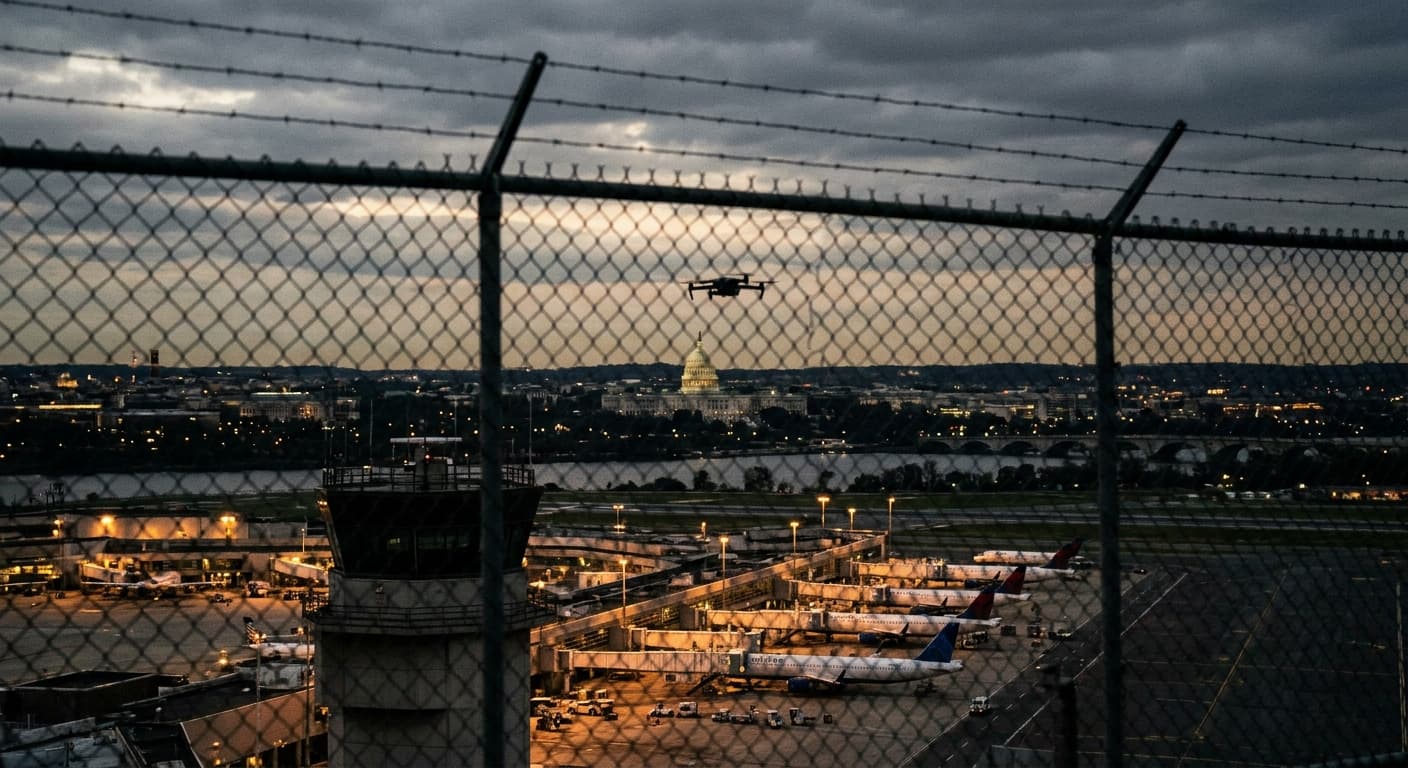
A single unauthorized drone hovering near a runway at Washington National Airport (DCA) forced a brief shutdown of arrivals and departures in September 2026. The incident lasted less than 30 minutes yet triggered immediate reviews of drone detection systems across the National Capital Region. For institutional investors tracking AI infrastructure, the real story lies in what this reveals about physical security gaps that could cripple data center construction timelines, strain already constrained power grids, and intensify competition for the minerals required to manufacture semiconductors.
Key Takeaways
- Unauthorized drone activity near sensitive airspace exposes gaps in low-altitude surveillance that mirror vulnerabilities in protecting AI data center sites and high-voltage transmission lines.
- Northern Virginia data center operators face mounting pressure to secure perimeters against both physical and cyber threats as power demand surges toward 10-12 GW by 2030.
- Critical minerals such as gallium, germanium, and rare earth elements remain concentrated in geopolitically unstable supply chains, amplifying risks when physical infrastructure incidents signal broader security weaknesses.
- Recent drone incidents correlate with increased insurance premiums and delayed permitting for new hyperscale facilities in constrained grid regions.
- Investors should monitor OFAC sanctions compliance on mineral sourcing and sovereign wealth fund allocations to nuclear and small modular reactor projects that could ease grid pressure.
The DCA Drone Incident: What Actually Happened
Air traffic controllers received reports of a drone operating in restricted airspace near DCA runways on September 17, 2026. Flights were paused for roughly 20 minutes while authorities investigated. No collision occurred and the drone disappeared before interception. Similar events have increased in frequency near military installations and critical infrastructure since 2024.
The Federal Aviation Administration and Department of Homeland Security responded with temporary flight restrictions and expanded use of counter-drone technology. Yet the episode highlights a persistent detection gap: small commercial or hobby drones fly too low and too slow for traditional radar while evading many radio-frequency sensors. This same technology limitation applies to perimeter security at remote data center campuses that increasingly resemble small military bases in both power consumption and strategic importance.
Why AI Data Centers Are Particularly Exposed
Data centers supporting large language models and inference workloads now consume electricity equivalent to entire cities. Northern Virginia alone hosts more than 30 percent of global hyperscale capacity. A typical hyperscale campus under construction in 2026 requires 100-300 MW of firm power, with some planned facilities targeting 1 GW or more.
Physical security has become non-negotiable. A coordinated drone attack on cooling infrastructure, backup generators, or high-voltage substations could trigger cascading outages. The DCA incident demonstrates how quickly authorities lose visibility in low-altitude airspace. Data center developers in regions already facing grid constraints must now budget for military-grade counter-drone systems, increasing capital expenditure by an estimated 4-7 percent per project.
Northern Virginia Grid Constraints in Numbers
| Metric | Current (2026) | Projected 2030 | Implication |
|---|---|---|---|
| Regional Data Center Load | ~4.2 GW | 10-12 GW | Equivalent to adding two large nuclear plants |
| Available Transmission Capacity | Constrained | Further strained | Multi-year delays for new lines |
| Power Purchase Agreement (PPA) Prices | $55-75/MWh | $85-120/MWh | Inflation risk for hyperscalers |
| Counter-Drone Security Spend | $8-15M per campus | $25-40M per campus | New line item in project budgets |
Critical Minerals at the Intersection of Drone Threats and Data Center Demand
Advanced drones and the semiconductors powering AI servers both rely on the same scarce materials. Gallium and germanium, used in high-frequency radar and compound semiconductors, face export restrictions from China, which controls over 80 percent of refined supply. Any escalation in physical security incidents raises concerns about sabotage of mineral processing facilities or shipping routes.
The 2026 earthquakes already disrupted lithium and rare earth processing in key regions. When a drone appears over a major airport, investors correctly ask whether similar tactics could target ports handling critical mineral imports or factories producing GPU substrates. NVIDIA’s supply chain, already stretched by demand for Blackwell and Rubin architectures, faces compounded risk.
Modified consumer GPUs with expanded VRAM have emerged as a symptom of these shortages, forcing data center operators to improvise while waiting for purpose-built AI accelerators. Each delay increases exposure to volatile mineral prices.
How Sovereign Wealth Funds and Tech Giants Are Responding
Funds such as Saudi PIF and Singapore’s Temasek have accelerated direct investments in U.S. nuclear projects and behind-the-meter generation to bypass grid queues. Oracle, Amazon, and Google have all signed power purchase agreements for small modular reactors and geothermal capacity. These deals aim to insulate AI expansion from both regulatory delays and physical threats to shared infrastructure.
Yet the DCA incident underscores that private capital cannot fully substitute for public investment in airspace security and critical infrastructure protection. Tech companies now lobby quietly for expanded counter-UAS authority around their facilities, similar to protections granted to military bases.
Comparison of Mitigation Strategies
| Strategy | Cost Impact | Timeline | Effectiveness Against Drone Threats | Link to Mineral Security |
|---|---|---|---|---|
| On-site Nuclear / SMR | High upfront | 5-7 years | Reduces grid vulnerability | Lowers pressure on copper and rare earths for transmission |
| Counter-Drone Systems | Medium | 6-12 months | High for small UAS | Indirect — protects chip fabrication sites |
| Diversified Mineral Sourcing | Medium | 2-4 years | N/A | Direct reduction in China exposure |
| Geopolitical Hedging via SWFs | Variable | Ongoing | Indirect | Funds new mines in stable jurisdictions |
Common Mistakes Investors Make When Assessing These Risks
- Treating drone incidents as isolated aviation stories rather than signals of broader critical infrastructure vulnerability.
- Underestimating the correlation between physical security events and insurance costs for data center projects.
- Assuming U.S. grid operators can scale transmission fast enough to meet hyperscale demand without major policy changes.
- Overlooking secondary sanctions risks when pursuing alternative mineral sources in jurisdictions with weak compliance regimes.
- Failing to model the impact of airspace restrictions on construction logistics for new facilities near airports or military corridors.
Best Practices for Institutional Allocation in This Environment
- Stress-test portfolios against simultaneous 20 percent spikes in gallium and copper prices triggered by supply disruption events.
- Prioritize operators with firm power contracts and dedicated counter-drone programs already in place.
- Track congressional action on critical minerals stockpiling and domestic processing incentives.
- Monitor sovereign wealth fund flows into U.S. energy infrastructure as a leading indicator of where hyperscale capacity will be built.
- Build in 12-18 month buffers for new data center deployments near constrained airspace or transmission bottlenecks.
Cross-reference these practices with broader Red Sea shipping risk premiums that already affect mineral transport costs from alternative suppliers.
FAQ
What caused the unauthorized drone incident at DCA?
Investigators have not publicly identified the operator. The drone was detected visually and on radio scanners but evaded full tracking. Similar unidentified UAS activity has occurred near other sensitive sites, raising concerns about testing of detection gaps or simple operator error.
How do drone incidents affect AI data center development?
They increase perceived risk to physical infrastructure, raising insurance premiums, slowing permitting near airports or military zones, and forcing additional capital into perimeter security. This diverts funds from core computing capacity and power generation investments.
Which critical minerals are most at risk from supply chain disruptions?
Gallium, germanium, neodymium, and high-purity copper face the tightest constraints. China dominates processing for most of these. Geopolitical incidents that highlight security weaknesses tend to accelerate export controls and price volatility.
Can nuclear power solve the AI data center grid problem?
Nuclear and advanced geothermal offer the most reliable carbon-free baseload. However, deployment timelines remain long. Small modular reactors promise faster rollout but still face regulatory and supply chain hurdles, including the same mineral constraints affecting chips.
What role do sovereign wealth funds play in this sector?
They provide patient capital for energy infrastructure that regulated utilities cannot finance quickly. Investments in U.S. nuclear restarts, data center co-location projects, and critical minerals mines help de-risk AI expansion for technology operators.
Conclusion
The brief closure of Washington National Airport after an unauthorized drone sighting served as an early warning. For investors in the AI supply chain, it underscores that physical security, grid reliability, and critical minerals availability form a single risk triangle. Companies and funds that treat these three elements as interconnected — rather than separate operational issues — will hold a decisive edge as data center demand continues its exponential climb.
Review your exposure to hyperscalers, semiconductor fabricators, and energy infrastructure plays with these linkages in mind. The next drone incident may not end with a quick resumption of flights.
Sources
Share This Article