Supply Chain · Jonathan van den Berg · September 22, 2026
How Trump’s 2026 UN Address Reshapes Strait of Hormuz Risks, Critical Minerals Strategy, and Sovereign Wealth Fund Allocations
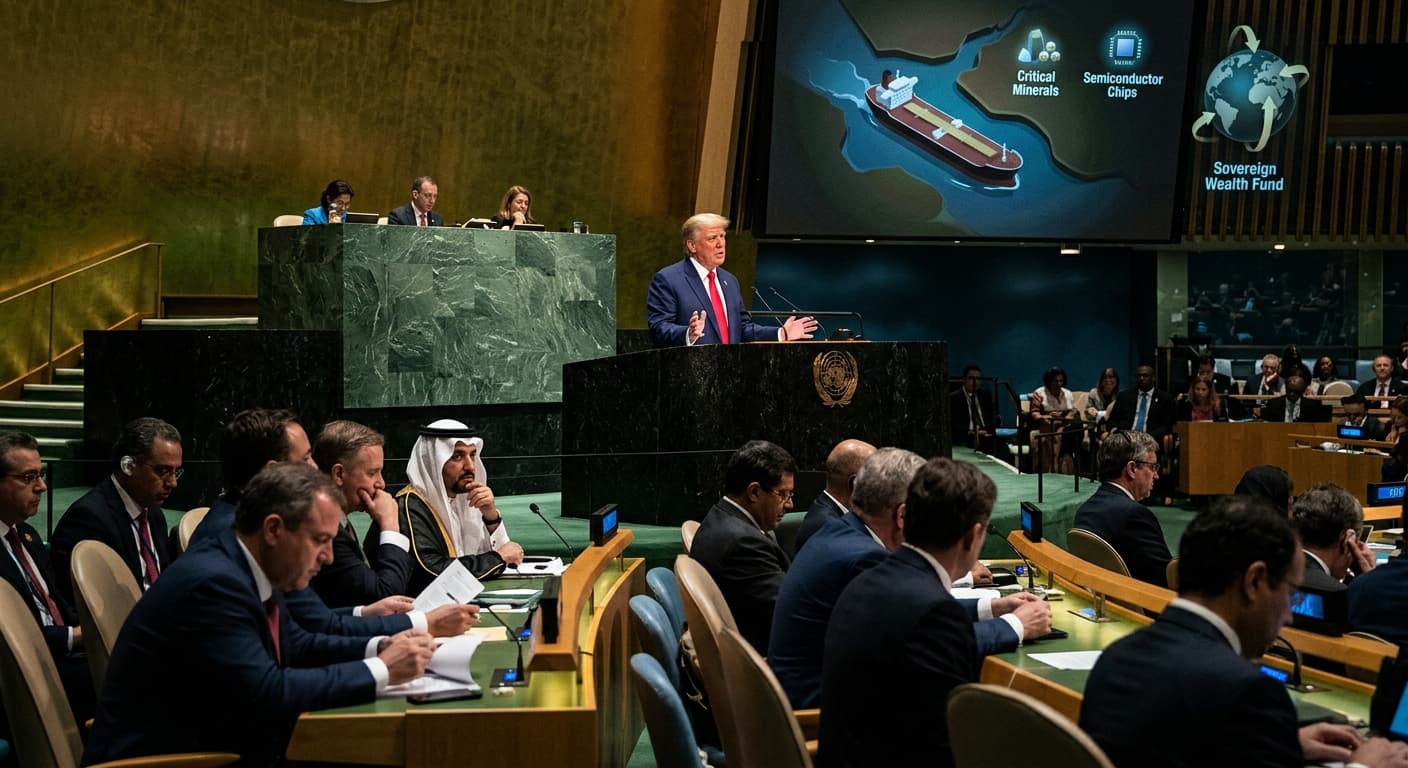
Trump’s direct challenge to Iran at the United Nations has renewed focus on the Strait of Hormuz as a primary supply-chain chokepoint. The speech signals higher risk premiums for energy, semiconductors, and AI infrastructure while forcing sovereign wealth funds to recalibrate exposure to Middle East volatility and critical minerals nationalism.
Trump’s 2026 UN address put the Strait of Hormuz back at the center of global risk calculations. By naming Iran’s nuclear progress and proxy activities as direct threats to energy security, the speech immediately lifted insurance premiums on tankers passing through the narrow waterway and forced portfolio managers to reassess exposure across energy, semiconductors, and AI infrastructure.
The 20-minute remarks blended familiar rhetoric on sovereignty with specific warnings about Tehran’s enrichment levels and Houthi disruptions in the Red Sea. Markets reacted before the speech ended. Brent crude rose 3.2 percent intraday. tanker rates for Persian Gulf routes jumped 18 percent within 48 hours.
Key Takeaways
- Trump’s UN speech explicitly linked Iran’s nuclear program to Strait of Hormuz security, raising the geopolitical risk premium on 21 percent of global oil transit.
- Critical minerals processors in Asia now face higher input costs as energy price volatility ripples into refining and smelting operations.
- Sovereign wealth funds from the Gulf and East Asia have accelerated diversification away from direct Middle East energy holdings toward North American AI data center assets and allied critical minerals projects.
- AI hyperscalers in Northern Virginia are accelerating nuclear power purchase agreements to hedge against diesel and natural gas price spikes tied to Hormuz risk.
- Insurance and freight markets now price in a 12–18 percent permanent risk premium on Red Sea and Hormuz routes compared with pre-2024 baselines.
The Strait of Hormuz as the Ultimate Supply Chain Chokepoint
The Strait of Hormuz is 21 miles wide at its narrowest point. Roughly 21 million barrels of oil pass through it every day. That figure represents about one-fifth of global petroleum consumption. Any sustained disruption triggers immediate knock-on effects across fuel, plastics, fertilizers, and the electricity that powers data centers.
Trump used the UN podium to argue that Iran’s enrichment to near-weapons grade material and its support for Houthi attacks on shipping have turned the strait into a de facto hostage situation for the world economy. The message was aimed as much at Beijing and European capitals as at Tehran.
Since the speech, shipping firms have rerouted additional vessels around Africa. This adds 10–14 days to transit times from the Gulf to Asia. The resulting fuel price surges have already increased jet fuel costs for carriers flying long-haul Pacific routes.
How Houthi Activity Compounds the Hormuz Risk
The Houthis continue to launch drones and missiles at vessels in the Bab el-Mandeb and southern Red Sea. Their campaign has forced most container lines to avoid the Suez Canal entirely. The combined effect of Hormuz threats and Red Sea attacks creates a pincer movement on global trade.
Insurers now charge 0.75–1.25 percent of hull value for single transits through the high-risk corridor. That is up from 0.1 percent in 2023. Reinsurers in London and Singapore report capacity is tightening fast. This directly raises costs for any company dependent on just-in-time delivery of components containing refined copper, rare earths, or lithium chemicals.
Read more about parallel disruptions in Houthi advances in Yemen and Bab el-Mandeb chokepoints.
Critical Minerals Exposure: From Mine to AI Chip
Semiconductor fabrication and AI training clusters require enormous quantities of energy and specialized minerals. Copper for wiring, lithium and nickel for backup batteries, gallium and germanium for chips, and uranium or natural gas for baseload power all become more expensive when energy markets tighten.
NVIDIA’s supply chain alone consumes materials from more than 40 countries. When energy prices spike, the cost to refine copper in Chile or process gallium in China rises in lockstep. Those increases flow downstream to data center construction budgets and ultimately to hyperscaler capex.
The 2026 Japan earthquake already tightened certain specialty chemical supplies. Trump’s UN remarks add a second layer of energy-driven cost pressure. Companies are now stress-testing scenarios in which Hormuz is partially blocked for 30–90 days.
Related analysis on mineral vulnerabilities appears in NVIDIA’s $279 billion AI data center gamble.
Sovereign Wealth Fund Repositioning After the Speech
Gulf sovereign wealth funds hold large portfolios in Western energy majors and Asian downstream assets. After the UN address, several accelerated sales of long-dated oil futures and increased allocations to North American power generation and critical minerals mines outside China.
Temasek and GIC of Singapore have reportedly raised exposure to U.S. nuclear developers and Canadian lithium projects. Norway’s Government Pension Fund Global quietly increased stakes in companies building small modular reactors. PIF of Saudi Arabia continues to fund domestic diversification but is also quietly buying into AI infrastructure plays in Texas and Virginia that can run on stable, non-oil power sources.
The pattern is clear: treat Middle East energy transit risk as a permanent feature of the portfolio and hedge it with ownership in the technologies and fuels that reduce dependence on seaborne crude.
AI Data Center Operators Face New Grid Realities
Hyperscalers in Northern Virginia already struggle with grid connection queues measured in years. A sustained rise in diesel and natural gas prices makes on-site generation and long-term nuclear power purchase agreements far more attractive.
Microsoft, Google, and Amazon have all signed new deals for nuclear restarts or small reactor deployments since early 2026. The UN speech accelerated internal planning for microgrids that can operate independently of volatile fuel markets.
Backup battery systems using lithium iron phosphate become more expensive when lithium carbonate prices rise with energy input costs. This creates a feedback loop: higher oil risk leads to higher battery costs, which raises the total cost of resilient AI infrastructure.
Compare this dynamic to earlier constraints explored in coverage of drone incidents exposing data center grid constraints.
Oil Market Reaction and Downstream Effects
West Texas Intermediate and Brent both moved higher in the days following the speech. More important than the outright price level is the shape of the futures curve. Backwardation in the six-to-twelve-month segment signals physical tightness and fear of actual supply interruption.
Diesel cracks widened sharply. That matters because diesel powers most of the trucks moving critical minerals from mines to processing plants and most of the ships moving refined products to market. Higher diesel prices act as a tax on every link in the critical minerals supply chain.
Retail chains such as Dollar General have already warned that lower-income consumers are trading down further. Transportation and packaging cost increases tied to fuel risk eventually appear on store shelves.
Common Mistakes Investors Make in This Environment
- Treating Hormuz risk as a binary “blockade or no blockade” event instead of a permanent risk premium that affects insurance, freight, and capex budgets every quarter.
- Assuming sovereign wealth funds will simply buy more oil equities during dips. Many are instead rotating into power infrastructure and non-Chinese critical minerals processors.
- Underestimating the speed with which AI data center operators will pay premiums for firm, carbon-free power when fuel price volatility rises.
- Ignoring second-order effects on gallium, germanium, and graphite refining, which are highly energy-intensive and often located in jurisdictions sensitive to global energy prices.
Best Practices for Portfolio Managers and Corporate Strategists
- Model supply chains with explicit energy price shock scenarios tied to 30-, 60-, and 90-day Hormuz disruptions. Include knock-on effects on critical minerals refining margins.
- Increase allocations to companies with secured, non-fossil power sources for data centers and manufacturing. Nuclear restarts and small modular reactor developers benefit directly.
- Diversify critical minerals sourcing away from single points of failure. Contracts with Australian lithium, Canadian graphite, and U.S. rare earth separation capacity become more valuable.
- Stress-test freight and insurance budgets at 1.0–1.5 percent of cargo value for Asia-Europe and Asia-U.S. routes. Build these costs into product pricing models now.
- Monitor sovereign wealth fund flows into North American energy transition and AI infrastructure assets as a leading indicator of long-term capital allocation shifts.
FAQ
What exactly did Trump say about Iran in the 2026 UN address?
He stated that Iran’s continued enrichment beyond civilian needs and its arming of proxies constitute a direct threat to freedom of navigation through the Strait of Hormuz and the Red Sea. He called on European and Asian allies to impose stricter secondary sanctions.
How much oil flows through the Strait of Hormuz daily?
Approximately 21 million barrels per day, representing roughly 21 percent of global liquid fuels consumption. A significant portion supplies Asian refiners that produce feedstock for semiconductor and battery manufacturing.
Which sovereign wealth funds are most exposed to Hormuz risk?
Gulf funds (PIF, Mubadala, Qatar Investment Authority) hold substantial energy and downstream assets. East Asian funds (GIC, Temasek, Korea Investment Corporation) have large exposure through long-term LNG and crude contracts. All have increased hedging and diversification activity since the speech.
Will this push AI data center development away from Northern Virginia?
Not immediately. The region still offers the densest fiber connectivity in North America. However, new projects are being sited with explicit attention to on-site power generation and proximity to nuclear or hydro resources to limit exposure to volatile fuel prices.
How do higher energy prices affect critical minerals supply?
Refining bauxite to aluminum, smelting copper, and processing rare earths are all energy-intensive. Diesel powers heavy mining equipment and bulk ore carriers. Sustained higher prices raise marginal costs across the entire chain and slow investment in new capacity.
Conclusion
Trump’s UN address did not create the Strait of Hormuz problem, but it removed any remaining illusion that the risk could be wished away through diplomacy alone. The speech has crystallized a new baseline for risk pricing across energy, critical minerals, semiconductors, and the AI infrastructure that depends on them.
Investors and corporate boards who treat the current environment as temporary will underperform those who build permanent structural hedges into their supply chains, power strategies, and capital allocations. The chokepoint is real. The repricing is underway.
Position accordingly.
Sources
Share This Article