Supply Chain · Jonathan van den Berg · September 20, 2026
How Airline Fuel Price Surges and Strait of Hormuz Risks Are Reshaping Global Aviation Supply Chains in 2026
Surging jet fuel costs driven by Middle East tensions are compelling airlines to trim routes and raise fares, exposing deeper vulnerabilities in global energy supply chains that directly affect critical minerals demand for both aircraft manufacturing and AI data center infrastructure.
Major airlines are slashing flight capacity and warning investors of margin pressure as jet fuel prices climb above $3.20 per gallon in key U.S. hubs. American Airlines explicitly flagged the risk of capacity adjustments in its latest guidance, joining Delta, United, and several regional carriers that have already shifted schedules or grounded less efficient aircraft.
The immediate trigger is a combination of tight diesel inventories, renewed geopolitical friction in the Middle East, and persistent supply chain friction at critical maritime chokepoints. For investors tracking energy market volatility, these developments signal broader stress across transportation and manufacturing sectors that rely on refined petroleum products.
Key Takeaways
- Jet fuel prices have risen 28% year-to-date, outpacing crude benchmarks due to refining constraints and diesel competition.
- American, Delta, and United have collectively trimmed Q4 capacity guidance by 1.5–3% in response to fuel costs.
- Strait of Hormuz tanker traffic remains elevated despite insurance premiums jumping 40% since July.
- Critical minerals used in jet engines and airframes face parallel pressure from competing AI data center demand.
- Airlines with newer, fuel-efficient fleets (Boeing 787, Airbus A350) are gaining relative cost advantage.
- Sovereign wealth funds with exposure to both energy and aviation are quietly increasing hedges against chokepoint disruption.
Why Jet Fuel Prices Are Rising Faster Than Crude
Crude oil itself trades in a relatively narrow band, but jet fuel and diesel have decoupled upward. Refineries optimized for gasoline production are struggling to meet simultaneous demand for middle distillates. Winter diesel stockpiling in Europe and Asia has pulled incremental barrels away from aviation kerosene.
U.S. Energy Information Administration data shows distillate inventories at their lowest seasonal level since 2022. This tightness is amplified by export demand from Europe, where German and French utilities burn diesel in peaking plants to compensate for variable renewable output.
The result is a structural premium on jet fuel that directly hits airline operating costs, which typically represent 25–35% of total expenses depending on aircraft age and route length.
Strait of Hormuz and Bab el-Mandeb: The Dual Chokepoints
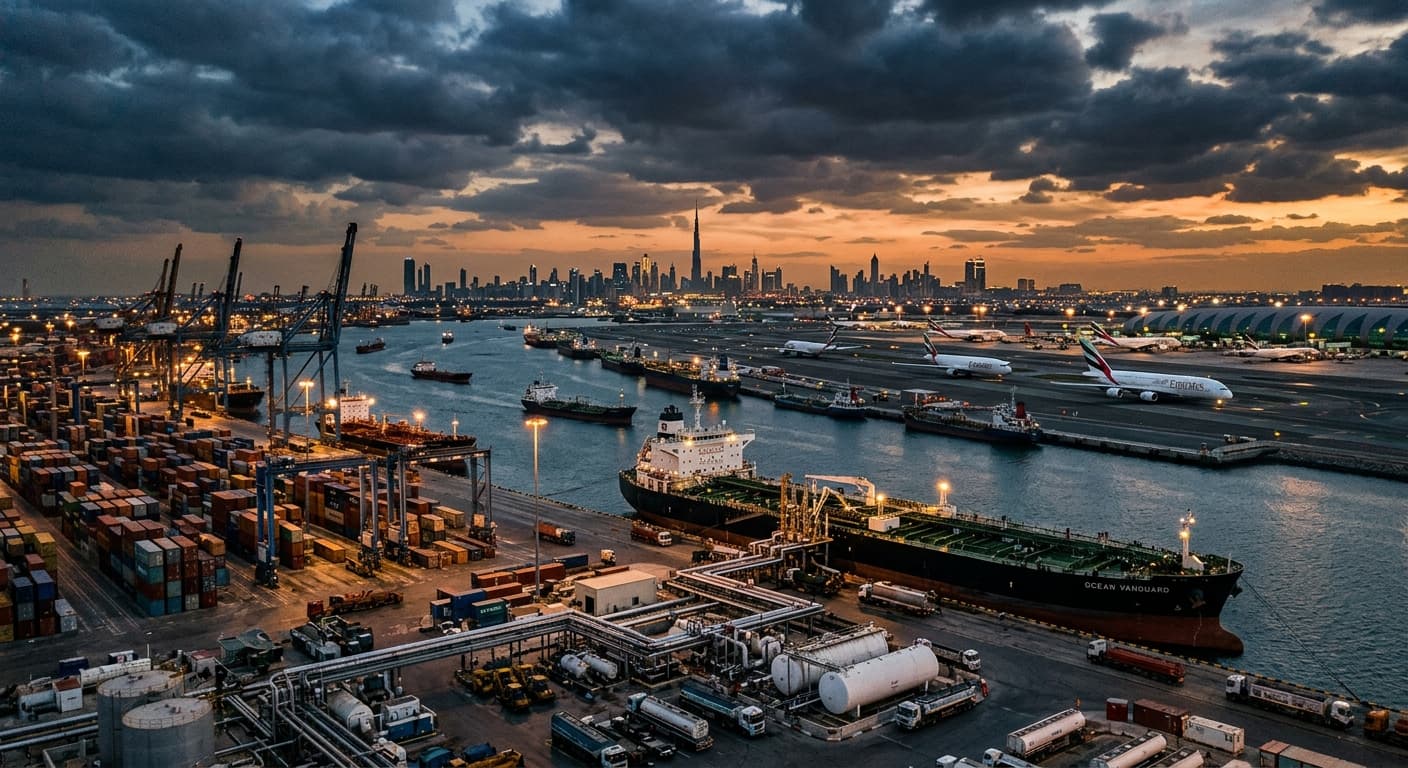
Approximately 21% of global liquefied natural gas and 20% of seaborne crude oil pass through the Strait of Hormuz. Even credible threats of closure or harassment push insurance and freight rates higher across the entire Asia-Europe route.
Parallel risk at Bab el-Mandeb has not disappeared. Houthi advances in Yemen continue to force many container vessels around the Cape of Good Hope, adding 10–14 days and roughly 40% more fuel burn per voyage. That incremental fuel consumption tightens global distillate markets further, creating a feedback loop.
Insurance underwriters now quote 0.75–1.25% of hull value for single transits through the Red Sea corridor, compared with 0.1% in 2023. Tanker operators have largely rerouted, but the longer distances consume more bunker fuel and reduce effective global refining throughput available for jet kerosene.
Airline Capacity Adjustments: What the Carriers Are Doing
American Airlines warned analysts that sustained fuel above $2.80 per gallon would require domestic capacity cuts of up to 2% in the fourth quarter. Delta has already retired older Boeing 717s and delayed some international expansion. United is shifting widebody deployment away from marginal European routes toward higher-yield Asia lanes where fuel surcharges are more easily passed to customers.
Regionals operating under capacity purchase agreements face acute pressure. Many contracts include fuel cost pass-through language, yet parent carriers are pushing back on rate increases, leading to reduced block hours and pilot attrition.
Low-cost carriers with newer Airbus A320neo and Boeing 737 MAX fleets show better resilience. Their 15–20% fuel efficiency advantage over legacy narrowbodies translates into meaningful margin protection when kerosene prices spike.
Impact on Aircraft Manufacturers and Critical Minerals
Boeing and Airbus face their own supply chain headwinds. High fuel prices accelerate demand for next-generation engines and airframes, yet both OEMs are constrained by shortages of titanium, nickel-based superalloys, and rare earth elements used in turbine blades and avionics.
These same materials are increasingly diverted to AI data center power infrastructure. Data center operators compete for high-performance transformers, switchgear, and specialized cabling that require comparable mineral inputs. The 2026 earthquakes in Asia further tightened semiconductor and advanced materials markets, as detailed in multiple supply chain analyses.
Airlines therefore sit at the intersection of two powerful demand pulls: immediate operational fuel costs and longer-term capital expenditure competition for the very minerals needed to build more efficient planes. The Flydubai Incident 2026 and Israel aviation emergency further highlighted how Middle East airspace chokepoints can rapidly amplify these aviation supply chain risks.
Sovereign Wealth Fund Positioning
Gulf sovereign wealth funds, particularly those tied to hydrocarbon revenue, are recalibrating. Qatar Investment Authority and Kuwait Investment Authority have increased stakes in both fuel-efficient aircraft lessors and specialty chemical companies that produce synthetic lubricants and additives capable of stretching jet fuel supplies.
Temasek and GIC of Singapore maintain heavy exposure to Changi Airport and regional aviation plays but have added commodity trading houses with physical storage assets near chokepoints. The strategic logic is clear: physical ownership of midstream infrastructure offers better protection than pure financial hedges when political risk materializes.
Norwegian and Australian funds with large airline holdings are quietly adding put protection on both jet fuel futures and shipping equities.
Common Mistakes Investors Make
- Treating jet fuel as a simple beta to crude oil. The crack spread behavior in 2026 has been far more volatile than WTI or Brent.
- Assuming all airlines are equally exposed. Fleet age, hedging programs, and route mix create dispersion of 400–600 basis points in unit costs.
- Ignoring second-order effects on Boeing and Airbus order backlogs. Higher fuel prices accelerate replacement demand yet simultaneously raise manufacturer input costs.
- Overlooking the minerals overlap between aviation and AI infrastructure. A single hyperscale data center can consume as much specialized copper and rare earths as several hundred new narrowbody aircraft.
Best Practices for Portfolio Managers
- Stress-test airline holdings against sustained $3.50 jet fuel. Model both capacity cuts and fare elasticity on key routes.
- Examine supplier concentration in engine and airframe critical minerals. Companies with diversified sourcing from Australia, Canada, and recycled aerospace scrap carry lower geopolitical risk.
- Monitor weekly EIA distillate inventory reports and Strait of Hormuz tanker tracking data from Lloyd’s List Intelligence or Vortexa. These lead airline earnings revisions by 4–6 weeks.
- Consider basket exposure: pair legacy carriers with lessors (AerCap, Air Lease) and specialty materials providers that benefit from replacement demand.
- Track sovereign wealth fund flows into aviation infrastructure. Large-ticket commitments often precede public capacity expansions or route announcements.
Longer-Term Implications for AI Data Centers and Grid Demand
The same energy price volatility affecting airlines also complicates power purchase agreements for hyperscale operators in Northern Virginia and other load centers. Natural gas and diesel backup generation become more expensive exactly when data center utilization rates are climbing.
This convergence increases interest in small modular nuclear reactors and advanced geothermal, both of which require their own critical minerals. The feedback loop between aviation fuel markets, maritime chokepoints, and technology infrastructure is tighter than most investors appreciate.
Airlines that successfully hedge or pass on fuel costs will maintain capital discipline for fleet renewal. Those that cannot may defer orders, further tightening supply for efficient aircraft and indirectly raising costs for every sector that moves goods or people.
FAQ
How much of an airline’s costs come from fuel?
In 2026, fuel typically accounts for 26–34% of operating expenses for major U.S. carriers. The percentage rises on longer international routes and falls for ultra-low-cost domestic operators with newer aircraft.
Will higher jet fuel prices lead to fewer flights?
Yes. Carriers have already announced modest capacity reductions for late 2026 and early 2027. Routes with low load factors or high fuel burn per passenger are most vulnerable.
Does the Strait of Hormuz directly affect jet fuel availability?
Indirectly but powerfully. Disruption or even credible threat raises insurance costs, diverts tankers, and tightens global distillate balances. Refineries cannot instantly shift yields from gasoline to jet fuel without significant cost.
Which airlines are best positioned?
Those with younger fleets (average age under 10 years), strong balance sheets for hedging, and exposure to premium long-haul routes where fuel surcharges are easier to implement. Delta and United currently hold advantages over American on these metrics.
How do critical minerals shortages connect to airline fuel prices?
High fuel prices accelerate demand for new, efficient aircraft. Building those aircraft requires titanium, rhenium, and specialty alloys already in tight supply because of competing demand from semiconductor fabrication and data center electrification.
Conclusion
Airline fuel price pressure is not an isolated transportation story. It reflects deeper stress across global supply chains, maritime chokepoints, and mineral competition between legacy industries and new technology infrastructure. Investors who map these interconnections rather than treating fuel costs as a simple expense line will be better prepared for the volatility ahead.
Track distillate inventories, chokepoint tanker flows, and sovereign capital shifts. Those data points will signal the next round of airline guidance changes before earnings calls begin.
Share This Article