Critical Minerals · Jonathan van den Berg · August 25, 2026
How the 2026 Japan Earthquake Reshapes Semiconductor Markets, AI Data Center Expansion, and Critical Minerals Strategy
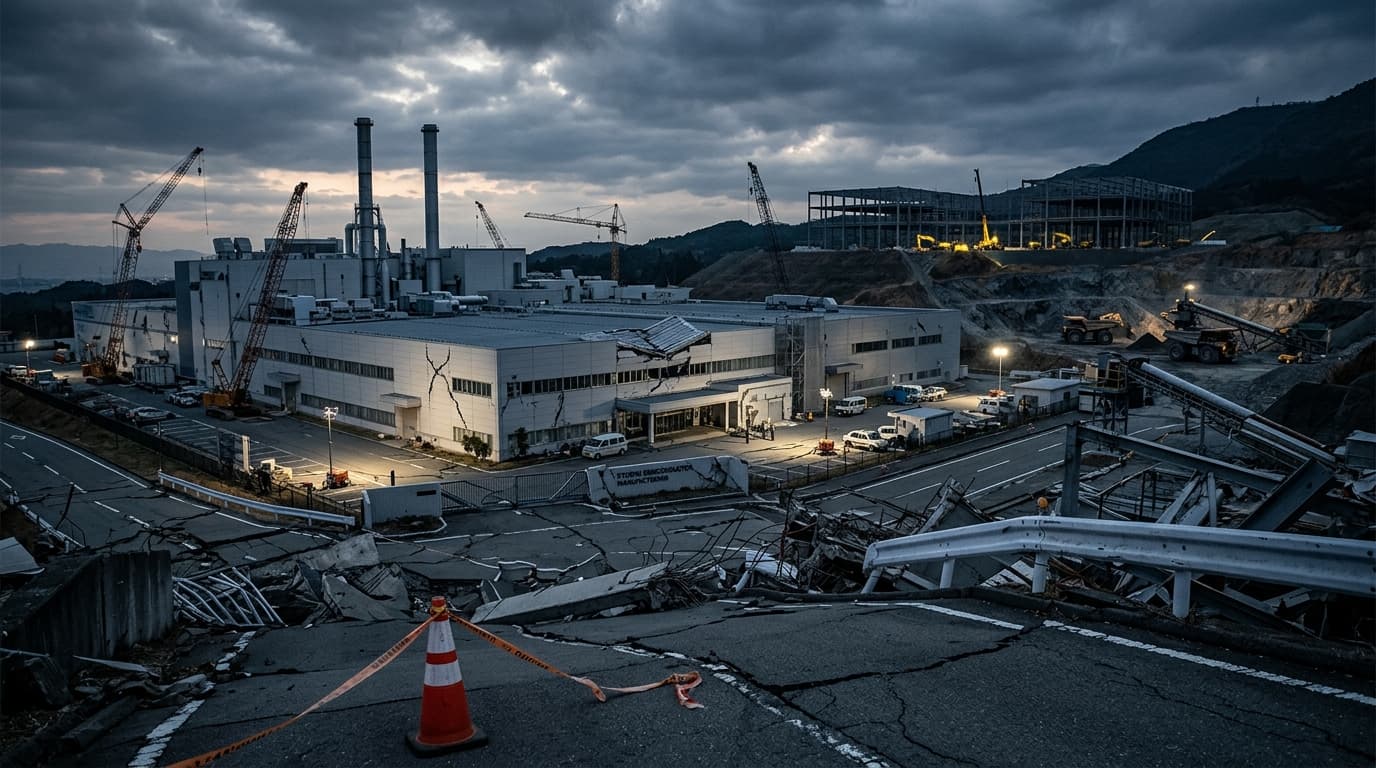
A magnitude 7.1 quake struck Kyushu and exposed deep fragilities in the semiconductor supply chain that directly affect AI infrastructure buildout and critical minerals availability.
The magnitude 7.1 earthquake that struck Kyushu in 2026 exposed exactly how concentrated global semiconductor production remains. Within hours, several advanced fabrication plants reported damaged cleanrooms, interrupted power, and halted production of specialty wafers used in high-performance computing. The ripple effects reached Northern Virginia data center campuses, where operators already wrestle with power shortages, and pushed prices for certain critical minerals higher on fears of extended disruption.
This event is not an isolated natural disaster. It is a stress test for the same supply chains that power AI model training, autonomous systems, and next-generation defense electronics. Investors who treat these shocks as random miss the structural reality: the world depends on a handful of regions for the minerals, chemicals, and chips that make modern computing possible.
Key Takeaways
- The quake damaged key facilities in Kyushu, a hub for advanced packaging and materials used in AI accelerators.
- Short-term chip shortages are pushing up costs for hyperscalers building out AI data centers in Northern Virginia and beyond.
- Critical minerals like gallium, neon, and high-purity quartz saw immediate price spikes on renewed supply concentration fears.
- Sovereign wealth funds and corporate treasuries are accelerating diversification away from single-country risk in the semiconductor stack.
- Long-term winners include companies positioned in alternative sourcing, onshoring, and nuclear-powered data center projects.
Immediate Impact on Semiconductor Production
Kyushu hosts facilities operated by companies such as Tokyo Electron (TYO:8035) and Lasertec (TYO:6857), which produce equipment essential for extreme ultraviolet lithography and inspection tools. Initial reports confirmed structural damage to at least two cleanrooms and temporary power loss at multiple supplier sites.
Advanced packaging lines that stack high-bandwidth memory with logic dies also faced downtime. These processes are critical for Nvidia (NASDAQ:NVDA) GPUs and custom AI chips from hyperscalers. Even a two-week halt creates months-long delays because the industry runs at near-full utilization.
TSMC (NYSE:TSM), while primarily based in Taiwan, sources specialty chemicals and substrates from Japanese suppliers concentrated in the affected region. The quake triggered a 4-7% drop in TSM shares in the first trading session as analysts recalculated input cost inflation and lead time extensions.
Why AI Data Centers Feel the Pain First
AI training clusters require dense racks of high-power GPUs that depend on the latest memory and interconnect technology. Any disruption in the supply of these components forces operators to delay rack deployments or pay premiums on the spot market.
Northern Virginia, already facing transmission grid constraints and long wait times for new substations, now contends with higher component prices on top of record power demand. Oracle (NYSE:ORCL) and others expanding in the region have quietly increased orders for backup generation capacity while they wait for clearer delivery timelines from Asian suppliers.
The quake also highlighted a secondary risk: many data center cooling systems rely on specialty fluids and sensors whose production chains run through the same Japanese industrial clusters. Extended outages could force temporary derating of existing facilities during peak summer loads.
Critical Minerals Under Renewed Pressure
The earthquake damaged infrastructure near facilities that refine and process several minerals essential to semiconductors:
- High-purity quartz used in crucibles for silicon wafer production
- Neon gas critical for excimer lasers in lithography
- Gallium and indium compounds used in compound semiconductors for 5G, radar, and power electronics
Global inventories of these materials were already tight following earlier disruptions referenced in the Evergrande collapse aftermath that altered Chinese industrial priorities and export behavior. Japanese producers typically account for over 50% of certain high-grade materials. The quake immediately lifted spot prices by 12-22% within 72 hours.
Resource nationalism is accelerating. Countries with deposits of these minerals are tightening export controls or demanding local processing. This raises costs for chipmakers and, by extension, for every company building AI infrastructure.
Market Reactions and Stock Implications
| Company | Ticker | Immediate Reaction | Strategic Exposure |
|---|---|---|---|
| TSMC | NYSE:TSM | -6.2% first day | Heavy reliance on Japanese materials |
| Tokyo Electron | TYO:8035 | -4.8% | Direct facility damage in Kyushu |
| SK Hynix | KRX:000660 | -3.9% | Memory supply chain overlap |
| Applied Materials | NASDAQ:AMAT | +1.4% | Potential gain from accelerated diversification spend |
| Oracle | NYSE:ORCL | -2.1% | AI cloud expansion faces higher input costs |
Longer-term, the market rewarded companies with diversified or domestic supply options. Firms involved in U.S. CHIPS Act-funded projects and those developing alternative mineral sources in Australia and Canada saw relative strength.
Supply Chain Chokepoints Exposed
The Japan quake reinforced three major chokepoints that institutional investors now track closely:
- Specialty gases and chemicals: Over 70% of global neon supply historically traced back to Ukrainian facilities before the Russia conflict; Japan filled much of the gap. The quake showed this replacement capacity is itself geographically concentrated.
- Advanced substrates and wafers: Kyushu’s role in producing 300mm silicon wafers and bonded substrates creates a single-point vulnerability for leading-edge logic and memory.
- Seaborne trade routes: Damage to port infrastructure in southern Japan briefly slowed shipments through the East China Sea, raising insurance premiums on routes already stressed by tensions near the Strait of Hormuz and Malacca Strait dynamics.
These overlapping risks explain why sovereign wealth funds from Singapore, Norway, and the Middle East have increased allocations to projects that reduce dependence on any one Asian manufacturing hub. Himalayan flash floods expose critical minerals supply chain risks.
Longer-Term Strategic Shifts
Companies and governments are responding with three parallel strategies:
- Onshoring and friendshoring: New fabs in Arizona, Ohio, and Germany receive accelerated permitting and higher subsidies after the quake.
- Inventory buffering: Hyperscalers are signing longer-term offtake agreements for critical minerals and pre-paying for chip capacity to secure priority during future shocks.
- Technology substitution: Greater investment in silicon carbide and gallium nitride alternatives that can reduce reliance on certain constrained materials, though each brings its own mineral intensity.
NVIDIA’s aggressive $279 billion bet on AI data center infrastructure now faces these exact critical minerals shortages and geopolitical chokepoints in sharp relief.
Nuclear power purchase agreements are gaining traction as data center operators seek firm, carbon-free electricity that does not depend on weather or fuel imports disrupted by earthquakes or geopolitical events. How Super El Niño drives excess mortality, supply chain disruptions, and critical minerals volatility in 2026
Common Mistakes Investors Make
- Treating the event as one-off rather than evidence of systemic fragility in just-in-time global supply chains.
- Focusing only on direct semiconductor stocks while ignoring upstream mineral miners and downstream data center operators.
- Underestimating secondary effects on power infrastructure and permitting timelines in AI expansion hotspots like Northern Virginia.
- Assuming diversification is easy; many alternative mineral sources require years of permitting and infrastructure buildout.
Best Practices for Portfolio Positioning
- Build exposure across the full stack: equipment makers, chip designers, foundries, mineral processors, and data center REITs with strong power contracts.
- Track quarterly disclosures for mentions of “geographic concentration risk” and “supply redundancy” spending.
- Monitor government critical minerals stockpiling programs and CHIPS Act implementation updates for early signals of policy direction.
- Consider paired trades that hedge concentrated Asia exposure with positions in companies benefiting from onshoring tailwinds.
FAQ
How long will the semiconductor shortage from the 2026 Japan earthquake last?
Most analysts expect 8-14 weeks of meaningful disruption for affected product lines, with full recovery taking 4-6 months as facilities are inspected, repaired, and requalified. High-end AI accelerators face the longest lead times.
Which critical minerals were most affected?
High-purity quartz, neon, and certain gallium compounds saw the sharpest price moves. These materials have few immediate substitutes and highly concentrated production.
Will this accelerate onshoring of semiconductor manufacturing?
Yes. The quake added urgency to existing CHIPS Act and European Chips Act projects. Several companies have already announced accelerated capital expenditure plans in North America and Europe.
How are AI data center operators responding?
Many are increasing capital reserves for higher component costs, signing take-or-pay contracts with suppliers, and accelerating investments in alternative computing architectures that may reduce reliance on the most disrupted supply chains.
Does this change the long-term demand outlook for AI infrastructure?
No. Demand for compute remains structurally higher than supply. The quake simply raises the cost and extends timelines, making resilient supply chains and secure power sources even more valuable.
Conclusion
The 2026 Japan earthquake is a reminder that natural events can expose the same vulnerabilities that geopolitical tensions target. For investors, the message is clear: the companies and jurisdictions that reduce dependence on concentrated critical minerals and single-region manufacturing will capture disproportionate value as AI data center buildout continues.
Positioning portfolios with this geographic and material resilience in mind is no longer optional. Those who act on the lessons from Kyushu will be better prepared for the next shock, whether it arrives from the earth, a chokepoint strait, or a government export ban.
Sources
Callofduty·News·Blog·Fox10phoenix·Kold·Azfamily·Thezoereport·Aol·Instyle·People·Yahoo·Imdb·Moneycontrol·Yahoo·Mashable·Cricinfo·Sports·Rediff·Nbcsandiego·Crossingbroad·Cbssports·Wtvr·Wric·12onyourside·Silverscreenandroll·Sports·Nypost·Dailytitan·Lmulions·Fullertontitans·Bloomberg·Reuters·Semianalysis·Iea·Usgs
Share This Article