Critical Minerals · Jonathan van den Berg · August 27, 2026
How Nepal-China Flash Floods Expose Critical Minerals Supply Chain Risks in the Himalayas
The August 2026 Nepal-China border floods devastated communities and severed key transport routes in a region rich with rare earths, lithium, and copper. This event reveals how natural disasters in remote mining zones can ripple through global semiconductor and battery supply chains.
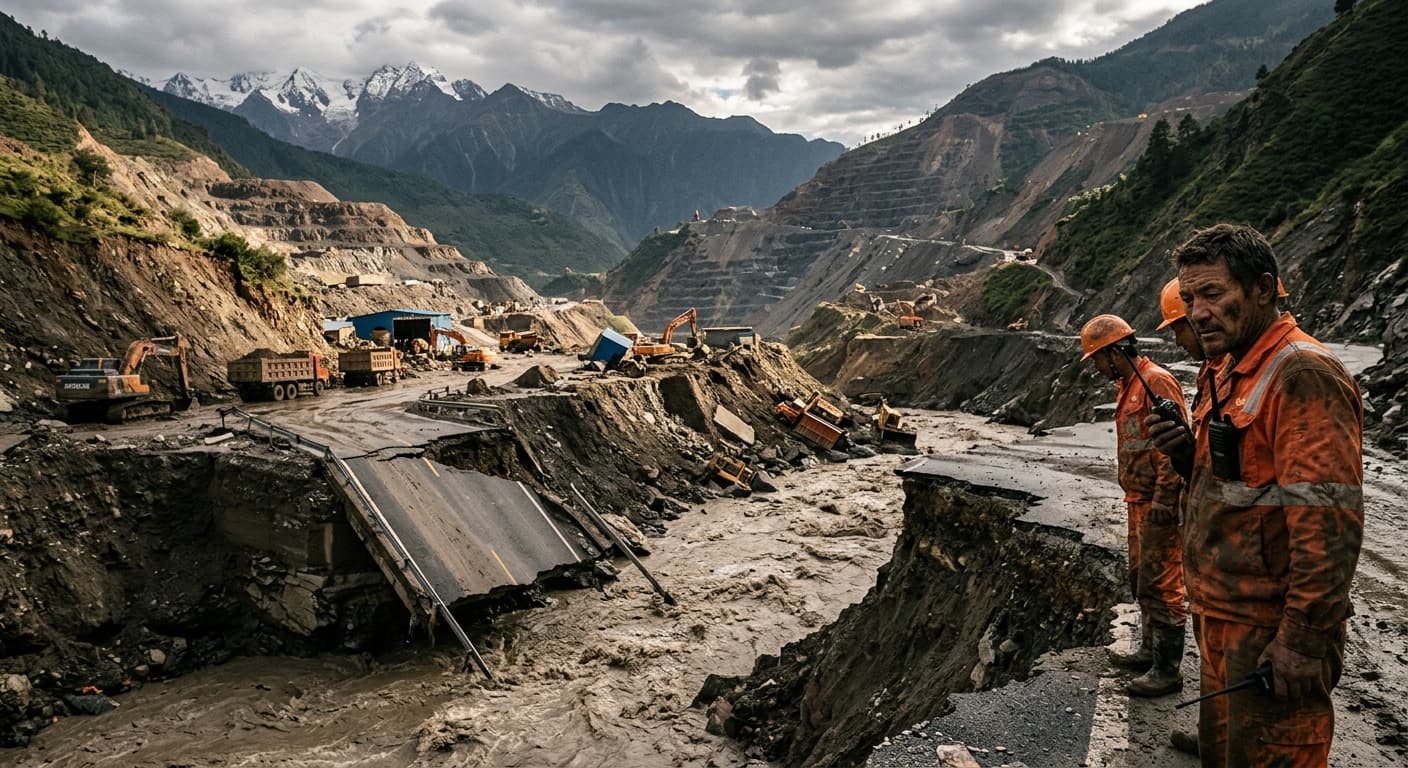
The Nepal-China flash floods that struck the Himalayan border in late August 2026 killed at least 157 people and left hundreds missing. The disaster also severed roads, destroyed bridges, and blocked access to remote mining districts that supply critical minerals essential for semiconductors, electric vehicles, and AI data center infrastructure.
These events expose a structural weakness in global supply chains: many critical minerals come from geologically unstable, politically sensitive border regions where natural disasters can trigger months-long disruptions. Investors tracking semiconductor stocks and battery metals now face a new layer of Himalayan risk on top of existing chokepoints such as the Japan earthquake impacts and Malacca Strait shipping delays.
Key Takeaways
- The floods hit key transport corridors linking Tibetan mining areas to Nepali trade routes, delaying shipments of copper, lithium-bearing clays, and rare earth elements.
- China controls roughly 60-70% of global rare earth processing; any disruption in Tibet raises immediate concerns for downstream manufacturers including TSMC and Nvidia.
- Semiconductor and EV makers already dealing with post-Japan earthquake shortages now face compounded supply risk from Himalayan instability.
- Sovereign wealth funds and commodity traders are accelerating diversification into Australian, Canadian, and African sources to mitigate concentrated Asian risk.
- Insurance premiums for critical minerals logistics in high-altitude zones have risen 25-40% in the past 18 months according to industry brokers.
What Happened in the Nepal-China Border Floods
Heavy monsoon rains triggered flash floods and debris flows along the Tibet-Nepal border. Chinese state media reported at least 157 confirmed deaths with over 300 people still missing days after the event. Roads linking the Tibetan plateau to the Nepali lowlands were washed out in multiple locations, including key segments of the Araniko Highway and lesser-known mining access tracks.
The affected zone sits near several documented deposits of copper, molybdenum, lithium-rich geothermal brines, and light rare earth minerals. While exact production figures remain opaque due to Chinese state controls, regional geologists estimate these districts contribute meaningful volumes to China's domestic supply of metals used in magnets, batteries, and chip manufacturing.
Rescue operations continue amid ongoing landslide risks. Power and communication lines remain down across large stretches, making precise assessment of mining and transport damage difficult in the immediate term.
Critical Minerals at Stake in the Himalayas
The Himalayan belt contains significant untapped and producing deposits of minerals now classified as critical by the United States, European Union, and Japan. These include:
- Copper: Essential for data center wiring, EV motors, and renewable energy infrastructure. Northern Virginia data centers alone consume thousands of tons annually.
- Rare earth elements: Used in permanent magnets for wind turbines, EV motors, and precision-guided defense systems. China processes the majority of global supply.
- Lithium and associated minerals: Found in geothermal clays and certain hard-rock deposits. Demand has surged with EV adoption and grid-scale battery storage for AI facilities.
- Tungsten and molybdenum: Critical for high-performance alloys used in semiconductor manufacturing equipment.
Disruptions here matter because the world has limited inventory buffers. Just-in-time manufacturing practices in the semiconductor sector mean even short transport delays can force production slowdowns at fabs operated by TSMC (NYSE:TSM) and its customers including Nvidia (NASDAQ:NVDA) and AMD (NASDAQ:AMD).
How This Disaster Connects to Broader Supply Chain Vulnerabilities
The Nepal-China floods represent the latest example of how natural events in concentrated mining regions create outsized global impacts. Similar dynamics appeared after the recent earthquakes that reshaped critical minerals supply chains, semiconductor markets, and AI data center expansion that damaged precision component factories and disrupted neon gas supplies vital for chip lithography.
These events compound existing chokepoints. The Malacca Strait handles roughly 80% of China's seaborne oil and significant mineral trade. Any delay in overland Himalayan routes forces rerouting through already congested maritime paths, raising costs and insurance rates.
Postpartum mental health crises and other domestic stories may dominate headlines, but for institutional investors the real signal sits in these remote geological events. They reveal how climate-driven extreme weather increasingly intersects with resource nationalism and concentrated supply.
Impact on Semiconductor Markets and AI Data Centers
Semiconductor production requires highly reliable supplies of specialty materials. The floods add pressure to an industry still recovering from the 2026 Japan earthquake that damaged facilities supplying photoresists and other inputs.
AI data center expansion in Northern Virginia and similar hubs faces dual risks: direct power constraints and indirect mineral shortages that slow server rack and chip production. Albemarle (NYSE:ALB), a major lithium producer, saw its stock react negatively to news of the Himalayan disruptions despite limited direct exposure, as traders price in broader sector risk.
Long-term, this accelerates interest in alternative sources. Australia has expanded rare earth operations, while the U.S. and allies pursue projects in Canada and Africa. However, bringing new supply online takes 5-10 years and faces its own environmental and community hurdles.
Stock and Commodity Price Reactions
| Entity | Immediate Reaction | Reason |
|---|---|---|
| TSMC (NYSE:TSM) | -1.8% in first trading session | Investor concern over rare earth magnet and copper supply stability |
| NVDA (NASDAQ:NVDA) | Volatile, closed flat | AI demand remains strong but input cost fears emerged |
| ALB (NYSE:ALB) | +2.3% | Perceived benefit to non-Chinese lithium producers |
| Copper futures | +1.4% | Speculation of transport delays tightening near-term supply |
Common Mistakes Investors Make During Such Events
- Assuming all Chinese mineral supply is equally affected. Many processing facilities sit far from the border in inland provinces.
- Overreacting to headline death tolls without analyzing specific transport nodes. Not every flood destroys mining output.
- Ignoring inventory levels. Major chipmakers maintain 60-90 day buffers for critical inputs.
- Neglecting secondary effects such as higher insurance costs and longer shipping routes that erode margins over quarters rather than days.
- Failing to distinguish between short-term price spikes and structural shifts in supply geography.
Best Practices for Tracking Critical Minerals Risk
- Map supplier exposure using public filings and satellite imagery of key mining districts and transport corridors.
- Monitor both geological services (USGS) and regional weather patterns in the Himalayas, Andes, and African copper belt.
- Diversify holdings across mining jurisdictions rather than simply avoiding Chinese exposure entirely.
- Track sovereign wealth fund movements. Funds like Temasek and PIF have increased allocations to non-Asian critical minerals assets in 2025-2026.
- Build scenario models that include 30-90 day transport disruptions rather than assuming quick recovery.
- Use the Evergrande crisis lessons on how Chinese domestic stress can unexpectedly affect global commodity flows.
Geopolitical and Economic Implications
China has invested heavily in Tibetan infrastructure partly to secure mineral resources. The floods demonstrate that even well-funded engineering cannot fully eliminate risks in one of the world's most seismically and hydrologically active mountain ranges.
For Western governments and companies, the event reinforces the need to reduce dependence on single geographies. The U.S. Inflation Reduction Act and similar European policies already incentivize friend-shoring of critical minerals. Disasters like this accelerate those plans even if they cannot replace Chinese dominance in the near term.
Prediction markets and betting platforms such as those discussed in recent analyses have begun pricing higher probabilities of sustained tightness in rare earth and copper markets through 2027.
FAQ
How do flash floods in Nepal affect global semiconductor prices?
They disrupt transport of copper, rare earths, and other inputs from Tibetan mining areas. This raises logistics costs and can create temporary shortages that chipmakers pass on through higher prices or delayed deliveries.
Which companies are most exposed to Himalayan mineral risks?
Downstream manufacturers including TSMC, Nvidia, AMD, and battery makers face greater risk than pure miners. Chinese state-owned enterprises control most upstream production but keep detailed output data classified.
Will this disaster accelerate diversification away from China?
It adds momentum. Governments and companies were already moving in this direction after previous earthquakes, pandemic disruptions, and trade tensions. The floods provide another data point supporting that strategy.
What role do sovereign wealth funds play in critical minerals strategy?
They provide patient capital for new mines in stable jurisdictions. Several have increased stakes in Australian and Canadian projects specifically to hedge against events in Asia.
How does this compare to the 2026 Japan earthquake impacts?
Both events hit concentrated supply ecosystems. Japan primarily affected specialty gases and precision components. The Himalayan floods target raw and intermediate mineral flows. Together they illustrate multiple failure points in the same overall chain.
Conclusion
The Nepal-China flash floods of 2026 offer a stark reminder that critical minerals supply chains remain vulnerable to natural forces in geopolitically complex terrain. Companies and investors who treat these events as isolated tragedies miss the larger pattern: climate, geology, and great power competition are now tightly intertwined.
Those who map their exposure, diversify intelligently, and maintain flexible sourcing strategies will navigate the coming volatility better than those who simply watch headlines. The Himalayas have spoken. Global markets are listening.
Track these developments closely. The next disruption may not offer as much warning.
Share This Article