Critical Minerals · Jonathan van den Berg · September 7, 2026
How Recent Earthquakes Reshape Critical Minerals Supply Chains, Semiconductor Markets, and AI Data Center Expansion
Earthquakes in key regions expose hidden fragilities in critical minerals supply chains, forcing semiconductor makers and AI infrastructure developers to rethink sourcing, inventory, and power strategies.
Earthquakes in seismically active zones are forcing companies that rely on critical minerals to confront sudden disruptions in extraction, refining, and shipping. These events drive up costs for rare earth elements, lithium, gallium, and cobalt while exposing just how concentrated global supply remains in vulnerable geographies.
The result reaches far beyond mining. Semiconductor fabrication plants face raw material shortages that slow chip output. AI data center operators see their expansion plans complicated by both mineral constraints and the parallel stress earthquakes place on power grids.
Key Takeaways
- New earthquake prediction models allow better risk mapping for critical minerals sites but cannot prevent physical damage to mines and ports.
- Kamchatka and Kyushu quakes have tightened gallium and rare earth supplies already strained by export controls.
- Semiconductor leaders like TSMC and NVIDIA must carry higher inventory or diversify away from high-risk zones.
- AI data center projects in Northern Virginia now factor seismic-adjusted power reliability into site selection and nuclear PPA negotiations.
- Sovereign wealth funds are accelerating investments in alternative mineral sources in stable jurisdictions.
Why Earthquakes Matter More Now for Critical Minerals
Critical minerals supply chains operate with thin buffers. Many key deposits sit along tectonic boundaries. A single major event can idle operations for weeks or months while infrastructure is repaired.
Recent advances in prediction, including machine-learning models that analyze foreshocks and crustal strain, have improved forecasts for where large quakes will strike. Researchers at UC Riverside and others demonstrated methods that pinpoint likely rupture zones with increasing accuracy. Yet prediction does not equal prevention. Mines, processing plants, and transport links remain exposed.
When a magnitude 7+ quake hit Kamchatka, it damaged port facilities that handle shipments of metals used in high-performance electronics. The event followed earlier activity in Japan’s Kyushu region, where semiconductor-grade materials are sourced or routed. These incidents compound existing pressures from resource nationalism and export restrictions out of dominant producers.
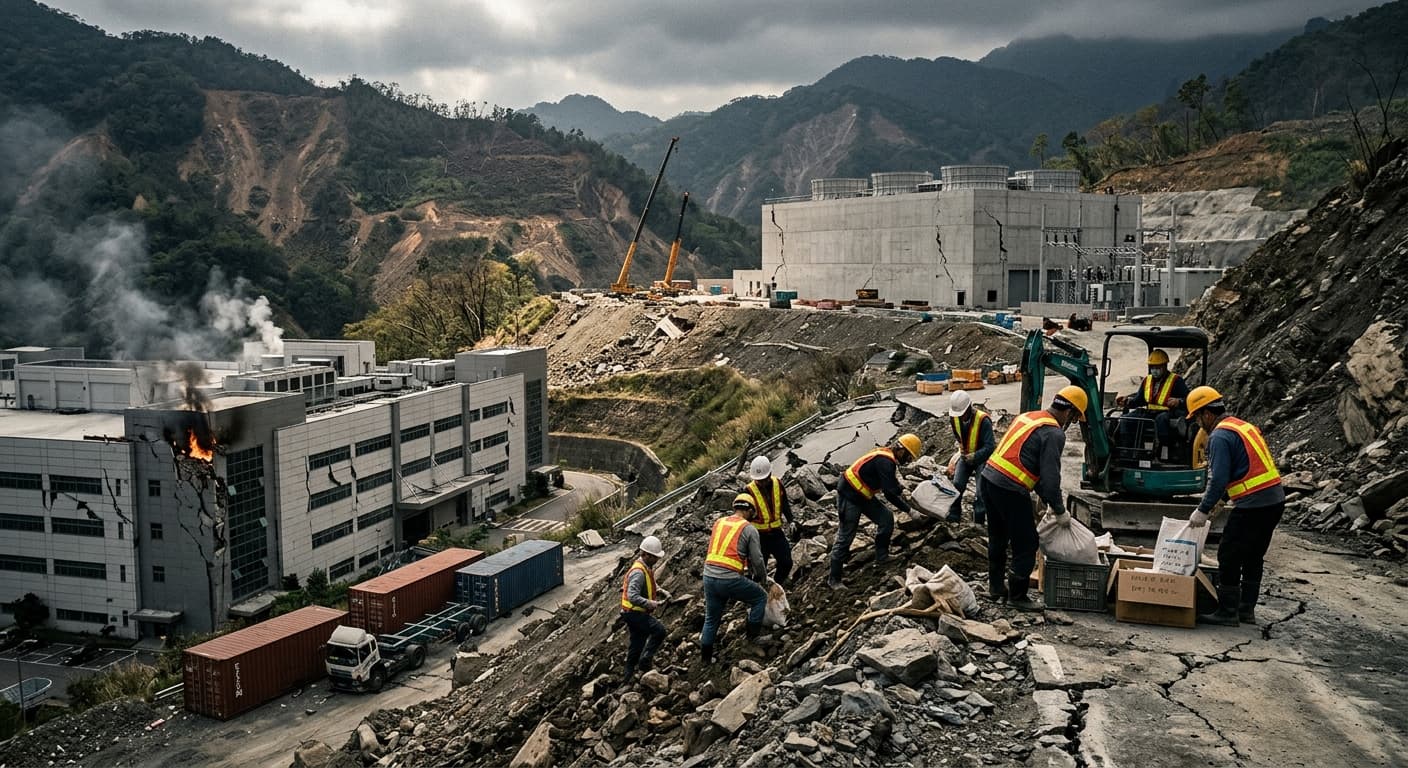
2026 earthquakes and their impact on critical minerals supply chains
Impact on Semiconductor Markets
Semiconductors require ultra-pure forms of gallium, germanium, indium, and rare earths for magnets, substrates, and doping. Supply tightness quickly translates into allocation battles among chipmakers.
TSMC, the world’s largest contract chip manufacturer, has already signaled longer lead times on advanced nodes. Customers building AI accelerators, including NVIDIA, face decisions on whether to pay premiums for expedited shipments or redesign chips around available materials.
NYSE:NVDA’s massive bet on AI infrastructure now contends with these input risks. Its supply chain extends through multiple chokepoints, including the Malacca Strait for Asian shipments. Earthquakes that damage ports or roads in supplier nations add another layer of volatility.
Memory chip producers have seen similar pressure. SK Hynix and others that rely on stable supplies of specialty chemicals derived from critical minerals report margin compression when forced to source from farther afield at higher cost.
Specific Mineral Vulnerabilities
- Gallium and Germanium: China dominates refining. Any disruption in alternative sources raises immediate concerns for 5G, radar, and high-speed computing components.
- Lithium and Cobalt: Battery-grade materials for backup power at data centers become more expensive and less predictable.
- Neodymium and Praseodymium: Essential for permanent magnets in cooling systems and robotics used in chip fabrication.
Diversification efforts are accelerating. Australia, Canada, and parts of Africa are seeing fresh capital for new mines, but bringing these projects online takes years. In the interim, prices swing on every seismic report.
AI Data Center Expansion Under Pressure
Hyperscale data centers consume enormous amounts of power and specialized hardware. Earthquakes affect both.
In Northern Virginia, the world’s largest data center market, operators already wrestle with grid constraints. A quake that damages transmission lines or forces nuclear plants into precautionary shutdowns tightens available megawatts precisely when AI training demand is growing fastest.
Companies such as Amazon, Google, and Microsoft have signed power purchase agreements for nuclear and renewable capacity to secure future supply. Yet seismic events in supplier regions for uranium fuel or rare earths used in wind turbines add upstream risk.
NVIDIA’s $279 billion in planned AI infrastructure faces dual headwinds: chip supply from strained semiconductor lines and reliable electricity at scale. Delays in one area cascade into the other.
Modified NVIDIA RTX 5090 GPUs with 96GB VRAM
Prediction Advances and Their Limits
Scientists now claim they can better forecast not just if but where the next major earthquake will strike. A new model successfully anticipated aspects of the Kamchatka event by tracking subtle ground deformation and historical stress patterns.
These tools help mining companies and governments prioritize reinforcements and emergency stockpiles. Insurance markets are beginning to price seismic risk into policies for critical minerals operations more granularly.
Still, the physics of earthquakes means perfect foresight remains elusive. Aftershocks, landslides, and tsunamis can destroy infrastructure even when the main shock is anticipated. Supply chain managers must therefore build resilience through inventory, multiple suppliers, and flexible logistics.
Investment Implications for Sovereign Wealth Funds and Asset Managers
Sovereign wealth funds from mineral-poor nations are moving earlier and more aggressively into upstream critical minerals assets. Temasek, PIF, and others have increased allocations to projects in geopolitically stable regions with lower seismic risk.
Public market investors track companies with vertically integrated supply chains or long-term offtake agreements. Those with exposure to single-region sourcing trade at discounts during heightened seismic activity.
Equity research now routinely includes “seismic-adjusted” supply disruption scenarios when modeling earnings for semiconductor and data center plays.
Common Mistakes in Assessing Seismic Risk to Supply Chains
- Relying solely on historical earthquake frequency while ignoring updated crustal stress data.
- Underestimating secondary effects such as port closures or road damage that halt shipments even when mines are untouched.
- Assuming diversification automatically equals resilience without verifying alternative suppliers’ own seismic exposure.
- Treating critical minerals as interchangeable commodities rather than highly specialized, qualification-intensive inputs for chips and batteries.
- Ignoring power grid interdependencies when modeling data center uptime after a regional quake.
Best Practices for Companies and Investors
- Map every tier of the supply chain against seismic hazard models updated with the latest prediction research.
- Maintain strategic stockpiles equivalent to at least 90 days of critical inputs, adjusting upward for single-source materials.
- Qualify at least two geographically dispersed suppliers for each high-risk mineral, including rigorous testing for semiconductor-grade purity.
- Incorporate earthquake scenarios into AI data center siting decisions alongside traditional power availability and latency metrics.
- Use financial hedges, including futures on key minerals and catastrophe bonds tied to seismic events, to smooth earnings volatility.
- Partner with governments on prepositioned relief supplies for key mining and refining clusters.
These steps do not eliminate risk but reduce the probability that a distant earthquake becomes a board-level crisis for technology companies.
FAQ
How do earthquakes specifically affect critical minerals supply chains?
They damage mines, processing facilities, roads, ports, and power infrastructure in producing regions. Even brief outages matter when global inventories run lean and demand from AI and semiconductors grows rapidly.
Can scientists really predict exactly where the next big earthquake will hit?
New models improve probability forecasts for specific fault segments and can successfully flag heightened risk periods. They cannot yet predict the exact day or hour with actionable certainty for operational planning.
Which semiconductor companies face the greatest exposure?
Firms heavily dependent on Asian refining of gallium, germanium, and rare earths, or those sourcing substrates from Japan and South Korea, sit at the sharp end. NVIDIA, TSMC, and their direct suppliers top the list.
How are AI data center operators responding to these combined risks?
They are signing more nuclear PPAs, exploring on-site generation like advanced turbines, increasing inventory of critical chips, and factoring seismic risk into new campus locations outside the most active zones.
What role do sovereign wealth funds play in mitigating these vulnerabilities?
They provide patient capital for new mines and refining capacity in stable jurisdictions, reducing long-term dependence on high-risk regions and smoothing supply over multi-year horizons.
Conclusion
Earthquakes are no longer abstract threats to critical minerals supply chains. They deliver tangible blows to semiconductor availability and the pace of AI data center buildout. Companies that treat seismic risk as a core strategic variable, rather than an insurance footnote, will hold advantages in cost, reliability, and speed to market.
Investors should scrutinize supply chain maps, inventory levels, and contingency plans as closely as they review earnings. The ground is moving, and the winners will be those who move first to secure their piece of it.
Explore related coverage on how data breaches expose hidden critical minerals laundering channels and the intersection with sanctions compliance in global trade.
Sources
Share This Article