Critical Minerals · Jonathan van den Berg · October 9, 2026
How Recent California Earthquakes Reshape Critical Minerals Supply Chains, Semiconductor Markets, and AI Data Center Expansion
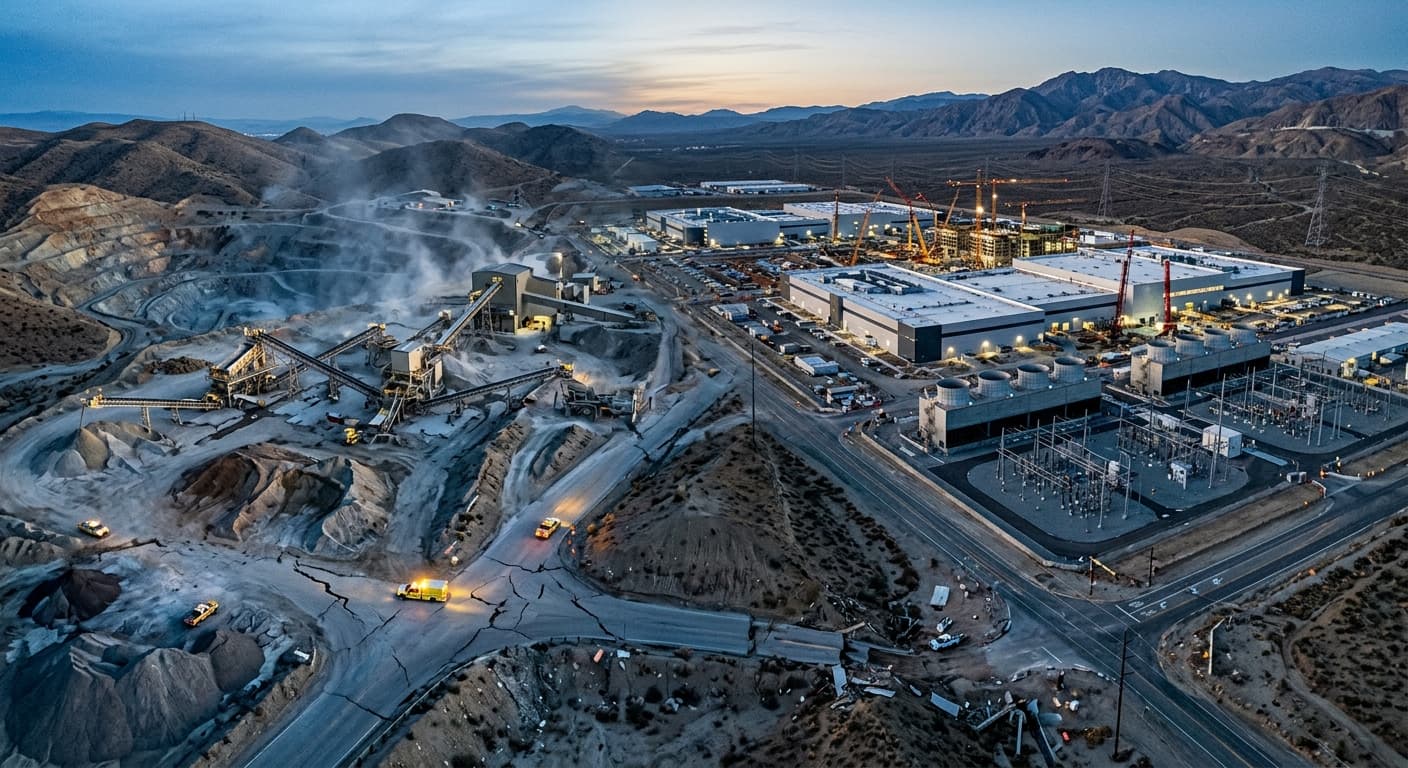
Earthquakes registering 3.2 to 3.7 magnitude near Los Angeles and Orange County highlight infrastructure risks that directly threaten critical minerals processing, semiconductor fabrication, and the explosive power demands of AI data centers.
Earthquakes registering between 3.2 and 3.7 magnitude struck areas near Signal Hill in Los Angeles County and the Orange County coast this week. These events, while moderate, rattled ports, logistics hubs, and energy infrastructure that support critical minerals processing, semiconductor manufacturing, and the massive power grid serving AI data centers across California and beyond.
The proximity of these quakes to key ports and transportation corridors raises immediate questions about supply chain resilience. Ports in the Los Angeles region handle significant volumes of rare earth elements, lithium compounds, and gallium used in chips and batteries. Any disruption here quickly ripples into semiconductor production timelines and the construction schedules for new AI data centers.
Key Takeaways
- Recent California earthquakes exposed vulnerabilities in ports and energy infrastructure critical to importing gallium, lithium, and rare earths.
- Semiconductor fabrication facilities in California and linked Asian supply chains face heightened risk from even modest seismic activity.
- AI data center operators in Northern Virginia and California are reassessing backup power strategies as grid strain intensifies.
- Investors are watching companies with diversified critical minerals sourcing and robust seismic hardening programs.
- Links between seismic events, mineral supply, and power demand create new risk premiums in tech and energy markets.
Seismic Activity and Immediate Infrastructure Impact
The 3.2 magnitude quake near Signal Hill and the 3.7 event off Orange County caused no major structural damage but triggered inspections at ports, rail lines, and power substations. These facilities form part of the West Coast supply artery for critical minerals imported from Australia, Chile, and China.
Port of Los Angeles and Long Beach together process over 17 million TEUs annually. Many containers carry gallium used in compound semiconductors and lithium chemicals destined for battery plants. Even short delays from seismic inspections raise costs and tighten already constrained supplies.
California sits on multiple active faults. The state has invested heavily in seismic retrofitting, yet the combination of aging infrastructure and surging demand from AI creates new pressure points. Data center developers in the state now face stricter requirements for earthquake-resistant designs, directly affecting project timelines and capital costs.
Critical Minerals Supply Chains Under Pressure
Critical minerals include gallium, germanium, lithium, cobalt, and rare earth elements essential for semiconductors, electric vehicles, and renewable energy systems. California earthquakes highlight how domestic infrastructure vulnerabilities compound geopolitical risks abroad.
China controls roughly 80 percent of global gallium refining. Export restrictions imposed in recent years have already forced semiconductor makers to seek alternative sources. Any delay at U.S. West Coast ports tightens this market further and pushes prices higher.
Lithium supply faces similar stresses. South American producers in Chile and Argentina ship significant volumes through California ports for processing. Seismic events that slow these imports increase costs for battery makers and electric vehicle manufacturers. Nationalization risks in South America add another layer of uncertainty that investors must price in.
Earthquakes in other regions have already shown how seismic activity can reshape critical minerals flows. The pattern repeats: modest quakes expose hidden fragilities in logistics that markets had overlooked.
Semiconductor Markets and Fabrication Risks
Semiconductor production depends on stable supply of high-purity materials and consistent power. California hosts major design centers for companies like NVIDIA and AMD. While fabrication occurs primarily in Taiwan, Arizona, and South Korea, the design and advanced packaging stages remain vulnerable to local disruptions.
TSMC, the world’s leading contract chipmaker, has expanded aggressively in the United States. Its Arizona facilities represent a strategic hedge against Taiwan risks, yet California’s role in the broader ecosystem means earthquakes here still matter. Power interruptions or logistics delays at California ports can slow delivery of specialty chemicals and substrates needed for advanced nodes.
NVIDIA’s AI GPU production relies on a complex global chain. Any increase in lead times for critical minerals raises costs and delays new data center deployments. AMD and Intel face parallel pressures. Markets have already priced in some risk, but repeated seismic events could widen risk premiums on semiconductor equities.
| Company | Ticker | Key Exposure | Risk Level |
|---|---|---|---|
| TSMC | NYSE:TSM | Gallium, germanium imports | High |
| NVIDIA | NASDAQ:NVDA | AI chip supply chain | Medium-High |
| AMD | NYSE:AMD | Advanced packaging materials | Medium |
| Oracle | NYSE:ORCL | Data center construction | Medium |
AI Data Center Expansion Meets Grid Constraints
AI training clusters consume enormous amounts of electricity. A single large facility can draw as much power as a small city. California’s aging grid, combined with seismic risks, creates a challenging environment for data center operators.
Northern Virginia has emerged as the world’s largest data center market, yet California remains important for West Coast hyperscalers. Amazon, Google, and Microsoft continue to expand in the state while navigating strict environmental rules and seismic building codes.
Recent earthquakes highlight the need for hardened backup systems. Diesel generators and battery storage must withstand seismic shaking. This raises capital expenditure and complicates permitting. Operators are increasingly turning to nuclear power purchase agreements and on-site small modular reactors to reduce reliance on vulnerable transmission lines.
Extreme natural events continue to expose the tight connection between minerals volatility and data center power risks. Investors who understand these links gain an edge in forecasting which infrastructure projects will face delays.
How Earthquakes Affect Sovereign Wealth Fund Strategy
Sovereign wealth funds from the Middle East and Asia allocate heavily to technology infrastructure and critical minerals. Seismic risks in California force these investors to reassess portfolio exposure. Developments in Ukraine continue to reshape critical minerals supply chains, AI data center power demand, and sovereign wealth fund strategies.
Funds that back data center projects now demand higher returns to compensate for earthquake-related insurance costs and potential downtime. Some are shifting capital toward hardened facilities in less seismically active regions or investing in seismic isolation technologies.
Resource nationalism adds complexity. Countries controlling lithium and rare earth deposits use supply as leverage. Earthquakes that disrupt Western processing capacity strengthen the hand of dominant producers. Sovereign funds with direct stakes in mining assets stand to benefit if prices rise.
Common Mistakes Investors Make
- Assuming all seismic activity below magnitude 5 poses negligible supply chain risk.
- Focusing only on direct damage while ignoring port inspection delays and logistics backups.
- Underestimating the compounding effect of earthquakes with existing critical minerals shortages.
- Overlooking how data center power contracts can be disrupted by damaged substations.
- Treating Taiwan and California risks as entirely separate when supply chains link them tightly.
Best Practices for Managing Seismic and Supply Risk
- Diversify critical minerals sourcing across multiple continents and transport routes.
- Require suppliers to maintain seismic-hardened warehouses and redundant logistics plans.
- Model worst-case port closure scenarios in financial forecasts for semiconductor and data center projects.
- Invest in on-site power generation, including nuclear PPAs, to reduce grid dependence.
- Monitor USGS seismic data alongside OFAC sanctions updates and export restriction announcements from China.
- Build inventory buffers for gallium, germanium, and high-purity lithium that exceed standard just-in-time levels.
Practical Examples from the Market
When a 2026 Japan earthquake hit, semiconductor lead times extended by nearly three weeks despite limited direct damage. Companies with diversified gallium suppliers recovered faster than those reliant on single routes. The same lesson applies to California events.
Data center operators in Northern Virginia have begun signing fixed-price nuclear power deals to avoid grid volatility. Similar strategies are gaining traction in California, where seismic activity adds another variable to already complex power planning.
NVIDIA’s aggressive buildout of AI infrastructure faces both mineral shortages and energy constraints. Firms that secure long-term contracts for critical minerals and power simultaneously hold a clear competitive advantage.
FAQ
How do California earthquakes affect global semiconductor supply?
They disrupt ports that import gallium and other materials essential for chip manufacturing. Even short delays raise costs and extend lead times for advanced semiconductors used in AI.
Which critical minerals face the highest risk from West Coast seismic activity?
Gallium, germanium, and lithium compounds are most exposed because of heavy reliance on Pacific shipping routes and concentrated refining capacity.
What does this mean for AI data center construction timelines?
Projects face higher insurance costs, stricter seismic standards, and potential power delays. Operators increasingly seek nuclear or on-site generation to mitigate risks.
Are sovereign wealth funds changing their investment approach?
Many now require higher risk premiums for California-based tech infrastructure and are increasing allocations to diversified minerals producers outside high-seismic zones.
Should investors avoid semiconductor stocks because of earthquake risk?
Not entirely. Companies with strong supplier diversification, inventory buffers, and alternative power strategies can navigate these risks better than peers.
Conclusion
California earthquakes serve as a recurring stress test for the systems that power modern technology. The combination of seismic vulnerability, critical minerals concentration, and insatiable AI power demand creates a complex risk landscape that investors cannot ignore.
Companies and funds that treat these events as signals rather than noise will make better capital allocation decisions. Those who build resilience into their supply chains, power contracts, and site selection will outperform as both natural and geopolitical pressures intensify.
Review your exposure to companies heavily tied to single-port logistics or vulnerable grid infrastructure. The next moderate quake could reveal which portfolios anticipated these converging risks.
Sources
Share This Article