Critical Minerals · Jonathan van den Berg · October 12, 2026
How Ukraine Developments Reshape Critical Minerals Supply Chains, AI Data Center Power Demand, and Sovereign Wealth Fund Strategies
Escalating developments in Ukraine continue to ripple through global critical minerals markets, tightening supplies of neon and other inputs vital for semiconductor production while driving up power demand for AI data centers and forcing sovereign wealth funds to recalibrate risk models.
Escalating developments in Ukraine continue to ripple through global critical minerals markets, tightening supplies of neon and other inputs vital for semiconductor production while driving up power demand for AI data centers and forcing sovereign wealth funds to recalibrate risk models.
Key Takeaways
- Ukraine supplies roughly 50% of global neon used in semiconductor lithography, and any disruption spikes costs for chipmakers feeding AI data center buildouts.
- Ceasefire talks tied to energy deals with Saudi Arabia and Russia are shifting power purchase agreements (PPAs) that tech giants need for Northern Virginia data centers.
- Sovereign wealth funds are reallocating away from high-risk European assets toward diversified critical minerals plays in stable jurisdictions.
- Linked energy market volatility from the Black Sea to the Strait of Hormuz is amplifying risk premiums across supply chains.
- Foreign investors fleeing Korean stocks signal broader rotation out of Asia-exposed semiconductor names tied to Ukraine-derived materials.
The Neon Chokepoint: Ukraine’s Hidden Role in AI Chip Production
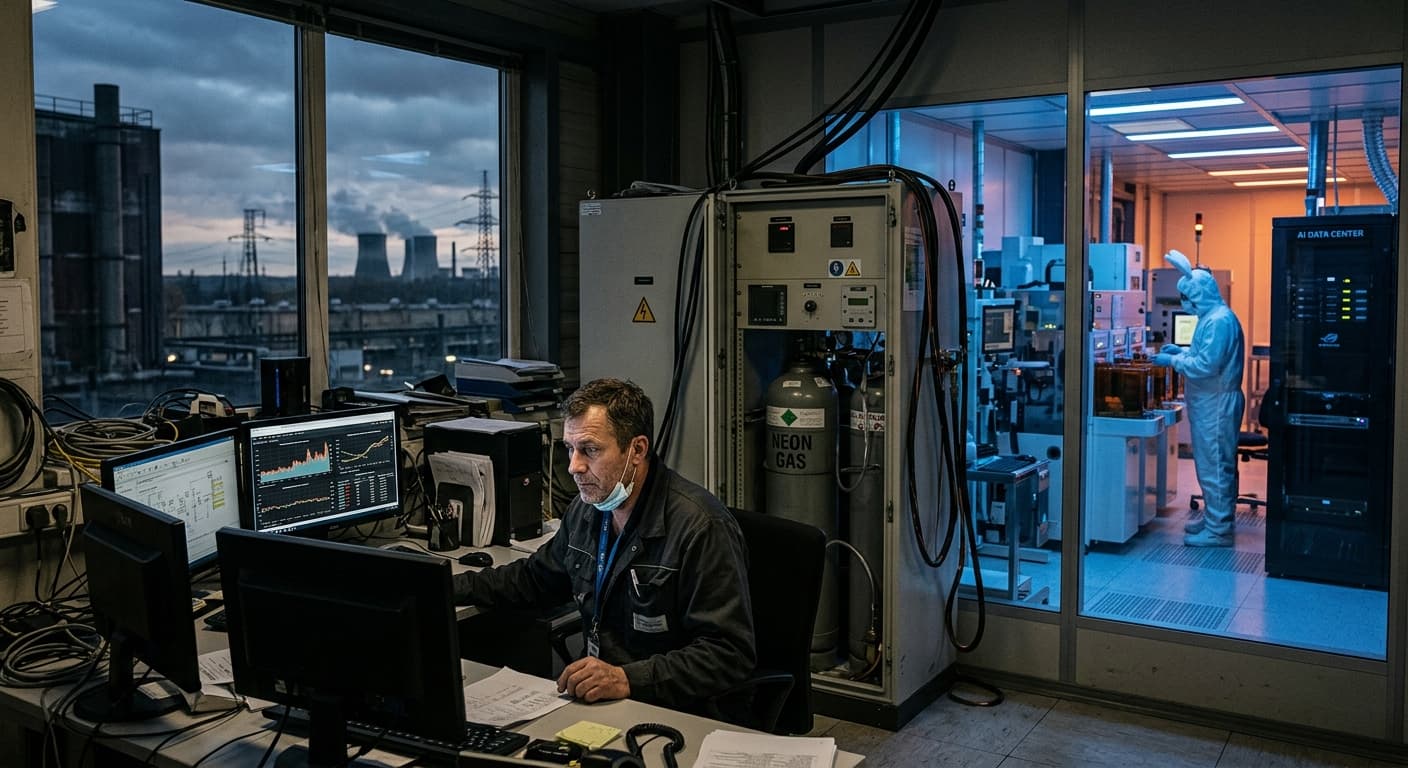
Neon gas, extracted as a byproduct of steel manufacturing in Ukraine, remains essential for excimer lasers that pattern advanced chips. Russia’s military operations near major production hubs have repeatedly cut output. When plants in Mariupol and Odessa went offline in earlier phases of the conflict, global neon prices jumped over 500% within months.
Today, even rumors of renewed strikes or logistics blocks send procurement teams at NVIDIA and TSMC scrambling. Chip fabs require ultra-pure neon for 5nm and 3nm processes that power the GPUs filling AI data centers. Any sustained shortage forces manufacturers to pay premiums or slow production lines already stretched by exploding demand for AI training clusters.
This dynamic directly connects to the NVIDIA supply chain gamble where $279 billion in projected AI infrastructure spend faces repeated critical minerals and gas input risks. Companies cannot simply switch suppliers overnight. Building new neon purification capacity elsewhere takes 18–24 months and billions in capital.
How Ukraine Energy Talks Influence AI Data Center Grid Constraints
Recent negotiations involving Trump, Zelenskyy, and Saudi officials center on energy exports and potential ceasefire frameworks. Any deal that alters Russian oil and gas flows changes the calculus for European and U.S. power markets. Higher European gas prices push more industrial and data center load toward U.S. grids already strained in Northern Virginia.
Northern Virginia holds the world’s largest concentration of data centers, with over 2.5 gigawatts of existing capacity and another 4 GW planned. Most new projects rely on nuclear or gas PPAs. When Ukraine-related diplomacy signals tighter global energy supply, utilities delay or renegotiate those agreements. Tech operators then face higher costs or postponed openings.
Oracle, already expanding its cloud footprint to meet AI demand, has publicly tied its growth targets to secure power contracts. Similar pressure appears in earnings calls from other hyperscalers. The connection is straightforward: uncertainty in Ukraine feeds uncertainty in global energy pricing, which feeds uncertainty in data center timelines.
Earthquake risks in semiconductor manufacturing regions add another layer. The 2026 earthquakes that hit key Asian production zones showed how quickly natural events compound geopolitical ones, forcing data center operators to seek more resilient supply chains.
Sovereign Wealth Fund Reallocation Patterns
Temasek, PIF, and Norway’s Government Pension Fund have trimmed direct exposure to European infrastructure assets vulnerable to Black Sea shipping risks. Instead, they are increasing stakes in Australian and Canadian lithium projects, U.S. rare earth processing facilities, and companies developing domestic neon recycling technology.
These moves reflect classic risk-off behavior. Funds model worst-case scenarios where prolonged Ukraine conflict disrupts not only neon but titanium, palladium, and other inputs used in both military and civilian tech. The same models now assign higher country risk premiums to any supply chain touching the former Soviet sphere.
Public filings and investment announcements show increased allocations to firms that can trace mineral provenance and maintain sanctions-compliant processing routes. This scrutiny favors vertically integrated miners and processors outside traditional Russian and Chinese dominance.
Impact on Semiconductor Markets and Korean Stocks
South Korea’s KOSPI has struggled as foreign investors exited positions in Samsung and SK Hynix. Both companies depend on stable neon and other Ukraine-linked inputs for memory and logic chip production. Memory chips are critical for AI training clusters, so any cost increase flows straight to hyperscaler budgets.
Bloomberg reporting confirms the “once-hot AI trade” has cooled in Seoul precisely because of these input cost fears and broader geopolitical risk. When investors flee Korean equities, liquidity dries up and volatility spikes, making it harder for chipmakers to fund capacity expansions needed to meet AI demand.
| Mineral/Input | Ukraine Share of Global Supply | Primary AI Use Case | Alternative Sources | Lead Time to Scale |
|---|---|---|---|---|
| Neon | ~50% | Lithography lasers | Israel, U.S. (limited) | 18–24 months |
| Krypton | ~30% | Specialty etching | China, U.S. | 12–18 months |
| Titanium | Significant refining | Servers & infrastructure | Japan, Kazakhstan | 9–15 months |
| Palladium | Indirect via Russia | Electronic components | South Africa, North America | 24+ months |
Real-World Procurement Shifts
One major U.S. cloud provider quietly added dual-sourcing clauses for neon in all new fab contracts during 2025. Another funded a pilot plant in Israel to recycle neon from existing fabs. These moves cost money today but protect margins if Ukraine tensions flare again. Smaller players without such leverage simply absorb price spikes, which eventually show up in cloud computing prices for enterprise customers.
Common Mistakes Investors Make
- Assuming neon disruptions are one-off events rather than chronic risks tied to infrastructure damage and logistics blocks.
- Underweighting the secondary effects of energy diplomacy on U.S. power markets and data center permitting.
- Treating all critical minerals as interchangeable when purity and processing standards create narrow supplier lists.
- Ignoring how sovereign wealth funds’ large-scale reallocations can move entire sub-sectors for months.
Best Practices for Supply Chain and Portfolio Resilience
- Map every tier of your semiconductor and data center supply chain for Ukraine exposure, including indirect gas and mineral routes.
- Build inventory buffers equal to at least six months of projected neon and krypton needs for critical production lines.
- Secure long-term PPAs with nuclear and renewable providers in regions less exposed to European energy volatility.
- Diversify critical minerals holdings across at least three geographic jurisdictions with stable governance records.
- Track sovereign wealth fund 13F filings and direct investment announcements for early signals of capital rotation.
- Stress-test portfolios against simultaneous Ukraine escalation and another major earthquake in a semiconductor hub.
FAQ
How dependent are AI data centers on Ukrainian materials?
Indirectly but significantly. While data centers themselves do not consume neon, the GPUs and TPUs inside them are manufactured using lasers that require high-purity neon. Any sustained price spike or shortage raises chip costs and slows delivery of new hardware needed for expansion.
Will a Ukraine ceasefire immediately ease critical minerals pressure?
Not necessarily. Even after ceasefire announcements, damaged infrastructure takes years to rebuild. Alternative capacity in other countries also requires time and capital. Markets typically price in gradual rather than instant relief.
Which sovereign wealth funds are most exposed to these shifts?
European and Middle Eastern funds with heavy allocations to energy and technology infrastructure show the largest adjustments. Asian funds with semiconductor exposure are also reallocating toward upstream mineral security.
What role does the Strait of Hormuz play in this picture?
Energy diplomacy linking Ukraine, Russia, and Saudi Arabia often references oil transit chokepoints. Any perceived risk in the Strait of Hormuz amplifies global energy price volatility, which in turn affects power costs for AI data centers in the United States.
How can individual investors gain exposure to these themes?
Consider companies developing domestic rare earth and gas processing capacity, nuclear power operators with data center contracts, and semiconductor equipment firms offering recycling or alternative lithography technologies. Avoid concentrated bets on single-country supply chains.
Conclusion
Developments in Ukraine are not a distant European story. They directly constrain the materials and energy required to scale AI infrastructure worldwide. Companies and investors that treat critical minerals security and power availability as strategic priorities, rather than operational afterthoughts, will hold clear advantages in the coming years. Tracking both diplomatic signals from Kyiv and procurement shifts at the fab level offers the clearest forward-looking indicators for portfolios and supply chains alike.
Review your exposure now. The next escalation or diplomatic breakthrough could move markets faster than most models anticipate.
Sources
Share This Article