Supply Chain · Jonathan van den Berg · October 17, 2026
How Houthi Advances in Yemen Expose Bab el-Mandeb Supply Chain Chokepoints and Red Sea Shipping Risk Premiums
Houthi advances tighten control over the Bab el-Mandeb Strait, forcing shipping lines to reroute around Africa and inflating insurance and fuel costs. These disruptions ripple through critical minerals flows, energy markets, and AI data center supply chains.
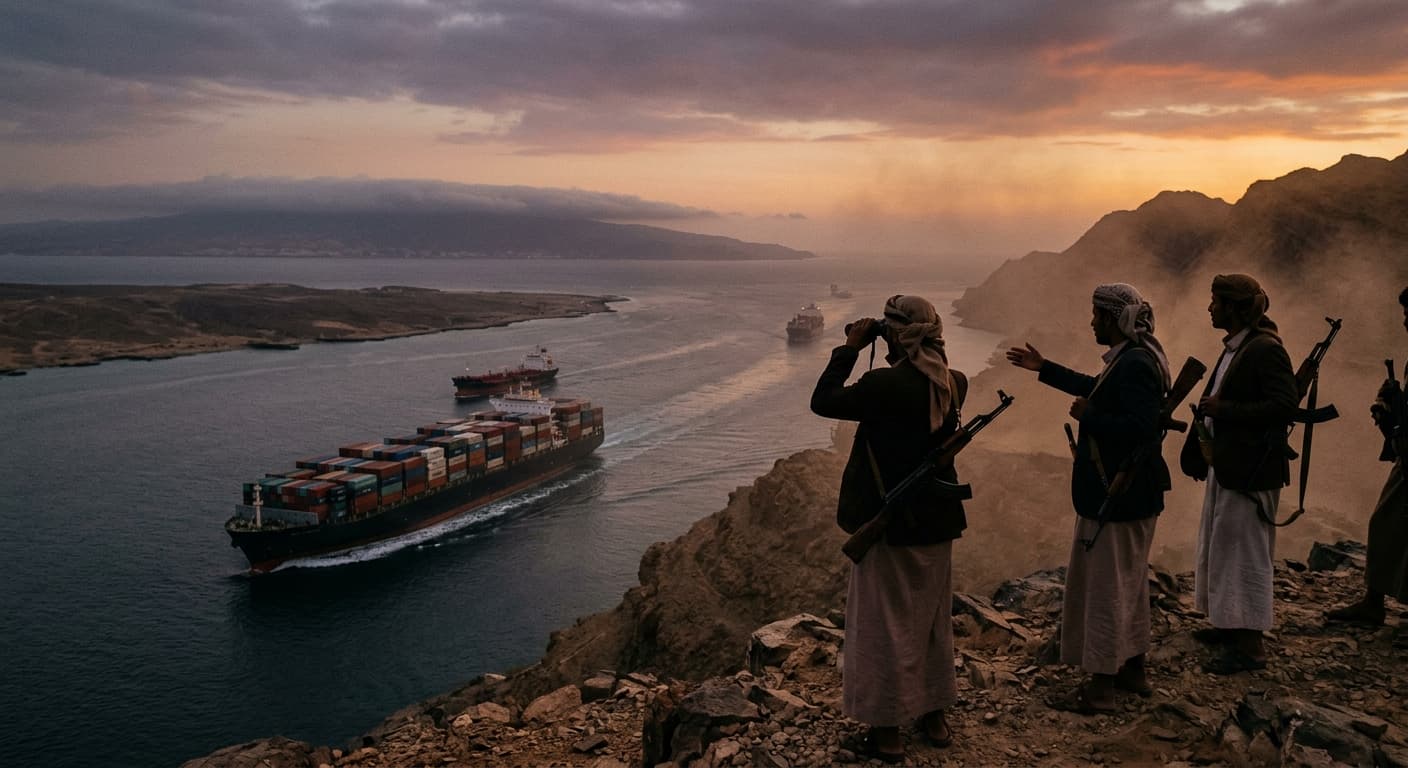
Bab el-Mandeb remains under pressure as Houthi forces consolidate control over key Yemeni coastal areas, directly threatening one of the world's most critical maritime passages.
Shipping companies now face insurance premiums that have climbed as much as 300% for Red Sea transits. Rerouting around the Cape of Good Hope adds 10 to 14 days to Asia-Europe voyages, burning extra fuel and delaying critical cargo. These disruptions hit everything from consumer goods to critical minerals essential for AI infrastructure.
The Bab el-Mandeb Strait, a narrow 18-mile-wide chokepoint between the Red Sea and the Gulf of Aden, carries roughly 12% of global seaborne trade and 30% of container traffic between Asia and Europe under normal conditions. When Houthi advances intensify, that flow shrinks dramatically.
Key Takeaways
- Houthi missile and drone strikes have forced over 90% of commercial shipping to avoid the Red Sea since late 2023, with the trend continuing into 2026.
- Insurance risk premiums for vessels transiting Bab el-Mandeb now range from 0.5% to 2% of hull value per voyage, compared to 0.1% before the escalation.
- Rerouting via the Cape of Good Hope increases fuel consumption by up to 40% and adds $1 million in extra costs per round-trip for a typical container vessel.
- Critical minerals shipments, including cobalt and rare earth elements routed from Africa, face the highest disruption risk.
- Sovereign wealth funds are reallocating capital toward logistics and defense firms positioned to benefit from prolonged Red Sea instability.
- AI data center operators in Northern Virginia and other hubs experience indirect pressure through delayed semiconductor and battery component deliveries.
The Strategic Importance of Bab el-Mandeb
The strait serves as the southern gateway to the Suez Canal. Together, these passages create the shortest maritime route between Europe and Asia. Roughly 6 million barrels of oil pass through Bab el-Mandeb daily, along with liquefied natural gas from Qatar and significant volumes of chemicals and containerized goods.
Houthi advances in western Yemen, particularly around Hudaydah and the mountainous terrain overlooking the strait, give them the ability to launch anti-ship missiles and drones with minimal warning. Their claimed attacks have targeted vessels linked to Israel, the United States, and the United Kingdom, but the fear effect has paralyzed neutral shipping as well.
This dynamic creates a classic chokepoint scenario: a relatively small group can impose outsized costs on global commerce. Similar dynamics appear in the Strait of Hormuz, where Iranian capabilities create parallel risks for oil flows.
How Houthi Advances Have Evolved
Since seizing Sana'a in 2014, the Houthis have expanded their territorial control and military reach. Advances in 2025-2026 have focused on securing additional coastline and inland launch sites. These moves improve their targeting accuracy against ships moving at speed through the narrow strait.
Recent strikes demonstrate improved precision. Several attacks have damaged commercial vessels despite naval escorts from the US-led Operation Prosperity Guardian. The persistent threat keeps most shipping companies on the longer route despite the added time and expense.
The group's alignment with Iranian supply lines for missiles and drone technology creates a proxy dynamic that complicates diplomatic solutions. Ceasefire talks in Yemen repeatedly stall, leaving the maritime threat intact.
Economic Impact on Global Shipping
Maersk, Hapag-Lloyd, and MSC have all maintained their avoidance of the Red Sea. The extra distance around Africa increases voyage duration from 25 days to nearly 40 days on the Asia-Europe route. Fuel costs rise proportionally.
Container freight rates from Shanghai to Rotterdam spiked more than 300% at the height of the crisis and remain elevated. Airlines have absorbed some overflow cargo, but capacity constraints and higher costs limit this option.
Smaller operators and bulk carriers carrying critical minerals face the toughest choices. Many lack the financial buffer to absorb repeated rerouting costs, leading to canceled shipments or steep price hikes passed to buyers.
Insurance and Risk Premium Dynamics
Lloyd's of London and other marine insurers have classified the Red Sea as a high-risk zone. War risk premiums now add hundreds of thousands of dollars per transit. Some policies exclude coverage entirely unless vessels take specific protective measures, such as traveling at night or using armed guards.
These premiums directly affect the cost of moving goods. For a $200 million vessel, a 1% premium per voyage equals $2 million in additional insurance expense. Shippers absorb some costs while passing the rest to consumers through higher prices.
Critical Minerals and Supply Chain Ripple Effects
The Red Sea route carries significant volumes of cobalt from the Democratic Republic of Congo, copper from Zambia, and phosphate rock from North Africa. These materials feed into battery production, semiconductor manufacturing, and renewable energy components.
Delays at Bab el-Mandeb create bottlenecks that compound existing pressures on critical minerals supply chains. Battery manufacturers in Europe report inventory shortages that slow electric vehicle production. Semiconductor fabricators face delays in specialty chemicals routed through the Suez Canal.
AI data center expansion depends on timely delivery of these materials. Copper for power infrastructure, rare earths for magnets in cooling systems, and lithium for backup batteries all feel the pressure when shipping routes lengthen and costs rise.
Energy Market Consequences
Oil tankers represent the most visible impact. While many now avoid the Red Sea, the longer route around Africa tightens global tanker availability. This contributes to higher freight rates across all crude routes.
LNG carriers from Qatar have largely shifted to the longer route, adding days to delivery schedules for European buyers. European nations already managing energy security concerns face additional volatility.
The risk premium spills into oil futures pricing. Traders price in the possibility of further escalation that could close the strait entirely, supporting higher Brent crude benchmarks.
| Route | Normal Duration | Rerouted Duration | Extra Fuel Cost (est.) | Primary Cargo Impacted |
|---|---|---|---|---|
| Asia to Europe via Suez | 25 days | 38-40 days | $800k-$1.2M | Electronics, critical minerals, apparel |
| Qatar LNG to Europe | 18 days | 32 days | $1.1M | Natural gas |
| East Africa to Mediterranean | 8 days | 22 days | $450k | Cobalt, copper concentrates |
Investor Implications and Sovereign Wealth Fund Strategies
Sovereign wealth funds from Gulf states and Asia have increased exposure to shipping, logistics technology, and defense contractors. Firms offering alternative routing solutions, drone defense systems, and satellite monitoring see strong capital inflows.
Funds tracking sovereign wealth fund strategies note a pivot toward assets that perform during supply chain stress. This includes companies developing overland rail corridors, expanded Panama Canal capacity, and Arctic shipping routes.
Insurance and reinsurance companies with marine war risk books have seen premium income surge, though catastrophic loss potential remains a concern.
Common Mistakes in Assessing Red Sea Risk
- Assuming the conflict is purely regional and will resolve quickly. Proxy relationships and ideological drivers suggest a longer timeline.
- Underestimating cascading effects on global freight rates. A disruption in one chokepoint raises costs across unrelated routes through vessel and crew shortages.
- Focusing only on oil flows while ignoring containerized critical minerals and components essential for technology supply chains.
- Over-relying on naval task forces for protection. Current operations have not restored confidence among commercial operators.
- Ignoring second-order impacts on AI infrastructure timelines and semiconductor availability.
Best Practices for Supply Chain Resilience
- Diversify routing options with built-in redundancy, including greater use of rail through Central Asia and expanded African port capacity.
- Build buffer inventory for critical minerals and semiconductor inputs, targeting 90-120 days of coverage for high-risk materials.
- Use real-time risk modeling that incorporates both kinetic threats and insurance market signals rather than static route planning.
- Partner with logistics providers offering multi-modal solutions that can shift between sea, air, and land based on daily threat assessments.
- Engage with sovereign wealth fund-backed infrastructure projects that aim to reduce dependence on traditional maritime chokepoints.
- Monitor Houthi statements and Iranian supply patterns as leading indicators of escalation risk.
Connection to Broader Geopolitical Trends
The Bab el-Mandeb situation does not exist in isolation. It intersects with tensions in the Strait of Hormuz, sanctions compliance challenges, and competition for critical minerals. Nations and companies that treat these as connected risks rather than separate crises gain strategic advantage.
AI data center operators face particular exposure. The power demands of training and inference already strain electrical grids. Any delay in delivery of transformers, high-voltage cables, or battery storage compounds existing constraints.
Companies that successfully navigate these chokepoints will likely capture market share as global trade fragments along more secure, if more expensive, routes.
FAQ
How long will Houthi threats to the Bab el-Mandeb Strait continue?
The conflict in Yemen has persisted for over a decade. Without a comprehensive political settlement that addresses Houthi grievances and their relationship with Iran, threats to shipping are likely to remain for years.
What is the current risk premium for Red Sea shipping?
War risk insurance premiums typically range from 0.5% to 2% of vessel value per transit, depending on specific routing, speed, and protective measures. This compares to roughly 0.05-0.1% in low-risk waters.
Which commodities face the greatest disruption from Bab el-Mandeb issues?
Containerized goods, crude oil, liquefied natural gas, and critical minerals including cobalt, copper, and phosphate rock experience the most significant delays and cost increases.
How are sovereign wealth funds responding to Red Sea disruptions?
Many are increasing allocations to logistics technology, alternative routing infrastructure, and defense systems while reducing exposure to companies heavily dependent on just-in-time Red Sea shipping.
Will naval protection restore confidence in the Red Sea route?
Current multinational naval efforts have reduced but not eliminated attacks. Most major shipping lines continue to avoid the area, suggesting naval presence alone is insufficient without a political resolution.
How does this affect AI data center development?
Delayed shipments of critical minerals, electrical equipment, and components slow construction timelines and raise costs for new facilities, particularly those in high-growth areas like Northern Virginia.
Looking Ahead
The Bab el-Mandeb chokepoint highlights the fragility of globalized supply chains. Companies and investors who build resilience against these recurring disruptions will hold advantages as geopolitical competition intensifies. Monitoring developments in Yemen while preparing for prolonged volatility represents the pragmatic approach in today's environment.
Understanding these dynamics helps decision-makers allocate capital more effectively across shipping, critical minerals, energy, and technology infrastructure. Those who act on this knowledge rather than waiting for resolution will navigate the next phase of supply chain stress more successfully.
Sources
Syracuse·Mentalfloss·Masslive·Leagueoflegends·Engadget·Massivelyop·Timesofindia·Zoomtventertainment·Suaragarut·Cbsnews·Chicagotribune·Abc7chicago·Sfchronicle·Mercurynews·Nbcsportsbayarea·Yahoo·People·Journalarta·Sports·Geo·Complex·Sportsbook·Sportsbook·Sportsbook·Yahoo·Instyle·Thedailybeast·Bloomberg·Lloydslist·Reuters·Eia·Worldbank·Cfr·Aljazeera
Share This Article