Jonathan van den Berg · July 2, 2026
Amazon Kuiper Satellite Launch: How the Final Atlas V Mission Reshapes Global Broadband Competition and Space Economics
ULA’s final Atlas V rocket successfully deployed the latest batch of Amazon’s Project Kuiper satellites, advancing one of the largest commercial satellite constellations ever built. The mission highlights shifting economics in the orbital economy and intensifying rivalry with Starlink for control of global broadband markets.
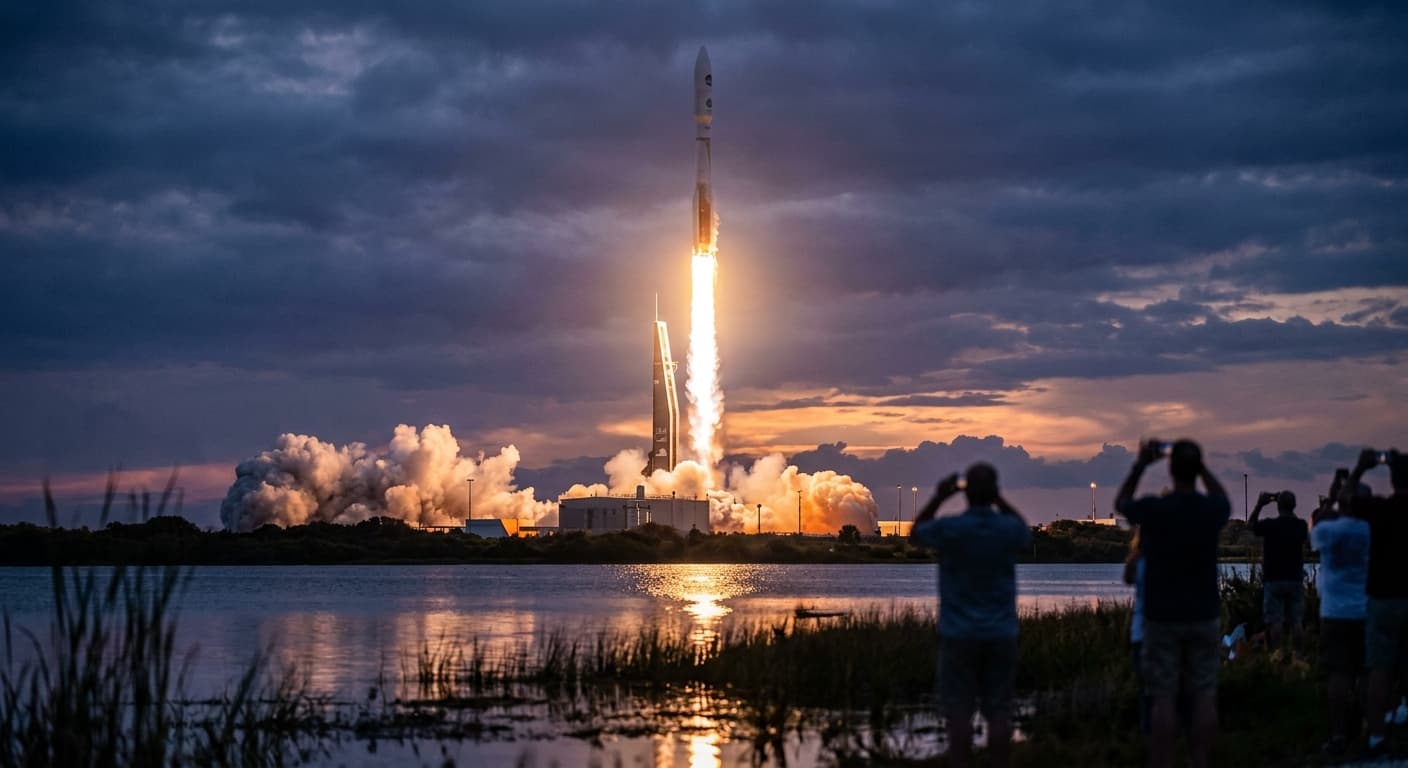
The final Atlas V rocket lifted off from Cape Canaveral carrying another batch of Amazon Project Kuiper satellites. This mission marks the end of an era for United Launch Alliance’s workhorse vehicle while accelerating Amazon’s push to build one of the world’s largest low-Earth orbit broadband constellations.
For everyday consumers and businesses in underserved regions, the launch brings tangible progress toward affordable high-speed internet from space. For governments and strategists, it underscores how private companies now drive critical infrastructure that once belonged exclusively to nation-states.
Key Takeaways
- ULA’s final Atlas V successfully deployed Kuiper satellites, completing the rocket’s 99th and last flight.
- Amazon has now placed over 1,000 satellites in orbit as it races toward a 3,200-satellite constellation.
- The mission intensifies direct competition with SpaceX’s Starlink in the $20+ billion annual satellite broadband market.
- U.S. commercial launch policy, supply chain vulnerabilities, and dual-use technology concerns shape the broader geopolitical stakes.
- Success here strengthens American leadership in the emerging orbital economy while highlighting risks of reliance on a single domestic launch provider after Atlas V retires.
The Final Atlas V and Its Cargo
United Launch Alliance designed the Atlas V to deliver reliable medium-lift capability for both national security payloads and commercial missions. The rocket’s retirement after nearly two decades reflects the industry shift toward reusable vehicles and higher launch cadence. Its final flight carried Kuiper satellites into a precise low-Earth orbit optimized for low-latency broadband.
Each satellite in Amazon’s constellation weighs roughly 500 kilograms and features advanced phased-array antennas and optical inter-satellite links. These capabilities allow the network to deliver speeds comparable to fiber without laying cables across oceans or remote terrain.
The successful deployment adds to the growing on-orbit fleet. Amazon aims to begin beta testing with customers later in 2026 and scale to full commercial service by 2027. Early tests have already shown download speeds exceeding 100 Mbps in controlled environments.
Project Kuiper’s Economic Scale
Amazon has committed more than $10 billion to Project Kuiper, one of the largest single infrastructure investments in tech history. The project includes satellite manufacturing, ground stations, launch contracts, and user terminal development. The economic ripple effects extend far beyond Seattle.
Manufacturing facilities in Washington and Florida employ thousands. Supply contracts support companies across 30 states. When fully deployed, the constellation could generate tens of billions in annual revenue while connecting millions of previously unserved households, farms, and businesses.
This investment also creates defensive value. Reliable broadband underpins everything from precision agriculture and remote healthcare to financial markets and emergency response. In economic terms, closing the digital divide in developing regions can add meaningful percentage points to GDP growth according to World Bank studies on connectivity.
Geopolitical Dimensions of Satellite Broadband
Control over global connectivity increasingly equals geopolitical influence. Nations that dominate satellite networks can shape information flows, set technical standards, and collect valuable Earth observation data.
China is rapidly expanding its own GuoWang constellation while Russia and India pursue more modest systems. Europe’s IRIS² project seeks strategic autonomy in space-based communications. The United States currently leads through private enterprise, but this model creates new dependencies and vulnerabilities.
Amazon’s progress matters because it diversifies American options beyond a single provider. A healthy competitive landscape between Kuiper, Starlink, and future entrants reduces single points of failure and prevents any one company from exercising monopoly power over orbital internet infrastructure.
The dual-use nature of these satellites raises legitimate national security questions. High-resolution sensors and secure communication channels can serve both civilian and military purposes. Regulators have imposed strict licensing requirements precisely to balance innovation with security.
Competition With Starlink and Market Realities
SpaceX’s Starlink currently operates the largest constellation with more than 7,000 satellites and over 4 million active users. It has proven the technical and commercial viability of satellite broadband. Kuiper’s approach differs in satellite design, spectrum strategy, and target markets.
Amazon benefits from its existing global retail and cloud infrastructure. AWS already operates extensive ground systems that can integrate with Kuiper terminals. This vertical integration potentially lowers costs and speeds deployment compared to pure-play space companies.
User terminals remain the biggest practical hurdle. Both companies must drive down the price of phased-array dishes to reach price-sensitive markets in Africa, Latin America, and Southeast Asia. Current estimates place hardware costs between $300 and $600 depending on subsidies and volume.
The winner in this race will capture significant share of the projected $50 billion global satellite services market by 2030. Economic power in orbit increasingly translates to influence on the ground.
Launch Industry Transition and Supply Chain Risks
The retirement of Atlas V highlights the precarious state of U.S. medium-lift launch capacity. Vulcan Centaur, ULA’s next-generation rocket, has faced delays. SpaceX dominates reusable heavy-lift but faces its own capacity constraints and regulatory scrutiny.
This situation creates strategic risks. The Pentagon and intelligence community rely on reliable access to space. Commercial customers like Amazon provide the high launch cadence needed to keep American factories operating and engineers employed.
Semiconductor shortages, rare earth mineral dependencies, and specialized component bottlenecks continue to affect satellite production. These vulnerabilities mirror challenges seen across global semiconductor supply chains and highlight why diversification matters.
Broader Implications for the Orbital Economy
The Kuiper launch forms part of a larger transformation. Space has evolved from a domain of scientific exploration and military advantage into a commercial marketplace measured in hundreds of billions of dollars.
Investors have poured capital into satellite operators, launch providers, in-space manufacturing, and debris remediation technologies. Public markets have rewarded companies that demonstrate both technical capability and clear paths to profitability.
This commercial surge carries strategic weight. Nations that foster vibrant space industries gain advantages in technology, talent, and soft power. The United States currently leads, but sustained policy support for regulatory reform, spectrum allocation, and skilled immigration will determine whether that lead holds.
Related developments in quantum computing breakthroughs and advanced materials research will further reshape what becomes possible in orbit over the coming decade.
Common Mistakes in Assessing Space Infrastructure Projects
- Assuming technical success guarantees commercial success. Many constellations have failed due to poor unit economics.
- Underestimating regulatory and spectrum coordination challenges between multiple operators.
- Overlooking ground system costs and last-mile integration issues that often exceed satellite expenses.
- Ignoring national security review processes that can delay or modify deployment plans.
- Expecting rapid profitability. Most serious space infrastructure projects require 7-10 years to reach scale.
Best Practices for Policymakers and Industry Leaders
- Maintain multiple viable domestic launch providers to avoid dependency on any single system.
- Coordinate spectrum policy internationally to minimize interference between competing constellations.
- Invest in ground infrastructure and user terminal subsidies for strategically important regions.
- Develop clear rules for space traffic management and debris mitigation as orbital density increases.
- Balance export controls with the need for commercial innovation and allied collaboration.
FAQ
What is Project Kuiper?
Amazon’s low-Earth orbit satellite internet constellation designed to provide high-speed broadband to unserved and underserved communities worldwide. The project aims for more than 3,200 satellites.
Why does the final Atlas V launch matter?
It represents both the successful deployment of critical communications infrastructure and the transition away from a proven but non-reusable launch vehicle toward newer systems. The mission advances America’s commercial space leadership.
How does Kuiper compare to Starlink?
Both systems seek to deliver broadband from space but differ in satellite size, numbers, spectrum use, and corporate strategy. Starlink currently leads in scale and active users while Kuiper leverages Amazon’s global infrastructure and cloud expertise.
What are the geopolitical risks of satellite constellations?
Concerns include data sovereignty, potential for surveillance, vulnerability to anti-satellite weapons, spectrum interference disputes, and the risk that dominant providers could influence information access in developing nations.
When will Kuiper service become available?
Amazon plans initial customer trials in 2026 with broader commercial availability targeted for 2027, depending on regulatory approvals and constellation completion.
Conclusion
The final Atlas V launch carrying Amazon Kuiper satellites represents more than a routine space mission. It signals the accelerating integration of private capital, advanced technology, and strategic infrastructure in the contest for global connectivity dominance.
Success in this domain will help determine which nations and companies shape the digital economy of the 2030s. For millions of people still waiting for reliable internet, the real impact will be measured in educational opportunities, economic participation, and access to global markets.
The orbital economy is no longer science fiction. It has become a central arena of technological competition, economic power, and geopolitical maneuvering. Wednesday’s launch moved the ball forward for one of the major players.
Stay informed on how space infrastructure, connectivity markets, and strategic technology investments continue to reshape global power dynamics by exploring our coverage of SpaceX’s potential IPO and emerging trends in commercial space.
Share This Article