Jonathan van den Berg · May 16, 2026
Samsung's OLED TV Price Crash Reveals Deeper Cracks in Global Semiconductor Supply Chains
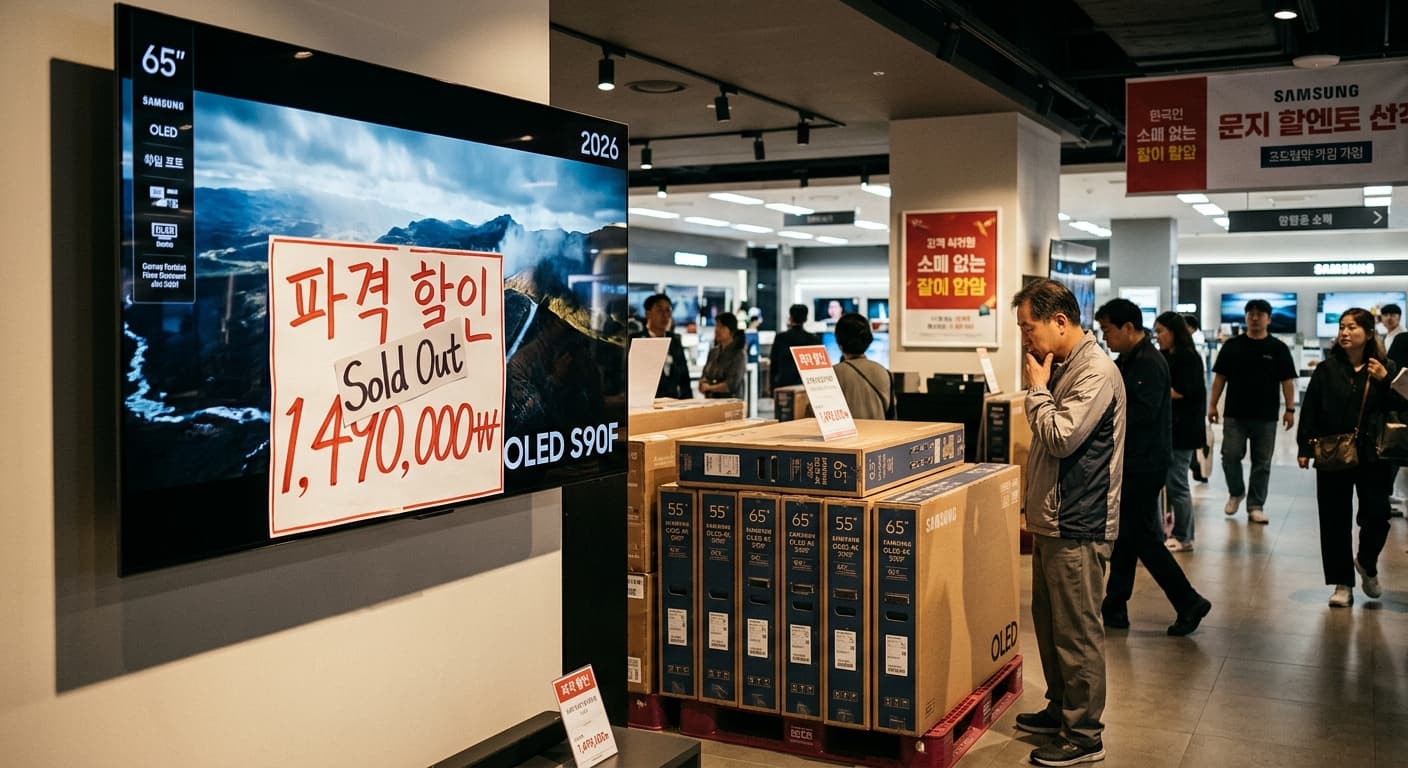
In South Korea, aggressive clearance sales on 2025 and 2026 Samsung OLED 4K S90F smart TVs have pushed premium 55-inch and 65-inch models to record lows, exposing how memory chip volatility and US-China tech tensions continue to reshape consumer electronics pricing worldwide.
One of the most surprising facts in consumer electronics right now is that premium Samsung OLED TVs — models that cost well over $2,000 just a year ago — are being cleared out at prices lower than many mid-range LCD sets. The 55-inch version of the S90F series has recently hit record lows around $1,200 in some markets, while the larger 65-inch model frequently dips below $1,800 during flash sales.
This isn't simply a story about good deals for shoppers. It reveals how fiercely competitive the television industry has become and how tightly its fortunes are tied to the volatile global market for memory chips and advanced display components. What looks like a simple clearance sale actually reflects deeper shifts in manufacturing power, trade tensions, and investment decisions that stretch from Seoul to Silicon Valley to Beijing.
The Scale of Samsung's Clearance Push
Samsung has moved aggressively to clear inventory of its 2025 television lineup as it prepares for newer 2026 models. Retail partners in the United States and Europe report that both the OLED S90F series and certain Crystal UHD models are seeing discounts of 30 to 45 percent off original launch prices.
What Hi-Fi? and Mashable have documented sustained price drops throughout May, with the 65-inch S90F frequently appearing as one of the strongest value propositions in the premium TV segment. Kotaku noted that even non-OLED Crystal UHD U8000F models reached all-time lows near $500 for the 55-inch version, creating unusual pricing pressure across Samsung's entire range.
These discounts matter because Samsung remains one of the two dominant forces — alongside LG Display — in the global OLED television panel market. When the South Korean giant slashes prices this sharply, it forces competitors to respond. That ripple effect eventually determines what everyday families pay for their living room screens.
Memory Chip Volatility Drives Display Economics
To understand why these TVs are suddenly so affordable, you need to look at the memory chip market. DRAM stock surge highlights memory chip volatility and its ties to global semiconductor power struggles. Prices for dynamic random-access memory — the chips that handle fast data storage in everything from servers to smartphones to TVs — have swung wildly over the past 24 months.
When DRAM prices fall, electronics makers can reduce costs across their product lines. When they spike, manufacturers face pressure to protect margins by raising retail prices. Samsung itself is both a major consumer of these chips and one of the world's largest producers through its semiconductor division. This dual role creates complicated incentives that directly affect TV pricing.
Industry analysts tracking the market in 2026 note that a recent softening in DRAM contract prices has given Samsung breathing room to discount finished consumer products. At the same time, the company faces stiff competition from Chinese manufacturers who continue expanding their own display production capacity despite Western export controls on advanced manufacturing equipment.
US-China Tensions Cast a Long Shadow
The television market cannot be separated from broader technology competition between Washington and Beijing. Trump-Xi Summit Signals Fragile Pause in US-China Trade War as Taiwan Remains the Core Flashpoint. Although consumer TVs do not contain the most cutting-edge chips restricted under export controls, the entire supply chain feels the pressure.
Samsung Display's OLED production facilities in South Korea and Vietnam have become increasingly important as companies seek to reduce reliance on Chinese manufacturing for certain components. Yet Chinese firms like BOE and CSOT continue aggressive investment in large-format OLED technology, aiming to capture more of the premium TV segment that has traditionally been dominated by Korean and Japanese companies.
This competition benefits consumers in the short term through lower prices. But it also raises questions about long-term supply chain resilience. Many industry executives worry that years of heavy discounting could eventually lead to consolidation, reducing the number of companies capable of producing advanced display panels.
How Subnautica 2 and Gaming TVs Fit Into the Picture
The timing of these discounts coincides with growing interest in high-refresh-rate OLED panels among PC and console gamers. Unknown Worlds' Subnautica 2 roadmap has drawn attention to the game's beautiful underwater visuals that particularly shine on premium OLED displays with strong contrast and fast response times.
The Verge reported on the game's early access launch across Steam, Epic Games Store, and Xbox platforms, noting that many players are upgrading their home theater setups specifically to experience the title's atmospheric visuals. This gaming-driven demand has helped sustain interest in Samsung's S90F series even as the company clears older inventory.
Gaming televisions represent one of the fastest-growing segments in the industry. Features like 4K resolution at 120Hz or 144Hz refresh rates, variable refresh rate support, and low input lag have moved from niche PC monitor territory into mainstream TV marketing. Samsung has leaned heavily into these capabilities with the S90F, positioning it as both a cinema screen and a serious gaming display.
The Broader Economic Picture
These TV price wars occur against a complicated global economic backdrop. Central banks continue navigating inflation concerns while energy prices remain sensitive to developments in the Middle East. How the Iran Conflict Could Reshape Global Oil Flows and Energy Prices for Years. Higher energy costs eventually feed through to manufacturing expenses, making the current period of aggressive consumer electronics discounting even more notable.
South Korea's economy remains heavily dependent on its technology giants. Samsung Electronics employs tens of thousands directly and supports hundreds of thousands more through its supply chain. When the company adjusts production or pricing strategies, the effects reach far beyond Seoul headquarters.
Foreign investors have shown mixed sentiment toward Korean stocks recently. Some analysts point to intensifying competition in both semiconductors and displays as reasons for caution, while others see current discounts as smart inventory management ahead of newer, more profitable product cycles.
What This Means for Buyers and the Industry
For regular people, the practical impact is straightforward: this may be one of the best times in recent years to buy a premium OLED television. The S90F delivers excellent picture quality with perfect blacks, vibrant colors, and smooth motion handling. At current prices, it competes favorably against last year's models from both Samsung and LG.
Yet buyers should understand these prices reflect intense industry pressure rather than declining quality. Manufacturers are fighting for market share in a maturing industry where most households in developed markets already own at least one large flat-screen TV.
The situation also highlights why diversification of supply chains has become such a priority for governments and companies alike. When too much advanced manufacturing capacity concentrates in too few locations — whether South Korea, Taiwan, or certain regions of China — price volatility and geopolitical risks increase for everyone downstream, including consumers.
Looking Ahead: Technology and Trade in 2026
Samsung has signaled plans to expand its quantum dot OLED offerings and improve brightness levels in future models. The company continues investing heavily in research and development despite current pricing pressure. Meanwhile, competitors are accelerating their own next-generation display technologies.
Trade policy remains a major variable. Any significant changes in tariffs or technology export rules could quickly alter the cost equations for all players in the television supply chain. Companies must balance the desire for lower prices to capture market share against the need to maintain healthy profit margins that fund future innovation.
The memory chip market will likely remain cyclical. Periods of oversupply and heavy discounting tend to be followed by tighter supply and rising prices as manufacturers cut production to protect profitability. Smart buyers might consider current TV deals as a rare alignment of favorable chip pricing, competitive pressure, and seasonal inventory clearance.
The Human Element Behind the Screens
It's worth remembering that these products come from complex global networks of factories, engineers, designers, and logistics teams. When Samsung decides to discount thousands of television units, it affects workers at panel plants in South Korea, component suppliers across Southeast Asia, retail staff in American big-box stores, and delivery drivers moving heavy boxes to people's homes.
The surprisingly low prices on flagship OLED models represent real economic forces colliding: rapid technological improvement, intense international competition, cyclical semiconductor markets, and companies trying to balance short-term sales targets with long-term strategic positioning.
Consumers win when these forces drive prices down. But the same dynamics that create today's bargains can create tomorrow's shortages or quality compromises if the industry becomes too concentrated or if geopolitical tensions disrupt supply lines. A Magnitude 7.1 Kyushu earthquake's impact on global supply chains and semiconductor markets would further illustrate how vulnerable these concentrated production hubs remain to sudden disruptions.
The Samsung OLED clearance wave of 2026 offers a window into how consumer technology markets actually work — not as isolated retail categories, but as deeply interconnected pieces of larger economic and strategic puzzles. Your next television purchase, it turns out, carries faint echoes of decisions made in corporate boardrooms from Seoul to Washington about everything from memory chip production quotas to technology export licenses.
That's what makes these record-low prices more than just a good deal. They represent a momentary calm in an industry constantly shaped by global forces far bigger than any single product launch or sales event.
In the end, the counterintuitive truth remains: sometimes the highest-quality screens become most affordable precisely when the competitive and geopolitical pressures surrounding their creation reach peak intensity.
Share This Article