Critical Minerals · Jonathan van den Berg · October 21, 2026
Japan Export Surge 2026: How Semiconductor Demand Reshapes Critical Minerals Supply Chains and AI Data Center Expansion
Japan's latest export numbers show semiconductor shipments leading a 16.7 percent rise, tightening competition for gallium, germanium, and rare earths while accelerating AI data center buildouts that already strain power grids from Northern Virginia to Tokyo.
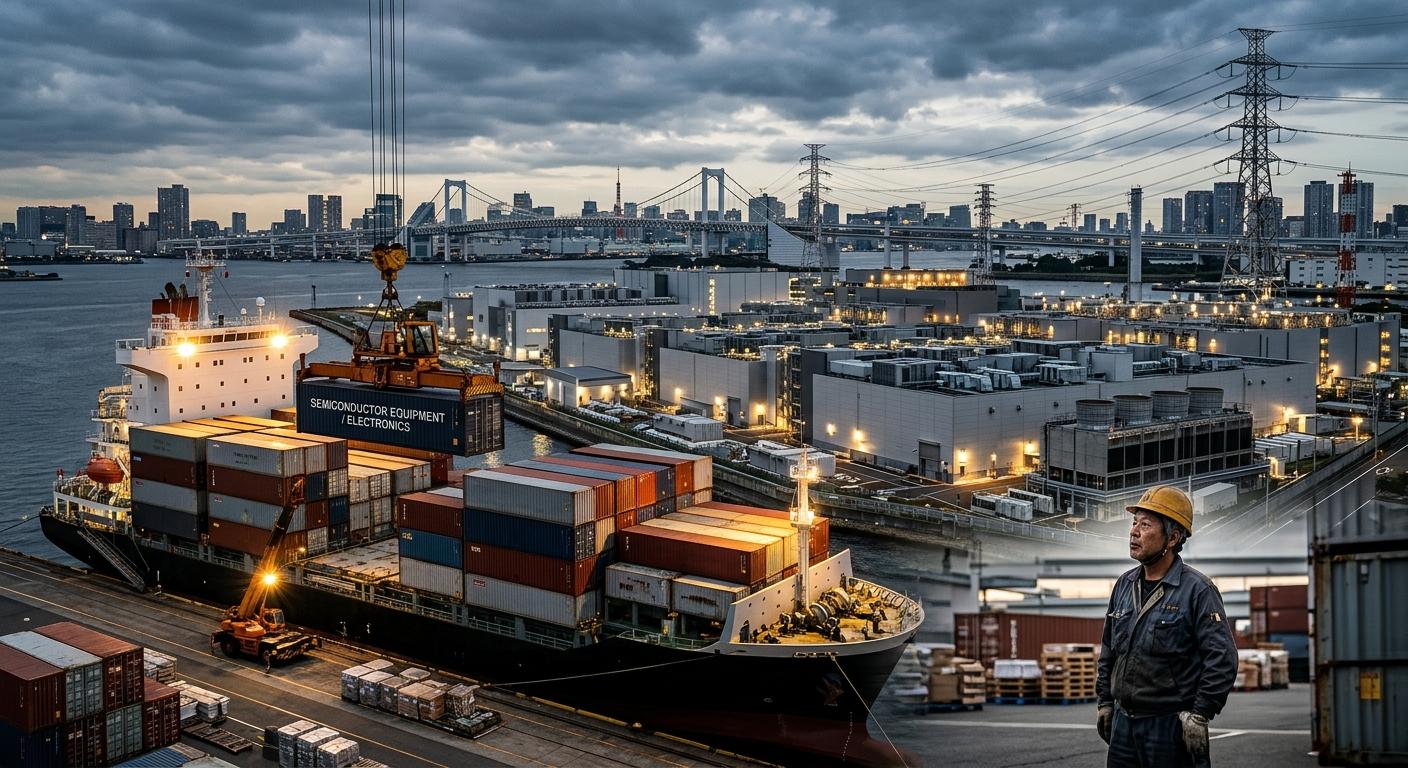
Japan's September exports jumped 16.7 percent year-over-year, the strongest gain in months, powered by semiconductor shipments and automobile demand. The numbers confirm what supply-chain analysts have tracked for quarters: chip-related exports are pulling forward critical minerals consumption at a pace that directly feeds AI data center expansion worldwide.
Ministry of Finance data released this week show semiconductor and electronic component exports rose sharply, offsetting weakness in consumer goods. Auto exports also contributed as global manufacturers rebuilt inventories. The yen's relative weakness helped, but the real driver sits in data centers that need ever-more powerful chips built with materials China increasingly controls.
Key Takeaways
- Japan recorded 16.7% export growth in September 2026, led by semiconductors and autos.
- Gallium and germanium shortages are tightening as AI training clusters scale faster than refining capacity.
- AI data center power demand in Northern Virginia alone is projected to exceed several gigawatts within three years, mirroring Japan's own domestic constraints.
- Sovereign wealth funds are quietly shifting allocations toward companies with secured mineral offtake agreements.
- Investors face higher risk premiums on any supply disruption along the Malacca Strait or through Taiwan.
What the Export Data Actually Shows
The headline 16.7 percent rise masks concentration. Semiconductor equipment and components accounted for the largest share of incremental growth. Japanese firms like Tokyo Electron (TSE:8035) and Advantest ship critical tools that enable TSMC (NYSE:TSM) and Samsung to produce the advanced nodes required for NVIDIA (NYSE:NVDA) GPUs and custom AI accelerators from Amazon (NASDAQ:AMZN), Google (NASDAQ:GOOGL), and Oracle (NYSE:ORCL).
This creates a feedback loop. Stronger Japanese exports signal stronger global AI investment, which in turn pulls more gallium, neon, and rare-earth elements out of an already strained market. China, which dominates refining of these materials, has demonstrated willingness to restrict exports when geopolitical tensions rise, as seen in previous cycles.
The South China Sea tensions add another layer. Much of Japan's semiconductor-related trade passes near contested waters, exposing shipments to potential delay or interference that markets currently price at low probability but high impact.
Critical Minerals Under Pressure
Gallium and germanium sit at the center of the squeeze. Both are byproducts of aluminum and zinc refining, with China controlling roughly 80-90 percent of global supply in recent years. Export restrictions or even rumors of tighter quotas send prices spiking and force chipmakers to scramble for alternative sources.
Japan holds some refining capacity and long-term contracts, yet it still imports the majority of its raw needs. The export surge indicates Japanese producers are operating near capacity, leaving little buffer if China tightens controls again. Similar dynamics apply to neon gas used in laser lithography and to specialized rare earths for magnets in advanced manufacturing equipment.
These shortages do not remain abstract. Every new hyperscale AI data center requires thousands of GPUs and supporting infrastructure built on these materials. The tighter the mineral supply, the higher the cost and the longer the lead times for new clusters.
Link to AI Data Center Buildout
Northern Virginia already hosts the world's largest concentration of data centers. Power demand from these facilities is forecast to double within five years, forcing utilities to seek new generation sources while transmission lines remain constrained. The same story repeats in Japan, where land scarcity and grid limitations slow domestic expansion even as export demand grows.
Companies building these facilities face three simultaneous bottlenecks:
- Chip availability tied to critical minerals
- Power purchase agreements that grow more expensive each quarter
- Water and land constraints in preferred locations
The Netflix Q3 2026 earnings illustrated the pressure clearly. Higher infrastructure costs tied to both power and specialized hardware compressed margins even as subscriber growth continued. Other hyperscalers report similar trends in private calls with investors.
How Investors Are Positioning
Sovereign wealth funds and large asset managers now screen for companies with vertical integration or long-term offtake deals in critical minerals. Firms with exposure to Japanese semiconductor equipment benefit directly from the export surge but carry correlation risk if mineral prices spike or China restricts flows.
Relevant tickers show divergent performance. NVIDIA remains the clearest proxy for AI demand, yet its valuation already prices in sustained growth. Tokyo Electron and Advantest offer more direct leverage to Japan's export strength with lower multiples. TSMC sits in the middle, balancing Taiwan risk against unmatched manufacturing scale.
| Company | Exposure Type | Key Risk | Investor Implication |
|---|---|---|---|
| NVIDIA (NVDA) | AI GPU demand | Mineral-driven cost inflation | Strong revenue but margin pressure possible |
| Tokyo Electron (8035.T) | Semiconductor equipment | Export concentration to Asia | Direct beneficiary of Japan data |
| TSMC (TSM) | Foundry capacity | Geopolitical Taiwan risk | Central to AI supply chain |
| Oracle (ORCL) | Data center operator | Power and land constraints | Long-term beneficiary if nuclear PPAs secured |
Funds are also increasing stakes in companies developing alternative materials or recycling technologies, though these remain early-stage and cannot scale quickly enough to offset near-term shortages.
Supply Chain Chokepoints in Focus
The Malacca Strait remains the primary maritime artery for much of Japan's energy and raw material imports. Any disruption there, whether from geopolitical friction or natural events, would compound mineral shortages by delaying feedstock arrivals. Japanese refiners keep strategic stocks, but sustained closure would force production cuts within weeks.
Compare this to the Bab el-Mandeb chokepoint risks that have already raised shipping insurance premiums for Europe-bound trade. While Japan's primary exposure runs through the Indian Ocean and Malacca, the interconnected nature of global shipping means Red Sea disruptions ripple into container rates and schedule reliability for components.
Common Mistakes Investors Make
- Treating semiconductor export growth as purely positive without modeling mineral input constraints.
- Assuming China will avoid export controls on gallium and germanium despite precedent.
- Underweighting power and grid constraints when evaluating data center operators and their chip suppliers.
- Focusing only on headline export percentages rather than the composition and geographic concentration of that growth.
Best Practices for Tracking This Theme
- Monitor monthly Japanese trade data for semiconductor and electronic component trends as a leading indicator of AI capex momentum.
- Track spot prices and Chinese export licensing data for gallium, germanium, and rare earth oxides weekly.
- Follow power purchase agreement announcements and grid interconnection queues in key data center markets like Northern Virginia, Texas, and Japan.
- Assess company disclosures for mineral sourcing strategies and inventory levels rather than relying solely on revenue guidance.
- Stress-test portfolios against a 30-50 percent spike in critical minerals prices or a six-month delay in advanced chip deliveries.
FAQ
How sustainable is Japan's current export growth?
Growth tied to semiconductors looks more durable than consumer-driven rebounds because it reflects structural AI investment. However, mineral supply limits and potential Chinese export restrictions could cap upside within 12-18 months without new refining capacity coming online.
Will critical minerals shortages slow AI data center buildout?
They already are. Lead times for certain chips have extended, and hyperscalers are paying premiums for priority allocation. Power constraints in key markets compound the issue, creating a dual bottleneck of hardware and energy.
What role does the yen play in these exports?
A weaker yen improves competitiveness, particularly against Korean and Taiwanese rivals. Yet currency translation effects matter less than actual unit demand from AI developers and automotive manufacturers.
Which regions face the tightest data center power constraints?
Northern Virginia leads in absolute demand growth, followed by certain markets in Ireland, Singapore, and Japan. Transmission infrastructure lags new generation additions in almost every major hub.
How are sovereign wealth funds responding?
Many are increasing direct investments in mining and refining assets while favoring technology companies with multi-year mineral supply contracts. Temasek and similar Asian funds show particular interest in securing Japanese and Taiwanese supply chains.
Conclusion
Japan's export surge confirms the AI buildout remains on track even as material and energy constraints tighten. Investors who treat critical minerals and power availability as core variables rather than afterthoughts will better navigate the next phase of this cycle. Those positioned in companies with secured supply, efficient manufacturing, and realistic power strategies stand to capture the upside while others face margin compression and delivery delays.
Track the monthly trade data, mineral prices, and grid announcements closely. The feedback loop between Japanese exports, critical minerals, and AI infrastructure is only growing tighter.
Share This Article