Critical Minerals · Jonathan van den Berg · October 19, 2026
Philippines China South China Sea Tensions: How Escalating Threats Reshape Critical Minerals Supply Chains and AI Data Center Risks
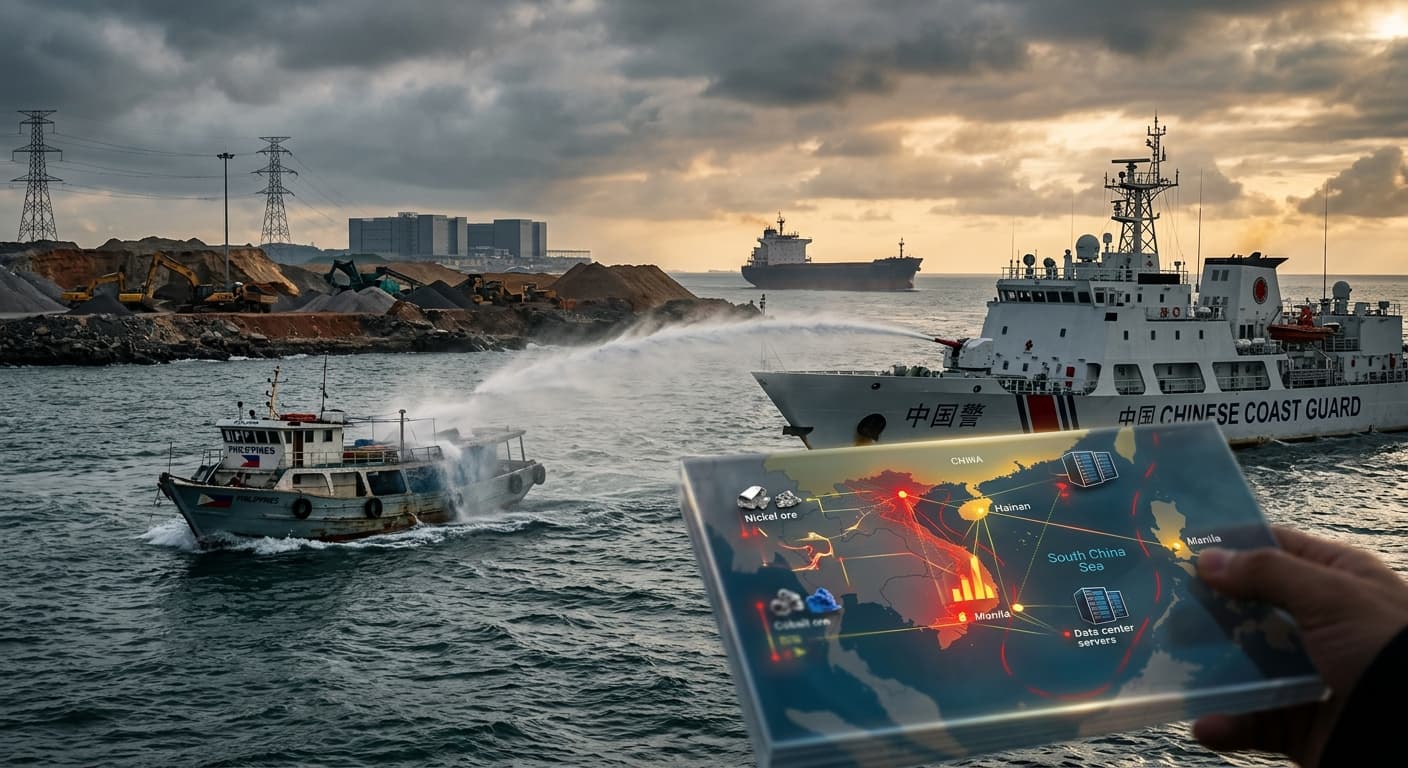
Philippines' summons of China's envoy over explicit threats of force highlights rising risks in one of the world's most contested maritime corridors, directly threatening critical minerals flows essential to semiconductors and AI infrastructure.
Philippines summons of China's envoy marks the latest escalation in South China Sea disputes, with Beijing's ambassador accused of conveying direct threats of force. This incident tightens pressure on vital sea lanes that carry rare earths, gallium, germanium, and other critical minerals essential for semiconductor manufacturing and AI data center infrastructure.
These waters sit at the heart of global supply chains. Roughly 80% of global rare earth processing and significant portions of gallium and antimony production transit routes vulnerable to disruption here and through the connected Malacca Strait. For investors and corporate strategists, the immediate question is how this friction translates into higher costs, delayed projects, and portfolio reallocation.
Key Takeaways
- Philippines' formal diplomatic protest follows remarks interpreted as explicit threats, raising the risk premium on South China Sea transit.
- Critical minerals used in chips and data center components face concentrated supply risks, with China controlling over 80% of refined supply for several key elements.
- Semiconductor firms including TSMC, NVIDIA, and Applied Materials remain exposed to potential export restrictions or physical disruptions.
- AI data center operators in Northern Virginia and similar hubs could see power component costs rise if magnet and transformer mineral supplies tighten further.
- Sovereign wealth funds are quietly shifting allocations toward non-Chinese critical minerals projects in Australia, Canada, and Vietnam.
The Diplomatic Flashpoint
Manila summoned Ambassador Jing Quan after comments that Philippine officials described as conveying a threat of force. The exchange occurred amid ongoing confrontations near Second Thomas Shoal and other disputed features. Both sides accuse the other of provocative actions, yet the explicit language marks a departure from previous diplomatic posturing.
This is not an isolated event. Tensions in the South China Sea have repeatedly spilled into economic domains. Previous incidents triggered temporary halts in Philippine nickel exports and heightened insurance costs for vessels. The current episode arrives as global demand for minerals used in defense, electronics, and renewable energy continues climbing.
China has maintained expansive claims across nearly the entire South China Sea, overlapping with exclusive economic zones of the Philippines, Vietnam, Malaysia, and others. The 2016 arbitral tribunal ruling against Beijing's claims has done little to reduce operational friction between coast guard and fishing vessels.
Critical Minerals at Stake
The South China Sea region and its supply routes matter because of downstream dependencies. China dominates processing of rare earth elements, gallium, germanium, graphite, and antimony. These materials appear in semiconductors, permanent magnets for data center cooling fans and hard drives, and high-voltage transformers required for grid connections.
Gallium, used in compound semiconductors and RF chips, sees over 90% of global supply refined in China. Export controls imposed in 2023 already forced some diversification. Renewed maritime tension risks further restrictions or logistical delays that compound existing shortages.
Philippine waters themselves contain undeveloped rare earth deposits and nickel laterite resources. However, investment has slowed amid legal uncertainty and security concerns. Any sustained conflict would freeze new critical minerals projects across the region.
Related analysis shows how fiction can mirror real demand pressures on these exact materials, highlighting the thin margin between cultural hype and physical supply constraints.
Impact on Semiconductor Supply Chains
Semiconductor production depends on stable access to critical minerals. NVIDIA's advanced GPUs, TSMC's 3nm and 2nm processes, and ASML's lithography equipment all incorporate components tied to these materials.
A prolonged disruption would likely trigger:
- Spot price spikes for gallium and germanium exceeding 2023 levels
- Accelerated inventory hoarding by chip fabricators
- Further delays in data center buildouts already constrained by power availability
- Pressure on Applied Materials and Lam Research margins from higher input costs
Oracle's growing role in cloud infrastructure and AI clusters adds another layer. The company has expanded aggressively into data center capacity. Any sustained increase in component costs feeds directly into higher capital expenditure forecasts.
AI Data Center Power and Infrastructure Risks
AI training and inference clusters consume enormous electricity. Supporting infrastructure—transformers, switchgear, and backup systems—relies on critical minerals. Neodymium and dysprosium magnets appear in generators and cooling systems. Copper and rare earths feature in grid interconnection hardware.
Northern Virginia data center operators already face grid connection queues stretching years. Additional supply shocks from the South China Sea would compound delays. Operators have turned to nuclear power purchase agreements and on-site generation, yet these solutions still require specialized components with long lead times.
Earlier studies on next-generation AI models demonstrated how even modest increases in mineral prices can delay hyperscale deployments by quarters. The current diplomatic flare-up adds another variable to already tight planning models.
Sovereign Wealth Fund Reallocation Patterns
Major state investors have adjusted portfolios in response to repeated South China Sea incidents. Temasek, GIC, and Middle Eastern sovereign wealth funds have increased commitments to Australian rare earth projects, Canadian lithium, and Vietnamese processing facilities.
Norway's Government Pension Fund has flagged concentrated China exposure in critical minerals as a long-term risk factor. Saudi PIF continues targeting AI infrastructure but pairs those investments with upstream mineral security plays outside traditional supply routes.
These shifts reflect a broader move toward supply chain resilience. Funds now model scenarios involving partial closure of key sea lanes for weeks or months, factoring in insurance, rerouting, and substitution costs.
Comparison of Supply Chain Risk Scenarios
| Scenario | Duration | Est. Gallium Price Impact | AI Data Center Delay Risk | Most Affected Tickers |
|---|---|---|---|---|
| Diplomatic Spat Only | 1-3 months | +15-25% | Low | TSM, AMAT |
| Restricted Exports | 6-12 months | +60-120% | Medium | NVDA, ASML, ORCL |
| Physical Disruption / Blockade | 3+ months | +150%+ | High | Entire semiconductor complex |
Common Mistakes Investors Make
- Assuming diversification announcements equal actual reduced dependence. Many "friend-shoring" projects remain years from meaningful production.
- Underestimating insurance and freight cost multipliers during even modest tension spikes. War risk premiums can jump 400% in days.
- Treating critical minerals as interchangeable commodities. Specific purity grades and long-term contracts limit substitution flexibility.
- Over-relying on public statements from Beijing or Washington about de-escalation. Operational incidents at sea often contradict diplomatic language.
Best Practices for Supply Chain and Portfolio Resilience
- Map Tier 2 and Tier 3 suppliers for critical minerals exposure. Most companies disclose only direct suppliers.
- Stress test data center expansion timelines against 30-60 day South China Sea closure scenarios.
- Build strategic stockpiles of finished components rather than raw minerals where possible. Refined materials face the tightest constraints.
- Track Philippine, Vietnamese, and Indonesian permitting timelines for new nickel and rare earth projects. These represent the most credible near-term diversification options.
- Monitor sovereign wealth fund flows into non-Chinese processing capacity. Large commitments often precede broader industry shifts.
Analysis of Red Sea disruptions offers a useful parallel. Even limited threats produced measurable risk premiums that persisted for months. The South China Sea carries far higher volumes of critical materials.
FAQ
How does the Philippines-China dispute affect global chip prices?
Indirectly through higher costs and potential delays for gallium, germanium, and rare earth magnets used in chip manufacturing equipment and data center hardware. Direct price transmission usually appears first in spot markets before flowing to contract pricing.
Which companies face the highest exposure?
NVIDIA, TSMC, ASML, Applied Materials, and data center operators with aggressive expansion plans carry elevated risk. Companies with diversified mineral sourcing and long-term contracts fare better in the short term.
Could this lead to broader sanctions or export controls?
Yes. China has previously used export licensing for critical minerals as leverage. Renewed tensions increase the probability of tightened controls on dual-use materials.
What role do sovereign wealth funds play in mitigation?
They provide patient capital for new mining and processing projects outside dominant supply routes. Several funds have increased allocations to Australia and North America specifically to hedge geopolitical concentration risk.
How might AI data center operators respond?
Many are accelerating nuclear and small modular reactor deals, redesigning cooling systems for lower rare earth content, and extending component procurement lead times from 12 to 24 months.
Conclusion
The latest Philippines China South China Sea incident serves as another reminder that maritime friction in Asia directly constrains physical limits on AI growth. Companies and investors who treat these tensions as background noise miss the tightening connection between geopolitical flashpoints and critical minerals availability.
Those positioning upstream in diversified supply chains and securing long-lead components stand to navigate the next phase of AI infrastructure buildout with fewer surprises. Monitoring both diplomatic cables and actual vessel movements near disputed features remains essential.
Track developments through primary shipping data, mineral spot prices, and sovereign wealth fund disclosure filings. The next incident may arrive with less warning.
Share This Article