Supply Chain · Jonathan van den Berg · October 1, 2026
How Starbucks Store Closures Expose Supply Chain Chokepoints, Critical Minerals Risks, and AI Data Center Grid Constraints in 2026
Starbucks is closing dozens of U.S. locations as rising costs, softening demand, and operational pressures mount. These moves highlight fragile supply chains for coffee equipment and ingredients, exposure to critical minerals used in commercial machinery, and the strain AI data centers place on the same power grids that keep stores running.
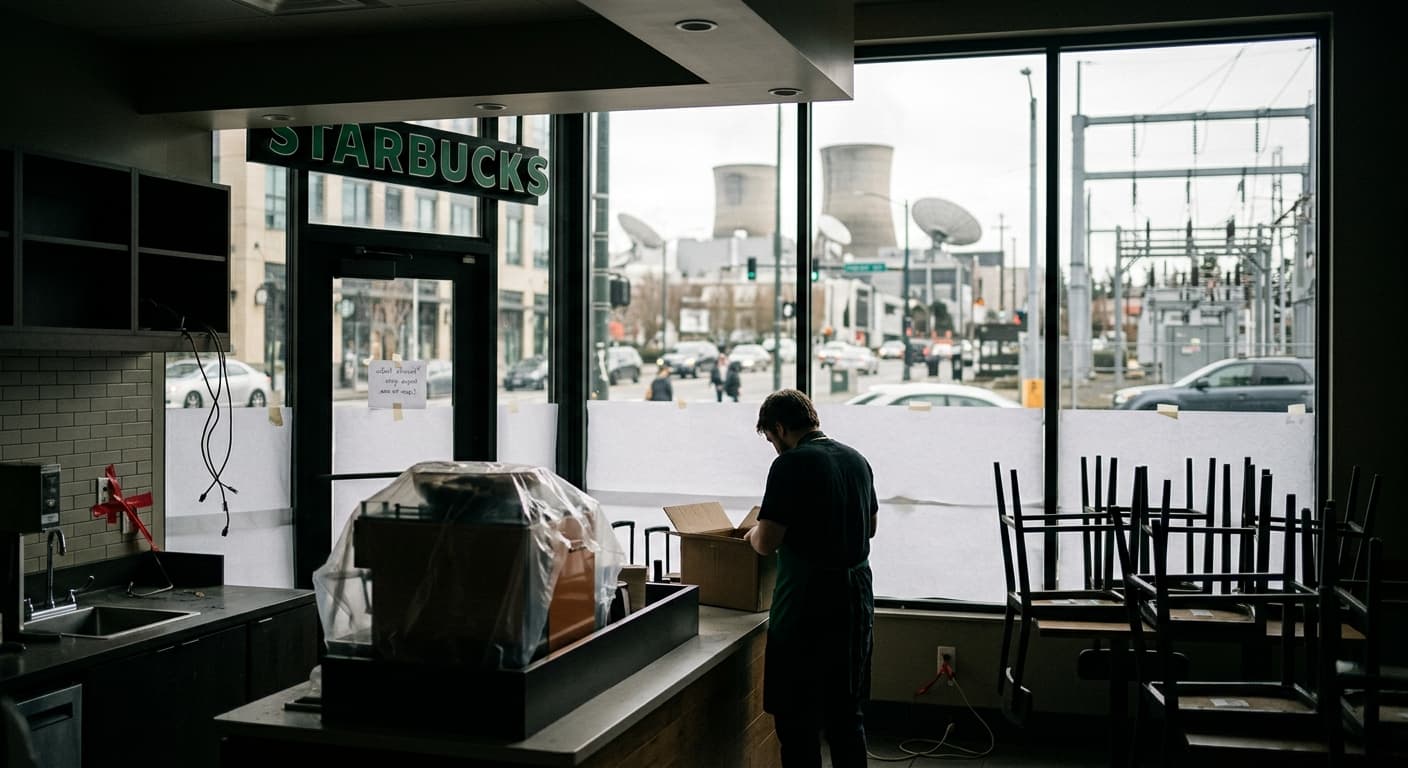
Starbucks is closing dozens of U.S. stores in 2026, citing softening traffic, higher operating costs, and shifting consumer habits. These closures expose structural weaknesses that reach far beyond retail: concentrated coffee supply routes vulnerable to disruption, reliance on critical minerals for espresso machines and refrigeration, and competition for electricity from power-hungry AI data centers.
Investors tracking supply chain resilience now see these store exits as early signals. When a global brand with 10,000-plus U.S. locations trims its footprint, the underlying pressures often affect broader sectors including semiconductors, energy infrastructure, and commodity logistics.
Key Takeaways
- Starbucks plans to close over 100 underperforming stores across multiple states, with notable cuts in Wisconsin, Idaho, and the Midwest.
- Coffee equipment manufacturing depends on rare earth elements and specialty alloys facing export restrictions and mining bottlenecks.
- AI data centers in high-growth regions like Northern Virginia consume massive power, tightening grid capacity for commercial users including restaurants and roasters.
- Red Sea and Malacca Strait shipping risks continue to inflate costs for coffee beans, dairy, and imported machine parts.
- Sovereign wealth funds and institutional portfolios increasingly price in these overlapping chokepoints when allocating to consumer staples, tech hardware, and energy.
Scope of the 2026 Starbucks Store Closures
Recent announcements list closures in Milwaukee, Madison, several Idaho cities, and scattered suburban markets. Many affected locations showed declining same-store sales amid post-pandemic normalization and competition from local cafes and quick-service rivals.
The company cited elevated labor, rent, and supply costs. What receives less attention is how those costs trace back to global logistics fragility. Coffee beans from Latin America and East Africa move through chokepoints where delays add weeks and premium freight charges. Dairy and syrup suppliers face their own transportation squeezes.
Each closure also reflects capital reallocation. Instead of renovating aging stores, Starbucks directs resources toward drive-thru formats, mobile ordering infrastructure, and markets with stronger demographics. This shift mirrors broader corporate caution seen in U.S. cities experiencing home price softening.
Supply Chain Chokepoints in the Coffee Ecosystem
Coffee is among the most traded agricultural commodities. Yet its journey from farm to cup depends on vulnerable maritime routes. The Bab el-Mandeb strait off Yemen remains a flashpoint where attacks have already forced rerouting around Africa, adding 10-14 days and thousands of dollars per container.
The Malacca Strait carries much of Asia’s trade, including packaging materials and spare parts for commercial coffee equipment. Any congestion here ripples into higher costs for chains like Starbucks.
Internal supply chain mapping shows concentration risk. A handful of ports and a limited number of roasting facilities handle the majority of volume. Extreme weather events, labor strikes at key facilities, or policy changes in producing countries can create sudden shortages.
These pressures echo patterns documented in Houthi advances disrupting Red Sea shipping. Risk premiums on marine insurance for those routes remain elevated, directly affecting profitability for importers and retailers.
Critical Minerals Hidden in Your Coffee Order
Commercial espresso machines, grinders, refrigeration units, and point-of-sale systems contain components reliant on critical minerals. Neodymium magnets in motors, copper wiring, specialized steel alloys, and semiconductors in control boards all trace back to constrained supply chains.
China’s dominance in rare earth processing creates exposure. Export controls or nationalistic policies can spike prices overnight. Lithium used in backup batteries for stores during outages faces similar demand pressure from electric vehicles and grid storage.
Semiconductor shortages that began in the auto sector have never fully resolved for smaller industrial applications. A single delayed chip can idle an entire shipment of new equipment. This dynamic explains why some chains defer store upgrades or opt for refurbishment over replacement.
Recent earthquakes in key producing regions have further tightened mineral flows, as explored in analyses of how seismic events reshape critical minerals supply chains. For a company like Starbucks, these translate into higher capital expenditure and slower rollout of new technology.
AI Data Center Power Demand Crowds Out Commercial Users
AI infrastructure has become one of the fastest-growing electricity consumers. Hyperscale facilities in Northern Virginia alone are projected to require power equivalent to several large cities. Utilities struggle to add capacity fast enough, leading to higher rates and connection delays for everyone else.
Starbucks stores use significant electricity for lighting, HVAC, roasting (at centralized facilities), and always-on equipment. In markets where data centers bid aggressively for power purchase agreements, commercial users face rising costs or outright capacity constraints.
Utilities in affected regions increasingly prioritize large tech tenants with long-term contracts. Smaller commercial loads, including restaurants and retail, move down the queue. This dynamic contributes to decisions to close marginal locations where energy expenses erode margins.
The same grid pressures appear in discussions of how AI startups drive data center power demand and mineral competition. For consumer-facing companies, the effect is indirect but measurable in utility bills and backup generator fuel costs.
Investment Implications for Institutional Portfolios
Publicly traded companies exposed to these overlapping risks show distinct patterns:
| Company | Ticker | Exposure Type | Key Risk |
|---|---|---|---|
| Starbucks | NASDAQ:SBUX | Retail Operations | Supply cost inflation, energy prices, foot traffic volatility |
| Oracle | NYSE:ORCL | Cloud & Data Center Infrastructure | Power demand growth, grid constraints in key markets |
| NVIDIA | NASDAQ:NVDA | AI Hardware | Critical minerals for chips, supply chain concentration |
| Eaton | NYSE:ETN | Power Management | Electrical infrastructure demand from data centers and commercial sites |
Sovereign wealth funds monitoring these themes adjust allocations toward firms offering solutions: diversified mineral sourcing, on-site power generation, microgrids, and supply chain transparency technology. Pure-play coffee or retail exposure faces margin compression unless hedged against commodity, freight, and energy volatility.
Common Mistakes in Assessing These Risks
- Treating store closures as isolated brand weakness rather than symptoms of systemic cost pressures.
- Underestimating the mineral intensity of everyday commercial equipment.
- Assuming power grids can scale linearly with data center growth without tradeoffs for other users.
- Ignoring secondary sanctions or export controls that suddenly restrict access to components.
- Failing to model combined impact of maritime chokepoints and energy nationalism.
Best Practices for Supply Chain and Critical Minerals Monitoring
- Map Tier 1 and Tier 2 suppliers for key equipment categories, identifying shared chokepoints.
- Track real-time shipping data through Bab el-Mandeb, Malacca Strait, and Panama Canal for cost signals.
- Monitor utility interconnection queues and power purchase agreement announcements in target markets.
- Diversify mineral sourcing through long-term contracts with non-dominant producers and recycling programs.
- Stress-test financial models against simultaneous 20-30% increases in freight, energy, and component costs.
- Engage with policy developments on critical minerals stockpiling and data center permitting reform.
Companies that treat these factors as strategic rather than operational noise gain advantage. For Starbucks, optimizing the remaining portfolio around lower-energy formats and localized sourcing may stabilize performance. For investors, the closures serve as a reminder that consumer brands sit at the intersection of geopolitics, resource competition, and technological transformation.
FAQ
Why is Starbucks closing so many stores in 2026?
Lower foot traffic in certain markets, higher labor and energy costs, and strategic focus on higher-performing drive-thru and urban locations drive the decisions. Many closures target stores opened during pandemic-era expansion that no longer meet return thresholds.
How do AI data centers affect local coffee shops and restaurants?
Data centers compete for the same electricity supply. In constrained regions, this leads to higher utility rates, delayed service upgrades, and occasional reliability issues that increase operating costs for commercial users.
What critical minerals are used in coffee shop equipment?
Neodymium for motors, copper for wiring and heat exchangers, lithium for backup systems, and various rare earths in electronic controls and semiconductors. Supply tightness in these materials raises replacement and maintenance costs.
Which shipping chokepoints matter most for the coffee industry?
The Bab el-Mandeb strait for East African beans and European routing, the Malacca Strait for Asian packaging and components, and key Latin American export corridors vulnerable to weather and port congestion.
How should investors track these overlapping risks?
Monitor quarterly utility earnings for data center load growth, critical minerals price indices, marine insurance rates for key straits, and corporate disclosures on supply chain costs from large consumer companies.
Conclusion
Starbucks store closures are not merely a retail story. They reflect converging pressures from fragile logistics networks, competition for critical minerals, and explosive power demand from AI infrastructure. Institutional investors who connect these dots gain clearer insight into portfolio resilience across consumer, technology, and energy sectors.
Track chokepoint developments, mineral availability, and grid capacity metrics closely. The companies that solve these constraints stand to capture significant value as the decade progresses.
Share This Article