Critical Minerals · Jonathan van den Berg · September 1, 2026
How Shein’s Hong Kong IPO Exposes Critical Minerals Supply Chain Risks and Fast Fashion’s Geopolitical Vulnerabilities
Shein’s volatile Hong Kong debut highlights how fast fashion’s reliance on Chinese manufacturing intersects with critical minerals shortages, export controls, and geopolitical tensions reshaping global supply chains.
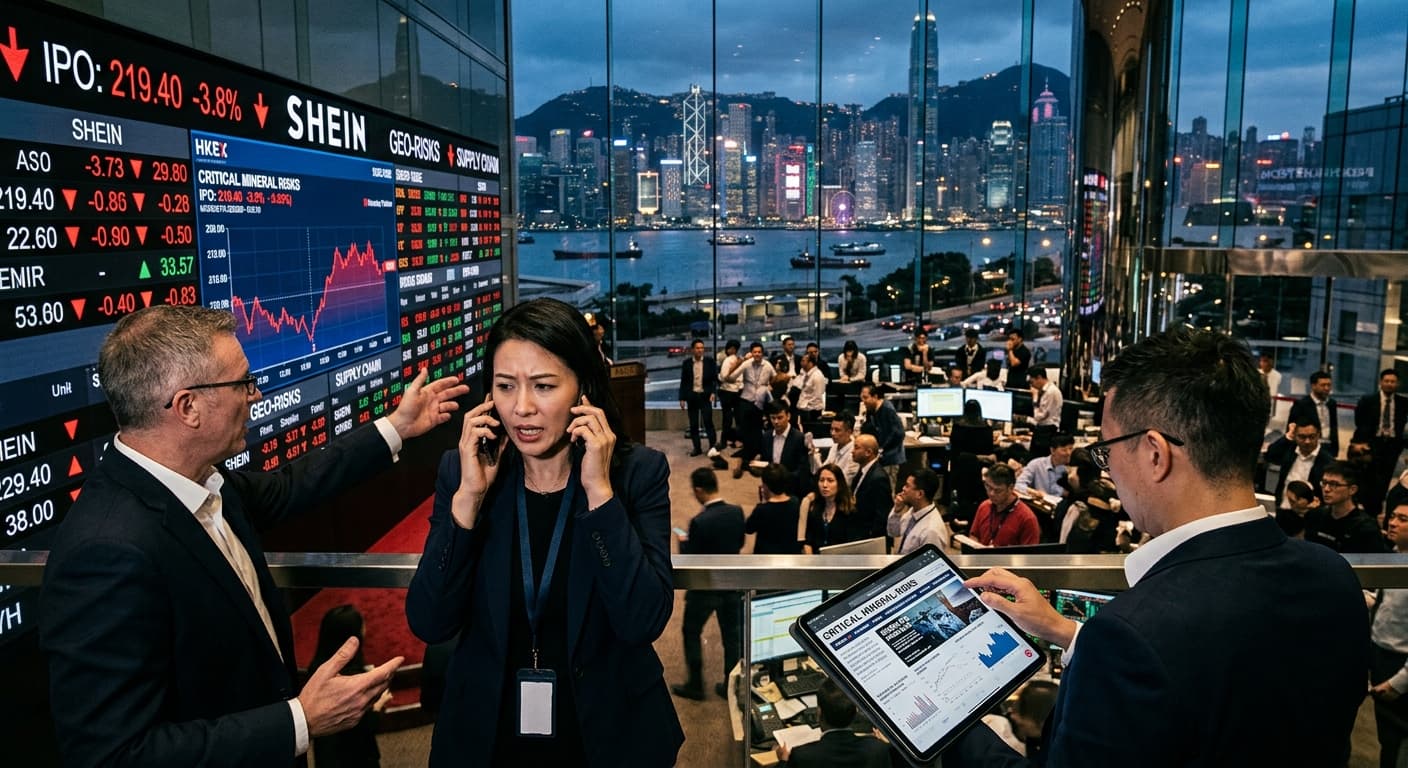
Shein’s Hong Kong IPO opened with a sharp slide in share price, underscoring investor skepticism about the fast fashion giant’s ability to navigate tightening Chinese export controls, critical minerals shortages, and Western regulatory pressure. The debut laid bare how even non-tech companies now face the same supply chain chokepoints and resource nationalism risks that have hammered semiconductor and AI infrastructure stocks.
Key Takeaways
- Shein’s listing reveals heavy dependence on Chinese manufacturing hubs vulnerable to critical minerals disruptions, particularly gallium and germanium used in dyes, catalysts, and textile processing equipment.
- Hong Kong debut shares dropped immediately after opening, reflecting concerns over Beijing’s export restrictions and potential secondary sanctions exposure.
- Fast fashion supply chains intersect with the same critical minerals bottlenecks affecting NVIDIA’s $279 billion AI data center bets.
- Investors are pricing in higher risk premiums for companies tied to Chinese supply chains amid escalating US-China tech and resource competition.
- Sovereign wealth funds and institutional investors are reassessing exposure to firms like Shein that sit at the intersection of consumer retail and strategic materials.
Shein’s IPO Reality Check
The online fashion retailer, valued at over $60 billion at peak private valuations, saw its shares fall sharply on the first day of trading in Hong Kong. Reuters reported the stock opened lower and continued sliding as investors weighed regulatory risks, slowing growth in key markets, and Beijing’s increasingly assertive resource policies.
While Shein sells clothing, its production ecosystem relies on thousands of suppliers in Guangdong and other industrial clusters. These same regions face power constraints, water shortages, and competition for the chemicals and specialty materials derived from critical minerals. The Guardian noted that the listing comes at a time when China has tightened controls on multiple strategic materials, creating ripple effects far beyond semiconductors.
This is not an isolated retail story. The same dynamics that caused volatility in Tesla’s stock amid Chinese competition and Apple’s upcoming iPhone launch event also pressure Shein’s cost structure and scalability.
Critical Minerals Hidden in Fast Fashion
Gallium and germanium, both subject to Chinese export licensing since 2023, appear throughout the textile production chain. Gallium compounds serve as catalysts in polyester synthesis and specialty dyes. Germanium finds use in infrared sensors for quality control systems and high-efficiency machinery.
China produces roughly 80-90% of global refined gallium. Any tightening of these controls immediately raises input costs for chemical suppliers that serve garment factories. The BBC highlighted how Shein’s ultra-fast trend cycle demands rapid scaling of production, making it particularly sensitive to even modest disruptions in specialty chemical availability.
These same minerals power compound semiconductors used in 5G infrastructure, electric vehicles, and data center chips. The overlap means fashion supply chains now compete directly with AI data center expansion for limited refined supply. When China restricted gallium shipments in response to US chip curbs, the effects reached far beyond tech into industrial and consumer sectors.
Supply Chain Chokepoints Meet Fashion Economics
Shein’s model depends on just-in-time manufacturing and rapid sea freight from Chinese ports. The Malacca Strait and South China Sea routes remain vulnerable to geopolitical friction. Any tension that slows container traffic raises costs and delays new collections.
This mirrors risks detailed in analyses of how 2026 earthquakes disrupted semiconductor markets and critical minerals flows. Natural disasters and geopolitical events expose the fragility of concentrated production. For Shein, a port closure or export licensing delay can halt thousands of daily SKUs.
Investors have started applying the same risk framework used for tech hardware to consumer goods companies. Those with heavy China exposure now trade at discounts that reflect potential sanctions compliance costs, higher insurance premiums, and supply diversification expenses.
Impact on Semiconductor and AI Infrastructure Stocks
The critical minerals squeeze affecting Shein also pressures companies central to AI growth. NVIDIA faces gallium and germanium shortages for advanced packaging. Data center operators in Northern Virginia compete for the same power and materials needed to build out infrastructure.
Oracle has benefited from the shift toward diversified supply chains and domestic AI capacity, with its stock rising on geopolitical decoupling tailwinds. T. Rowe Price, managing significant exposure across tech and emerging markets, has adjusted portfolios to account for resource nationalism risks in China-tied companies.
Shein’s IPO performance serves as a canary for broader market sentiment. When even a fast fashion pure-play faces valuation pressure from critical minerals policy, it signals that resource competition now touches every sector.
| Mineral | Primary Use in Fashion/Textiles | China Market Share | Related Tech Application |
|---|---|---|---|
| Gallium | Catalysts, specialty dyes | ~85% | Compound semiconductors, RF chips |
| Germanium | Infrared sensors, fiber optics | ~70% | Data center optics, solar cells |
| Antimony | Flame retardants | ~55% | Batteries, semiconductors |
Lessons from Recent Supply Chain Shocks
The 2026 Japan earthquake demonstrated how quickly seismic events can reshape semiconductor markets and force AI data center operators to rethink expansion plans. Similar dynamics now apply to consumer retail.
Evergrande’s collapse aftermath showed how China’s property crisis altered sovereign wealth fund strategies and critical minerals demand. State capital flows have shifted toward securing domestic resource processing and reducing reliance on Western markets. This reorientation directly affects suppliers serving Shein and similar platforms.
Fast fashion’s low margins leave little room for absorbing higher material costs. Companies must either raise prices—risking demand destruction—or accept lower profitability while scrambling for alternative suppliers in Vietnam, India, or Latin America. Each option carries execution risk.
Common Mistakes Investors Make
- Assuming consumer discretionary stocks are insulated from critical minerals policy. The Shein IPO proves otherwise.
- Underestimating secondary sanctions risk. European and US regulators increasingly scrutinize supply chains with indirect China exposure.
- Ignoring water and power constraints in manufacturing hubs. Guangdong faces the same grid pressures seen in Northern Virginia data centers.
- Valuing Shein solely on user growth and GMV without adjusting for geopolitical risk premiums.
- Failing to model competition for the same minerals used in defense, EVs, and AI infrastructure.
Best Practices for Portfolio Managers
- Stress test retail holdings against Chinese export control scenarios for gallium, germanium, and rare earth processing chemicals.
- Track sovereign wealth fund flows into critical minerals projects as a leading indicator of supply tightness.
- Evaluate supply chain diversification plans. Companies moving production to India or Mexico may warrant valuation premiums.
- Monitor OFAC and EU sanctions guidance for new textile or chemical restrictions that could hit fast fashion indirectly.
- Consider paired trades: long diversified semiconductor names like Oracle while hedging pure China-exposed consumer plays.
Asset managers like T. Rowe Price have quietly increased allocations to firms building resilient supply chains outside traditional Asian manufacturing clusters. This shift reflects a broader recognition that geopolitical risk now permeates every link in global commerce.
Broader Implications for AI Data Centers and Resource Competition
The minerals required for Shein’s production ecosystem overlap with those powering high-performance computing. As data center demand in Northern Virginia and other hubs accelerates, competition for refined gallium and related materials will intensify.
Analyses of SpaceX’s turbine blade factory solving AI data center power constraints illustrate parallel innovation in energy infrastructure. Similar ingenuity will be needed in materials processing to prevent consumer sectors from crowding out strategic technology builds.
Shein’s IPO volatility offers a real-time case study in how resource nationalism reshapes business models once considered remote from geopolitics. Fast fashion has joined semiconductors, EVs, and renewable energy on the front lines of critical minerals competition.
FAQ
Why did Shein’s Hong Kong IPO shares fall on debut?
Investors cited concerns over Chinese government export controls on critical minerals, potential US and EU regulatory pushback, slowing growth in Western markets, and broader skepticism about high valuations in China-tied consumer businesses.
How are critical minerals connected to fast fashion?
Gallium, germanium, and antimony appear in textile chemicals, catalysts, dyes, flame retardants, and manufacturing equipment sensors. China dominates production of these materials, so any export restrictions raise costs across the apparel supply chain.
What does Shein’s listing mean for semiconductor stocks?
It reinforces that critical minerals shortages affect multiple industries simultaneously. Companies like NVIDIA face the same supply constraints, potentially driving up prices and encouraging further onshoring or alternative material research.
Should investors avoid all China-exposed consumer stocks?
Not necessarily. Focus on companies with credible diversification plans, strong balance sheets to absorb higher input costs, and transparent sanctions compliance programs. Pure plays like Shein carry elevated risk premiums.
How might future Chinese resource policies affect global retail?
Tighter controls on specialty chemicals and minerals could force faster fashion retailers to raise prices, slow trend cycles, or accelerate shifts to production bases in Southeast Asia and Latin America—changes that will reshape margins and competitive dynamics for years.
Conclusion
Shein’s disappointing Hong Kong debut is more than a retail story. It signals that critical minerals policy, supply chain chokepoints, and great power competition now influence valuation across sectors once viewed as disconnected from geopolitics. Investors who integrate these realities into their frameworks will be better positioned as resource nationalism intensifies.
Track how companies respond to these pressures. Those that diversify sources, invest in material efficiency, and maintain clear compliance pathways will separate from those clinging to outdated China-centric models. The next wave of supply chain winners will be defined not just by speed to market, but by resilience against resource and geopolitical shocks.
Sources
Share This Article