Supply Chain · Jonathan van den Berg · August 31, 2026
How Russian Strikes on Ukrainian Warehouses Expose NATO Supply Chain Chokepoints and Critical Minerals Risks
Russian missile and drone attacks on Ukrainian storage facilities highlight how concentrated defense supply chains create strategic vulnerabilities that ripple through global critical minerals markets and NATO readiness.
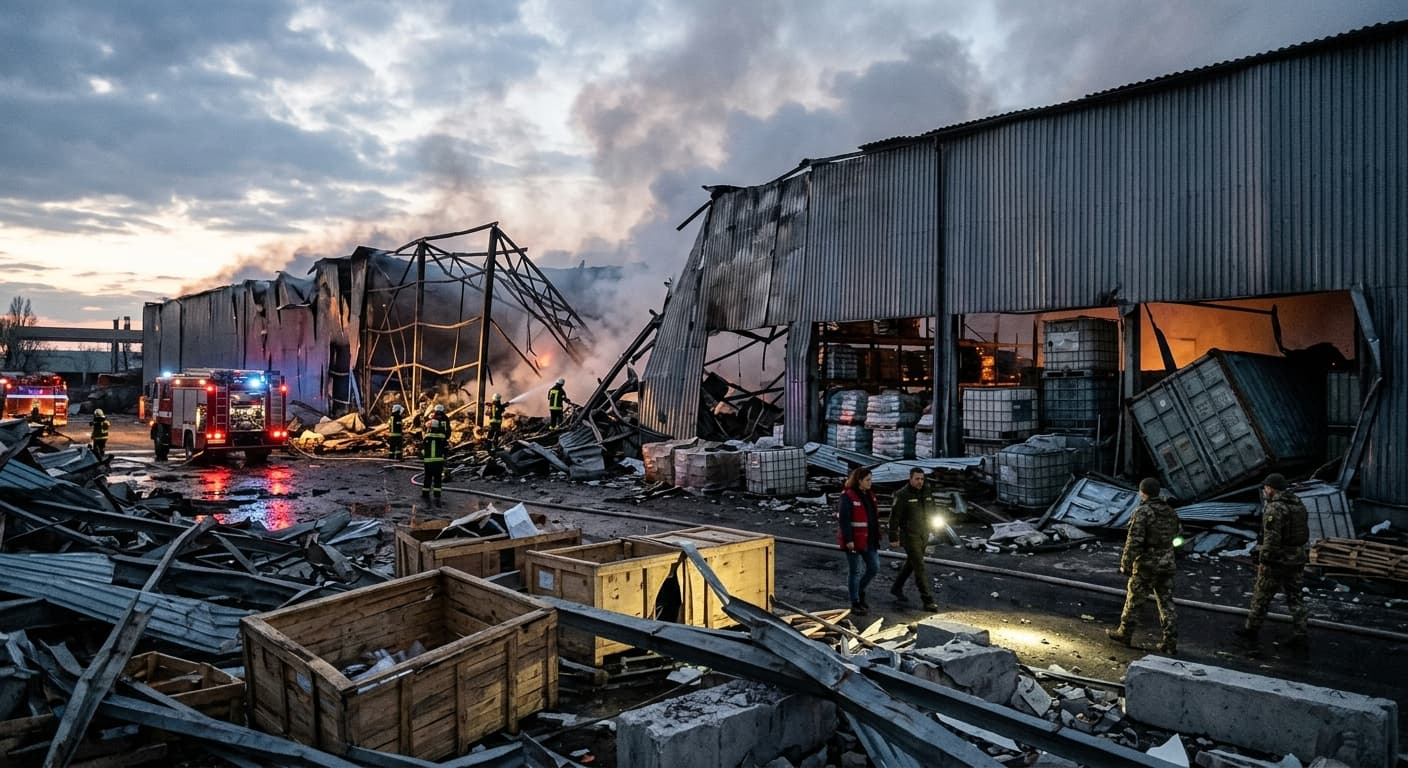
Russian strikes on Ukrainian warehouses continue to expose the fragility of NATO's extended supply lines. A recent attack in the Kyiv region killed dozens and destroyed significant stores of ammunition and equipment, forcing Western defense contractors to confront concentrated production risks and dependence on vulnerable transport routes.
These incidents reveal how modern conflict turns warehouses into high-value targets. The pattern forces investors and policymakers to reassess how defense supply chains intersect with critical minerals availability and energy infrastructure constraints.
Key Takeaways
- Russian forces have repeatedly targeted Ukrainian weapons storage sites, with the latest Kyiv region strike raising the death toll to 38 and destroying key ammunition reserves.
- NATO countries face pressure to replenish stocks while production lines for shells, missiles, and spare parts remain concentrated in a handful of facilities.
- Critical minerals such as rare earth elements, tungsten, and titanium used in precision munitions create additional chokepoints that adversaries can exploit indirectly.
- Energy infrastructure supporting manufacturing and logistics faces parallel risks, mirroring vulnerabilities seen in AI data center power constraints.
- Defense stocks show mixed reactions as investors weigh short-term demand spikes against longer-term supply chain restructuring costs.
The Latest Strike and Immediate Impact
The August 30 strike on a warehouse in the Kyiv region underscores a deliberate Russian strategy. Ukrainian officials reported 38 deaths with the toll expected to rise. The facility stored both Ukrainian and Western-supplied weapons, highlighting how integrated the supply effort has become.
Destruction of stored munitions creates an immediate shortfall. Western allies must accelerate production of 155mm artillery shells, Javelin missiles, and Stinger systems. Yet most production capacity sits in facilities that themselves depend on just-in-time delivery of components sourced from multiple continents.
This concentration turns every warehouse strike into a strategic win for the attacker. It forces defenders to disperse storage, which increases costs and slows distribution to front-line units.
NATO Supply Chain Vulnerabilities Exposed
NATO's defense industrial base has shrunk since the Cold War. Many member states maintain minimal stockpiles and limited surge capacity. The Ukraine conflict has already drawn down stocks of key systems faster than expected.
Production bottlenecks appear in multiple areas:
- Explosive propellant manufacturing limited by a small number of specialized chemical plants in Europe and the United States.
- Precision guidance components that rely on semiconductors produced in Taiwan and South Korea.
- Heavy transport aircraft and ships needed to move equipment across the Atlantic face their own maintenance and fuel constraints.
The Black Sea corridor remains contested, forcing alternative routing through Poland and Romania. Each additional transit point adds delay and cost. Similar dynamics appear in commercial sectors, as seen in Black Sea airspace breaches that expose NATO supply chain risks.
Critical Minerals Dependencies
Modern munitions depend heavily on materials designated as critical minerals. Tungsten for penetrators, rare earth magnets for electric motors in drones, and titanium for airframes all trace back to concentrated supply sources.
China controls roughly 80% of global rare earth processing capacity. Any escalation that draws Beijing closer to Moscow increases risk of export restrictions. Investors tracking this exposure often cross-reference patterns outlined in analyses of NVIDIA's exposure to critical minerals shortages.
Recent natural disasters have compounded these risks. Earthquakes in Asia have disrupted both semiconductor fabrication and mining operations, tightening availability of materials essential for both commercial electronics and defense systems. Parallel risks appear in medical device manufacturing where similar minerals underpin precision equipment.
Energy Infrastructure Parallels
Weapons production requires stable, high-quality power. Explosives manufacturing and advanced machining both depend on consistent electricity. Russian strikes on Ukrainian energy infrastructure mirror the pressure Western defense plants could face in a wider conflict.
The same grid constraints that challenge AI data center expansion in Northern Virginia also affect defense contractors. Facilities producing advanced missiles compete for the same transformers, substations, and skilled electrical workforce.
Diversifying energy sources through small modular reactors or on-site generation becomes a strategic necessity rather than an environmental preference. Companies that solve these constraints gain advantage, much like specialized manufacturing approaches that address power crunches in high-tech sectors.
Defense Contractor Exposure and Stock Implications
Major contractors show varied exposure to these risks:
| Company | Ticker | Key Exposure | Recent Pressure Points |
|---|---|---|---|
| Raytheon Technologies | NYSE:RTX | Missiles, radar, propellants | Supply chain delays on Stinger and Javelin replenishment |
| Lockheed Martin | NYSE:LMT | Javelin, HIMARS, F-35 components | Backlog growth but margin pressure from raw material costs |
| Boeing | NYSE:BA | Logistics aircraft, munitions handling | Commercial aviation recovery competing for production capacity |
| Northrop Grumman | NYSE:NOC | Ammunition, electronics | Explosives production ramp-up constrained by chemical feedstocks |
European firms such as Rolls-Royce (LON:RR) face additional pressure on turbine components used in both military and energy applications. Share prices typically rise on increased order flow but face downward pressure when analysts highlight execution risks from supply chain fragility.
Comparison of Supply Chain Risk Factors
| Risk Type | Commercial AI/Data Centers | Defense Supply Chains | Overlap Impact |
|---|---|---|---|
| Critical Minerals | High (chips, magnets) | Very High (munitions, armor) | Competition for same limited refined supply |
| Power/Grid Constraints | Acute in Northern Virginia | Growing for new production lines | Shared demand for new generation capacity |
| Geographic Concentration | Taiwan, South Korea | United States, Germany, Poland | Vulnerable to coordinated disruption |
| Transportation Chokepoints | Pacific shipping lanes | Atlantic and Black Sea routes | Parallel exposure to insurance and fuel price spikes |
Common Mistakes in Assessing These Risks
- Assuming stockpiles shown in annual reports reflect actual ready-to-deploy inventory rather than items already committed or outdated.
- Underestimating the time required to restart production lines for complex munitions once they have been idled.
- Treating critical minerals as interchangeable commodities instead of recognizing highly specialized refining and processing steps.
- Focusing solely on headline contract values while ignoring the multi-year lag between order and delivery.
- Overlooking how commercial demand for the same materials and skilled labor creates hidden competition with defense priorities.
Best Practices for Investors and Policymakers
- Map full supply chains for critical components, including second- and third-tier suppliers of minerals and chemicals.
- Track sovereign wealth fund investments in mining and refining capacity as early indicators of resource nationalism trends.
- Evaluate contractor progress on dual-use technologies that can serve both commercial and defense markets to spread fixed costs.
- Monitor insurance rates for maritime transport through high-risk areas as a real-time signal of perceived escalation risk.
- Assess geographic diversification plans, including nearshoring of sensitive production and development of alternative mineral sources in allied nations.
Companies that invest in resilient manufacturing—whether through advanced automation, on-site power generation, or vertical integration of critical materials—position themselves to capture both defense contracts and commercial opportunities in a more fragmented world.
Broader Geopolitical Context
The strikes fit a pattern of targeting logistics rather than solely front-line forces. By destroying stored equipment, Russia aims to degrade Ukraine's ability to sustain prolonged defensive operations and to impose mounting replacement costs on Western treasuries.
This approach echoes historical efforts to interdict supply lines but adapts them to precision strike capabilities and real-time intelligence. The implications extend beyond Ukraine. Nations watching the conflict update their own defense industrial strategies, accelerating efforts to build domestic capacity in critical minerals and advanced manufacturing.
Similar dynamics appear in other regions. Flash floods in the Himalayas have exposed mining vulnerabilities, while seismic events in Japan continue to reshape semiconductor and critical minerals strategies. Each disruption reinforces the need for more robust, geographically distributed supply networks.
FAQ
How do Russian strikes on warehouses affect global critical minerals markets?
Each strike increases demand for replacement munitions, which accelerates consumption of tungsten, rare earths, and other minerals. This tightens already constrained supply and can push prices higher for both defense and commercial buyers.
Which defense stocks face the greatest supply chain risk?
Companies heavily exposed to precision munitions and electronics—such as RTX and LMT—carry higher risk due to their dependence on specialized materials and components with limited alternative suppliers.
What role does energy infrastructure play in defense supply chains?
Reliable power is essential for manufacturing explosives, machining advanced alloys, and operating logistics hubs. Grid vulnerabilities represent a parallel threat to production capacity.
How do these events compare to risks in AI data center development?
Both sectors compete for the same pool of critical minerals, skilled technical labor, and new electricity generation. Solutions that address power constraints in one area often translate to the other.
Can NATO realistically disperse its ammunition storage?
Dispersion helps reduce vulnerability to single strikes but raises costs for security, climate control, and rapid retrieval. Most analyses suggest a hybrid approach of hardened sites plus strategic prepositioning in multiple countries offers the best balance.
Conclusion
Russian strikes on Ukrainian warehouses serve as a live stress test for NATO's defense industrial model. The resulting pressure on supply chains, critical minerals availability, and energy infrastructure will shape defense spending priorities and contractor strategies for years ahead.
Investors who look beyond immediate contract announcements to underlying vulnerabilities in minerals, power, and logistics will be better positioned to identify winners in this new era of great power competition. Companies that solve these interlocking constraints stand to gain regardless of how individual conflicts evolve.
Share This Article