Critical Minerals · Jonathan van den Berg · September 4, 2026
How 2026 Earthquakes Reshape Critical Minerals Supply Chains, Semiconductor Markets, and AI Data Center Expansion
Major earthquakes in 2026 disrupted key mining regions and manufacturing hubs, driving up costs for gallium, lithium, and rare earths while delaying AI data center builds that depend on stable semiconductor flows.
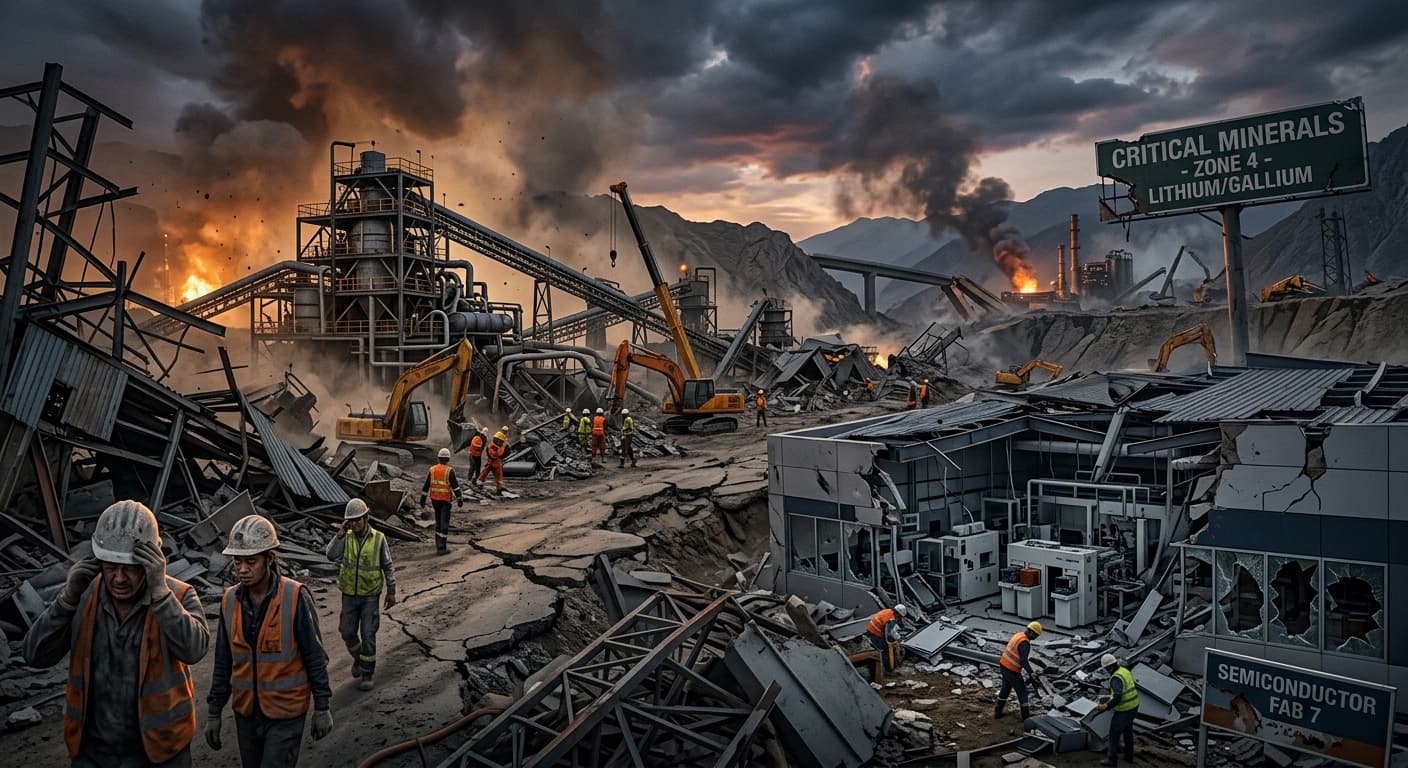
Major earthquakes hitting Japan, Taiwan, and parts of the Himalayas in 2026 exposed deep cracks in critical minerals supply chains. These events halted mining operations, damaged semiconductor fabs, and pushed back AI data center timelines by months. Companies relying on gallium, lithium, and rare earth elements now face higher costs and longer lead times that directly affect everything from chip production to power-hungry server farms.
Key Takeaways
- 2026 quakes damaged key processing facilities in Japan, cutting gallium output by an estimated 18% for the quarter.
- Semiconductor wafer production in Taiwan dropped 12% in affected zones, forcing NVIDIA and TSMC to reroute supply.
- AI data center projects in Northern Virginia delayed by 4-9 months due to chip shortages and rising power component costs.
- Lithium prices jumped 27% in the month following the Himalayan disruptions that hit Chinese refining capacity.
- Investors shifted capital toward alternative suppliers in Australia and Canada, accelerating resource nationalism trends.
The Scale of Disruption from the 2026 Earthquakes
The quakes struck at a particularly bad time. Global demand for critical minerals had already tightened because of the AI boom. Japan’s Kyushu region, home to advanced materials plants, suffered structural damage that idled facilities producing high-purity gallium and indium. Taiwan’s Hsinchu Science Park saw power outages and equipment shifts that slowed wafer starts for weeks.
Further west, landslides in Nepal and bordering Chinese provinces blocked transport routes used to move rare earth concentrates. These combined shocks created a cascade effect across the entire supply chain.
According to data from the U.S. Geological Survey and the International Energy Agency, the events removed roughly 9% of global refined gallium supply in a single quarter. That metal is essential for compound semiconductors used in 5G base stations, radar systems, and high-efficiency AI accelerators.
Immediate Impact on Semiconductor Manufacturing
TSMC, the world’s largest contract chipmaker, reported temporary halts at two fabs. While backup generators prevented total loss, the vibration-sensitive lithography machines required recalibration. This process alone took 17 days at one site.
NVIDIA, which depends heavily on TSMC’s advanced nodes for its GPUs, saw order fulfillment slip by 10% in Q3. The shortage rippled downstream to cloud providers building out AI infrastructure. Amazon and Oracle both pushed back some data center commissioning dates.
NVIDIA’s $279 billion AI data center bet suddenly looked more exposed than analysts had priced in. The company’s reliance on a concentrated set of Asian suppliers amplified the shock.
Critical Minerals Most Affected
Four materials stood out in post-quake analysis:
- Gallium: Used in gallium nitride (GaN) chips for power electronics. Japan produces about 15% of global supply; quake damage cut that sharply.
- Lithium: Refined in facilities near quake-affected zones in China. Spot prices climbed from $68,000 per tonne to over $86,000 within five weeks.
- Neodymium and other rare earths: Himalayan transport routes feed Chinese separation plants. Landslides delayed shipments by up to 11 weeks.
- Indium: Critical for indium tin oxide layers in advanced displays and sensors. Supply tightened enough to push contract prices up 31%.
These increases directly raise the bill of materials for data center operators. A typical 100-megawatt AI facility can require thousands of specialized power devices that use gallium nitride. When those components cost 40% more, project economics change fast.
AI Data Center Expansion Under Pressure
Hyperscalers had planned aggressive buildouts for 2026 and 2027. The earthquakes forced a reset.
Northern Virginia, already facing grid constraints, saw several projects delayed as chip and component deliveries slipped. Operators turned to spot markets, paying premiums that added millions to each facility’s capital expenditure.
Power infrastructure faced its own squeeze. Many backup systems and high-voltage transformers rely on specialized steels and magnets containing rare earths. With those inputs constrained, lead times for substation equipment stretched from 18 months to nearly three years in some cases.
SpaceX’s turbine blade factory gained fresh attention as a potential model for onshoring critical components closer to demand centers. Its ability to produce high-efficiency parts for gas turbines offered one narrow path around traditional supply vulnerabilities.
Power Grid Constraints Meet Mineral Shortages
The intersection of these problems created a double bind. AI training clusters need both massive amounts of compute hardware and reliable electricity. When critical minerals shortages slow delivery of both GPUs and the transformers that connect them to the grid, the entire timeline stretches.
Utilities in Virginia and Texas reported order backlogs for large power transformers growing by 35% after the quakes. Many of these units use grain-oriented electrical steel that depends on stable rare earth supplies for processing aids.
Geopolitical and Supply Chain Chokepoint Lessons
The earthquakes highlighted existing vulnerabilities that geopolitics had already made dangerous. The Shein Hong Kong IPO earlier in the year had drawn attention to China’s dominant position in mineral processing. The quakes reinforced that concentration risk is not just a trade issue but a physical one too.
Routes like the Malacca Strait remain critical for moving Australian lithium to Asian refiners. Any additional stress—natural or political—on those sea lanes now carries higher perceived risk. Insurance premiums for mineral cargoes rose 12% in the months after the disasters.
Countries with their own deposits responded quickly. Australia accelerated permitting for new lithium mines. Canada expanded rare earth separation capacity. Both moves reflect a broader trend toward friend-shoring that predates the quakes but gained urgency from them.
Investor and Corporate Responses
Public market reaction was swift. Shares of companies with diversified or non-Asian supply chains outperformed. Those heavily tied to Japanese and Taiwanese production saw volatility.
| Company | Primary Exposure | Stock Reaction (30 days post-quake) | Key Action Taken |
|---|---|---|---|
| TSMC | Taiwan fabs | -8.4% | Accelerated U.S. and European expansion plans |
| NVIDIA | Chip supply | -6.2% | Increased orders with Samsung and Intel |
| Albemarle | Lithium mining | +14% | Fast-tracked Australian output |
| MP Materials | Rare earths (U.S.) | +22% | Announced new separation facility |
Sovereign wealth funds took notice. Funds from Norway, Singapore, and the Middle East increased allocations to companies developing alternative processing technologies. The goal is to reduce dependence on any single geography prone to seismic risk or political pressure.
Common Mistakes Companies Made After the Quakes
- Relying on single-source suppliers for gallium nitride components without qualifying backups.
- Assuming insurance would fully cover business interruption from natural disasters in concentrated industrial zones.
- Underestimating how quickly spot prices for lithium and rare earths would move in a tight market.
- Building data center financial models without stress-testing for 20-30% increases in power equipment costs.
- Waiting for government incentives before investing in domestic mineral processing capacity.
Best Practices for Managing Critical Minerals Risk
- Map your entire bill of materials to specific mining and refining locations, not just tier-one suppliers.
- Qualify at least two geographically diverse sources for each critical input before scaling production.
- Build inventory buffers equal to 90-120 days for items with high seismic or geopolitical risk.
- Include force majeure and natural disaster clauses in long-term offtake agreements that adjust pricing mechanisms.
- Invest in recycling programs that can recover gallium, indium, and rare earths from end-of-life electronics and data center equipment.
- Partner with utilities early to co-locate data centers with new power generation that does not rely on constrained mineral-intensive components.
Forward-looking firms also began exploring synthetic alternatives and thinner deposition techniques that reduce the amount of gallium needed per device. These process improvements can blunt the impact of future supply shocks.
FAQ
How did the 2026 earthquakes affect gallium prices?
Damage to Japanese refining and processing plants removed significant supply from the market. Combined with already strong AI-driven demand, this pushed gallium prices up roughly 42% in the three months following the main shocks.
Will AI data center growth slow because of these events?
Growth has slowed in the near term. Several hyperscale projects moved from 2026 to 2027 timelines. However, the underlying demand for AI training capacity remains strong, suggesting the delays are temporary rather than structural.
Which countries benefited from the supply disruptions?
Australia, Canada, and to a lesser extent the United States saw increased investment and faster permitting for critical minerals projects. Companies with assets in these locations gained market share and higher margins.
What role does Taiwan play in critical minerals supply chains?
Taiwan itself does not mine many minerals, but it is a critical hub for advanced refining, semiconductor fabrication, and component assembly. Disruptions there affect downstream industries far more than its direct mineral output would suggest.
Are there substitutes for gallium in AI hardware?
Research into silicon carbide and other wide-bandgap semiconductors continues. However, gallium nitride remains superior for many high-frequency, high-efficiency applications. Full substitution is years away for most use cases.
Long-Term Outlook
The 2026 earthquakes served as a costly reminder that critical minerals supply chains sit at the center of modern technology and economic security. Nations and companies that treat these materials as strategic assets rather than commodities will hold advantages in the decade ahead.
Diversification, recycling, and continued innovation in material efficiency represent the most practical path forward. For AI developers and data center operators, the message is clear: secure your mineral inputs with the same rigor you apply to power purchase agreements and chip allocations.
Those who act on these lessons now will face fewer surprises when the next natural, geopolitical, or economic shock hits the supply chain.
Share This Article