AI Infrastructure · Jonathan van den Berg · November 7, 2026
GTA 6 Generative AI Porting: How Unofficial Clones Threaten Critical Minerals Supply Chains and AI Data Center Economics
Rockstar's accelerated PC port timeline for GTA 6 stems directly from the threat of generative AI creating near-perfect unauthorized versions that could siphon millions in revenue while driving explosive demand for GPUs, power, and the critical minerals that fuel AI infrastructure.
Rockstar Games is rushing the official PC version of GTA 6 to market specifically to counter generative AI tools creating unauthorized high-fidelity ports that threaten both revenue and the fragile economics of AI infrastructure itself.
Former Rockstar technical director Obbe Vermeij stated that the studio now plans an earlier PC release than historically typical because generative AI can recreate entire games with shocking accuracy using publicly available console footage and assets. This shift has direct implications for semiconductor demand, power grids already strained by AI training, and the critical minerals required to manufacture the hardware powering these models.
Key Takeaways
- Generative AI tools can now reconstruct full 3D environments, physics systems, and character models from gameplay footage, enabling unauthorized GTA 6 PC ports within weeks of console launch.
- Rockstar's accelerated PC timeline aims to protect hundreds of millions in potential revenue while inadvertently accelerating GPU and data center demand.
- Each major AI-generated game clone requires thousands of GPU hours to train and run inference, directly competing with commercial AI data center workloads for power and critical minerals.
- Northern Virginia data center operators already face grid constraints that could worsen if consumer AI gaming tools scale rapidly.
- Chipmakers like NVIDIA and AMD stand to benefit from increased demand but face supply chain risks tied to minerals such as gallium, germanium, and copper.
- Unofficial ports using generative AI raise complex questions around intellectual property enforcement in an era of rapidly advancing diffusion models.
How Generative AI Enables Rapid Game Porting
Traditional game porting requires months or years of manual engineering to adapt console code for PC architectures, optimize for varied hardware, and implement features like ultrawide support and higher frame rates. Generative AI changes this equation completely.
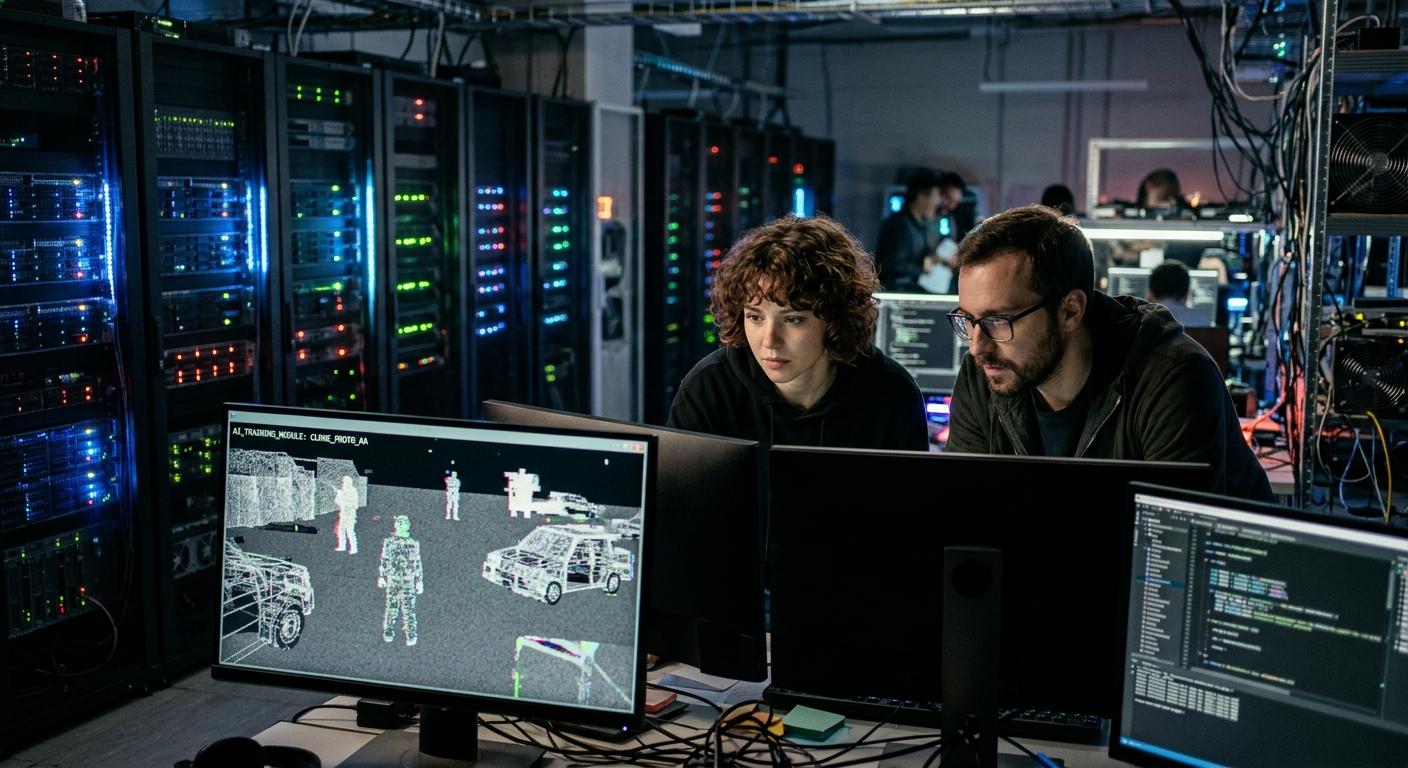
Diffusion models and video generation systems trained on millions of hours of gameplay can now infer missing assets, reconstruct lighting systems, and even approximate complex game logic. Tools can analyze console footage frame by frame, then generate PC-native versions that include ray tracing, variable refresh rates, and modding support that official ports sometimes delay.
One reported unauthorized GTA 6 port allegedly used token-based systems where users pay thousands of dollars for access, highlighting both the commercial viability and the legal gray areas these AI clones occupy. The process bypasses much of the traditional reverse engineering that console manufacturers and publishers previously relied upon for protection.
This capability arrives at a moment when AI data centers are already consuming electricity equivalent to small countries. Training a single high-fidelity game recreation model can require compute resources comparable to fine-tuning large language models.
The Critical Minerals Connection
Every GPU deployed for AI game porting consumes the same scarce resources driving tension in global supply chains. Gallium and germanium, heavily used in advanced semiconductors, face export restrictions from certain producers. Copper demand for data center cabling and cooling systems continues climbing as AI workloads multiply.
Recent seismic events have already disrupted critical minerals flows, exposing vulnerabilities that could intensify if consumer-facing generative AI tools for gaming gain widespread adoption. Lithium for battery backup systems in data centers and rare earth elements for magnets in cooling fans add further pressure.
NVIDIA's data center GPUs, central to both professional AI development and these emerging game recreation tools, rely on complex supply chains spanning multiple continents. Any surge in consumer or gray-market demand for high-end inference hardware directly competes with hyperscale operators building out capacity for commercial applications.
AI Data Center Grid Constraints Meet Gaming AI
Northern Virginia, the world's largest data center market, already struggles with power availability. Utilities have warned of delays for new facilities while existing ones face transmission constraints. Generative AI tools capable of cloning AAA games could accelerate residential and small-scale commercial compute demand, further straining the grid.
Models powerful enough to generate coherent open-world environments need substantial VRAM and tensor core performance. Modified consumer GPUs with expanded memory, already appearing in certain markets, hint at how enthusiasts might repurpose gaming hardware for AI porting tasks.
Freeze warnings and extreme weather events have repeatedly highlighted the fragility of current power infrastructure when AI demand spikes. A wave of AI-driven game content creation could create unpredictable load patterns that grid operators struggle to forecast.
Power purchase agreements (PPAs) with nuclear and renewable providers, already heavily subscribed by tech giants, could face new competition if smaller players enter the AI gaming space at scale.
Rockstar's Strategic Response and Market Impact
By accelerating the PC port, Rockstar aims to capture revenue before AI clones erode the market. Historical data shows PC versions of Grand Theft Auto titles generate significant long-term sales through mods, online play, and replayability.
GTA 6 console pre-downloads are scheduled to begin November 10, 2026 with substantial install sizes confirmed by Rockstar. The physical edition includes a detailed map of Leonida, the game's setting, signaling confidence in traditional retail channels even as digital threats emerge.
Yet the company now navigates a landscape where generative AI blurs lines between inspiration, modification, and outright replication. This creates both defensive urgency around release timing and broader questions about content ownership in AI-augmented creative industries.
Competitive Dynamics Among Chipmakers
NVIDIA currently dominates the AI accelerator market with its CUDA ecosystem and data center GPUs. AMD has gained ground with MI series accelerators and more open software approaches. Both companies benefit from heightened interest in generative tools regardless of application.
| Company | Key Product Lines | AI Gaming Relevance | Supply Chain Exposure |
|---|---|---|---|
| NVIDIA | H100, H200, Blackwell | High - dominant in inference and training | Gallium, cobalt, copper |
| AMD | MI300, MI350 | Medium-High - growing software ecosystem | Similar mineral dependencies |
| TPU v5, v6 | Medium - internal tools could expand | Heavy data center power user | |
| Oracle | Cloud infrastructure | Emerging - enterprise AI services | Indirect through cloud customers |
Oracle's cloud growth and Google's continued investment in custom silicon illustrate how the competitive field extends beyond traditional GPU makers. Companies providing the underlying infrastructure for these generative tools face the same mineral and power constraints as those developing the models.
Common Mistakes in Assessing AI Gaming Impact
- Assuming AI-generated games remain low quality. Current models already produce visuals and physics that can fool casual observers.
- Underestimating power consumption. A single high-quality game recreation model can consume as much electricity as training smaller language models.
- Ignoring supply chain concentration. Over 80% of certain critical minerals processing occurs in concentrated geographic areas vulnerable to disruption.
- Dismissing legal risks. While enforcement remains challenging, publishers are developing new technical and contractual approaches to protect assets.
- Overlooking second-order effects on professional AI workloads. Consumer AI gaming tools compete for the same specialized hardware and skilled engineers.
Best Practices for Investors and Operators
- Track GPU utilization trends across both commercial data centers and consumer applications. Spikes in consumer AI gaming could signal upcoming pressure on component pricing.
- Monitor critical minerals pricing, particularly gallium and germanium, as leading indicators of supply tension that could affect semiconductor margins.
- Evaluate data center operators' access to firm power contracts. Facilities with diversified, reliable energy sources will hold advantages if AI demand fragments across more use cases.
- Assess intellectual property strategies of major game publishers. Companies developing robust technical protections against AI scraping may preserve more value.
- Consider diversified exposure across the AI stack rather than pure-play GPU manufacturers. Power generation, mineral processors, and cooling technology providers may offer more resilient investment profiles.
Geopolitical tensions in key shipping regions like the Bab el-Mandeb and Strait of Hormuz further complicate mineral and energy supply chains that support AI infrastructure. Any escalation adds risk premiums that flow through to technology costs.
FAQ
Will generative AI make official game ports obsolete?
No. While AI can accelerate cloning, official versions offer optimized performance, online infrastructure, developer support, and legal multiplayer servers that unauthorized versions cannot match. Rockstar's move to accelerate PC release demonstrates confidence that a quality official product retains significant value.
How much power do AI game porting models actually consume?
Training a sophisticated game recreation model can require hundreds of GPU hours, comparable to certain commercial AI workloads. Inference — generating or running the cloned game — adds ongoing power demand that scales with user numbers. At scale, this contributes meaningfully to data center electricity consumption.
Which companies benefit most from GTA 6 AI porting trends?
Hardware providers NVIDIA and AMD see direct GPU demand. Cloud operators like Oracle and Google benefit from increased AI service usage. Critical minerals producers and processors may see price support, though concentrated supply creates volatility.
Can publishers prevent AI from scraping their game footage?
Technical measures like watermarking, access controls on footage, and legal frameworks are evolving. However, the open nature of gameplay streaming and content creation makes complete prevention difficult. Publishers increasingly focus on speed to market and superior official experiences.
What does this mean for AI data center expansion plans?
It adds another variable to already complex demand forecasting. Grid operators and hyperscalers must account for potentially fragmented, hard-to-predict consumer and small-business AI workloads alongside large training clusters. This reinforces the need for flexible power solutions and diversified infrastructure.
Conclusion
The race between official GTA 6 PC development and generative AI clones reveals deeper tensions in today's technology ecosystem. What appears as a niche gaming industry issue actually highlights fundamental constraints around compute resources, energy availability, and critical minerals that will define AI progress across all sectors. New GTA 6 screenshots showing dynamic weather systems further illustrate how in-game environmental mechanics could influence long-term modeling of resource consumption and infrastructure resilience.
Investors tracking semiconductor stocks, data center operators, and resource companies should monitor how entertainment applications influence broader AI infrastructure demand. The same forces driving innovation in game creation are reshaping power grids, mineral strategies, and geopolitical resource competition.
Understanding these connections helps separate short-term hype from structural shifts that will persist long after GTA 6 launches on every platform.
Sources
Share This Article