The Inner Path · April 15, 2026
ASML Stock Surges Amid Geopolitical Tensions: How Dutch Semiconductor Tech Became a Flashpoint in US-China Chip Wars
ASML Holding, the Dutch monopoly supplier of extreme ultraviolet lithography machines critical to advanced chip manufacturing, finds itself at the center of escalating US-China technological decoupling as export restrictions tighten and global semiconductor supply chains face new strains in 2026.
As of April 15, 2026, ASML stock has emerged as one of the most watched equities in global markets. The Dutch company, which commands nearly 100% market share in extreme ultraviolet (EUV) lithography systems essential for producing the most advanced semiconductors, sits at the epicenter of the ongoing technological and geopolitical rivalry between the United States and China.
Recent Google Trends data showing "asml stock" among today's top searches reflects heightened investor anxiety and interest following fresh developments in export control policies and Beijing's latest countermeasures. What was once an obscure specialized manufacturer based in Veldhoven has become a strategic asset — and a geopolitical pressure point — in the battle for supremacy in artificial intelligence, quantum computing, and next-generation military systems.
This article examines how ASML's technological dominance, Dutch and European regulatory dilemmas, American national security imperatives, and Chinese industrial policy have combined to create one of the most significant economic battlegrounds of the 21st century.
The Strategic Importance of Lithography Technology
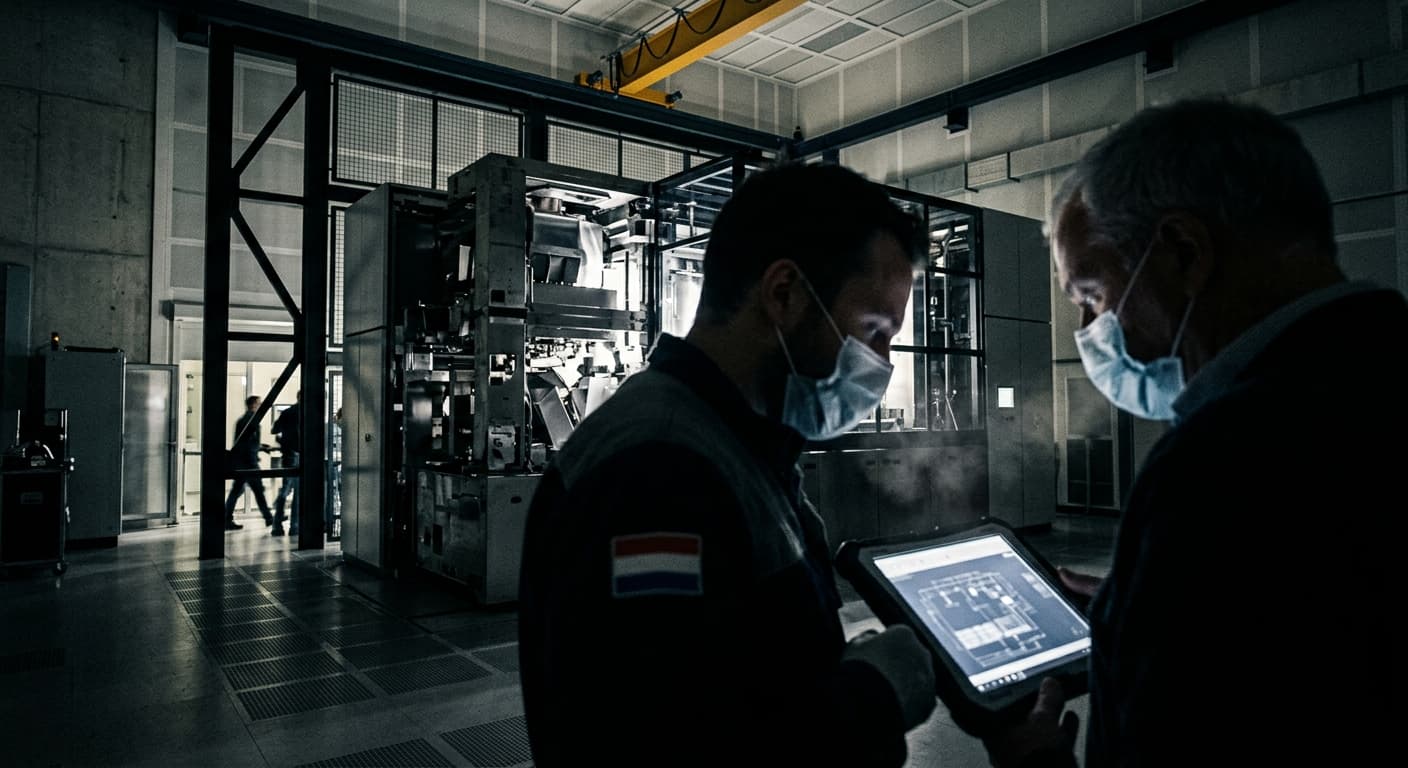
ASML's EUV machines represent the pinnacle of precision engineering. These systems, which use lasers to create patterns on silicon wafers at scales measured in single-digit nanometers, are indispensable for manufacturing cutting-edge chips at 3nm, 2nm, and future Angstrom-scale processes. Without EUV lithography, companies like TSMC, Samsung, and Intel cannot produce the processors that power everything from smartphones and data centers to F-35 fighter jets and hypersonic missiles.
The company's High-NA EUV systems, the latest generation currently being installed at select fabs, push the boundaries even further. Industry analysts estimate that each High-NA machine costs approximately $400 million, with total systems often exceeding $500 million when including ancillary equipment. ASML delivered roughly 40 EUV systems in 2025 and expects to increase output in 2026 despite export headwinds.
This technological monopoly did not emerge by accident. Decades of collaborative research between ASML, Zeiss, Trumpf, and various European universities, supported by substantial Dutch and EU funding, created a capability that no other country or company has been able to replicate. Intel, Samsung, and TSMC have collectively invested billions in ASML through prepayments and equity stakes to secure priority access to these machines.
The Evolution of Export Controls: From Obama to Trump 2.0
The current restrictions on ASML trace their origins to the Obama administration but dramatically accelerated under both the first Trump administration and the Biden presidency. The Netherlands, while a close NATO ally, initially resisted full alignment with American demands, citing its own commercial interests and European sovereignty.
A pivotal moment came in 2023 when the Dutch government, after intense diplomatic pressure from Washington, imposed licensing requirements on ASML's most advanced DUV (deep ultraviolet) systems in addition to the already-restricted EUV machines. By late 2024, following the return of the Trump administration, these controls were further tightened. Reports from early 2026 indicate that the US has successfully pressured the Netherlands to block servicing of certain installed Chinese systems and to limit exports of critical spare parts.
ASML's CEO Christophe Fouquet has repeatedly emphasized in earnings calls that the company complies with all applicable export regulations while seeking to maintain its technological edge. In the company's most recent quarterly report, management noted that China still represented approximately 20-25% of total revenue in 2025, down significantly from peaks above 40% in previous years. This decline reflects both direct restrictions and Chinese customers accelerating purchases ahead of anticipated new controls.
China's Response: Indigenous Innovation or Forced Localization?
Beijing has responded to these restrictions with a multi-pronged strategy combining massive state subsidies, talent recruitment, and aggressive intellectual property acquisition. The "Big Fund" (National Integrated Circuit Industry Investment Fund) has deployed over $100 billion across multiple phases, with a particular focus on lithography, etching, and deposition equipment.
Chinese state media recently highlighted progress by Shanghai Micro Electronics Equipment (SMEE), which claims to have achieved 28nm lithography capability domestically. However, independent analysis by semiconductor experts suggests that SMEE's systems still rely heavily on imported components and lag several generations behind ASML's EUV technology. Reliable sources indicate that China's most advanced domestic chips remain stuck at 7nm-class processes for high-volume manufacturing, with yields and performance significantly below TSMC's 3nm offerings.
The geopolitical stakes extend beyond commercial competition. Advanced semiconductors are now considered foundational dual-use technologies. The same chips that enable ChatGPT-like AI models also power sophisticated targeting systems, autonomous drones, and cyber warfare capabilities. This blurring of civilian and military applications has justified increasingly stringent export controls under both Wassenaar Arrangement guidelines and unilateral American entity list designations.
European Dilemma: Economic Interests vs. Alliance Obligations
The Netherlands finds itself in an particularly uncomfortable position. ASML employs over 40,000 people directly and supports tens of thousands more in its extensive supply chain across Europe. The company's market capitalization frequently exceeds €300 billion, making it one of Europe's most valuable technology firms. Any further restrictions on sales to China carry significant economic costs for the Dutch economy and pension funds heavily invested in ASML stock.
At the same time, Dutch intelligence agencies have grown increasingly concerned about technology leakage and espionage risks. Multiple incidents involving Chinese students and researchers at Dutch technical universities, as well as suspected supply chain infiltration attempts, have been documented in classified reports that later reached public attention through investigative journalism.
The European Union as a whole has attempted to chart a "de-risking" rather than "decoupling" strategy, as articulated by European Commission President Ursula von der Leyen. However, the reality of integrated global supply chains makes surgical separation extremely difficult. Germany's automotive and industrial sectors, which depend on Chinese markets, have lobbied against overly restrictive policies, while Eastern European member states have pushed for harder lines on national security grounds.
Market Implications and Stock Performance
ASML stock has exhibited significant volatility tied directly to geopolitical headlines. Following reports of potential new Dutch licensing requirements in early 2026, shares experienced sharp selloffs before recovering on strong demand from non-Chinese customers and the company's demonstrated ability to maintain high gross margins (typically above 50%) despite restrictions.
Analysts at major investment banks have issued divergent forecasts. Goldman Sachs maintains an optimistic outlook citing ASML's technological moat and growing demand for AI accelerators from companies like Nvidia, AMD, Broadcom, and emerging challengers. Morgan Stanley has taken a more cautious approach, highlighting risks from potential Chinese retaliation against European firms and the possibility of accelerated indigenous development in China over the longer term.
The semiconductor equipment sector broadly has benefited from the "China +1" diversification trend. TSMC's massive investments in Arizona, Japan, and Germany, along with Intel's European expansion under the CHIPS Act, have created substantial pull-through demand for ASML systems outside of China. However, these new fabs come online more slowly than anticipated, with construction delays and skilled labor shortages reported across multiple continents.
Energy Politics and Broader Supply Chain Vulnerabilities
The semiconductor industry's geopolitical tensions intersect with energy politics in important ways. Advanced chip manufacturing requires enormous amounts of ultra-pure water and stable, cheap electricity. Taiwan's vulnerability to potential Chinese coercion takes on new dimensions when considering that TSMC's fabs consume more electricity than many small countries. Similar concerns exist regarding the Netherlands' reliance on natural gas and its nuclear energy policy.
Russia's invasion of Ukraine and subsequent energy crisis in Europe served as a wake-up call for many policymakers about critical dependencies. The semiconductor supply chain's concentration in East Asia, combined with Europe's energy challenges and America's efforts to reshore manufacturing, creates a complex web of interdependencies that few nations can fully escape in the near term. Samsung's OLED TV price crash reveals deeper cracks in global semiconductor supply chains
ASML itself has invested heavily in improving the energy efficiency of its systems while facing pressure from institutional investors on ESG metrics. The company's 2025 sustainability report highlighted progress in reducing the carbon footprint per wafer processed, though critics note that overall industry growth continues to drive absolute increases in energy consumption.
Future Scenarios: Three Potential Paths
Looking ahead, several scenarios appear plausible for ASML and the broader geopolitical technology competition:
- Continued managed tension: Export controls remain in place but are not dramatically tightened further. China makes incremental progress on legacy nodes while remaining dependent on Western equipment for leading-edge applications. ASML maintains strong profitability serving US-allied markets.
- Escalation and bifurcation: New crises in the Taiwan Strait or South China Sea trigger much stricter controls, including secondary sanctions on companies servicing Chinese equipment. Global semiconductor supply chains split into two largely separate ecosystems, driving up costs and slowing innovation for all parties.
- Technological breakthrough or breakthrough in diplomacy: Either China achieves an unexpected leap in domestic EUV capability through a combination of talent programs and creative engineering, or a change in political leadership in Washington or Beijing leads to some form of technology détente. Both outcomes currently appear low-probability but cannot be entirely dismissed.
Conclusion
ASML's position at the heart of the US-China technology competition illustrates how specialized technological capabilities can acquire strategic importance that far exceeds their direct economic footprint. The Dutch company's lithography monopoly has become one of the West's most important comparative advantages in the contest for technological leadership — an advantage that policymakers are determined to protect even at considerable commercial cost.
For investors, ASML stock represents both an extraordinary growth story tied to the exponential demands of artificial intelligence and a high-stakes geopolitical proxy. The company's ability to navigate export restrictions while continuing to push the frontiers of physics will determine its performance for years to come.
More broadly, the ASML saga reveals the limitations of simple globalization narratives. In an era of great power competition, even the most specialized industrial companies must contend with national security considerations that transcend traditional commercial logic. The semiconductor industry's increasing centrality to both economic prosperity and military capability ensures that ASML will remain in the geopolitical spotlight long after today's trending searches have moved on to new topics. SK Hynix stock surge and memory chip demand in global semiconductor rivalry
The coming decade will test whether the current strategy of controlled technological separation can be sustained or whether the enormous costs — financial, innovative, and diplomatic — will eventually force a rethinking of current approaches. For now, ASML remains one of the clearest corporate manifestations of the new era of great power technological competition, with its stock price serving as a daily barometer of global strategic tensions.
Share This Article