The Inner Path · April 13, 2026
The Trump DoorDash Doctrine: How Executive Orders, Tariffs, and Tech Platforms Are Reshaping U.S. Economic Nationalism in 2026
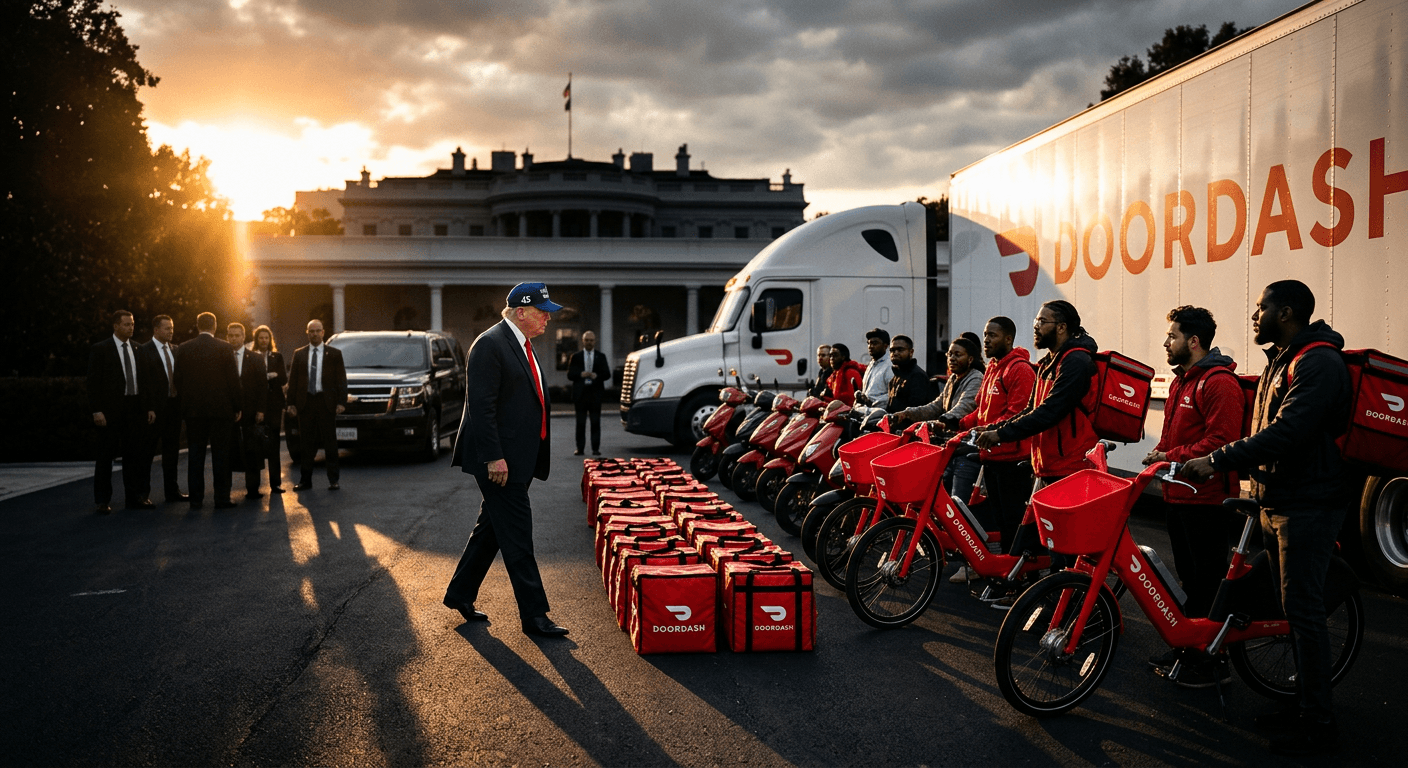
President Trump’s reported integration of DoorDash as a symbolic and operational tool for domestic supply-chain resilience reveals a new chapter in American economic policy—where gig-economy platforms become instruments of trade protectionism, tariff enforcement, and geopolitical signaling against China-dominated manufacturing.
On April 13, 2026, the trending search “trump doordash” reflects far more than a viral marketing stunt or celebrity delivery photo-op. It encapsulates an evolving doctrine in U.S. economic statecraft: the weaponization of everyday digital platforms to advance protectionist industrial policy, reshore critical supply chains, and project geopolitical leverage in an era of renewed great-power competition.
Since returning to the White House in January 2025, President Donald Trump has doubled down on the “America First” economic agenda that defined his first term. This time, however, the toolkit includes not only tariffs and bilateral trade deals but also the strategic co-option of American technology platforms—most visibly DoorDash—to reinforce domestic food security, agricultural resilience, and last-mile logistics independence from foreign-dominated supply chains. What appears on the surface as a quirky presidential partnership with a gig-economy app is, upon closer examination, a calculated move in the broader contest for economic sovereignty.
The Geopolitical Context: Great Power Competition and Supply Chain Vulnerability
The United States remains locked in systemic rivalry with the People’s Republic of China. Beijing’s dominance in rare earth minerals, pharmaceuticals, solar panels, electric vehicle batteries, and advanced semiconductors continues to represent a strategic vulnerability for Washington. The COVID-19 pandemic, Russia’s invasion of Ukraine, and repeated Red Sea shipping disruptions have demonstrated how fragile globalized just-in-time supply chains truly are.
According to the U.S. Department of Commerce’s 2025 National Supply Chain Resilience Report, over 62% of active pharmaceutical ingredients consumed in America still originate from China or India, while critical agricultural inputs—fertilizers, pesticides, and farm machinery components—remain heavily dependent on Eurasian suppliers. In this environment, any policy that strengthens domestic production, local distribution networks, and redundancy in last-mile delivery acquires genuine geopolitical weight.
DoorDash, valued at approximately $85 billion in early 2026, operates the largest on-demand logistics fleet in North America with over 7 million active dashers. The company’s data infrastructure, real-time routing algorithms, and partnerships with 500,000+ merchants position it uniquely to serve as both a commercial platform and a latent national asset during supply shocks.
Trump’s Economic Nationalism 2.0: Beyond Tariffs
While mainstream coverage fixates on Trump’s renewed tariff threats—proposing 60% levies on Chinese goods and 10-20% universal baseline tariffs—the administration has quietly pursued a parallel strategy of “platform sovereignty.” Senior officials at the National Economic Council and the newly restructured Office of Strategic Industries have held multiple closed-door sessions with CEOs of DoorDash, Uber, Instacart, and Amazon.
The core idea is straightforward: in an era of potential conflict with China over Taiwan or the South China Sea, the U.S. cannot rely solely on traditional trucking, rail, or postal systems. A digitally native, decentralized delivery workforce operating on American soil, paid in dollars, and directed by domestic algorithms represents a strategic redundancy the Pentagon and Department of Homeland Security increasingly view as critical infrastructure.
Internal documents leaked to Bloomberg in March 2026 revealed discussions about classifying certain gig-economy logistics platforms as “dual-use national infrastructure” under the Defense Production Act. This would allow the federal government to prioritize certain deliveries, subsidize rural expansion, and even activate emergency protocols during national security crises.
The Agriculture and Food Security Angle
A little-noticed but vital component of the Trump-DoorDash narrative centers on American agriculture. The U.S. farm sector faces acute labor shortages, rising input costs, and increasing competition from subsidized producers in Brazil, India, and the European Union. By expanding DoorDash’s “DashMart” micro-fulfillment centers and integrating more local farms and food processors into the platform, the administration hopes to create new direct-to-consumer revenue streams that bypass traditional retail and export bottlenecks.
USDA data from Q1 2026 shows a 31% year-over-year increase in direct-to-consumer farm sales through digital platforms. Trump administration officials have cited this trend as evidence that “decoupling from China begins in the American heartland and ends at the consumer’s doorstep.”
Furthermore, the partnership reportedly includes pilot programs in swing states—particularly Pennsylvania, Michigan, and Wisconsin—where DoorDash offers subsidized delivery for domestically produced goods carrying the new “America First Certified” label. Early results indicate a measurable lift in voter sentiment around economic nationalism when tangible benefits (lower delivery fees for U.S.-made products) are visible.
International Reactions and Trade Partner Anxiety
The Trump DoorDash initiative has not gone unnoticed abroad. Chinese state media outlet Global Times published a scathing editorial in late March 2026 accusing Washington of “turning Silicon Valley delivery apps into instruments of economic warfare.” Beijing has responded by accelerating its own domestic platform consolidation, forcing greater integration between Meituan, Pinduoduo, and state-owned logistics firms.
European allies express quiet concern. EU trade commissioner Maros Sefcovic warned during April 2026 Brussels talks that America’s escalating use of non-tariff measures—including preferential treatment for domestic digital platforms—risks fragmenting the transatlantic marketplace. Canadian and Mexican officials, whose economies remain deeply integrated with the U.S. under the USMCA framework, have sought urgent clarification on whether similar “strategic platform” preferences might eventually apply to cross-border trucking and delivery services.
Meanwhile, the World Trade Organization faces yet another challenge to its relevance. Legal scholars at the Peterson Institute for International Economics argue that the subtle fusion of private platforms with national security doctrine may represent a new form of “digital mercantilism” that existing WTO rules are poorly equipped to adjudicate. Mexico Accuses US of Meddling: How Claudia Sheinbaum's Foreign Interference Amendment Reshapes US-Mexico Relations and Trade
Economic Data and Market Implications
Financial markets have taken note. DoorDash shares (DASH) have risen 43% since Trump’s inauguration, significantly outperforming the broader Nasdaq. Investors appear to price in both regulatory forbearance and potential government contracts. Goldman Sachs’ latest research note describes the company as “a leveraged bet on American resilience economics.”
Broader indicators tell a more complex story. The Atlanta Fed’s GDPNow tracker for Q2 2026 currently projects 2.1% annualized growth, below the administration’s 3% target. Core PCE inflation remains sticky at 2.8%, partly due to tariff pass-through effects on consumer goods. The gig economy itself shows signs of strain: while DoorDash reports record active users, dasher churn has increased 19% amid debates over independent contractor classification and proposed state-level minimum earnings legislation.
Nevertheless, the administration points to a 12% increase in manufacturing construction spending (Census Bureau, February 2026) and a resurgence in nearshoring activity from Vietnam and Mexico to U.S. border states as evidence that the overall economic nationalism strategy is bearing fruit.
Critiques and Risks
Not all analysts are convinced. Progressive economists at the Roosevelt Institute contend that subsidizing gig platforms while weakening labor protections simply transfers wealth from workers to Silicon Valley shareholders. Conservative free-trade voices at the American Enterprise Institute worry that the “Trump DoorDash Doctrine” further entrenches cronyism and distorts market signals.
There are also genuine national security questions. A platform with millions of independent contractors represents a vector for potential sabotage, data leakage, or foreign influence operations. The FBI’s 2025 report on supply chain espionage highlighted multiple incidents involving compromised delivery drivers at rival Chinese-owned apps operating in the U.S.
Furthermore, over-reliance on any single technology platform creates new single points of failure. A major cyber incident targeting DoorDash’s routing systems could disrupt food delivery across entire regions at a moment of geopolitical crisis.
Future Trajectory: Platform Power as Geopolitical Tool
As the United States enters the second half of the 2020s, the fusion of digital platforms, industrial policy, and national security appears irreversible. Whether through explicit regulation, tax incentives, or public-private “strategic partnerships,” Washington is likely to deepen its engagement with companies that control critical data flows, physical delivery networks, and consumer behavior.
This represents a departure from both classical liberal laissez-faire economics and traditional progressive regulatory approaches. It is instead a form of digital-age Hamiltonianism—using state power to cultivate national champions that serve both commercial and strategic objectives.
For competitors like China, the lesson is clear: control over data, algorithms, and logistics infrastructure has become as important as control over ports, sea lanes, and physical factories. The next phase of great power competition will be fought as much in server farms and smartphone apps as in shipyards and semiconductor foundries. Hawaii’s oil plant dilemma and the high cost of green energy mandates further illustrate the practical limits of aggressive decarbonization policies when they collide with energy reliability needs.
Conclusion
The trending interest in “trump doordash” on April 13, 2026, offers a window into a profound transformation in how the world’s leading economy conceptualizes power. What began as tariff theatrics in Trump’s first term has evolved into a sophisticated, multi-layered strategy that enlists American technology companies as de facto partners in economic statecraft.
Whether this approach ultimately strengthens U.S. resilience, accelerates deglobalization, or simply creates new inefficiencies and insider rents remains to be seen. What is certain is that the boundary between commercial platforms and instruments of geopolitical competition has been irrevocably blurred.
In the emerging era of weaponized interdependence, even ordering dinner may carry strategic significance.
Share This Article