Jonathan van den Berg · April 23, 2026
The Persistent Myth of Housing Shortages as the Root of Homelessness
What if the homelessness crisis in major Western cities has far less to do with a lack of housing units than with deep failures in mental health policy, drug legalization experiments, and economic incentives that reward dependency? The data increasingly supports this uncomfortable truth.
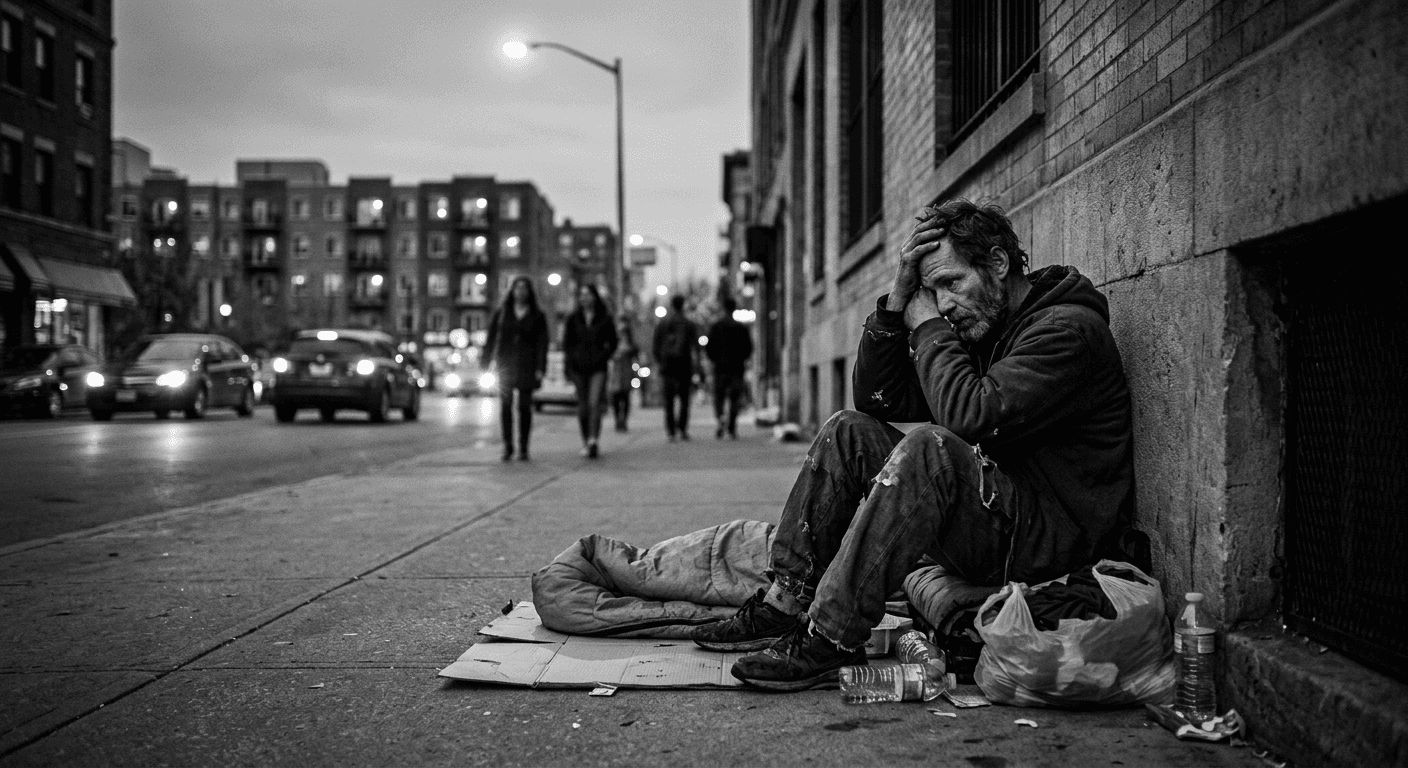
The persistent myth that homelessness is primarily a housing supply problem has dominated policy discussions for over a decade. This conventional wisdom conveniently ignores the transformation of street-level conditions in cities like San Francisco, Los Angeles, Seattle, Portland, and Minneapolis, where tent encampments proliferated despite billions spent on new housing units. The reality is more complex and politically inconvenient: homelessness in its visible, chronic form is driven primarily by severe mental illness, untreated addiction, and policy choices that have decriminalized public disorder and hard drugs.
While housing costs certainly exacerbate economic vulnerability, the explosion of unsheltered homelessness since roughly 2015 correlates far more strongly with the widespread adoption of harm reduction policies, the aftermath of deinstitutionalization, and the arrival of potent synthetic opioids like fentanyl than with any measurable shortage of apartments. Understanding this requires moving beyond simplistic narratives and examining the empirical evidence on who actually experiences chronic homelessness and why.
The Scale and Nature of Modern Homelessness
According to point-in-time counts and longitudinal studies, the United States has seen a dramatic rise in unsheltered homelessness even as overall poverty rates have fluctuated and housing construction in many cities has increased. In California, which accounts for roughly 30% of the nation's homeless population despite representing 12% of its people, the number of unsheltered individuals grew significantly between 2015 and 2023. Los Angeles County reported over 75,000 homeless individuals in recent counts, with the majority unsheltered.
Crucially, studies consistently show that the chronically homeless—the population most visible in tent encampments and urban sidewalks—represent a distinct subgroup. Research from the Department of Housing and Urban Development and independent analyses indicates that between 25-40% of the homeless population suffer from severe mental illness, while 30-50% struggle with severe substance use disorders. These figures likely understate the overlap, as comorbidity is extremely common. A 2022 study of San Francisco's homeless population found that nearly 60% had both psychiatric and substance use conditions.
This is not the "economic homelessness" of families temporarily displaced by job loss or high rents. The individuals who remain on streets for years typically cycle through a predictable pattern of addiction, psychosis, and repeated interaction with overwhelmed emergency services. Seattle's downtown saw calls for service related to behavioral health skyrocket in the years following the implementation of lenient drug policies and reduced enforcement of quality-of-life laws.
The Housing Supply Argument Falls Short
Proponents of the "build more housing" theory often cite correlations between rents and homelessness rates across metropolitan areas. There is indeed a relationship between extremely high housing costs and economic precarity. However, this explanation collapses when examining cities with similar housing markets but divergent homelessness outcomes, or when looking at timing.
Minneapolis, for instance, has pursued aggressive upzoning and housing deregulation policies yet continues to struggle with visible encampments and street disorder. Meanwhile, certain high-cost cities in Texas and the Southeast with stricter enforcement of public space laws and different approaches to addiction maintain significantly lower per-capita rates of unsheltered homelessness despite comparable rental markets in some districts.
More tellingly, many jurisdictions have poured enormous sums into "housing first" initiatives that provide apartments with few conditions attached. San Francisco spent over $1.2 billion on homelessness programs in a single recent fiscal year, much of it directed toward permanent supportive housing. Yet street conditions visibly deteriorated. Why? Because a substantial percentage of those housed eventually returned to the streets or continued behaviors that made them undesirable tenants, while new individuals flowed into the system. The supply of addiction and mental health treatment slots did not keep pace with demand created by permissive drug policies.
The Fentanyl Factor
The timing of the most dramatic increases in unsheltered homelessness aligns closely with the arrival of fentanyl in illicit drug markets. Starting around 2013-2015 and accelerating sharply after 2018, fentanyl and its analogs transformed street drugs from dangerous to frequently lethal. Overdose deaths in many West Coast cities tripled or quadrupled within a few years.
This is not coincidence. Fentanyl creates rapid and profound dependency while inducing psychosis at higher rates than previous generations of opioids or stimulants. The drug's potency means that even brief relapses can be catastrophic. Harm reduction advocates argued that providing clean needles, safe supply, and decriminalization would reduce harm. The evidence from cities that fully embraced this approach—Portland after Measure 110, San Francisco's Tenderloin, Seattle's downtown core—suggests the opposite occurred. Public drug use became normalized, overdose rates climbed, and businesses and residents fled.
Portland's experiment with decriminalizing possession of all drugs, passed in 2020, was reversed by voters in 2024 after the predictable surge in open drug use and disorder. Similar policy reconsiderations have occurred or are underway in San Francisco, Seattle, and parts of Los Angeles as the human and economic costs became impossible to ignore.
Mental Illness, Deinstitutionalization, and Civil Liberties
The modern homelessness crisis has roots in the well-intentioned but poorly executed deinstitutionalization of mental health care beginning in the 1960s. The closure of state psychiatric hospitals was supposed to be accompanied by robust community mental health systems. In most places, those systems never materialized at sufficient scale.
Today, laws prioritizing individual civil liberties over treatment for those with severe mental illness make involuntary commitment extraordinarily difficult. Someone must typically pose an imminent danger to themselves or others—and even then, the process is lengthy and uncertain. The result is that individuals suffering from schizophrenia, severe bipolar disorder, or methamphetamine-induced psychosis are left to deteriorate in public spaces until they commit crimes serious enough for incarceration or experience medical emergencies.
Studies of homeless populations in Los Angeles and New York have found that roughly one in four suffer from schizophrenia or schizoaffective disorder. These conditions respond to medication in most cases, but compliance is nearly impossible on the streets amid constant access to drugs and the chaos of encampment life. The "housing first" model that refuses to require treatment as a condition of shelter has demonstrable limitations when dealing with this population.
Economic and Policy Dimensions
While not the primary driver for chronic street homelessness, economic factors play a role at the margins. The expansion of remote work, the rise of gig economy instability, and the long-term effects of the 2008 financial crisis and COVID-19 disruptions have expanded the pool of economically vulnerable people. However, converting economic vulnerability into years-long street homelessness requires the additional catalysts of severe addiction or mental illness in the current policy environment.
Welfare systems in high-cost states can paradoxically enable homelessness. Generous disability payments, food stamps, and general assistance provide enough resources to survive on the streets—especially when combined with theft, panhandling, or occasional work—while the absence of mandatory treatment allows underlying conditions to worsen. In contrast, jurisdictions that tie benefits more closely to compliance with treatment or sobriety requirements often show better outcomes in reducing chronic homelessness.
Central banking policies and their effect on housing affordability represent a deeper structural issue. Decades of loose monetary policy, quantitative easing, and regulatory barriers to construction have driven housing costs far beyond wage growth in coastal cities. This creates genuine hardship. Yet solving the housing supply problem alone will not address the behavioral health crisis visible on city streets. A person with untreated schizophrenia cannot reliably maintain employment or even an apartment without significant support and accountability.
International Comparisons and Lessons
Looking abroad provides useful perspective. Japan maintains very low visible homelessness rates despite high population density and expensive cities. Cultural factors, different family structures, strict drug policies, and a different approach to mental health play roles. European cities with strong social safety nets have seen rising homelessness in recent years as migration, fentanyl-like synthetics, and changing drug policies created new challenges.
The Netherlands and Portugal, frequently cited by harm reduction advocates, actually maintain more structured systems than American cities. Portugal's much-lauded decriminalization was paired with mandatory diversion to treatment and strong social controls that the U.S. largely abandoned. Cities like Vienna have maintained relatively orderly environments through consistent enforcement of public space rules alongside generous housing and treatment programs.
The lesson is not that housing doesn't matter. Adequate affordable housing stock makes supportive services easier to deliver and reduces the cost of intervention. But without addressing the behavioral health and public order components, simply building more units functions as an expensive form of musical chairs—newly housed individuals are replaced by others who flow in from surrounding areas attracted by permissive conditions.
Toward More Effective Approaches
Effective solutions require abandoning ideological purity on all sides. Conservative approaches emphasizing personal responsibility must acknowledge the genuine difficulty of treating severe mental illness and addiction without stable housing. Progressive approaches focused on compassion and harm reduction must confront the empirical failure of models that treat all homelessness as an economic justice issue while ignoring the profound impairment of many street-dwelling individuals.
Promising models include:
- Conservative housing combined with mandatory treatment for those with severe mental illness or addiction histories ("treatment first" or "housing with accountability")
- Expansion of involuntary commitment capacity for those unable to care for themselves, paired with modern psychiatric care rather than warehousing
- Restoration of broken windows policing for quality-of-life crimes that make public spaces uninhabitable
- Targeted construction of specialized facilities—mental health respite centers, addiction treatment campuses, and highly structured supportive housing—rather than standard apartments
- Reform of disability and welfare programs to incentivize recovery rather than permanent dependency
Cities that have begun moving in these directions, including parts of Los Angeles under new mayoral leadership, Houston's coordinated system emphasizing temporary shelter and rapid rehousing with accountability, and certain European experiments, are showing tentative success where purely housing-focused or purely permissive approaches have failed.
Conclusion
The homelessness crisis reflects a profound societal failure to balance compassion with realism. For too long, policymakers have embraced the comforting fiction that providing enough apartments would solve the problem while avoiding the harder task of managing severe mental illness and addiction in an age of potent synthetic drugs and weakened social controls. This approach has failed the very people it claimed to help. The hidden inequality of war
Chronic street homelessness is not primarily an affordable housing shortage. It is a behavioral health and public order crisis enabled by policy choices made over decades. Recognizing this does not diminish the importance of increasing housing supply or addressing economic inequality. Rather, it demands intellectual honesty about root causes and the courage to implement solutions that may feel less compassionate in the short term but deliver better outcomes for individuals and communities over time.
Until cities distinguish between the economically vulnerable who need affordable housing and the chronically impaired who require structured treatment and supervised living environments, the tents will remain, the deaths will continue, and the conventional wisdom will remain a dangerous myth. The data is clear for those willing to see it. The question is whether political incentives will finally align with empirical reality.
Share This Article