Jonathan van den Berg · April 27, 2026
The Hidden Inequality of War
According to the World Bank’s latest estimates (early 2026), a sustained $30 increase in oil prices could push an additional 38–45 million people into extreme poverty globally within 18 months.
The recent escalation of conflict involving Iran — including direct strikes, heightened sanctions, and disruptions in the Strait of Hormuz — has sent shockwaves through the global economy. Oil prices have surged, inflation has spiked in dozens of countries, and supply chains for everything from fertilizer to shipping have been strained. While headlines focus on geopolitics and military movements, a quieter story is unfolding: the burdens of this conflict fall disproportionately on the world's poorest people, while a small group of wealthy individuals, corporations, and investors stand to profit.
This is not an accident of war. It is the predictable outcome of how modern conflicts interact with existing global inequality. In this long-form article, we examine the mechanisms driving this disparity, the human cost to ordinary families, and what can realistically be done to mitigate it.
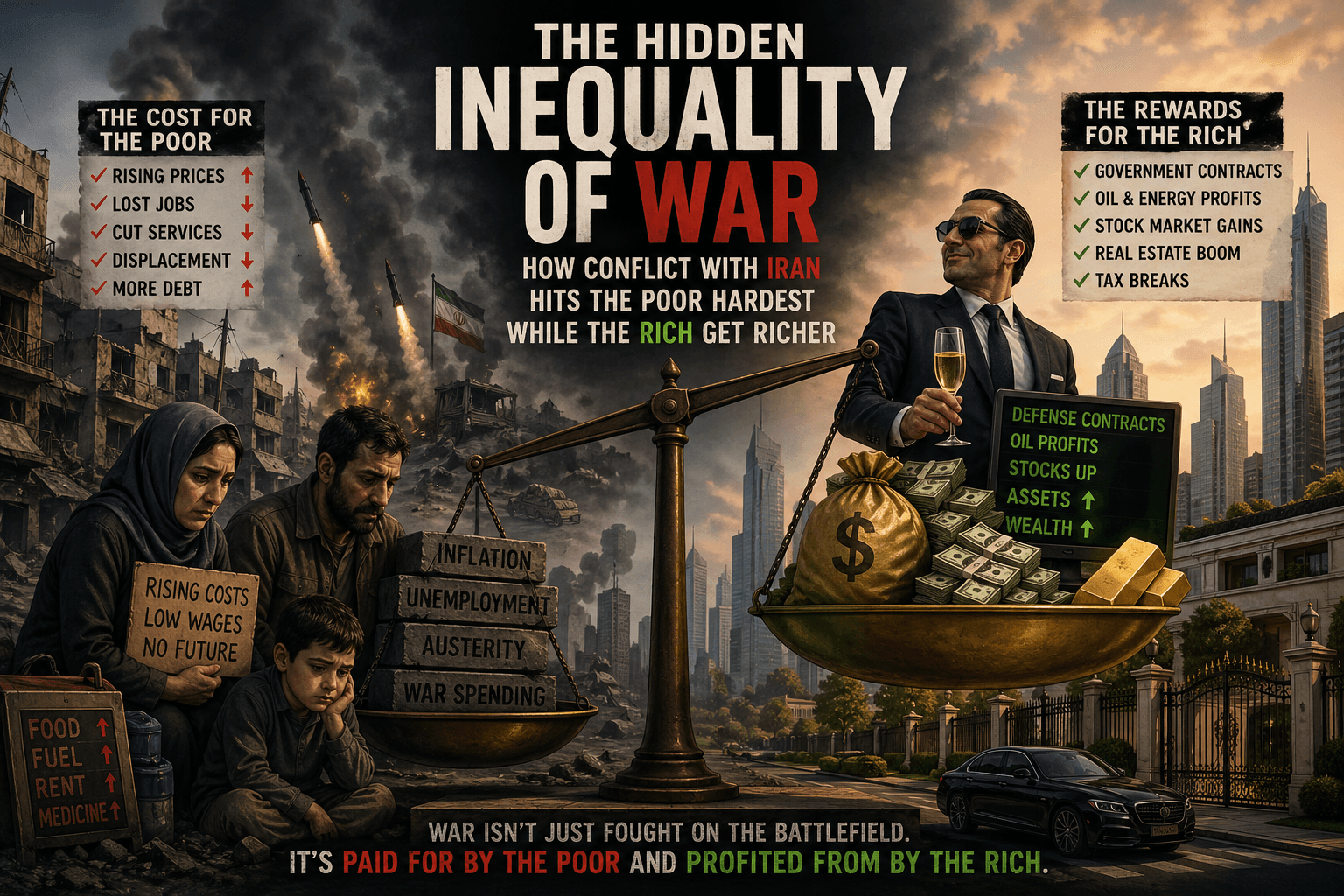
[Image: A split-screen image showing on one side a long queue of worried families waiting for subsidized bread in a Middle Eastern market under harsh sunlight, and on the other side oil traders in suits celebrating on the trading floor with rising price charts in the background, symbolizing economic inequality during conflict]
The Economic Mechanics: Why War Amplifies Inequality
When conflict disrupts major oil-producing regions like Iran, several things happen almost immediately:
Oil price spikes: The Strait of Hormuz carries about 21% of the world’s seaborne oil. Even the threat of closure pushes Brent crude above $100–$120 per barrel.
Inflation contagion: Higher energy costs flow into transportation, manufacturing, and especially food production. Fertilizer prices, already volatile, rise sharply.
Currency shocks: Many developing countries see their currencies weaken against the dollar, making imported food and fuel even more expensive.
Sanctions tightening: Secondary sanctions limit Iran’s ability to export oil legally, but they also restrict financial flows that affect neighboring economies and global commodity markets.
These effects do not hit everyone equally. The rich have multiple layers of protection. Wealthy households can absorb higher fuel and grocery bills. Investors can pivot into commodities, defense stocks, or energy futures. Multinational corporations often hedge their exposure or even benefit from volatility.
The poor, by contrast, have no hedges. A family living on $3–$5 a day in Egypt, Pakistan, Kenya, or Bangladesh suddenly faces a 30–50% increase in the cost of cooking fuel and staple foods. For them, there is no “portfolio adjustment.” There is only choosing between food and medicine, or going deeper into debt.
Key Statistics on Disproportionate Impact
According to the World Bank’s latest estimates (early 2026), a sustained $30 increase in oil prices could push an additional 38–45 million people into extreme poverty globally within 18 months.
In low-income countries, food price inflation from energy shocks tends to be 2.5 times higher than in high-income countries due to weaker safety nets and higher import dependence.
Remittances from Iranian and Gulf migrant workers, which support millions of families in South Asia and Africa, have already dropped by an estimated 18–22% in the first quarter of 2026.
Informal sector workers — who make up 60–80% of employment in many developing nations — have seen their real wages fall fastest because they cannot easily pass on higher costs.
How the Poor Are Hit: Five Brutal Channels
The inequality is visible across multiple overlapping crises:
Energy Poverty
Millions of households that already spend 15–25% of their income on fuel now face impossible choices. In Lebanon, Jordan, and parts of Iraq, families are reported to be burning plastic and wood for cooking as kerosene and LPG prices have doubled. School attendance among girls drops when families can no longer afford fuel for transport or lighting.Food Insecurity and Malnutrition
Wheat, rice, and cooking oil prices have risen sharply. The FAO’s Food Price Index jumped 14% in the three months following the major escalation. In countries like Yemen, Sudan, and parts of Ethiopia — already fragile — this risks pushing millions from “acute food insecurity” into outright famine. Children under five are hit hardest, with long-term cognitive impacts.Job Losses in Vulnerable Sectors
Tourism in the Middle East has collapsed again. Construction and small manufacturing in import-dependent economies have slowed. Informal traders who rely on cross-border movement of goods are particularly exposed. Women, who dominate many of these informal roles, lose income fastest.Healthcare and Education Squeeze
Governments facing higher fuel import bills cut subsidies on health services or education. Families facing higher living costs pull children — especially girls — out of school. Mental health impacts from chronic economic stress are rising, yet counseling services are among the first to be deprioritized.Debt Traps and Migration Pressure
Poor households borrow at high interest rates from local moneylenders to survive price spikes. This creates multi-year debt cycles. Meanwhile, economic desperation is already driving increased irregular migration toward Europe and wealthier Gulf states, often under dangerous conditions.
Who Benefits? The Anatomy of War Profiteering
While the poor struggle, certain groups are positioned to gain:
Energy traders and commodity speculators who correctly bet on volatility.
Defense contractors seeing increased orders for missiles, drones, and surveillance systems.
Oil producers outside the conflict zone (particularly in the US, Canada, Brazil, and parts of Africa) who enjoy higher prices for their output.
Wealthy investors with diversified portfolios that include inflation hedges such as gold, real estate in stable jurisdictions, and energy stocks.
A 2025 Oxfam report (updated with 2026 data) found that the world’s billionaires increased their collective wealth by an estimated $1.8 trillion during the first year of major geopolitical turbulence involving the Middle East, with energy and defense sectors leading the gains.
This pattern is not new. Similar dynamics played out during the 1973 oil crisis, the 1990–91 Gulf War, the 2003 Iraq invasion, and the 2022 Russia-Ukraine energy shock. Each time, the poor paid the heaviest price in lost opportunities and health, while wealth concentrated further at the top.
A Voice of Authority
Economist Joseph Stiglitz, Nobel laureate and former chief economist of the World Bank, captured this reality clearly in a 2025 interview amid rising tensions:
“Wars and geopolitical shocks are profoundly regressive. They act like a massive tax on the poor and a subsidy to those who own the scarce resources that suddenly become more valuable. Without deliberate policy intervention, every major conflict of the last fifty years has widened the gap between the richest and the rest.”
Stiglitz’s observation is backed by decades of data. The question is whether we will continue to accept this pattern as inevitable.
Concrete Policy Proposals: Reducing the Inequality Toll
Acknowledging the problem is not enough. Here are three practical, actionable proposals that governments, international institutions, and civil society should pursue immediately:
1. Windfall Profit Tax on Energy and Defense windfalls
Implement a temporary 50–70% tax on extraordinary profits made by oil companies, commodity traders, and defense contractors directly resulting from the conflict. Revenue should be ring-fenced into a Global Crisis Relief Fund that provides targeted cash transfers, subsidized food and fuel vouchers, and nutrition programs to the most vulnerable populations in low- and middle-income countries. Historical precedent exists: similar taxes were used during the 1970s oil crises and more recently during the COVID-19 pandemic in several European nations.
2. International Commodity Price Stabilization Mechanism
Create a coordinated reserve system for critical commodities (wheat, rice, fertilizer, and cooking fuels) managed jointly by the UN, World Bank, and major producers/consumers. When prices spike beyond certain thresholds due to conflict or sanctions, strategic reserves would be released with priority given to low-income importers. Funding could come from a small transaction tax on oil futures trading. This would reduce volatility that currently punishes the poor most severely.
3. Debt Relief and Targeted Social Protection Expansion
The IMF and World Bank should fast-track debt suspension or reduction for the 25–30 poorest countries most affected by the current shocks. In parallel, donor nations should fund rapid scaling of social protection floors — including expanded cash transfer programs, school feeding, and energy subsidies for the bottom 40% of households. Evidence from programs in Brazil, India, and Kenya shows these measures can prevent millions from falling into irreversible poverty traps.
These proposals are not radical. They build on existing tools and institutions. What they require is political will and recognition that allowing inequality to widen during crises makes future conflicts more likely, not less.
The Human Stories Behind the Numbers
Consider Amina, a widow in rural Pakistan supporting three children through sewing work. Her monthly fuel costs have risen from 1,800 to 3,200 rupees. She has cut meals from three to two per day and stopped buying milk for her youngest. Or think of Joseph, a motorcycle taxi driver in Nairobi whose daily fuel expense now consumes nearly 60% of his earnings. He works longer hours, sees his children less, and still falls further behind on rent.
These are not isolated cases. They represent tens of millions of people whose lives are being quietly reshaped by decisions made in war rooms and trading floors far from their homes.
Conclusion: Breaking the Cycle
War has always been expensive. What has changed is how precisely we can now measure — and predict — who pays that expense. The data is unambiguous: the poorest 40% of humanity absorbs the majority of the economic pain from conflicts they had no role in starting. Meanwhile, those with capital and access to global markets often emerge with greater wealth and power.
This is not merely unfair. It is dangerous. Extreme inequality fueled by repeated crises erodes social cohesion, undermines trust in institutions, and creates fertile ground for future conflicts and authoritarianism.
The good news is that we have policy tools available today that were unavailable during previous oil shocks. The combination of better data, digital payment systems for rapid cash transfers, and growing international awareness of inequality creates a genuine opportunity to do better.
Protecting the most vulnerable during geopolitical crises is not charity. It is sound economics, basic morality, and enlightened self-interest. If we fail to act deliberately this time, we should not be surprised when the next conflict produces even starker divisions between those who suffer and those who profit.
The inequality of war is not inevitable. It is a choice — one we can still make differently.
Further reading and sources (available upon request): World Bank Poverty and Shared Prosperity Report 2025–2026 updates, FAO Food Price Index data through March 2026, Oxfam inequality reports, IMF working papers on conflict and inflation pass-through, and Joseph Stiglitz’s recent writings on geoeconomics and inequality.
Share This Article