Jonathan van den Berg · May 3, 2026
SpaceX Lawsuits Spotlight Risks in Private Space Ambitions
Texas homeowners are suing Elon Musk’s SpaceX over damage from Starship rocket launches, exposing tensions between America’s space leadership and the everyday costs borne by local communities.
Texas homeowners are suing SpaceX.
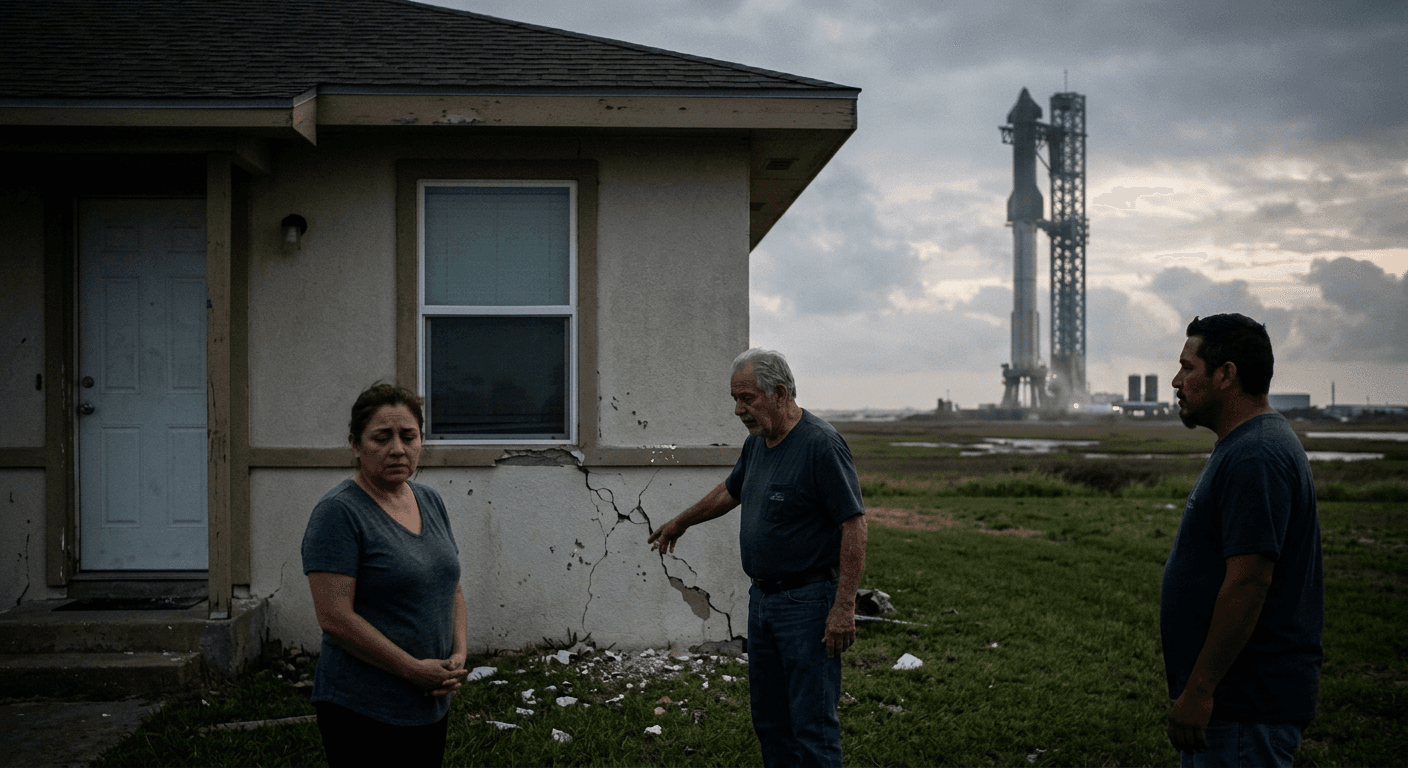
Nearly 60 households in the Rio Grande Valley have filed lawsuits claiming repeated Starship rocket launches and landings have cracked foundations, shattered windows, and disrupted their daily lives with deafening sonic booms. The legal action, filed in early May 2026, marks the most significant organized pushback yet against the world’s most valuable private space company as it ramps up testing at its Boca Chica facility.
This conflict pits cutting-edge innovation against the realities faced by families who live nearby. For many residents, the promise of jobs and national prestige collides with practical concerns about property values, health, and quality of life. The cases arrive at a moment when commercial space activity has become intertwined with larger questions of economic power, technological leadership, and international competition.
The Core Dispute in South Texas
Residents near SpaceX’s Starbase claim the company’s activities have caused measurable physical damage to their homes. Lawsuits cite cracked walls, broken windows, and structural issues that appeared only after increased launch cadence. Sonic booms — the loud thunder-like sounds created when rockets break the sound barrier — have reportedly rattled nerves and triggered complaints of anxiety and sleep disruption.
One plaintiff told local reporters that what began as occasional noise has become a near-constant disturbance. Another described finding new foundation cracks after a particularly powerful test flight. The suits seek compensation for repairs and, in some cases, relocation costs.
SpaceX maintains it follows all federal regulations and works with the Federal Aviation Administration on environmental reviews. The company has offered to buy some properties outright and has paid for certain repairs in the past. Yet critics argue these measures fall short of addressing widespread impact across the community.
The timing matters. SpaceX is accelerating Starship development to meet both NASA contracts for lunar missions and its own Starlink satellite deployment goals. Each successful test brings the company closer to fully reusable heavy-lift capability — a breakthrough that could slash launch costs dramatically and expand access to space.
Economic Trade-offs for Local Communities
Boca Chica’s transformation from a quiet coastal area to a bustling launch site has brought clear economic benefits. SpaceX employs hundreds of workers in a region that has long struggled with high poverty rates. Local businesses report increased revenue from engineers and technicians who relocated for the jobs.
Yet the gains are uneven. Many longtime residents lack the specialized skills required for high-paying aerospace roles. Property values near the site have risen for some but become uncertain for others due to launch risks. Schools and public services face pressure from rapid population growth.
This pattern mirrors broader challenges in regions hosting critical infrastructure. Similar debates have played out around airports, energy facilities, and military bases. The difference here is the experimental nature of the technology. Starship remains under active development, meaning noise, vibration, and safety zones continue to evolve.
The lawsuits raise practical questions about who bears the cost of technological progress. When private companies pursue goals aligned with national interests — such as reducing reliance on foreign launch providers — should affected communities receive stronger protections or compensation mechanisms?
SpaceX’s Growing Role in National and Global Competition
Elon Musk’s company now launches more mass to orbit than every other nation or entity combined. Its Falcon 9 rocket has become the workhorse of commercial space, while Starlink provides internet to remote and contested regions worldwide.
This dominance carries strategic weight. The United States has steadily shifted toward commercial partnerships for space capabilities. NASA relies on SpaceX for crew transport to the International Space Station and for Artemis program elements. The Department of Defense uses Falcon launches for national security payloads.
Internationally, SpaceX faces competition from China’s state-backed programs and emerging players in Europe and India. The speed of Starship development could determine whether America maintains its edge in reusable rocket technology. A successful fully reusable system would dramatically lower costs, potentially pricing out slower competitors.
Yet rapid iteration comes with trade-offs. The aggressive test schedule at Boca Chica has increased the frequency of closures to public beaches and heightened local disruption. Regulators must balance safety, environmental protection, and the need for testing cadence.
Global economic outlook reports increasingly factor commercial space into assessments of technological competitiveness. Reliable, low-cost access to orbit supports everything from satellite broadband to earth observation for agriculture and disaster response.
Regulatory Framework Under Strain
The Federal Aviation Administration licenses commercial space launches in the United States. It requires environmental assessments under the National Environmental Policy Act. SpaceX holds the necessary approvals, though environmental groups have challenged the adequacy of reviews as launch volume grows.
Sonic booms fall into a gray area. While launch licenses address safety risks, property damage claims often move through civil courts. The current lawsuits test whether existing regulations sufficiently account for cumulative impacts on nearby populations.
Critics argue the FAA faces conflicting mandates: promoting commercial space growth while protecting public welfare. Supporters counter that overly restrictive rules could drive innovation overseas. China, for instance, faces fewer domestic constraints on test sites in remote areas.
This regulatory tension reflects larger debates about government’s role in fostering breakthrough technologies. History shows that major infrastructure projects — from railroads to interstate highways — often imposed costs on specific communities while delivering diffuse national benefits.
Links to Broader Economic and Strategic Trends
The SpaceX story connects to wider patterns in how nations pursue technological advantage. Private capital now funds much of the innovation once driven solely by government programs. This shift brings speed and efficiency but also introduces new accountability questions.
Starlink’s deployment in Ukraine demonstrated how commercial satellite networks can influence conflict outcomes by providing resilient communications. Similar systems support economic activity in Africa and Latin America where traditional infrastructure lags.
In the financial realm, SpaceX’s valuation has soared past $200 billion, making it one of the world’s most valuable private companies. Its success influences investment flows into the entire space sector. Public markets have rewarded firms that partner with or supply SpaceX. SpaceX’s potential 2026 IPO would mark a pivotal shift from private valuation to public market scrutiny.
These developments intersect with energy politics and resource competition. Launch sites require significant land and coastal access. Propellant production and manufacturing facilities add to local environmental footprints. As demand for orbital slots and radio spectrum grows, coordination between commercial actors and governments becomes more complex.
Companies at the intersection of technology and energy face parallel challenges in balancing innovation with local impacts. Tesla’s expansion of manufacturing capacity, for example, has sparked debates about resource use and community effects in multiple countries.
What the Lawsuits Mean for Future Space Development
The Texas cases could set important precedents. If plaintiffs prevail on nuisance or property damage claims, other communities near launch sites may pursue similar action. This could raise operating costs and slow test schedules.
SpaceX has options. It could modify launch profiles to reduce sonic boom intensity over populated areas. It might expand its property acquisition program. Or it could invest in sound mitigation technologies and community benefit funds.
Longer term, the company eyes additional launch sites. Plans for facilities in Florida and potential offshore platforms could distribute activity. Yet each new location will likely face its own set of local concerns.
For residents, the lawsuits represent an attempt to assert their stake in decisions that affect their homes and livelihoods. Many support the space program in principle but seek fair treatment when bearing its costs.
Broader questions remain about equitable distribution of benefits. Space-derived technologies — improved weather forecasting, GPS, satellite imagery — touch billions of lives. Yet the most immediate burdens often fall on a small number of people living near key facilities.
International Dimensions
The United States is not alone in facing these tensions. Other nations pursuing space ambitions encounter similar pushback. France has managed local concerns around its Guiana Space Center for decades. China has developed inland and coastal sites with varying degrees of transparency about environmental impacts.
What makes the SpaceX situation distinctive is the company’s speed and visibility. Rapid progress attracts both admiration and scrutiny. Musk’s public profile amplifies media attention on every test flight and controversy.
Global competition adds pressure. As more countries invest in their own launch capabilities, the United States must weigh how regulatory caution might affect its competitive position. At the same time, ignoring legitimate community grievances risks undermining public support for space investment.
International norms around commercial space activity remain underdeveloped. Coordination on issues like orbital debris, spectrum allocation, and launch safety will grow more important as activity increases. The Texas lawsuits highlight the need for clearer frameworks that balance innovation with accountability.
Looking Ahead
The outcome of these lawsuits will not determine the future of commercial spaceflight. That future appears set — more launches, more satellites, lower costs, greater capabilities. But the cases will influence how that growth occurs and who participates in its benefits.
Effective solutions likely require collaboration. SpaceX, regulators, local governments, and residents all have legitimate interests. Creative approaches — such as revenue sharing from launch operations, enhanced monitoring programs, or community investment funds — could address concerns while supporting continued development.
For ordinary people, the story matters because space capabilities increasingly shape daily life. Satellite internet reaches remote schools. Earth observation aids farmers and first responders. Navigation systems guide everything from delivery trucks to emergency services.
The challenge is conducting this work in ways that respect the people closest to the hardware. Technological leadership brings national pride and economic opportunity. It should not come at the expense of basic fairness for families who happen to live near the launch pad.
As commercial space matures, the United States has an opportunity to demonstrate that rapid innovation and community protection can coexist. Getting this balance right will matter not just for Texas residents but for how other nations approach their own space ambitions.
The lawsuits represent growing pains for an industry transitioning from government-dominated projects to commercially driven enterprise. Those pains deserve serious attention. So does the remarkable progress they accompany.
SpaceX has changed what’s possible in space travel. The question now is whether it — and the broader ecosystem around it — can also pioneer new models for sharing both the risks and rewards with the communities that host its most ambitious work.
The answer will shape not only South Texas but the trajectory of human activity in space for decades to come.
Share This Article